You ask a model to return customer data as JSON for your CRM import. It replies with friendly prose, a markdown code block, and a trailing comment explaining assumptions. Your parser crashes. You ask again with "JSON only" in the prompt. It still wraps the payload in backticks. Prompt instructions help but do not guarantee valid structure at scale.
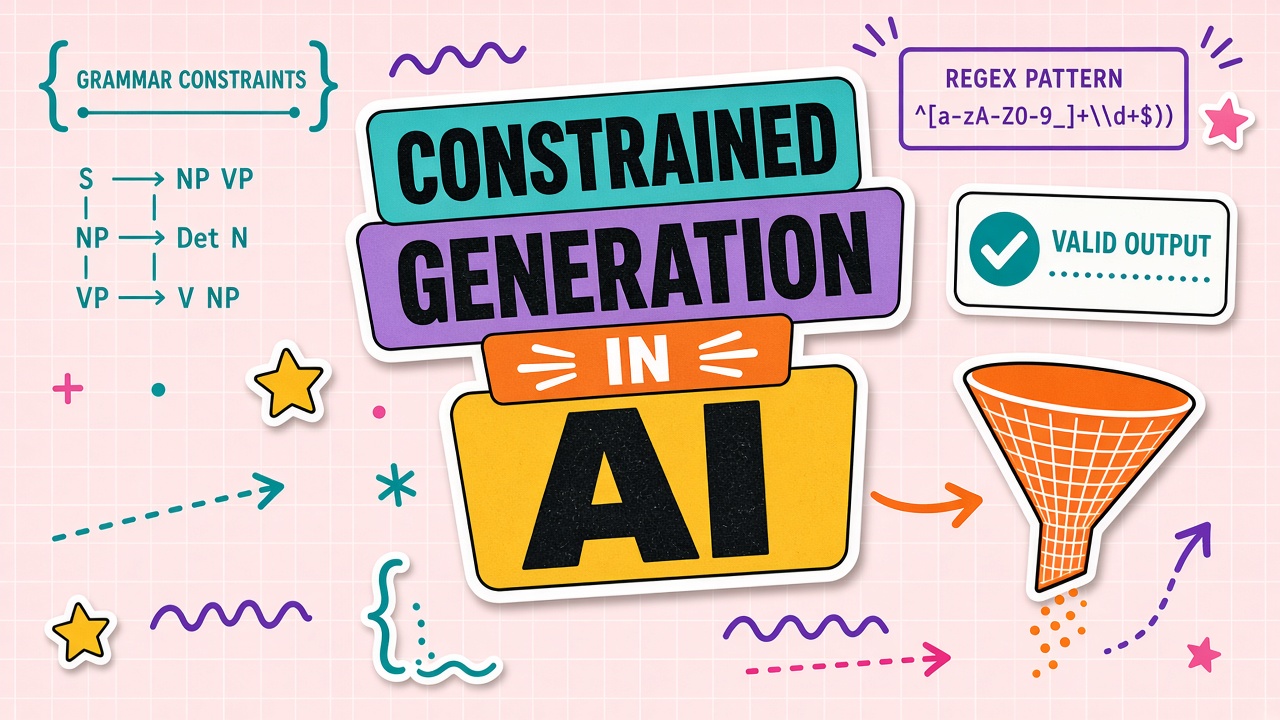
Constrained generation forces model output to satisfy a formal specification during decoding: JSON Schema, regular expressions, context-free grammars, or finite state machines. OpenAI structured outputs, Anthropic tool schemas, Google response schemas, Outlines, Guidance, and llama.cpp grammar modes all implement variants of this idea. Developers using AI APIs and AI coding assistants rely on constrained generation when downstream systems cannot tolerate free-form text. This guide defines the technique, compares constraint types, covers tradeoffs, and lists failure modes teams hit in production integrations.
As agents and automation products multiply, the volume of machine-readable payloads grows faster than human review capacity. Constrained generation is how teams keep programmatic integrations stable when free-form chat would break parsers on every edge-case phrasing.
Evaluation should include malformed user inputs, multilingual field values, and empty optional fields. Constraint modes behave differently under those stresses than under happy-path demo prompts.
Log constraint violations and repair attempts. Those logs reveal schema design problems faster than aggregate error rates alone. Review them weekly during the first month after launch.
What Constrained Generation Enforces on Model Output
Standard autoregressive decoding picks the next token from the full vocabulary. Constrained decoding masks illegal tokens at each step so the final string belongs to an allowed language. The model still "writes," but the sampler removes choices that would break the schema.
Constrained generation differs from post-hoc validation. Validation rejects bad output after the fact and triggers retries. Constrained generation prevents many invalid outputs during generation, reducing latency and cost from repair loops.
Three common constraint mechanisms
- JSON Schema constraints: Object keys, types, enums, and required fields enforced token by token.
- Regex constraints: Output must match a pattern such as ISO dates, SKU codes, or phone formats.
- Grammar constraints: Context-free grammars for SQL subsets, DSLs, or custom configuration languages.
| Constraint type | Best for | Limitation |
|---|---|---|
| JSON Schema | API payloads, tool arguments, config objects | Complex nested schemas increase decoding overhead |
| Regular expression | Fixed-width codes, identifiers, simple formats | Hard to express nested structure; readability suffers |
| Grammar (CFG) | SQL, query languages, templated markup subsets | Grammar design errors block valid outputs silently |
JSON Schema, Regex, and Grammar Rules Compared
Pick constraint types based on what your parser expects and how rigid the format must be. JSON Schema is the default for REST integrations. Grammars suit languages with nested syntax. Regex fits single-field extraction when structure is flat.
JSON Schema in API integrations
AI API providers increasingly expose first-class structured output modes that accept JSON Schema and guarantee parseable responses on supported models. Map schema fields to database columns carefully. Optional fields the model omits may still pass schema validation while breaking business logic if your code assumes presence.
Regex for strict field formats
Regex constraints work well when one string must match a known pattern, such as ^[A-Z]{3}-\d{4}$ for asset
tags. They struggle when relationships between fields matter, such as "end date after start date." Use JSON Schema or
post-validation for cross-field rules.
Grammars for code and query generation
AI coding tools and text-to-SQL products often constrain output to a grammar subset of the target language. That reduces syntax errors but does not guarantee semantic correctness. A valid SQL statement can still reference tables the user cannot access. Combine grammar constraints with permission checks on execution, not generation alone.
Search structured output LLM tools when comparing vendor support. Native constrained decoding beats prompt-only JSON requests for reliability at volume.
Tradeoffs: Reliability, Flexibility, and Latency
Constraints improve parse success rates but can reduce answer quality when the model needs nuance that does not fit the schema. Overly rigid schemas force empty enums or placeholder strings when the model lacks information.
| Approach | Parse reliability | Creative flexibility |
|---|---|---|
| Prompt-only ("return JSON") | Low to moderate; breaks under edge cases | High |
| Post-parse validation plus retry | Moderate; costly retry loops | High |
| Constrained decoding | High on supported models | Limited to schema expressiveness |
Latency and compute overhead
Token masking adds CPU work per step. Deep JSON schemas with many optional branches cost more than flat objects. Profile end-to-end latency with your real schemas before assuming constrained mode is free beyond API pricing.
Syntactic validity is not semantic truth
Constrained generation guarantees shape, not factual accuracy. A JSON object with valid types can still contain hallucinated customer IDs. Downstream systems must validate business rules, permissions, and data existence independently.
Streaming, Partial JSON, and Repair Strategies
Some applications stream tokens to the UI while constrained decoding runs server-side. Streaming improves perceived latency for long JSON payloads but complicates client parsers that expect complete objects. Document whether your provider emits incrementally valid JSON or raw tokens that only become valid at end of generation.
When constrained mode is unavailable on a chosen model, teams fall back to validation plus repair: parse with a lenient JSON extractor, feed errors back to the model in a second pass, or use a smaller model to rewrite malformed output. Set a hard retry cap to prevent runaway cost loops on adversarial inputs.
Patterns in AI coding assistants
Code completion tools often constrain output to syntax trees for specific languages. That reduces bracket mismatch errors but does not prevent logic bugs. Pair grammar constraints with static analysis or test execution in the IDE before merge. Buyers evaluating AI coding products should ask whether constraints apply during inline completion, chat patches, or both, because support differs by surface.
Production Patterns for Coding and Automation Pipelines
Mature teams combine constrained generation with defensive parsing and observability. Never assume 100% success because vendor docs say "guaranteed JSON" on a subset of models.
- Schema versioning: Version schemas in API contracts and log which version each response used.
- Fallback paths: When constrained mode fails or times out, degrade to human review or simpler fields.
- Partial objects: Use streaming parsers only when the provider supports incremental valid JSON.
- Union types sparingly: Discriminated unions increase branching complexity for decoders and models.
- Test adversarial prompts: Users will ask for prose inside JSON fields; ensure constraints hold.
Agent frameworks that chain tool calls depend on constrained argument generation. One malformed tool call breaks multi-step workflows. Invest in schema design reviews the same way you review REST API payloads.
Schema design tips that reduce decode failures
Prefer flat objects over deep nesting when possible. Use enums instead of free-text fields where values are finite. Document nullable fields explicitly and handle null in application code rather than assuming the model fills every optional property. Smaller schemas decode faster and fail less often under load.
For multi-tenant SaaS, isolate schemas per customer when output shapes differ. Shared mega-schemas with dozens of optional customer-specific fields confuse models and increase decode time. Version customer schemas independently and route requests through the matching constraint set at runtime.
Frequently Asked Questions
How is constrained generation different from function calling?
Function calling selects named tools and structured arguments in agent workflows. Constrained generation is the lower-level technique that enforces format during token sampling. Many function-calling APIs use constrained JSON under the hood for argument payloads.
Do all models support constrained decoding?
No. Support varies by provider, model size, and hosting environment. Self-hosted stacks use libraries like Outlines or Guidance. Verify support on your exact model before building critical parsers around it.
Can prompt engineering replace constraints?
Prompts improve average behavior but not tail reliability. Production systems that ingest model output programmatically should use constraints or rigorous validation with retries. Prompts alone are insufficient at scale.
Can you combine regex and JSON Schema?
Yes. JSON Schema pattern keywords on string fields embed regex constraints inside structured objects. Full
output regex is an alternative when the entire response is a single formatted string.
How do you debug grammar constraint failures?
Log masked token sets or use provider debug modes when available. Simplify grammars to isolate which production rule blocks generation. Golden tests with expected outputs catch schema drift early.
Do open-source inference servers support grammar constraints?
llama.cpp, vLLM with Outlines integration, and several Hugging Face serving paths support grammar and JSON constraints on compatible models. Capability varies by model architecture and server version. Test on your exact deployment before committing architecture to constrained decoding.
Should we validate after constrained generation?
Yes. Treat constrained output as syntactically reliable, not semantically verified. Run business validation, authorization checks, and database lookups on parsed objects before committing side effects. Constraints reduce parse errors; they do not replace domain rules.
Building Pipelines That Parse on the First Try
Constrained generation turns LLM output from probabilistic prose into contracts your code can depend on. It is essential for API integrations, data extraction, and AI-assisted development where compilers and databases reject malformed input.
Choose JSON Schema for structured objects, regex for flat identifiers, grammars for language subsets, and always validate semantics after syntax passes. Search structured output capabilities when evaluating models and hosting platforms. Reliable automation starts when output shape is enforced at decode time, not hoped for in the prompt footer.
Start with the smallest schema that satisfies your integration, measure parse success in staging under adversarial prompts, then expand fields only when product requirements demand them. Constraint complexity is a latency and reliability tax.