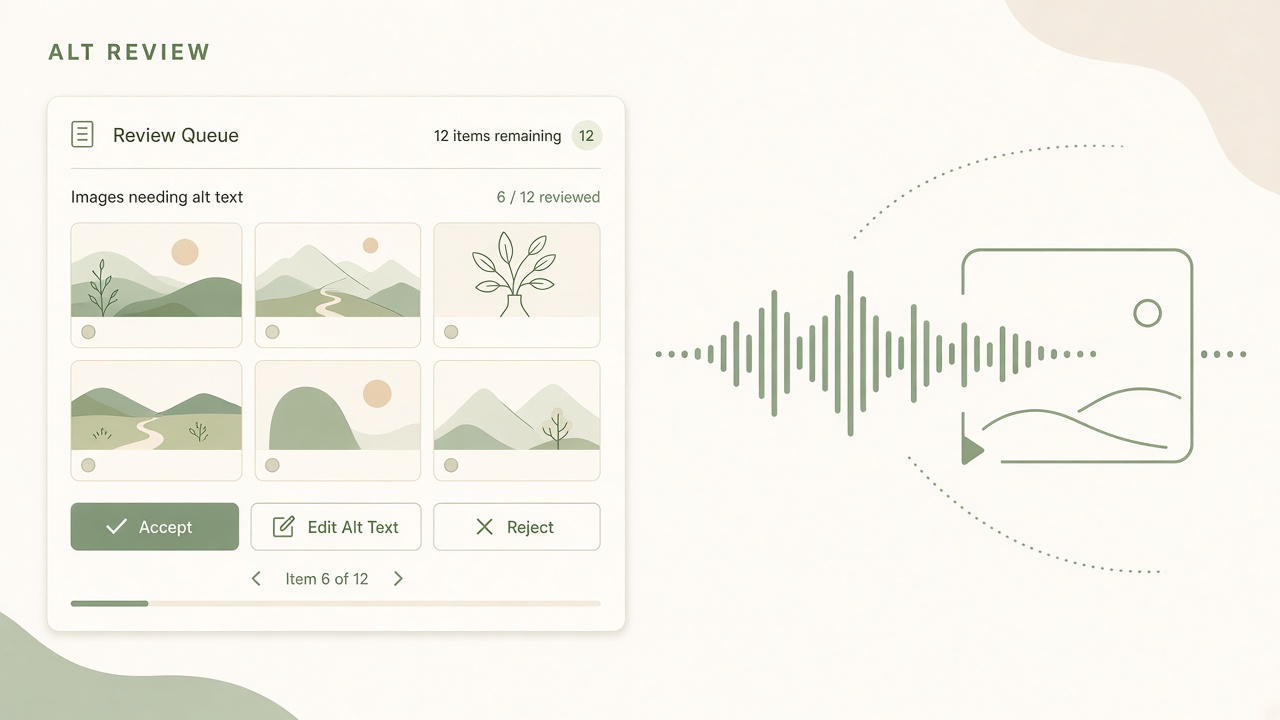
Publishers with tens of thousands of images face a structural problem: WCAG 2.2 expects informative images to carry equivalent text alternatives, yet manual alt text writing cannot keep pace with daily uploads. Generative vision models now draft descriptions in seconds, but blind and low-vision readers still depend on human judgment for charts, memes, and context-dependent scenes. Teams that adopt an ai alt text workflow accessibility pipeline blend machine drafts with editorial QA, audit sampling, and clear policies for decorative versus informative assets. Under ADA Title II, state and local governments must meet WCAG 2.1 Level AA by April 2027, pushing public sector sites toward scalable automation with accountable review. Readers exploring AI image generator tooling or popular AI tools for content operations should understand how review-edit-save workflows, context engineering, and failure modes differ from one-off caption experiments.
WCAG Expectations for Informative Images
Success Criterion 1.1.1 requires text alternatives that serve the same purpose as non-text content, with
empty alt attributes reserved for purely decorative images that add no information. Informative photographs,
diagrams, and UI screenshots need alt text that conveys meaning, not filenames or generic placeholders. Complex
images such as infographics may need longer descriptions in adjacent text or via aria-describedby.
WCAG 2.2 does not lower the bar; it adds criteria elsewhere that reinforce perceivable, operable interfaces.
Legal risk rises when alt text is missing, duplicated from captions without adding value, or stuffed with keywords
that harm screen reader experience.
Decorative images include spacer graphics, purely aesthetic borders, and photos that repeat adjacent headline text.
Marking them alt="" tells assistive technology to skip them. Informative images require authors to
decide what a non-sighted user must know: who appears, what action occurs, what data trend the chart shows. AI can
suggest candidates, but only humans with editorial context know whether a photo is stock filler or carries legal
meaning. Policy documents should define decision trees so contractors and CMS users apply consistent rules.
Generative Alt Text Quality Rubrics
Quality rubrics score AI drafts on accuracy, relevance, brevity, and absence of hallucinated objects before publication. A practical rubric asks: Does the description match visible content? Does it avoid repeating the caption? Is length appropriate (often under 125 characters for simple photos, longer when justified)? Does it omit speculative intent ("probably celebrating") unless visually obvious? Vision-language models trained on web alt text inherit noisy patterns; without rubrics, teams publish verbose or SEO-stuffed descriptions that violate spirit of accessibility guidelines.
| Rubric dimension | Pass example | Fail example |
|---|---|---|
| Accuracy | Three cyclists on a forest trail | Runners on a beach (wrong scene) |
| Context | CEO signing climate pledge at summit | Person at table (too vague) |
| Brevity | Red line chart rising 2020 to 2024 | Paragraph repeating article lede |
| No keyword stuffing | Solar panels on warehouse roof | Best solar AI tools discount buy now |
Context engineering improves drafts by passing page title, section heading, and image role into the prompt. A product thumbnail needs model name and color; a news photo needs who and where. Batch APIs that send only raw pixels without surrounding HTML produce generic output. Teams should version prompts and track regression when models update.
Human QA Sampling Strategies
Human-in-the-loop review does not require reading every AI draft; stratified sampling plus confidence thresholds routes high-risk images to editors while auto-approving low-risk stock. Mature operations target 200 to 400 images per hour in dedicated review UIs with keyboard shortcuts for accept, edit, and reject. Reviewers see the image, AI draft, surrounding paragraph, and character count. Queue prioritization surfaces user-uploaded content, medical imagery, and pages with legal exposure before archive backfill.
Sampling rates depend on model stability. After a model change, audit 100 percent for a week, then drop to 10 to 20 percent random sample plus 100 percent on flagged categories. Inter-rater agreement studies between blind consultants and internal editors calibrate rubrics. Rejected drafts feed fine-tuning datasets or prompt negative examples. The review-edit-save workflow must write back to the CMS atomically so partial saves never leave empty alt attributes live on production.
CMS Integrations and Editorial Policy
CMS plugins and webhooks generate alt text on upload, block publish when informative images lack alternatives, and log reviewer identity for compliance audits. WordPress, Drupal, and headless stacks integrate via middleware that calls vision APIs asynchronously. Editorial policy should state who owns alt text (photo desk versus SEO), how multilingual sites handle translation of descriptions, and whether AI disclosure appears in internal metadata. Public-facing pages rarely need "AI-generated" labels if humans verify content; internal logs suffice for accountability.
ADA Title II deadlines in 2027 accelerate procurement for government publishers. RFPs should require WCAG-aligned workflows, exportable audit trails, and opt-out for sensitive imagery. Enterprise newsrooms pair DAM systems with alt text services so rights-managed assets carry descriptions into every syndication channel. Policy also covers retroactive backfill: oldest high-traffic pages first, then long-tail archives using higher automation with spot checks.
Failure Cases: Charts, Memes, and Infographics
Vision models routinely fail on charts, memes, and dense infographics where meaning lives in text, cultural reference, or data trends rather than object recognition. Bar charts get described as "colorful rectangles" without stating values or comparisons. Memes lose punchline when the model omits overlaid text or misreads sarcasm. Infographics with dozens of icons produce laundry lists instead of hierarchical summaries. These categories should bypass full automation: AI may draft a starting point, but human authors or data journalists must supply equivalent long descriptions and table alternatives where appropriate.
Maps and screenshots of software UIs challenge models that hallucinate button labels. Medical and scientific figures need expert review for diagnostic accuracy. When automation confidence scores fall below team thresholds, route to manual queue with SLA timers so publishing pipelines do not silently ship empty alt text. Document known failure types in training for CMS users so they do not trust one-click fixes on complex visuals.
Accessibility auditors increasingly sample social embeds and third-party widgets that inject images outside the main CMS. Those assets need the same review-edit-save discipline or they become the weakest link in otherwise strong programs. API integrations with stock photo vendors should pull embedded descriptions only as drafts, because contributor-supplied alt text on Shutterstock and Getty is often keyword spam. Legal teams ask whether AI-generated descriptions require disclosure in privacy policies when images include recognizable people; biometric and likeness policies vary by jurisdiction and should be reviewed before face-heavy archives go through batch automation.
Frequently Asked Questions
Does AI alt text help SEO?
Search engines use alt text as a weak relevance signal, but keyword stuffing harms accessibility and may trigger quality penalties. Write for screen reader users first; accurate, concise descriptions align with both SEO and WCAG when they reflect real image content.
Can automation reduce lawsuit risk?
Automation without QA can increase risk if wrong descriptions mislead users or critical images stay empty. Documented human review, remediation SLAs, and third-party audits demonstrate good faith under ADA and similar laws. Title II entities should plan before 2027, not after complaints arrive.
How should multilingual sites handle alt text?
Translate verified alt text per locale; do not machine-translate unchecked English drafts. Cultural context in images may differ by market. Store locale-specific alternatives in the CMS and validate with native-speaking reviewers familiar with accessibility norms in each language.
What about user-generated content?
Platforms should prompt uploaders for descriptions, offer optional AI suggestions, and moderate high-traffic posts. Full automation on UGC without review is risky; combine client-side warnings with server-side blocks when alt text is missing on required fields.
How do teams classify decorative versus informative at scale?
Use rules: if removing the image loses information not present in adjacent text, it is informative. ML classifiers can suggest decorative candidates, but editors should override when headlines do not fully describe the visual. Revisit classification when page layout changes.
Which metrics track program health?
Track percent of informative images with non-empty alt text, edit rate on AI drafts, average review time, complaint volume from users, and sample audit pass rate. Sudden drops in edit rate after model upgrades may indicate silent quality regression rather than improvement.
Screen reader users benefit when publishers treat alt text as editorial content, not a checkbox. NVDA and VoiceOver users report that concise, accurate alternatives beat long AI monologues that repeat article text. Consulting blind reviewers during rubric design surfaces failure modes that sighted QA teams miss, especially for fashion, sports, and political photography where subtle gestures carry meaning.
Enterprise accessibility platforms now integrate with Jira and ServiceNow so missing alt text on high-traffic URLs opens remediation tickets with owner assignment. Coupling CMS webhooks to those systems prevents one-off fixes from disappearing when contractors rotate. For archive migrations, batch processing overnight with morning reviewer shifts balances API rate limits with human attention when traffic is lowest.
WCAG 2.2 Success Criterion 1.1.1 remains the anchor; automated tools that scan for empty alt attributes
catch only a fraction of quality problems. Pair automated scanners with human sampling so inaccurate AI text does not
pass audits that check presence but not equivalence. Publishers who document prompt versions and model vendors simplify
responses when users file formal accessibility complaints.
Training photo editors in alt text fundamentals before they touch AI review queues reduces edit rates and builds culture that treats accessibility as craft. Short lunch-and-learn sessions on how NVDA reads lists and links help teams hear why "image of" prefixes waste time. Quarterly refreshers when WCAG guidance updates keep contractors aligned with in-house standards across newsroom churn.
Retailers migrating product catalogs should sequence alt text backfill by revenue impact: top SKUs first, long-tail variants next. SKU-specific context such as size and material belongs in descriptions when the image alone does not show scale. Marketplace sellers uploading user photos remain responsible for accuracy even when platforms offer AI drafts; terms of service should state that obligation clearly.