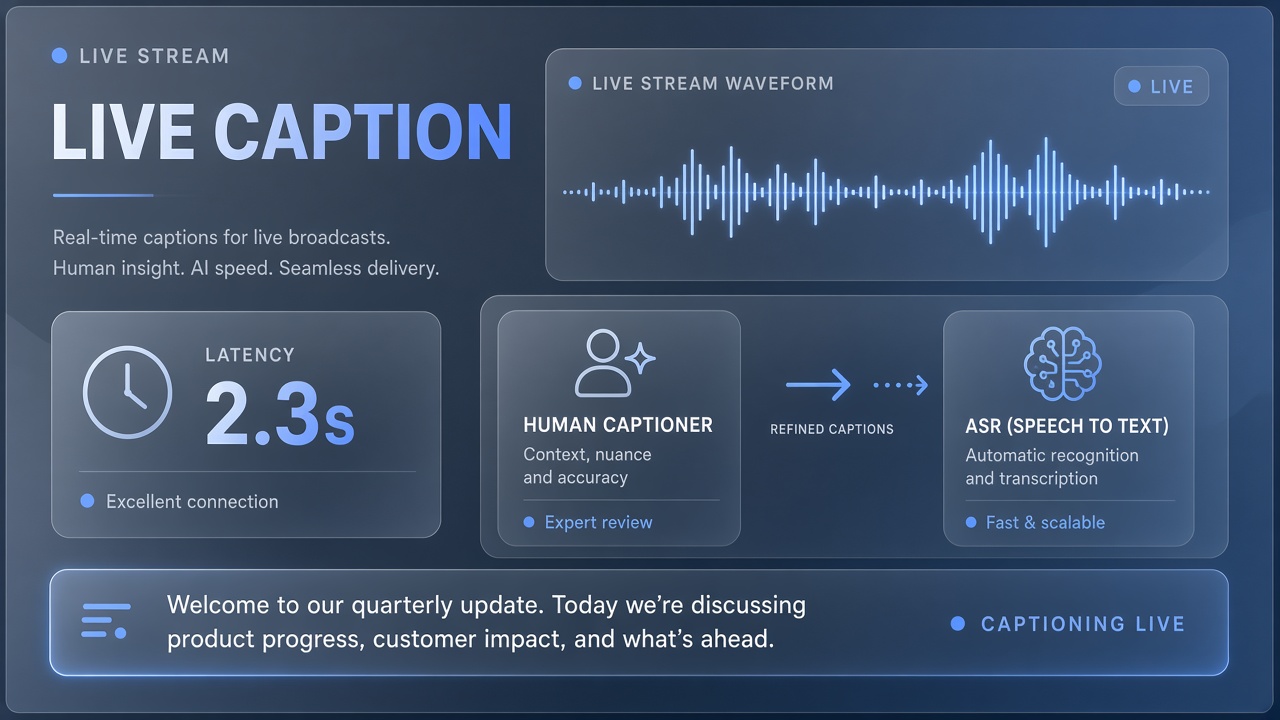
Deaf and hard-of-hearing audiences expect captions on live news, sports, concerts, and corporate streams that match broadcast intelligibility, not after-the-fact transcripts. Pure automatic speech recognition still stumbles on names, overlapping speech, and punctuation. An ai live captioning broadcast architecture layers streaming ASR, human respeakers or CART providers, domain adaptation, and failover when models degrade. U.S. FCC rules require closed captioning on television with accuracy benchmarks that effectively demand near-perfect transcription for pre-recorded content and high accuracy on live programming; many stakeholders cite a 99 percent accuracy expectation for usable captions. Human Communication Access Realtime Translation (CART) often achieves word error rates near 3.1 percent on prepared material. Research systems such as SAS-LIVE reported roughly 8 percent WER floors on live broadcast audio in 2024. Hybrid Q-LiveASR-style pipelines route uncertain segments to humans. Respeakers add four to seven seconds delay versus two to three seconds for ASR alone, a trade compliance officers weigh against comprehension. Teams evaluating AI image generator adjacent media stacks or popular AI tools for events should map latency budgets before promising ADA-compliant streams.
Regulatory Expectations for Live Captions
FCC closed captioning rules, ADA Title III venue obligations, and Section 508 for federal streams establish legal baselines; accuracy, synchronicity, completeness, and placement matter as much as presence of any captions. Live programming allows brief exceptions during breaking news when equipment fails, but chronic ASR garbage triggers complaints and fines. Universities streaming graduation must caption regardless of platform defaults. Corporate all-hands on global CDN feeds need multilingual options where audiences require them. Document vendor SLAs with measurable WER and maximum latency, not marketing superlatives.
International events face parallel rules: Ofcom in the UK, ACA in Australia, and EU accessibility directives shape procurement. Sports leagues with sponsor names and stadium noise stress models trained on clean studio speech. Legal teams should review indemnity clauses when pure ASR vendors claim compliance without human backup.
Streaming ASR Architecture and Latency
Streaming ASR ingests audio in overlapping windows, emits partial hypotheses every few hundred milliseconds, and stabilizes text as confidence rises, targeting two to three second end-to-end delay on well-tuned GPU clusters. Encoder-decoder models with chunked attention balance latency against WER. Punctuation and capitalization modules run as secondary passes; without them, captions read as run-on blocks. Speaker diarization labels who speaks when it works; overlapping dialogue collapses labels on panel shows. Domain language models bias toward product glossaries and roster names when fed custom vocabularies before airtime.
| Approach | Typical WER (live) | Latency |
|---|---|---|
| Human CART | Near 3.1% on clean speech | 1 to 2 seconds skilled stenographer |
| Streaming ASR alone | 8% floor (SAS-LIVE 2024 benchmark) | 2 to 3 seconds |
| Human respeaker | Lower than ASR on noisy audio | 4 to 7 seconds |
| Hybrid Q-LiveASR style | Varies; human fixes low-confidence spans | 3 to 5 seconds typical |
Human Respeaker Correction Loops
Respeakers listen to program audio and re-dictate into ASR tuned for a single clear voice, cleaning up jargon and disfluencies that raw microphone feeds confuse. The extra delay buys accuracy on award shows, earnings calls, and municipal hearings with public comment. Correction UIs let operators keyboard-edit hotwords when respeaking is impractical. Hybrid Q-LiveASR research routes low-confidence tokens to a human queue while high-confidence text flows straight to air. Staffing models need backup respeakers when primary operators fatigue during multi-hour events.
CART providers using stenography keyboards achieve excellent accuracy for single-speaker lectures but scale poorly for unscripted banter. Choose respeaking when panel chaos dominates; choose CART for keynote clarity. Train producers to mute audience mics and enforce turn-taking, which helps every caption path.
Domain Adaptation for Names and Jargon
Custom vocabularies, fine-tuned acoustic models, and pre-show pronunciation guides reduce WER on athlete names, drug compounds, and regional place names. Upload rosters 24 hours before sports broadcasts. Pharma earnings calls need FDA drug name lists. Political debates benefit from candidate name phonetics. ASR without adaptation invents plausible-sounding wrong names that misinform viewers reading captions. Post-event glossaries update models for the next game in a series.
Multilingual streams may require separate ASR tracks per language rather than translate English captions alone. Sign language interpretation is complementary; captions serve oral-language deaf users and noisy environments. AI translation of live captions introduces extra delay; test before promising bilingual simulcast.
Failover When Models Degrade
Runbooks switch to backup respeakers, secondary ASR vendors, or pre-recorded apology slides when primary engines exceed WER thresholds or audio feeds drop. Monitor confidence histograms in real time; sudden spikes often mean wrong input channel or music bleed. Redundant audio paths from venue mixers prevent single-cable failures. Cloud ASR should run in two regions when geopolitical latency allows. Post-incident reviews capture whether failure was acoustic, vocabulary, or network.
Zoom and Teams native captions suit internal meetings but rarely satisfy stadium-scale broadcasts without external encoders embedding CEA-608 or WebVTT into HLS streams. Theaters and concert halls increasingly contract hybrid vendors for touring acts rather than relying on venue Wi-Fi ASR alone.
Local government hearings on zoning and school budgets draw elderly constituents who rely on captions even without formal disability accommodations. Hybrid vendors assign respeakers familiar with local place names, reducing the embarrassing substitutions ASR makes on street names. Election night broadcasts face simultaneous accuracy and speed pressure; newsrooms maintain glossary hotlines so operators update candidate spellings as races tighten.
Caption placement on vertical social clips requires safe-title awareness so text does not sit under platform chrome. AI tools that auto-reframe captions for TikTok and Instagram Reels still need human review for profanity delay and sponsor tags. Internally, corporate communications should caption executive town halls even when attendance is optional, because recorded replays become training archives searched by employees who process audio poorly in open offices.
Frequently Asked Questions
Are Zoom captions enough for public webinars?
Platform defaults improve yearly but may lack broadcast embedding, speaker labels, and compliance logging required for large public-sector events. Assess audience size, recording redistribution, and legal context before skipping professional caption vendors.
Can ASR caption concerts?
Lyrics and crowd noise break general ASR; hybrid respeaking or human lyric transcription works better. Offer set-list-approved captions where possible and warn audiences when only partial coverage is available.
How handle sports with overlapping speech?
Use clean commentary feeds isolated from field mics. Custom vocabularies for player names are mandatory. Expect higher WER during crowd eruptions; delay captions slightly to incorporate replay audio if rights allow.
Why do captions lack punctuation and speakers?
Many ASR stacks emit lowercase streams without punctuation until post-processing runs. Speaker ID fails when voices overlap. Hybrid human layers or vendor-specific broadcast modules fix this for a price.
What about multilingual live events?
Run parallel ASR per spoken language or respeak per track. Machine translation of live English captions is risky for legal content. Budget extra operators and test latency across regions.
How measure caption success?
Sample WER against human transcripts, track complaint tickets, survey deaf user groups, and monitor synchronicity drift. A stream with captions that lag ten seconds fails usability even if words are perfect.
FCC enforcement history shows chronic under-captioning draws advocacy complaints faster than occasional glitches on breaking news. Investing in hybrid architectures costs more upfront than pure ASR SaaS but reduces reputational risk when names and numbers must be right the first time. Deaf consultants should review pilot streams before claiming broadcast quality publicly.
Encoder operators embedding WebVTT into HLS must validate on mobile apps deaf viewers actually use, not only desktop browsers. Latency stacks across CDN hops; test end-to-end from venue to living room TV. Archive captions with recordings for VOD compliance so edits after live air do not disappear from replays.
SAS-LIVE and successor research will push ASR floors lower, but human respeakers remain the insurance policy for sponsor reads and emotional acceptance speeches where every word carries legal and cultural weight. Plan hybrid staffing for peak moments even when baseline traffic runs on automation alone.
Weather emergencies and breaking news stretch caption teams when multiple feeds air simultaneously. Cloud autoscalers spin up extra respeaker stations when confidence scores drop across channels, a pattern major networks test during hurricane season drills. Caption quality complaints filed with the FCC often cite repeated misspellings of city names; maintaining regional pronunciation guides year-round prevents panic updates during live coverage.
Indie podcasters streaming live video to YouTube should not assume auto captions satisfy disability accommodations for ticketed virtual events. Promoting a stream as accessible without human backup invites backlash when names and technical terms garble. Budget line items for caption vendors belong beside camera rentals in event planning templates.
Museum livestreams of curator talks benefit from hybrid captioning when artifact names and foreign titles dominate dialogue. Archives should store corrected caption files alongside video so future exhibits reuse accurate transcripts in searchable catalogs for deaf researchers and students.
Religious services streaming to congregants who are deaf or hard of hearing often volunteer captioners who know liturgical vocabulary ASR misses. Hybrid vendors train custom language models on hymnals and scripture names when churches adopt subscription caption services for weekly broadcasts.
Corporate earnings webcasts with rapid-fire acronyms remain a benchmark for hybrid caption quality. Investor relations teams distribute pronunciation sheets to caption vendors the morning of calls, cutting errors on adjusted EBITDA and product codenames that generic ASR invents from phonetic guesses.
Paralympic broadcasts set caption accuracy expectations for global audiences; hybrid teams rehearse sport-specific glossaries before opening ceremony when national anthems and athlete names stream without script. Caption delay targets stay tighter than entertainment awards shows because sports fans expect play-by-play sync within a few seconds.