Personal injury attorneys, insurance carriers, and utilization review teams depend on medical chronologies: date-ordered summaries of diagnoses, treatments, providers, and costs drawn from thousands of pages of records. Manual abstraction takes days and invites inconsistency. AI medical chronology automation ingests PDFs, faxes, scans, and imaging, extracts clinical events, and outputs hyperlinked timelines with source citations. This workflow guide covers what chronologies are, the extraction pipeline, error types, attorney review gates, and HIPAA constraints. Related capabilities appear in AI transcription for recorded statements and AI writing tools for demand drafts after chronology review.
What Medical Chronologies Are
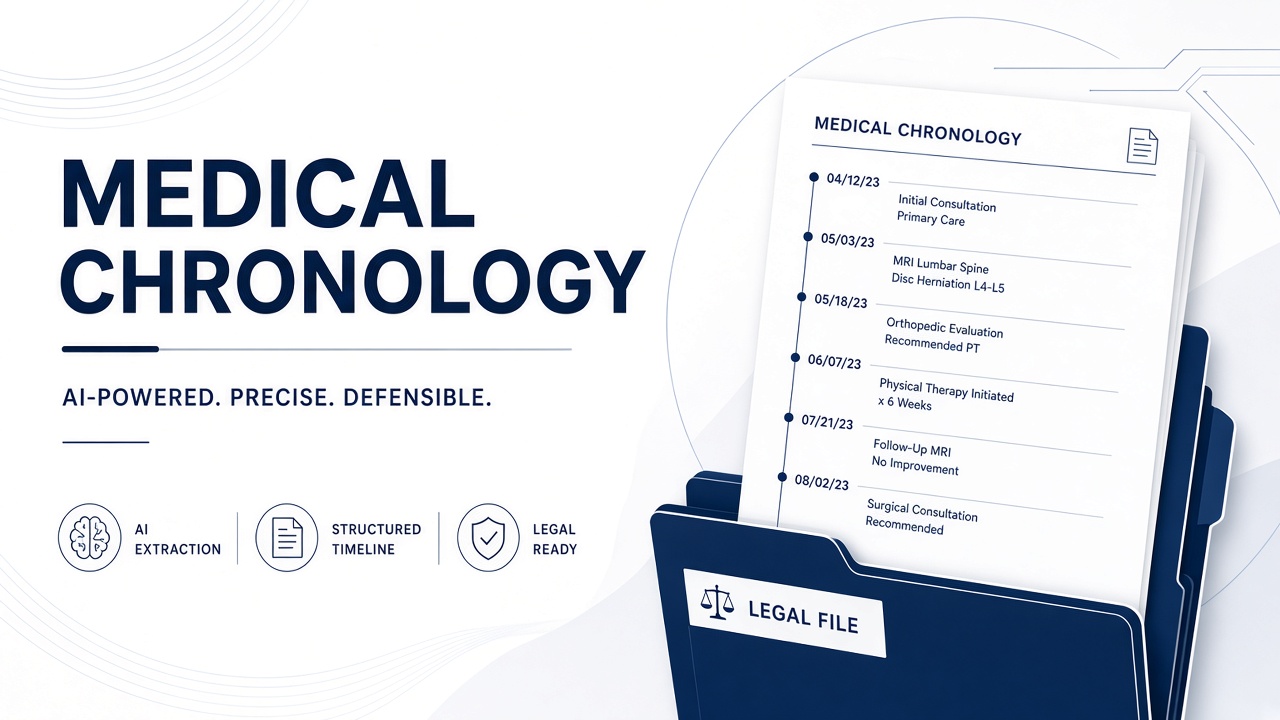
A medical chronology is a structured timeline of clinically relevant events extracted from a patient's records, organized by date or provider, with citations to source pages for verification. Unlike a raw record dump, a chronology highlights accident dates, emergency visits, surgeries, diagnostic findings, medication changes, gaps in care, and billing totals attorneys need for demands, depositions, and expert review.
Chronologies serve multiple audiences. Plaintiff firms build causation narratives. Defense teams hunt inconsistencies and pre-existing conditions. Insurers support utilization review and IME prep. Nurse consultants use them for life-care planning. The deliverable must be defensible: every line traceable to a source document because opposing counsel will challenge entries.
Volume drives automation demand. A complex injury file can exceed ten thousand pages across hospitals, orthopedics, radiology DICOM studies, pharmacy, and billing. Paralegals billing hourly to sort PDFs is expensive and slow. AI platforms promise to absorb sorting and first-pass extraction while humans verify critical events.
The Extraction Pipeline
Modern chronology pipelines ingest mixed-format records, OCR each page, classify document types, extract clinical entities, deduplicate events, and assemble a sortable timeline with per-field confidence scores. Vendors like Medrecords AI, Filevine MedChron, Eve Legal guides, and Chronos follow variations of this architecture.
- Intake: Bulk upload of PDFs, TIFFs, JPEGs, Word files, faxes, and DICOM imaging studies.
- Segmentation and OCR: Page splitting with quality flags on low-legibility scans; routing to specialized OCR engines for handwriting.
- Classification: Tag records as operative reports, nursing notes, radiology, billing, legal correspondence, etc.
- Entity extraction: Dates of service, providers, facilities, diagnoses (ICD), procedures (CPT), medications, vitals, and costs.
- Normalization and deduplication: Merge duplicate pages; split commingled claimants when files were mis-batched.
- Timeline assembly: Chronological index with hyperlinks to source pages or DICOM slices.
- Gap and inconsistency flags: Highlight delayed care, conflicting histories, missing records.
| Stage | Output | Human touchpoint |
|---|---|---|
| OCR | Searchable text per page | Re-request scans for flagged pages |
| Extraction | Structured events with citations | Verify low-confidence fields |
| Timeline | Sortable chronology export | Attorney narrative edit |
| Export | Word, PDF, or case management sync | Final sign-off before filing |
Multi-model cross-checking reduces single-model hallucination risk. Medrecords advertises multiple models validating extractions with confidence scores. Filevine MedChron integrates directly with Filevine matters; Chronos and others connect to Clio, Litify, CASEpeer, or SmartAdvocate. Integration depth determines whether chronologies live in the case system of record or export as static files.
Error Types and Accuracy Risks
Chronology automation fails predictably on poor OCR, ambiguous dates, duplicate records, wrong-patient commingling, and clinical abbreviation misreads. Treat AI output as a first draft requiring spot checks on high-stakes events, per Eve Legal and Filevine guidance.
OCR errors dominate on older faxed nursing notes and handwritten operative summaries. A misread "3/15" as "3/16" shifts causation arguments. Duplicate admissions from multiple providers inflate treatment narratives if deduplication misses. Models may hallucinate procedures not present if prompts over-summarize dense paragraphs. Billing lines without clinical correlation create misleading "treatment" entries if classification confuses UB-04 charges with visit notes.
Mitigation combines software and process: per-page quality scores, mandatory citation links, low-confidence highlighting, and attorney review of accident date, surgery date, key diagnoses, and largest cost drivers. When patterns of error appear, request higher-quality digital records from providers rather than repeatedly patching bad OCR.
Attorney Review Gate
Medical chronologies used in litigation require attorney or senior paralegal sign-off after structured spot checks, regardless of vendor accuracy marketing. The review gate is a professional responsibility barrier, not optional QA.
Effective review workflows sample strategically. Verify index events against source pages: date of loss, first treatment, MRI findings, surgical intervention, maximum medical improvement markers. Compare AI-flagged gaps against known record retrieval status (records still ordered vs true care gaps). Edit narrative language for tone and strategy but avoid altering cited facts without updating sources. Document who approved the chronology and when for privilege and malpractice files.
Utilization review teams apply a clinical lens: nurses validate whether timelines support medical necessity decisions. The same software pipeline serves both legal and clinical reviewers with different export templates and redaction rules.
HIPAA Constraints
Medical chronology vendors are business associates handling protected health information; law firms must execute BAAs, enforce encryption, role-based access, audit logging, and data retention policies before upload. Minimum expectations include SOC 2 Type II attestation, TLS encryption in transit, AES-256 at rest, and contractual prohibition on training public models with client PHI.
Chronos publishes HIPAA-aligned controls with signed BAAs on every account. Medrecords states PHI is never used for model training under BAA terms. Filevine cites SOC 2, HIPAA, and HITECH alignment for MedChron. Firms should verify subprocessors, breach notification timelines, and deletion upon matter closure during vendor diligence, not after pilot uploads.
Internal firm policies matter too: restrict chronology access to matter teams, disable personal device downloads where possible, and align retention with state ethics rules on client file storage. AI does not reduce HIPAA obligations; it concentrates them in fewer vendor relationships that must be audited annually.
Utilization Review and IME Use Cases
Beyond litigation, insurers and utilization review nurses use chronologies to evaluate medical necessity, prep independent medical examinations, and compare treatment patterns against clinical guidelines. The same extraction pipeline serves legal and clinical reviewers with different redaction and export templates. UR teams emphasize medication timelines, repeat imaging, and gaps between symptom reports and objective findings. IME physicians receive condensed timelines with imaging inline so review sessions focus on medical opinion, not record hunting.
Record Retrieval Coordination
Chronology software exposes missing records early when expected providers never appear in the index, accelerating subpoena and authorization workflows before trial deadlines. Firms should treat chronology gap flags as triggers for retrieval vendors, not as final conclusions about care quality. A missing hospital admission may reflect retrieval delay, not absence of treatment.
Cost and Billing Extraction
Demand drafting requires accurate billing totals by provider and date; AI extracts UB-04 and itemized bills but attorneys must reconcile summarized costs against source invoices before settlement conferences. Double-counting occurs when facility and professional charges overlap in poorly deduplicated files. Reviewers should validate largest cost drivers manually even when overall chronology confidence scores appear high.
Workflow for Plaintiff Firms
Typical plaintiff workflow runs record retrieval, AI chronology generation, attorney spot check, expert coordination, demand drafting, and deposition prep, with chronology exports feeding each downstream step. Firms batch chronologies at intake for smaller matters to decide viability before expert spend. Complex spinal injury cases may require radiology-heavy review with DICOM inline. Filevine MedChron users keep chronologies inside the matter file; export-oriented firms sync to Word templates for demand letter merge fields.
Workflow for Defense and Insurance
Defense teams emphasize pre-existing conditions, treatment gaps after MMI markers, and billing inflation; insurers add utilization review criteria and peer-to-peer prep summaries from the same automated timeline. Redaction rules differ: defense may mask unrelated prior accidents while insurers apply member ID protections. Configure vendor exports to match each audience without manual reformatting.
Expert Witness Preparation
Experts receive chronology exports with imaging and operative reports hyperlinked so deposition prep focuses on opinion formation, not reconstructing dates from unsorted boxes. Experts still perform independent record review; AI chronologies accelerate but do not replace expert methodology disclosures.
Training Junior Associates and Paralegals
Firms use AI chronologies as teaching tools: junior staff verify citations on flagged events before partners review narrative strategy, building record literacy faster than passive PDF scrolling. Training programs should document verification checklists so quality stays consistent as vendor models update quarterly.
Malpractice Risk Management
Malpractice carriers increasingly ask whether firms validated AI-generated chronologies before reliance in filings; maintain approval logs and spot-check documentation as part of risk management programs. Never file demands or expert reports citing chronology entries the responsible attorney has not personally verified against source records. The efficiency gain disappears quickly if a single uncorrected date error undermines causation at trial. Risk committees should treat chronology vendors like any other outsourced legal technology with annual security and accuracy reviews documented in the file. Partner sign-off on the final export closes the loop for both ethics and insurance questionnaires.
Frequently Asked Questions
How long does AI chronology generation take?
Large files that took paralegals days often process in hours, depending on page count, scan quality, and imaging volume. Human review time remains significant for complex litigation.
Does chronology software handle medical imaging?
Platforms like Medrecords ingest DICOM studies and place imaging inline on timelines with slice-level citations. Confirm PACS integration requirements during vendor selection.
Does AI replace medical record paralegals?
AI replaces sorting and first-pass abstraction; skilled reviewers still verify events, manage record retrieval, and craft case strategy. Firms redeploy hours to higher-value analysis.
Can defense and plaintiff firms use the same tools?
Yes. The same extraction pipeline supports both sides; strategy differs in which events attorneys emphasize during review. Configure exports and filters per matter type.
When is a BAA required?
Before any PHI upload to a vendor cloud, the firm must have a signed BAA in place. Piloting on redacted samples without BAA does not validate production security posture.
Are AI chronologies admissible in court?
Chronologies are attorney work product summaries backed by underlying records; admissibility turns on foundation for underlying records and expert use, not the AI tool alone. Citations to source pages strengthen defensibility.
How do firms choose chronology vendors?
Evaluate OCR quality on your typical scan mix, case management integrations, BAA terms, citation UX, and nursing or paralegal reviewer satisfaction during pilot matters before firm-wide rollout. Price per page matters less than error rate on high-value events.
How are commingled records handled?
Platforms like Medrecords detect duplicate packets and split unrelated claimants when files were mis-batched, preventing timeline contamination across matters. Human review confirms split accuracy on family or multi-plaintiff cases.
Conclusion
AI medical chronology automation compresses record sorting and first-pass timeline building for legal and clinical teams, but accuracy risks and HIPAA duties remain human-gated. Run mixed-format records through OCR, classification, extraction, and citation-linked timelines; spot-check high-stakes events; execute BAAs before production use. Pair chronologies with AI transcription for depositions and AI writing for demand drafts only after attorney review. The workflow delivers clear ROI when firms treat AI as accelerated abstraction, not autonomous advocacy.