Organizations deploy dozens of AI tools across chatbots, code assistants, image generators, and embedded vendor features without a single source of truth. When regulators, customers, or internal audit ask what AI systems exist, which data they process, and who owns risk decisions, spreadsheet fragments and Slack threads fail. A structured inventory register closes that gap before an incident forces reactive documentation.
An AI tool inventory register is a living catalog of every AI system your organization deploys or enables, with minimum fields auditors expect under the EU AI Act Article 49 registration obligations and NIST AI Risk Management Framework Govern function 1.6 inventory practices. This guide covers compliance and platform owners maintaining registers alongside AI API integrations and AI image generator tools employees adopt. The goal is audit-ready evidence, not checkbox paperwork.
Minimum Fields Per Tool Entry
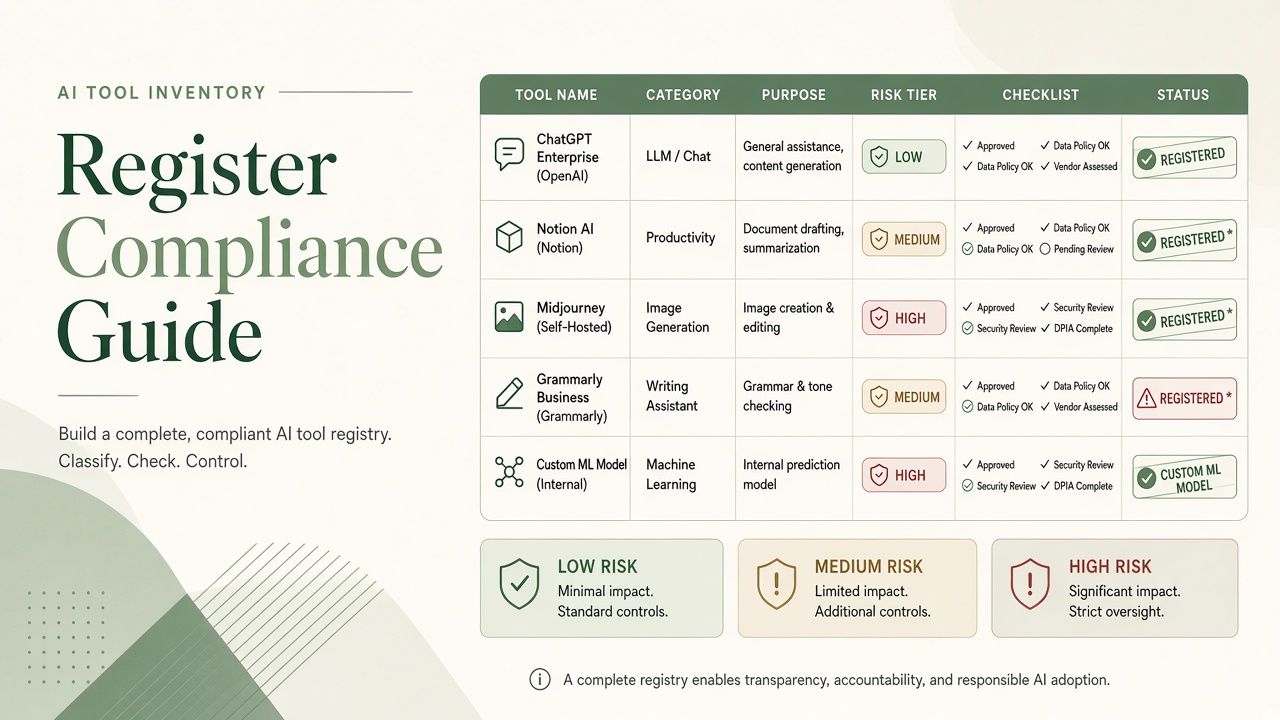
Every AI tool register entry needs at minimum: system name, business owner, technical owner, vendor, model name and version, data classes processed, risk tier, deployment status, and last review date. Regulators and enterprise customers increasingly request this schema during due diligence. Missing any field signals immature governance and delays security questionnaires.
| Field | Description | Audit purpose |
|---|---|---|
| System ID and name | Unique identifier and human-readable label | Cross-reference incidents and DPIAs |
| Business owner | Accountable executive or director | Decision authority for risk acceptance |
| Technical owner | Team operating integration | Escalation for outages and changes |
| Vendor and model | Provider name, model ID, version pin | Subprocessor and change tracking |
| Data class | Public, internal, confidential, regulated PII | Privacy and residency assessment |
| Risk tier | Low, limited, high, or prohibited mapping | EU AI Act and internal policy alignment |
| Use case description | What decision or task AI assists | Proportionality and oversight review |
| Deployment scope | Users, regions, environments | Blast radius and license compliance |
EU AI Act Article 49 Alignment
Deployers of high-risk AI systems in the EU must register entries in the EU database before market placement or use, per Article 49 requirements taking effect through 2026 enforcement phases. Your internal register should capture the same metadata you will submit externally: provider details, system classification, conformity assessment status, and national authority references. Maintain draft registration records even for systems still under legal review.
NIST AI RMF Govern 1.6
NIST AI RMF Govern function category 1.6 calls for policies and procedures to inventory AI systems and map them to organizational risk tolerance. The register is the operational artifact proving Govern 1.6 implementation. Link each entry to impact assessments, human oversight procedures, and monitoring controls documented elsewhere in your GRC platform.
Risk Tiering Methodology
Assign risk tiers using a consistent matrix of impact (harm if wrong) and likelihood (exposure volume), mapped to regulatory categories including EU AI Act prohibited, high-risk, limited risk, and minimal risk systems. A consumer-facing AI image generator for marketing assets differs from an HR screening assistant. Tiering drives documentation depth, not bureaucracy for its own sake.
| Tier | Example tools | Register requirements |
|---|---|---|
| Minimal | Internal grammar check on public copy | Basic fields, annual review |
| Limited | Chatbots with transparency obligations | Disclosure docs, user notice links |
| High | Credit scoring, hiring, medical triage assist | Full DPIA, human oversight logs, Article 49 prep |
| Prohibited | Social scoring, manipulative subliminal techniques | Do not deploy; document ban policy |
Escalation to Legal
Entries classified high-risk or handling special category personal data require legal and privacy review before production deployment. The register workflow should block "active" status until reviewers sign off. Record reviewer name, date, and rationale in evidence attachments.
Update Triggers: New Vendor, Model Change
Update register entries within defined SLAs when vendors change, models upgrade, data classes expand, or deployment scope grows to new regions or user populations. Silent model swaps by SaaS vendors are common in 2026; contract language should require change notification. Your technical owner should verify model version pins after each vendor release note.
- New vendor or subprocessors: new entry or major version bump within 10 business days.
- Model version change: update model field, trigger re-assessment if capabilities shift.
- New data class (e.g., adding customer PII): privacy review and tier re-evaluation.
- Geographic expansion: data residency and Article 49 registration check.
- Decommission: mark retired, archive evidence, revoke API keys.
API Integrations Tracking
Every production AI API integration should map to a register entry with endpoint URLs, authentication method, and rate limit owners. Shadow integrations discovered through expense reports or network logs get retroactive entries with elevated scrutiny.
Evidence Attachments for Audits
Link each register entry to evidence artifacts: data processing agreements, model cards, penetration test summaries, human oversight procedures, training completion records, and incident response playbooks. Auditors request samples; a register without attachments forces weeks of document hunting. Store evidence in your GRC tool with immutable version history.
- Vendor SOC 2 Type II report (dated within 12 months).
- Data processing agreement and subprocessor list.
- Impact assessment or DPIA for high-risk systems.
- Model card or vendor transparency documentation.
- Human oversight SOP with reviewer role definitions.
- Sample audit log export showing AI decision traceability.
- Employee acceptable use training acknowledgment stats.
Audit Sampling
Prepare a quarterly sample pack of three register entries across risk tiers with complete evidence chains. Internal audit uses samples to test control effectiveness before external assessors arrive. Gaps found internally cost less than gaps found during customer enterprise reviews.
Shadow AI Discovery
Shadow AI is employee use of unapproved tools, personal accounts, or browser extensions that process company data outside the register. Discovery methods include SSO log analysis, egress proxy categorization, expense report keyword scans, security awareness surveys, and DLP alerts on uploads to known AI domains. Each discovered tool gets a register entry marked "unapproved" until remediated or formalized.
- Network: block or monitor categories of generative AI SaaS domains per policy tier.
- Identity: detect OAuth grants to unapproved AI apps on corporate Google or Microsoft tenants.
- Endpoint: inventory browser extensions with AI capabilities on managed devices.
- Culture: provide an approved tool request path faster than shadow adoption.
- Metrics: track shadow AI discoveries per quarter as a governance KPI.
Remediation vs Approval
Remediate shadow AI by blocking access and migrating users to approved alternatives, or fast-track register approval when the tool meets security baseline. Punitive-only responses drive deeper concealment. Pair discovery with sanctioned options from your vetted catalog.
Register Operations and Tooling
Operate the register in a system of record (GRC platform, CMDB extension, or governed spreadsheet with change control) with role-based edit access and quarterly attestation by business owners. Spreadsheets work for startups under fifty employees; enterprises need workflow automation for approvals and evidence linking.
Integration With Change Management
Require register updates as a change management gate before production AI deployments, similar to security review for new SaaS. CI/CD pipelines that call external model APIs should fail deployment checks when no register ID is associated with the service metadata.
Frequently Asked Questions
How do we find shadow AI tools employees already use?
Combine network egress logs, SSO application discovery, expense audits, and anonymous surveys; then validate findings with targeted interviews. No single signal catches every personal ChatGPT session. Repeat discovery quarterly because new tools launch constantly.
Is a full register overkill for a 30-person startup?
Start with a lightweight register covering minimum fields for every tool processing customer or employee data; expand as headcount and enterprise sales requirements grow. Enterprise customers increasingly ask for AI inventories during security reviews regardless of company size.
How do we register systems built on GPAI providers like OpenAI or Anthropic?
Document your organization as deployer of the specific use case; record the GPAI provider as vendor with model version and your fine-tuning or RAG configuration described separately. Provider obligations under the EU AI Act differ from deployer obligations; legal counsel should map roles per system.
How long should we retain register history for decommissioned tools?
Retain decommissioned entries and evidence for at least the longest applicable statutory limitation period in your jurisdictions, commonly five to seven years for regulated industries. Mark status retired but preserve audit trail for investigations into historical decisions.
Cross-Functional Governance Council
A quarterly AI governance council with representatives from legal, security, privacy, procurement, and business units reviews register entries flagged high-risk or overdue for attestation. The council does not replace line ownership; it resolves tier disputes, approves exceptions, and prioritizes shadow AI remediation. Meeting minutes become audit evidence.
Vendor Questionnaire Mapping
Map register fields to standard security questionnaire sections (SIG Lite, CAIQ, custom enterprise RFPs) so responses reuse across customer deals. When procurement onboards a new AI vendor, create the register entry in draft status before contract signature. Link DPA execution date to the evidence attachment list.
Implementation Roadmap
Week one: inventory existing approved tools; week two through four: run shadow AI discovery and backfill minimum fields; month two: link evidence attachments and assign risk tiers; ongoing: quarterly attestation and council review. Do not wait for perfect tooling. A governed spreadsheet beats no register during an audit. Migrate to GRC workflow automation as volume grows past twenty active systems.
Metrics and Reporting
Report register KPIs to leadership: total active systems by tier, overdue reviews, shadow AI discoveries, and mean time to approve new entries. Boards increasingly request AI inventory summaries. Automate dashboards from your GRC tool rather than manual slide decks.
Living Register, Defensible Audits
An AI tool inventory register succeeds when every entry carries owners, data classes, risk tiers, vendors, and model versions, updates trigger on vendor and model changes, evidence attachments satisfy EU AI Act and NIST AI RMF expectations, and shadow AI discovery feeds back into governed approval paths. Compliance and platform teams own the register as operational infrastructure, not annual paperwork.