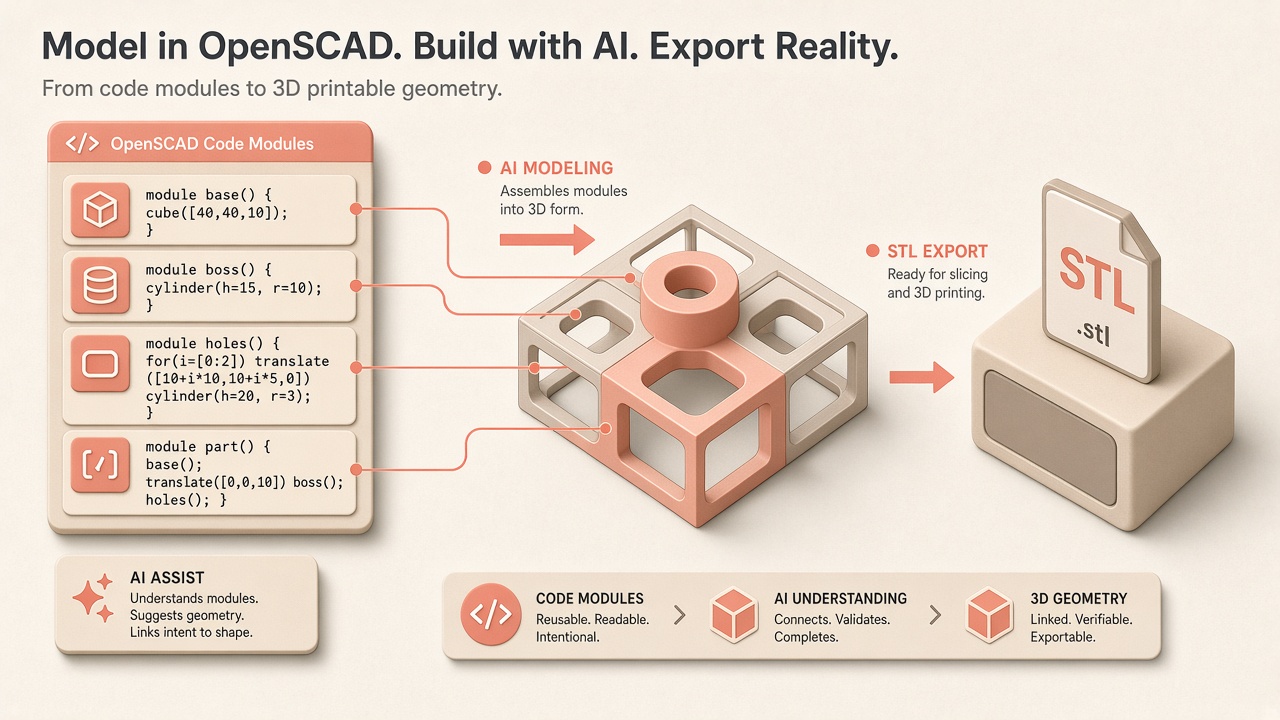
Three-dimensional modeling software assumes users can see meshes, gizmos, and viewport lighting. Blind and low-vision (BLV) makers who want to design tactile objects, assistive devices, or art pieces historically depended on sighted collaborators to operate CAD tools and confirm geometry. A11yShape, presented at ASSETS 2025, combines OpenSCAD code-to-model pipelines with GPT-4o feedback loops so BLV programmers create printable objects without constant sighted assistance. Four BLV programmers produced twelve models across the study, using cross-representation highlighting that links code, hierarchy trees, natural language descriptions, and rendered previews. Verification loops and STL export closed the path from intent to fabrication. Readers exploring AI image generator adjacent design tools or popular AI tools for accessibility should understand how code-first modeling plus AI narration differs from dragging invisible mesh handles before recommending tools to disability-led maker spaces.
Why Visual CAD Fails Blind Makers
Mainstream CAD packages center viewport manipulation: orbit, extrude, and boolean operations presented as graphical affordances without non-visual equivalents for complex assemblies. Screen reader support on commercial tools remains partial. BLV programmers who already write software gravitate toward parametric code environments like OpenSCAD, where geometry is defined textually. Yet even OpenSCAD defaults assume creators visually inspect rendered output to catch syntax mistakes, misaligned unions, and non-manifold meshes before printing. Without structured feedback linking code lines to spatial outcomes, blind authors restart sighted dependency at the verification step.
Tactile feedback from printed prototypes helps but wastes material and time when errors are fundamental. Audio sonification of height fields offers intuition for some shapes yet scales poorly to arbitrary CSG trees. A11yShape argues that multiple synchronized representations, not a single modality, enable reliable independent modeling for BLV experts who think in code and structure.
OpenSCAD and GPT-4o Pipeline
A11yShape wraps OpenSCAD compilation with GPT-4o generating and refining natural language descriptions of geometry, answering structural questions, and suggesting code edits when verification fails. Creators write or dictate parametric code; the system renders preview images for optional sighted collaborators while primarily serving textual and hierarchical explanations to blind users. GPT-4o interprets CSG programs to describe overall dimensions, wall thickness, hole positions, and symmetry properties in accessible prose. When creators suspect a feature is wrong, they query the model about specific modules or variables, receiving answers grounded in the current code state rather than generic CAD advice.
| Representation | What BLV users perceive | Highlight sync role |
|---|---|---|
| OpenSCAD code | Screen-reader navigable source | Selecting a line highlights related hierarchy nodes |
| Hierarchy tree | Nested module and primitive structure | Tree focus updates code and description panes |
| AI description | Plain-language spatial summary | Mentions tied to code ranges on request |
| Render preview | Optional visual for collaborators | Cross-highlight shows which code built visible region |
Cross-Representation Highlighting
Cross-representation highlighting synchronizes focus across code, hierarchy, description, and render views so a blind author navigating one pane immediately learns what other representations say about the same geometric feature. Selecting a cylinder primitive in the tree jumps the editor to its instantiation line and scrolls the AI description to the paragraph discussing diameter and height. This design reduces cognitive load compared to mentally mapping line numbers to spatial language. ASSETS 2025 participants reported faster error localization when a misplaced translation vector caused overlapping solids; hierarchy focus revealed duplicate modules that prose alone had obscured.
Highlighting must remain screen-reader efficient: announcements bundle related updates instead of spamming focus events on every keystroke during live compilation. A11yShape debounces render cycles and batches accessibility events when OpenSCAD recompiles large scripts. The a11yshape 3d modeling blind workflow treats rendering latency as an accessibility parameter, not only a performance metric.
Verification Loops Before STL Export
Before exporting STL files for 3D printing, creators run structured verification loops: AI-generated checklists, dimensional queries, and manifold warnings derived from OpenSCAD and mesh analysis. GPT-4o compares stated design goals against compiled geometry descriptions, flagging missing fillets, zero-thickness walls, or uncentered holes common in novice parametric scripts. Creators confirm each checklist item explicitly, mirroring preflight patterns from aviation and software release engineering adapted for tactile fabrication. Failed checks return focus to relevant code spans via cross-representation links rather than generic error codes.
STL export preserves scale metadata and naming conventions compatible with slicers such as PrusaSlicer and Cura. Four BLV programmers completed twelve models including containers, brackets, and tactile labels, iterating verification loops until print-ready exports passed both automated checks and participant confidence thresholds. Some models still benefited from optional sighted preview for aesthetic polish, but structural correctness no longer required continuous assistance.
Study Limitations and Future Work
The ASSETS 2025 evaluation involved four experienced BLV programmers; generalization to novice makers and non-code CAD paradigms remains open research. GPT-4o occasionally misstated subtle curvature or chamfer angles until creators quoted exact parameters from code. Larger models and fine-tuning on OpenSCAD corpora may tighten descriptions. Integration with audio height-map sonification or haptic tablets could augment, not replace, cross-representation linking for users who prefer hybrid perception.
Maker spaces adopting A11yShape principles should train staff on code-first accessibility rather than assuming Blender plugins alone suffice. Procurement of AI assistants must include offline or privacy-preserving options when designs depict medical or personal assistive devices. Export logs documenting verification acknowledgments could support quality standards in disability-led manufacturing cooperatives.
Maker Space Adoption Patterns
Community fab labs adopting A11yShape patterns should pair OpenSCAD workstations with screen-reader-tested editors, debounced compile servers, and verification checklists posted in accessible formats. Staff training covers cross-representation navigation so volunteers do not revert to sighted-only preview habits when assisting newcomers. Material libraries label filament colors with tactile codes; A11yShape descriptions reference those codes when models include color-dependent assembly steps. Print queue integration can announce estimated duration and weight in non-visual channels after STL export passes manifold checks.
BLV makers designing assistive devices often iterate faster than commercial vendors because they live with the problems addressed. A11yShape lets them prototype phone stands, cable organizers, and tactile labels overnight without waiting for sighted CAD operators. The ASSETS 2025 study's twelve models spanned functional brackets and educational tactile graphics, showing breadth beyond novelty prints. Liability considerations remain: medical devices require regulatory review even when creators verify geometry independently. Maker spaces should document verification acknowledgments without claiming FDA clearance from AI checklists alone.
Extending Code-First Accessible CAD
Future A11yShape versions may integrate parametric libraries for common assistive dimensions, keyboard macros for union and difference templates, and community-shared modules reviewed by blind engineers. GPT-4o successors could explain collision warnings in plain language when OpenSCAD reports empty geometry results. Haptic tablets paired with audio height maps may supplement cross-representation linking for users who prefer touch feedback on finished meshes before sending jobs to printers. Research prototypes should measure whether multimodal feedback reduces print failure rates beyond code and description alone.
Educational pipelines from high school through university computer science can introduce accessible CAD modules alongside graphics courses that historically excluded BLV students. Instructors export anonymized assignment scripts to benchmark AI description accuracy across semesters. The a11yshape 3d modeling blind community benefits when textbooks cite ASSETS 2025 findings and distribute OpenSCAD starter kits with verification rubrics, normalizing independent fabrication as a career skill rather than a charity project.
Frequently Asked Questions
What is A11yShape?
A11yShape is an AI-assisted 3D modeling environment for blind and low-vision makers, built on OpenSCAD and GPT-4o with cross-representation highlighting and verification loops before STL export. It was presented at ASSETS 2025.
Do I need to know OpenSCAD?
The study participants were programmers comfortable with code-based CAD. A11yShape targets users who can edit parametric scripts; visual-only CAD users may need additional onboarding.
How does GPT-4o help?
GPT-4o generates spatial descriptions, answers questions about modules and dimensions, suggests fixes, and powers pre-export verification checklists grounded in the current script.
What is cross-representation highlighting?
Selecting an element in code, hierarchy, description, or render views synchronizes focus and announcements across all panes so users understand how representations relate.
Can blind makers print models independently?
Participants produced twelve print-ready STL files after verification loops. Optional sighted aesthetic review may still help for complex organic shapes, but structural errors were caught non-visually.
Is A11yShape available publicly?
Consult ASSETS 2025 proceedings and authors for artifact release status. Design patterns apply even before a public installer exists.
Educational institutions teaching accessible STEM should pair A11yShape readings with hands-on OpenSCAD modules so BLV students learn verification discipline early. Combining code literacy with AI description beats promising invisible mesh editing that screen readers cannot navigate reliably.
Fabrication labs can extend verification loops with automated slicer previews that report print time and material estimates as additional non-visual channels, reducing surprises at the printer bed. Each channel must link back to code spans through the same highlighting fabric so users never hunt for error sources across disconnected logs.
Future integrations with AI image generator sketching tools should convert rough concept art into OpenSCAD starter scripts only when creators can audit every generated primitive through A11yShape-style cross-representation review, preventing silent geometry drift from opaque image models.
Long-term maintenance of parametric libraries benefits from version control hooks that announce diffs in accessible language when collaborators merge pull requests. BLV reviewers can accept or reject geometry changes based on AI-generated change summaries tied to highlighted code spans, extending A11yShape verification into team workflows beyond solo printing sessions.
Tactile inspection stations with calibrated rulers and hole gauges offer optional physical verification after STL export, complementing AI descriptions with measurements blind makers can perform independently. Documenting those measurements in verification logs creates audit trails for assistive device cooperatives shipping parts to remote customers who cannot visit the lab before installation.
Competition organizers hosting accessible design hackathons should supply A11yShape-style environments rather than defaulting to visual CAD packages that exclude BLV participants on day one. Prizes for parametric assistive tools incentivize reusable OpenSCAD libraries the whole community maintains, multiplying impact beyond single-event demos.
OpenSCAD parametric variables for finger clearance and grip diameter should appear in AI descriptions with explicit numeric values so blind makers comparing design iterations hear differences immediately without recompiling mental models from vague prose summaries alone.
National accessibility standards for public maker spaces should reference ASSETS 2025 A11yShape evidence when procurement teams evaluate whether donated 3D printers include software blind patrons can operate without scheduling sighted volunteers for every design session.
Slicer plugins that read OpenSCAD customizer parameters aloud extend the verification story into print preparation, announcing layer height and infill choices before jobs start so blind makers confirm settings match design intent.
Corporate accessibility teams prototyping internal tools should benchmark A11yShape against their existing CAD licenses, measuring hours blind employees spend waiting for sighted colleagues versus independent iteration cycles with cross-representation verification and STL export under participant control. Published ROI studies remain rare but qualitative interviews in ASSETS 2025 document substantial independence gains.