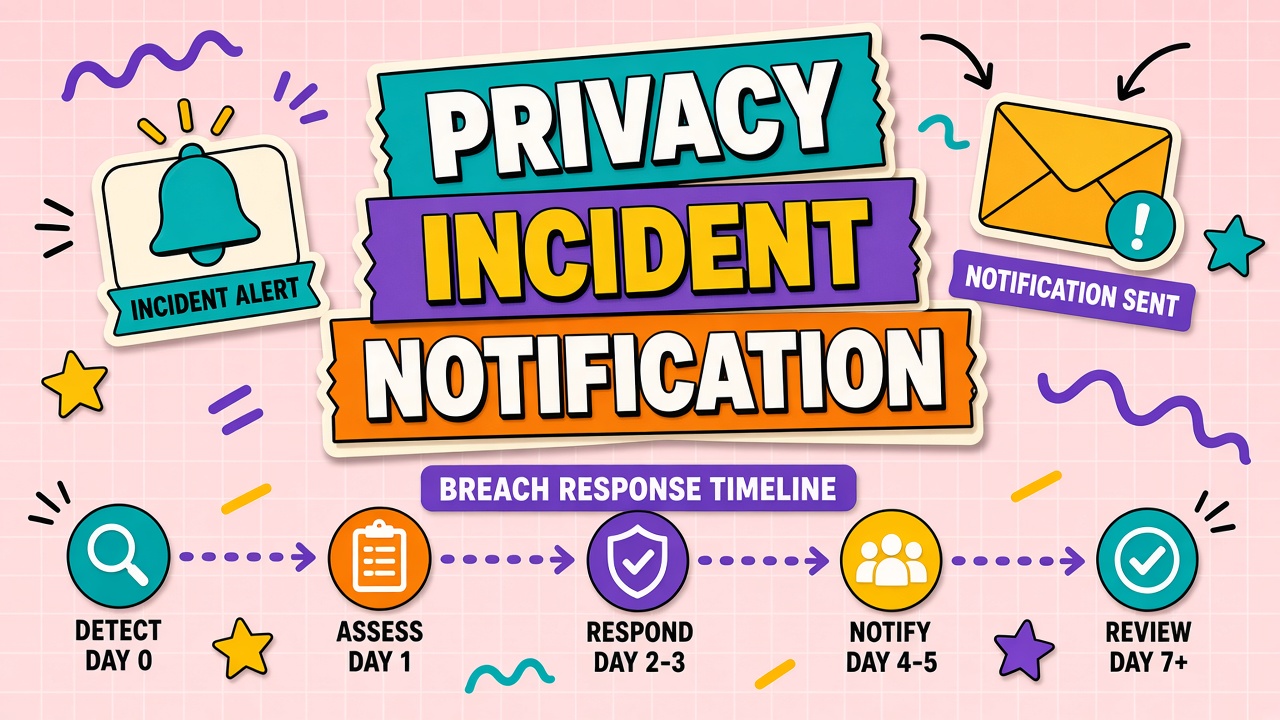
An employee pastes a customer export into a public chatbot. A vendor misconfigures logging and exposes prompts. A transcription model stores audio longer than the contract allows. These events may trigger AI privacy breach notification duties to regulators and individuals. Speed and clarity matter more than perfect root cause on day one.
This workflow guide covers definition, internal escalation, vendor contracts, and notification tests for teams using AI video and AI transcription tools that process voice and likeness data.
Define AI-Related Personal Data Incidents
Not every AI mistake is a breach. Define incidents that enter the privacy playbook:
- Unauthorized disclosure of personal data via model output or log exposure
- Processing without lawful basis or beyond disclosed purpose
- Failure to honor deletion or opt-out in AI pipelines
- Cross-tenant data leakage in multi-tenant AI SaaS
- Training on customer data contrary to contract
- Biometric or sensitive category data sent to unapproved tools
Quality failures (wrong summary) without personal data exposure may be operational incidents, not privacy breaches. Legal classifies borderline cases using jurisdiction-specific tests (e.g., GDPR risk to rights and freedoms).
Internal Escalation Within 24 Hours
Clock starts when anyone with authority knows or should have known. First 24 hours:
- Contain: Disable integration, rotate keys, block tool access
- Preserve: Snapshot logs, prompts, config; chain of custody
- Notify: Privacy lead, CISO, legal, communications, executive sponsor
- Assess: Data categories, volume, individuals affected, likelihood of harm
- Document: Incident ticket with timeline, decisions, open questions
Teams processing media through transcription services should verify whether audio snippets remain in vendor caches after containment.
Vendor Contractual Notice Periods
DPAs often require processors to notify controllers within 24–72 hours of becoming aware of a personal data breach. Your playbook should list:
- Vendor security contact and after-hours path
- Contractual notification window per vendor
- Information vendors must provide (categories, counts, remedial actions)
- Cooperation on regulator and individual notices
- Indemnity and insurance triggers (legal review)
If the vendor is silent past the contractual deadline, escalate to account executive and consider statutory notification based on facts you already know.
Regulator and Individual Notification Tests
GDPR-style regimes often require regulator notification within 72 hours when risk exists, and individual notice when high risk. Document your test:
| Factor | Higher notification likelihood |
|---|---|
| Sensitivity | Health, financial, children, biometrics |
| Volume | Large affected population |
| Consequence | Identity theft, discrimination, physical harm |
| Mitigation | Weak or absent encryption, no quick fix |
Customer communications should be plain language: what happened, what data, what you did, what they should do, contact channel. Coordinate with PR before video or media assets leak scenarios where reputational harm is immediate.
Coordinating Vendor and Regulator Timelines
Build a master timeline template with columns for discovery time, containment time, vendor notification sent, legal assessment complete, regulator notification deadline, customer notification sent, and public statement if any. AI incidents often involve vendor assessment lag; start your internal clock at discovery, not when vendor confirms breach.
Vendor DPAs may require you to notify them within 24 hours of becoming aware of an incident involving their processing. Parallel track your regulatory analysis. Waiting for vendor root cause should not delay initial regulator assessment when your data is clearly exposed.
Accidental paste into consumer AI tools is a frequent real-world scenario. Run tabletop exercises where engineering reports paste, security isolates account, legal evaluates notifiability, and comms drafts holding statement. Pre-written decision trees reduce panic clicks that destroy evidence or over-notify unnecessarily.
Log exposure incidents differ from training data leaks. Regulators ask whether individuals are identifiable in logs and whether logs were accessed by unauthorized parties. Technical forensics should answer access scope before legal commits to notification wording.
Post-incident, update runbooks with lessons: which vendor contact worked, which logging gap delayed analysis, whether DLP should block the paste vector. AI incident response matures like classic security IR through documented iterations, not one heroic weekend.
Communications Templates
Pre-draft regulator notification skeletons and customer email templates with placeholders for facts, legal review in 24 hours, not composed from scratch during crisis. Templates exist for: accidental paste, vendor breach notice received, misdirected AI output, retention violation discovered.
Media teams need holding statements when video or voice data is involved because press interest spikes faster than text-only incidents.
Cross-border notification
Multinationals may need parallel notices to EU lead authority, UK ICO, US state AGs, and APAC regulators. Map which entity is controller per region and which vendor acts as processor. Legal owns matrix; engineering supplies technical timeline.
Transcription-specific playbook
For transcription vendors, incidents include wrong speaker diarization sending one user's audio to another's account. Test account isolation during onboarding and document results for incident comparison.
Regulator Notification Factors
GDPR Article 33 requires notification within 72 hours when breach likely risks rights and freedoms. US state laws vary on timing and thresholds for personal information. Sector regulators add overlays for health, finance, and education data in AI workflows. Maintain jurisdiction matrix keyed by data categories you process through AI tools.
Individual notification tests ask whether harm is likely: identity theft, fraud, discrimination, reputational damage, confidentiality loss. AI-specific harms include exposure of inferred sensitive attributes from prompts, publication of draft content not meant for release, and incorrect automated decisions with legal effect if acted upon before human review.
Vendor coordination calls should use structured agenda: scope of affected data, approximate record count, root cause timeline, remedial actions, commitment to supplemental report date. Record call notes in incident ticket. If vendor is slow, proceed with your assessment using available logs rather than waiting indefinitely.
Communication Templates and Legal Holds
Pre-draft regulator notification skeleton and customer email templates with placeholders for date, data types, steps taken, and contact. Legal approves templates annually. During incident, fill placeholders rather than writing from scratch at 2 a.m.
Accidental paste scenarios need internal comms too: remind employees of approved tools, offer refresher training, and confirm whether vendor deletion request submitted. External notification decision may be negative but internal documentation still required.
Log exposure without unauthorized access may still trigger review. Public bucket misconfiguration for embedding files might be contained before download by third parties; forensic evidence of access logs determines notifiability. AI log platforms should provide access audit trails, not only storage.
Post-Incident Review and Vendor Accountability
After notification cycle completes, run blameless postmortem within fourteen days. Capture timeline accuracy, vendor response quality, and gaps in logging. Update incident playbooks and training slides. If vendor breached notice SLA, invoke contractual remedies and document for renewal negotiation.
Tabletop exercises twice yearly should include AI-specific scenarios: RAG index leak, prompt log misconfiguration, shadow AI paste with customer list, and vendor subprocessors breach announcement. Rotate roles so legal, engineering, and comms each practice lead once.
Keep a printed one-page incident hotline list for holidays: privacy counsel mobile, vendor security desk, PR approver, and cloud admin on-call. AI incidents do not respect business hours. The first hour still belongs to containment and evidence preservation, not debate about whether the pasted spreadsheet was "really" personal data.
Frequently Asked Questions
Accidental paste into public AI: breach?
Often yes if personal data left your control to a processor without authorization. Assess vendor retention and whether data was logged or used for training. Notify internally immediately even if external notice is not yet determined.
Vendor log exposure without public internet leak?
Internal misconfiguration at vendor may still be a processor breach triggering contractual and regulatory duties. Request forensic report and affected tenant list.
Model hallucination revealing one person's data?
If real personal data appeared in output to wrong recipient, treat as disclosure incident. Investigate retrieval isolation failure.
Can we delay notice to investigate?
Regulators allow phased notices if initial report within deadline states unknowns. Do not wait for full RCA if statutory clock runs. Legal guides timing.
Run tabletops?
Annual AI breach tabletop with legal, engineering, comms, and vendor success. Scenario: transcription vendor retention mismatch.
The Bottom Line
Privacy incident notification when AI tools are involved requires clear definitions, 24-hour internal escalation, vendor contract clocks, and documented regulator tests. Media-heavy stacks using video AI and transcription carry heightened sensitivity: rehearse playbooks, keep vendor contacts current, and never assume "just a prompt" exempts you from breach law.
Post-Incident Improvement Loop
Within 30 days of closing an AI privacy incident, ship at least one systemic fix: DLP rule, training module, vendor config change, or workflow gate. Track fixes in same ticket system as incidents. Regulators and customers ask what changed, not only what happened.
Share anonymized lessons learned with all staff quarterly. Fear-based silence increases shadow AI; calibrated transparency reduces repeat paste mistakes.