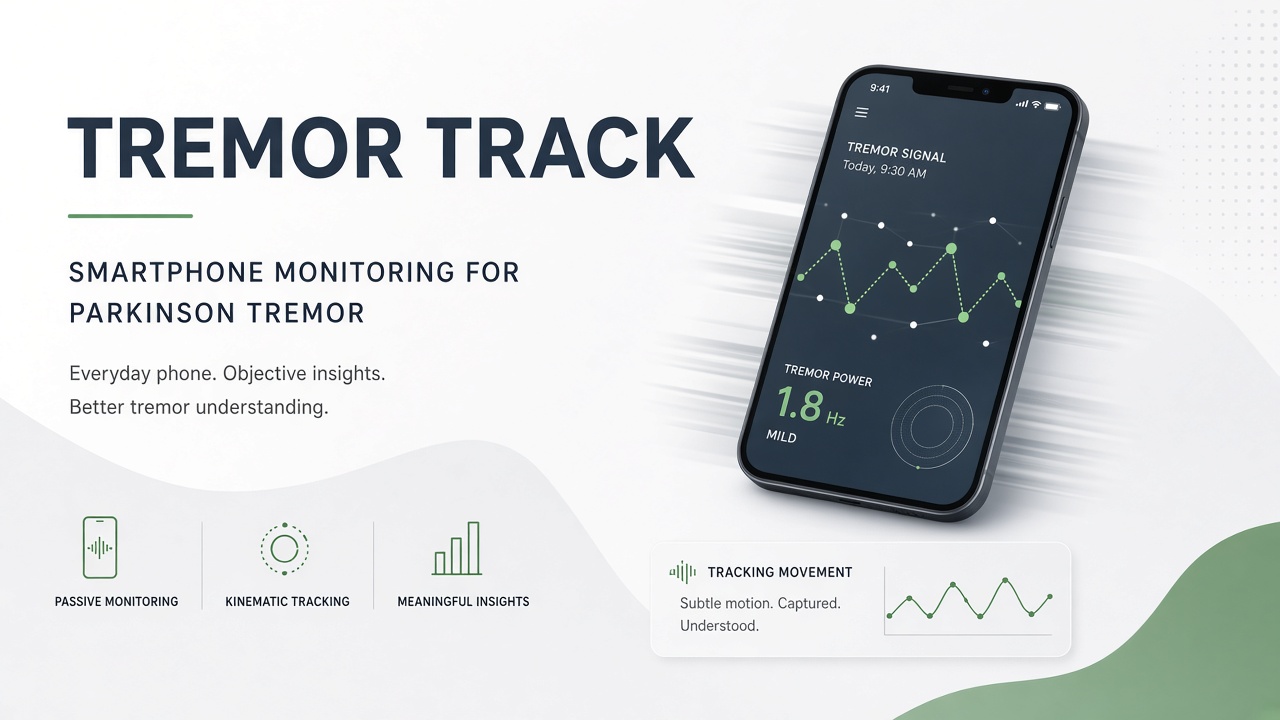
AI Parkinson's tremor monitoring from smartphones uses accelerometer kinematics or front-camera video to estimate tremor amplitude and frequency, correlating with MDS-UPDRS clinical scores for remote symptom tracking. The FDA cleared Neu Platform (510(k) K250153, decision April 25, 2025) for accelerometer-based quantification, while research platforms such as VisionMD demonstrate video-based metrics without external calibration references. These tools assist clinicians; they do not replace in-person neurological examination. Clinics exploring AI healthcare workflows should distinguish regulatory-cleared sensor apps from open-source video pipelines still in validation.
Why Tremor Matters in Parkinson's Care
Tremor is one of four cardinal Parkinson's motor signs and strongly influences medication timing, deep brain stimulation programming, and quality-of-life assessments. Rest tremor, postural tremor, and kinetic tremor fluctuate with dopaminergic medication cycles ("on" and "off" states) and disease progression. Movement disorder specialists historically relied on in-clinic Unified Parkinson's Disease Rating Scale (UPDRS) or Movement Disorder Society revision (MDS-UPDRS) scoring during brief visits that may not represent home symptom burden.
Continuous objective tremor measurement could shorten titration cycles for levodopa and adjunct therapies, detect wearing-off earlier, and supply outcome measures for clinical trials with higher temporal resolution than quarterly appointments. Tremor also overlaps with essential tremor and drug-induced tremor, so quantitative kinematics support differential diagnosis when combined with broader motor and non-motor assessments.
Remote monitoring gained urgency after telehealth expansion during the COVID-19 pandemic. Smartphone penetration among older adults makes pocket-sized sensors attractive, provided workflows respect motor limitations (hand steadiness for video tasks) and digital literacy barriers.
Video-Based Kinematic Features
Video pipelines track hand landmarks in pixel space, convert motion to metric units using iris diameter scaling, and extract tremor amplitude and dominant frequency via spectral analysis. A 2025 npj Parkinson's Disease study (doi:10.1038/s41531-025-01196-5) integrated iris-based scaling, 3D pose estimation, and hand tracking to quantify postural tremor from ordinary smartphone videos without checkerboard calibration targets. Spearman correlation between video-derived amplitude and clinician UPDRS postural tremor scores reached 0.83 (p < 0.001), with Kendall tau 0.72.
The algorithm detected low-amplitude oscillations in some videos clinicians rated as tremor-absent (score 0), suggesting objective sensitivity to subtle movement invisible to brief bedside exams. Deep brain stimulation on/off comparisons showed expected amplitude reductions, linking digital metrics to therapeutic interventions.
Earlier work in npj Digital Medicine (2024, doi:10.1038/s41746-024-01153-1) applied Google MediaPipe pose tracking to clinical tremor videos in essential tremor and Parkinson cohorts, computing canonical tremor features from hand time series. A fine-tuned tremor-specific model outperformed stock MediaPipe on challenging real-world clips, highlighting that general vision models need domain adaptation for neurology-grade precision.
Frequency domain analysis separates physiological tremor (roughly 4 to 6 Hz in Parkinson postural tremor) from voluntary movement and camera jitter. VisionMD reports dominant frequency alongside amplitude in millimeters after iris scaling converts pixels to metric units without checkerboard calibration, enabling home environments where patients lack laboratory equipment. DBS programming teams can compare pre- and post-implant spectral peaks to document stimulation benefit during telehealth reviews.
| Approach | Input | Output metrics | Clinical correlation |
|---|---|---|---|
| Neu Platform (FDA cleared) | Smartphone accelerometer during motor tasks | Tremor kinematics dashboard | r = 0.92 rest, r = 0.85 postural vs MDS-UPDRS |
| VisionMD video pipeline | Front-camera postural hold video | Amplitude (mm), frequency (Hz) | Spearman rho = 0.83 vs UPDRS postural |
| MediaPipe tremor analysis | Clinical or home video | Hand trajectory features | Convergent validity in ET and PD cohorts |
Remote Monitoring Workflow for Clinics
Typical deployments assign standardized motor tasks at home, upload sensor or video captures to a cloud dashboard, and let neurologists review trends before telehealth visits. Neu Platform pairs a patient smartphone app with a clinician web portal. Adults aged 45 and older with mild to moderate Parkinson's perform prescribed holds and movement tasks while accelerometers record tremor kinematics. Data encrypt in transit to cloud infrastructure; clinicians inspect longitudinal plots rather than single scalar scores.
Video workflows such as VisionMD ask patients to extend arms, maintain postural tremor positions, and record short clips in consistent lighting. Automated pipelines return amplitude and frequency estimates flagged against personal baselines. Integration with electronic health records remains vendor-specific; FHIR-compatible export is a procurement criterion for hospital systems.
Workflow design must specify action thresholds. A 15% amplitude increase week-over-week might trigger nurse outreach, while isolated spikes during caffeine use are ignored. Without clinical protocols, dashboards become noise. Combining patient-reported diaries with kinematics improves interpretability when medication changes coincide with signal shifts.
Training materials should demonstrate proper phone placement, arm extension angle, and lighting for video tasks. Poor protocol adherence inflates variance and can trigger unnecessary medication adjustments. Nurse educators or physical therapists can review first home sessions over telehealth before unsupervised weekly captures begin. For accelerometer tasks, scripted countdown timers and haptic feedback reduce timing inconsistency between visits.
Clinical trials increasingly accept digital kinematic endpoints to reduce rater burden across international sites. Video-based VisionMD metrics could supplement MDS-UPDRS in decentralized trials if vendors lock analysis pipelines and provide audit trails. Sponsors must still align digital endpoints with FDA qualification guidance for novel outcome measures.
Regulatory Cleared vs Research-Only Tools
Only a subset of smartphone tremor tools have FDA 510(k) clearance; open-source video pipelines remain investigational aids. Neuhealth Digital's Neu Platform received FDA substantial equivalence (K250153) on April 25, 2025, as a Class II tremor transducer (product code GYD), predicate-linked to H2O Therapeutics' Parky App (K220820). Intended use covers quantifying tremor kinematics in adults 45+ with mild to moderate Parkinson's, explicitly not providing diagnosis or treatment recommendations. Performance testing was bench-based correlation against MDS-UPDRS without new clinical trial enrollment in the submission summary.
VisionMD, built on the 2025 video quantification research, is described as an open-source platform for movement disorder video analysis. Researchers and clinicians can deploy it, but it is not identified as an FDA-cleared medical device in the publication. Academic MediaPipe studies similarly stop short of commercial claims.
Apple Watch tremor monitoring features marketed to consumers occupy a gray zone between wellness and medical device regulation depending on labeling and intended use. Clinicians should verify regulatory status before using data for dosing decisions. Teams surveying AI research to product pathways should map each tool to its clearance letter or lack thereof.
Privacy and Continuous Filming Concerns
Video tremor assessment captures identifiable faces, household backgrounds, and bystanders unless framing and retention policies are strict. Accelerometer-only cleared devices reduce visual privacy risk but still reveal timing of motor impairment tied to identity. Cloud dashboards create HIPAA business associate obligations when US clinics participate. Minimum necessary retention, on-device preprocessing, and face-cropping should be default engineering choices for video pipelines.
Continuous passive filming is not required for tremor quantification; structured 30 to 60 second tasks suffice. Patients with cognitive comorbidities need caregiver consent workflows. Data sovereignty concerns arise when UK-based vendors such as Neuhealth Digital process EU patient data; Standard Contractual Clauses and encryption audits matter in procurement.
Apple Watch, Telehealth, and Accuracy Limits
Consumer wearables detect movement irregularities useful for wellness journaling but lack the labeled MDS-UPDRS correlation studies FDA reviewers expect for therapeutic dosing support. Apple Movement Disorder API and related ResearchKit studies motivated industry interest, yet cleared tremor transducers such as Neu Platform document bench correlations against MDS-UPDRS in 510(k) summaries. Clinicians should not equate generic smartwatch tremor flags with regulatory-grade kinematics when adjusting levodopa or DBS parameters.
Telehealth visits benefit when patients upload week-long trend charts before video calls, letting neurologists focus visit time on medication changes rather than snapshot exams. Accuracy limits remain: video pipelines struggle with low light, off-angle cameras, and background clutter; accelerometer tasks fail when patients cannot hold postures due to severe rigidity. Combining modalities (video plus accelerometer plus patient diaries) improves robustness in research prototypes not yet unified in single cleared products.
Inter-rater variability among clinicians assigning UPDRS tremor items introduces noise when validating AI. Digital measures sometimes detect subclinical oscillation clinicians rate as zero, reopening debates about whether objective sensitivity should redefine mild tremor categories. Longitudinal within-person change may prove more clinically actionable than absolute agreement with a single rater on a single day.
Patient consent for home video should cover who can view recordings (clinician only versus broader care team), retention duration, and deletion upon request. Children or caregivers appearing in frame need blurred backgrounds or cropping policies. For accelerometer-only cleared workflows, consent text should clarify that the app is not diagnosing new Parkinson's disease in undiagnosed users; screening asymptomatic populations remains outside current labeling.
Frequently Asked Questions
Can smartphone video replace neurologist visits?
No. Video and accelerometer tools supplement telehealth by quantifying tremor between visits. Comprehensive Parkinson's care still requires examination of rigidity, bradykinesia, gait, autonomic symptoms, and medication management beyond tremor alone.
Is VisionMD FDA cleared?
The 2025 VisionMD publication describes a research and open-source clinical tool, not an FDA-cleared commercial device. Neu Platform holds 510(k) clearance for accelerometer-based tremor transduction.
How accurate is Neu Platform?
Bench testing reported correlation 0.92 (p < 0.01) for rest tremor and 0.85 (p = 0.002) for postural tremor versus MDS-UPDRS, comparing favorably to its predicate device. Real-world home performance may vary with task adherence.
Does Apple Watch work for Parkinson tremor?
Consumer smartwatches detect rhythmic motion patterns useful for wellness insights, but regulatory-cleared Parkinson tremor quantification currently centers on dedicated apps like Neu Platform with validated MDS-UPDRS correlation studies submitted to FDA.
What UPDRS scores mean for video metrics
UPDRS postural tremor items grade severity 0 to 4 by maximal amplitude bands, with score 4 representing amplitude above 10 cm in clinical rating conventions. Video algorithms map millimeter-scale estimates onto these ordinal grades for validation.
Can telehealth use these metrics?
Yes when platforms integrate cleared devices into clinician dashboards and care protocols define how trends alter management. Reimbursement codes for remote therapeutic monitoring may apply depending on jurisdiction and documentation.
What about essential tremor?
Video kinematic research includes essential tremor cohorts, but FDA-cleared Neu Platform labeling specifies Parkinson's disease. Off-label use demands separate validation and regulatory strategy.
The Parky App (K220820) served as FDA predicate for Neu Platform, illustrating how earlier tremor transducer clearances pave the way for updated software and correlation evidence. Movement disorder clinics comparing vendors should read each 510(k) summary for intended population age limits, motor task protocols, and whether video or accelerometer sensing was validated.