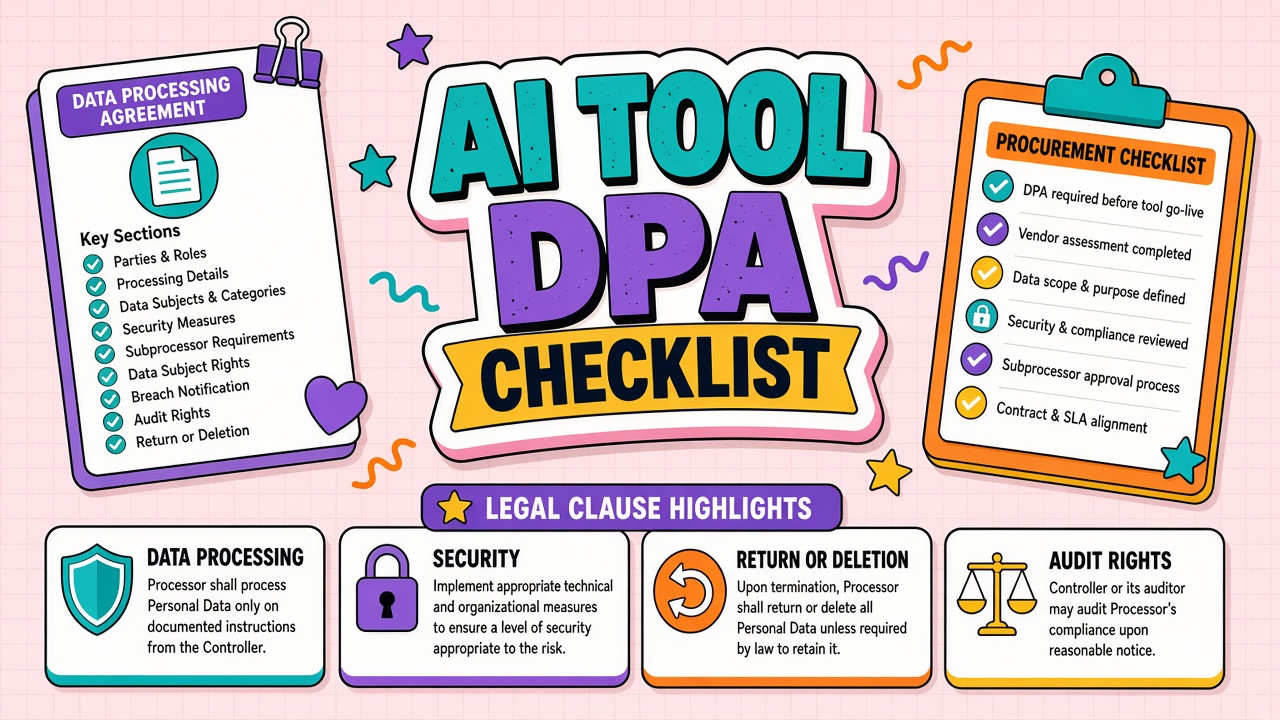
Procurement signs a SaaS data processing agreement and assumes it covers AI workloads. Months later, legal discovers the vendor may use prompts for model improvement, subprocessors include inference hosts in multiple countries, and deletion SLAs do not mention vector embeddings. An AI tool DPA checklist helps teams verify clauses before personal or confidential data flows to language models.
This article is operational guidance, not legal advice. Work with counsel on final language. Use it when evaluating AI API vendors and private AI chatbot platforms that process customer or employee data.
Maintain a clause library of acceptable fallback language negotiated with counsel. Procurement uses the library in redlines instead of reinventing training prohibitions each deal. Update the library when regulators or major vendors shift standard terms.
Track DPA expiry and auto-renew alongside MSAs. A lapsed DPA with active API traffic is a common finding in enterprise audits. Calendar reminders at 90 and 30 days before expiry trigger legal review even when MSA auto-renews silently.
What a DPA Must Cover for AI Workloads
AI processing introduces purposes beyond classic SaaS storage: inference, fine-tuning, evaluation, logging, and safety classification. The DPA should name each processing activity and tie it to Article 28-style processor obligations (or equivalent in your jurisdiction).
- Subject matter and duration: Chat, document Q&A, code completion, image generation, etc.
- Nature of processing: Automated analysis, generation, transformation, indexing for retrieval
- Categories of data subjects: Employees, customers, prospects, minors if applicable
- Categories of personal data: Contact info, message content, files, telemetry, biometric if relevant
- Controller instructions: No processing outside documented instructions except legal compulsion
If the vendor offers both enterprise "no training" and consumer tiers, confirm the DPA matches the SKU you purchased, not marketing pages for a different product line.
Subprocessor Transparency and Change Notification
AI stacks rely on cloud inference, embedding APIs, moderation services, and analytics. The DPA must include an up-to-date subprocessor list and advance notice of changes (typically 30 days) with objection rights.
- Request the public subprocessor page and the contractually binding annex
- Verify model hosting providers, CDN, logging, support ticketing, and email delivery subprocessors
- Define how you receive change notifications (email, portal, webhook)
- Document your internal review SLA when a new subprocessor appears
- Confirm flow-down terms require subprocessors to meet the same security standard
| Clause | Plain-language test |
|---|---|
| Subprocessor list | Can we name every party that touches payload content? |
| Change notice | Do we get 30+ days to object before new hosts go live? |
| Flow-down | Are subprocessors contractually bound to the same DPA terms? |
Training, Retention, and Deletion Commitments
The highest-risk AI-specific gap is training use. Verify in the DPA and order form:
- Opt-out or default prohibition on using customer content to train foundation models
- Retention period for prompts, outputs, and fine-tuning datasets
- Deletion timelines after contract end or upon data subject request
- Whether embeddings, caches, and backups are in scope for deletion
- Proof of deletion (certificate or API confirmation) if required
Enterprise private chatbot offerings often advertise zero retention; confirm if abuse monitoring or billing logs still store excerpts. Short retention with broad exceptions is not the same as zero retention.
Cross-Border Transfer Mechanisms
Model inference may run in regions different from your headquarters. The DPA should specify transfer tools: Standard Contractual Clauses, UK IDTA, binding corporate rules, or adequacy decisions. Map where prompts are processed, not only where the vendor is incorporated.
Ask about failover routing: if US-East is down, does traffic shift to EU or APAC without notice? Document approved regions in your vendor risk file and revisit when the vendor adds new inference locations.
Breach notification
AI incidents may involve prompt logging exposure or misconfigured training pipelines. DPA breach clauses should match your incident playbook: notification window (often 24–72 hours), required detail, cooperation on regulator notices, and contact paths outside business hours.
Procurement Checklist Summary
- DPA signed before production customer data
- Subprocessor list reviewed and monitored
- Training and retention match steering committee policy
- Transfers documented for each data region you serve
- Breach and deletion clauses tested in tabletop exercise
- Technical settings (zero retention, no training) match contract
Negotiating AI-Specific Addenda
When vendor standard DPAs lack AI language, attach an order form addendum covering training prohibition, prompt retention, human review of abuse monitoring, and subprocessors for model inference. Procurement should not treat addenda as blockers if the alternative is shadow use without any contract.
Compare enterprise tiers for API vendors and private chatbot hosting models: zero-retention flags, VPC options, and audit logs often appear only at tiers legal would require anyway.
Align DPA scope with actual integrations. If engineering plans RAG on customer uploads next quarter, the DPA signed today should cover file storage and embeddings, not only chat completion tokens. Gap analysis between roadmap and contract prevents retroactive scrambling when legal blocks launch.
Processor Instructions and Audit Rights
Beyond subprocessors, verify the DPA states you may issue documented instructions on processing purposes and that the vendor will not materially change processing without notice. Audit rights (or acceptance of SOC reports) should cover inference infrastructure, not only corporate IT systems unrelated to your data.
Ask whether the vendor supports customer-configurable retention and training flags in writing, not only in admin UI. UI toggles without contractual backing vanish during acquisitions.
Liability and indemnity
Legal teams compare limitation of liability caps to contract value and data exposure. AI-specific indemnity for training misuse or cross-tenant leakage is increasingly negotiated on enterprise deals. Procurement should not sign unlimited liability waivers in click-through terms for regulated data.
Employee copilot DPAs
Internal productivity AI still processes employee personal data (names in documents, performance text). Execute DPAs even without customer data. Harmonize employee privacy notice with DPA commitments.
Verifying zero-retention claims
For private chatbot SKUs, request architecture letter explaining what "zero retention" excludes (billing metadata, abuse signals, support tickets). Test with a unique canary string and search vendor logs under supervised test conditions if contract allows.
DPA Version Control and Storage
Store executed DPAs with version numbers, signatories, and effective dates in the vendor record. Order form amendments stack; ambiguity about which training clause applies destroys audit defensibility. Legal owns the repository; procurement owns trigger to update when SKUs change.
When vendors publish updated standard DPAs, diff against executed version rather than re-signing blindly. Some updates narrow customer rights; legal must approve adoption before click-through acceptance in admin consoles.
Subprocessor Objection Playbook
Maintain a playbook for exercising objection rights: who decides, customer notification templates, migration timelines, and walk-away criteria. Objection windows expire quickly; unprepared teams accept unwanted subprocessors by default.
Playbook links to internal subprocessor register and customer DPA annexes so decision makers see downstream impact before accepting vendor additions.
Frequently Asked Questions
What if the vendor is an SMB without a custom DPA?
Many offer standard DPAs on request. If they only provide click-through terms, escalate to legal before processing personal data. Consider enterprise tier or a different vendor for regulated workloads.
Are click-through terms enough?
Rarely for GDPR-scale processing. Click-through may lack AI-specific training prohibitions, subprocessor objection rights, or audit clauses your program requires.
Should we demand audit rights?
SOC 2 Type II and ISO 27001 reports often satisfy practical needs. On-site audit rights matter for critical vendors; negotiate frequency and scope to avoid unreasonable cost.
Does employee copilot use need a DPA?
If the vendor processes personal data about identifiable employees on your instructions, treat them as a processor and execute a DPA even for internal tools categorized under AI API workloads.
DPA vs master services agreement: which wins?
Define order of precedence in writing. Security and privacy teams prefer DPA and security addendum over generic limitation of liability in the MSA for data breaches.
Technical Verification After DPA Signing
Legal signature is not the last step. Engineering verifies admin console settings match contract: training opt-out enabled, retention minimized, region pinned, logging scope documented. Mismatch between DPA and default tenant config is a common audit finding.
Run a synthetic customer record through the pipeline after configuration and confirm deletion request flow end to end. Deletion clauses untested on go-live day fail when the first data subject request arrives.
Store verification screenshots and API responses in the vendor record beside the executed DPA for API integrations subject to annual reassessment.
Processor Audits and Questionnaires
Security questionnaires sent to vendors should reference DPA clause numbers requiring affirmative answers on training, retention, and subprocessors. Generic questionnaires allow vendors to answer yes on enterprise security while omitting AI-specific gaps.
Track vendor questionnaire responses alongside executed DPAs. Contradictions between questionnaire and DPA trigger legal review before renewals.
Attach completed checklist PDFs to vendor records in procurement systems. Renewals should require checklist refresh, not rubber stamp, when subprocessors, regions, or SKUs changed since last signing.
Require vendor confirmation in writing when admin toggles for zero retention or no training differ from marketing pages. Written confirmation attaches to executed DPA as implementation exhibit.
Steering should see DPA checklist completion status in intake packets before production votes. Missing checklist should block approval same as missing security review.
Legal should receive procurement redlines before vendor countersign when AI-specific clauses are non-standard. Late legal review after vendor signature limits negotiation leverage.
Check the AI-Specific Clauses Before Go-Live
A thorough AI tool DPA checklist covers processing purposes, subprocessors, training prohibitions, retention and deletion, transfers, and breach notice. Generic SaaS DPAs miss inference and embedding storage. Procurement teams evaluating private chatbots and AI API vendors should attach this review to every security questionnaire response and refuse go-live until gaps are closed or risk-accepted in writing.