Social media periodically announces that artificial intelligence has "solved" Linear A or translated a lost tongue overnight. Epigraphers read those headlines with caution. AI does accelerate cognate alignment, damaged manuscript reconstruction, and corpus-scale search across digitized inscriptions. It has not replaced the scholarly workflow that turned Michael Ventris's 1952 Linear B breakthrough into accepted knowledge. This guide covers decipherment tasks AI can assist, why training data scarcity limits claims, why scholars must stay in the loop, famous case studies from Ugaritic to 2026 Linear A debates, and misuse risks for teams exploring AI research tools and AI writing assistants in humanities pipelines. Hype moves fast; consensus moves at the speed of peer review, held-out tablets, and scholars willing to publish null results when beautiful hypotheses fail. Until then, share skepticism with the same reach as hype.
Decipherment Tasks AI Can Assist
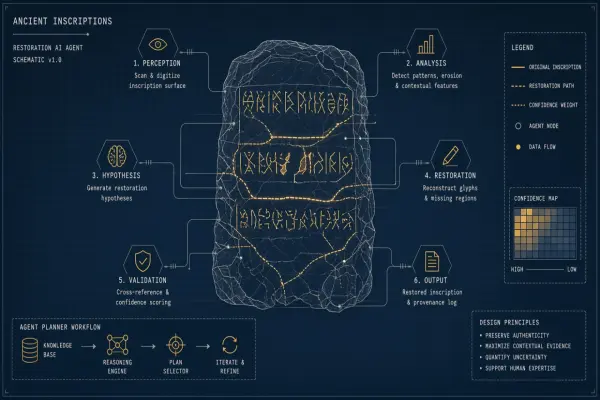
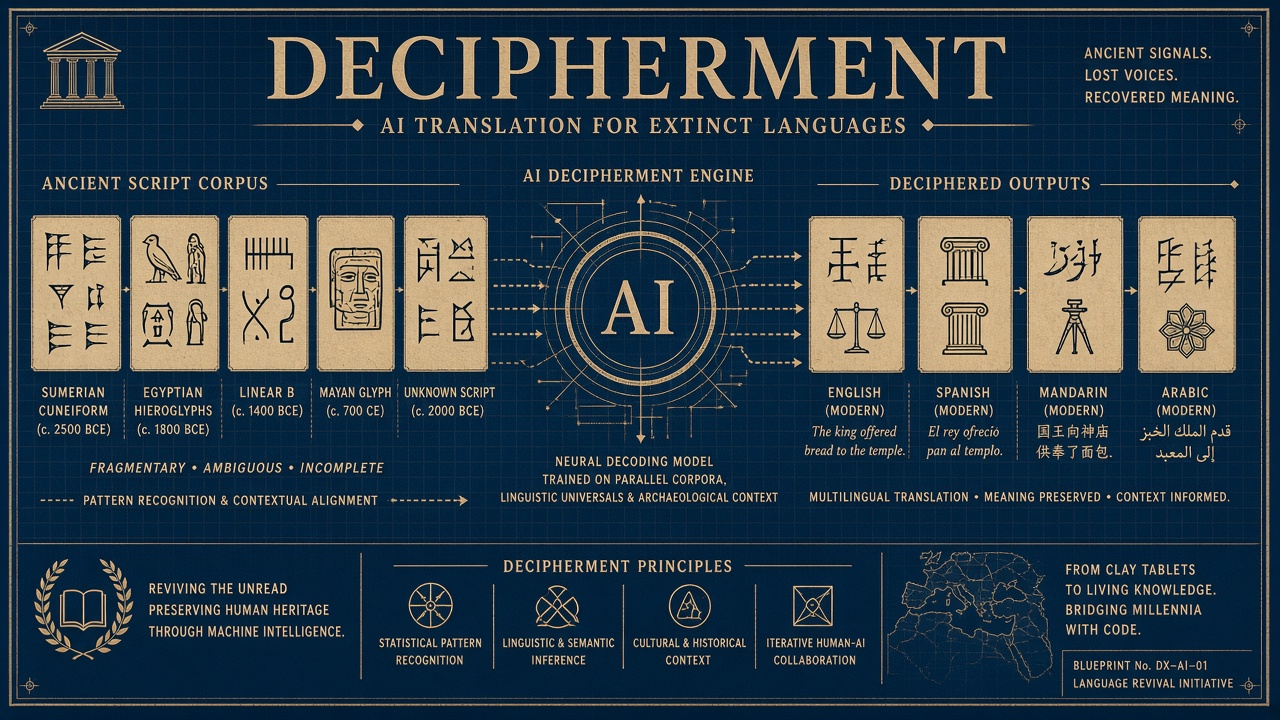
AI helps extinct language work primarily on cognate alignment between related scripts, sign-frequency analysis, contextual prediction in damaged texts, and large-scale search across inscription databases, not on declaring final translations without verification. Decipherment scenarios fall into categories epigraphers label by how much of the language family is known. When a lost script maps to a documented relative (Ugaritic to Biblical Hebrew, Linear B to Greek), machine learning can propose character correspondences. When no accepted relative exists (Linear A, Cypro-Minoan), automation proposes hypotheses that humans must falsify.
Neural decipherment models such as the 2019 minimum-cost flow approach reported 5.5% absolute improvement on Ugaritic cognate identification and 67.3% accuracy translating Linear B cognates into Greek equivalents in benchmark settings. A 2025 Frontiers paper describes combinatorial optimization with coupled simulated annealing for Bronze Age scripts, testing sign assignments under phonotactic and historical linguistics constraints. These are assistive scores on curated datasets, not certificates that Linear A is readable in full.
| Task | AI role | Scholar role |
|---|---|---|
| Cognate mapping | Propose sign-to-sound alignments | Validate against known vocabulary |
| Corpus search | Query GORILA, SigLA, TEI archives at scale | Interpret archaeological context |
| Restoration | Fill lacunae in damaged manuscripts | Reject implausible completions |
| Language ID | Score hypothetical affix patterns | Adjudicate competing families |
Training Data Scarcity
Extinct languages offer tiny corpora compared with modern NLP training sets, so models overfit pattern matches that look coherent locally but fail held-out inscription tests. Linear A preserves roughly 7,500 known characters across fragmentary tablets. Linear B before Ventris was larger yet still minuscule by LLM standards. Ugaritic and Phoenician datasets help when Semitic cognates exist, but each new script adds palaeographic variation machines must not treat as noise. General LLMs trained on Wikipedia prose know about Linear A headlines but lack grounded sign-level supervision unless fine-tuned on epigraphic exports.
Scarcity pushes workflows toward constrained optimization and explicit linguistic priors rather than end-to-end "translate this tablet" prompting. It also explains why viral decipherment claims often rely on circular reasoning: assign sign values that make one formulaic prayer line resemble Hebrew, then treat resemblance as proof. Open frameworks like logos (2026) exist precisely to apply held-out testing and multiple-comparison corrections that informal AI-assisted claims skip. When training data is sparse, the burden of proof rises; marketing language rarely reflects that asymmetry.
Scholar-in-the-Loop Requirement
Credible AI-assisted decipherment keeps epigraphers, historical linguists, and archaeologists as final arbiters who publish methods, sign lists, and falsifiable predictions before consensus shifts. Ventris's Linear B success required public grids mapping signs to Greek syllables, predictive checks on new tablets, and peer scrutiny across years. AI can compress search steps Ventris performed manually, but consensus still demands reproducible sign assignments independent of the original researcher’s tooling.
A scholar-in-the-loop workflow looks like this: digitize inscriptions with TEI-EPIGraphy markup; run alignment models to propose sign values; test predictions on held-out tablets excluded from tuning; require morphological analyses consistent with typological claims (agglutination, prefixing, root patterns); publish negative results when hypotheses fail. Labs adopting AI research agents for humanities should treat inscription corpora like clinical trials: preregister which tablets are training versus test, log every model version, and invite external replication before press releases.
Famous Case Studies
Ugaritic and Linear B represent successful AI-assisted cognate workflows; Linear A in 2026 illustrates hype outpacing peer review when AI engineers publish outside scholarly gates. Ugaritic cuneiform relates closely to Northwest Semitic languages. Neural alignment models improve cognate spotting versus earlier statistical baselines because character-level sequence models capture regular sound correspondences. Linear B's syllabic structure challenged earlier systems; minimum-cost flow training jointly optimized alignments under global constraints, reporting majority cognate recovery in decipherment simulation.
Linear A remains undeciphered in the scholarly consensus sense. In June 2026, AI engineer Tom Di Mino publicized a Semitic-language hypothesis, proposing sign values including a reading for sign *301 as "na," built with Python scripts querying GORILA and SigLA via agentic coding tools. Rutgers and Cambridge linguists began examining the claim; it had not completed peer review at time of public discussion. Independent auditors using the logos framework argued the public evidence fails held-out morphological tests and risks cherry-picked fits. The episode mirrors Cyrus Gordon's 1957 Semitic hypothesis for Linear A, which most specialists rejected for insufficient systematic fit. AI scale did not automatically fix the evidentiary bar.
Damaged manuscript restoration uses different AI tools: vision models inpaint lacunae in papyri or palimpsests under palaeographer supervision. Success means plausible text candidates for human selection, not autonomous publication of restored passages as definitive. AI writing models may fluently paraphrase Ugaritic glossary entries yet invent citations if not grounded in epigraphic databases.
Misuse Risks
Misuse includes announcing decipherments on social media without replication, contaminating public Wikidata entries with unverified translations, and letting tourists apps speak authoritative audio guides from LLM guesses. Cultural heritage stakes are high. Minoan Linear A belongs to Cretan archaeological context; incorrect Semitic readings imposed without consensus can skew historical narrative and tourism interpretation. Nation-state and religious groups may weaponize plausible-sounding translations for identity claims unsupported by epigraphy.
Technical misuse also matters. Overfitting sign values to a handful of prayer formulas produces lexicons that fail on administrative tablets. LLMs asked to "translate Linear A" confabulate confident prose without sign-level accountability. Repositories should flag machine-generated transcripts as provisional, block merge into canonical sign lists without reviewer approval, and require DOI-linked methodology papers before citing AI decipherments in education materials. Journalists should distinguish "hypothesis generated with AI assistance" from "language deciphered."
Building a Scholarly AI Pipeline
A scholarly pipeline starts with TEI-compliant digitization, version-controlled corpora, explicit train or test splits, and publication of sign proposals before media outreach. Epigraphy departments should partner with computer science groups on pre-registered evaluation plans, not post-hoc press releases. Agentic coding tools that query GORILA or SigLA accelerate hypothesis iteration but do not replace the logos-style graduation gates that measure false discovery rates under cherry-picked null models. When a pipeline reports zero surviving hypotheses after correction, that null result is scientifically valuable.
Graduate programs increasingly teach Python alignment scripts alongside palaeography because the skill boundary blurred. Hiring committees should distinguish candidates who can operate tools from those who understand why a proposed affix pattern contradicts Davis 2013 descriptions of Linear A morphology. AI fluency without philology produces confident errors at scale. Philology without automation misses corpus patterns humans cannot search manually.
Open Corpora and Community Governance
Open inscription databases accelerate AI assistance only when community governance controls merges to canonical sign lists. Wikidata imports of provisional translations can propagate errors globally within hours. Maintainers should require DOI-linked methodology, reviewer identity, and status flags (hypothesis, disputed, accepted) before elevating machine-assisted readings to authoritative nodes. Citizen science contributions help digitize corpora; sign value commits remain specialist decisions. Transparent governance prevents a single viral blog post from rewriting public knowledge graphs overnight. Undergraduate courses should teach students to read status flags on corpus entries before citing translations in papers, the same way they check peer-review status for journal articles.
Frequently Asked Questions
Has AI deciphered Linear A?
No peer-reviewed consensus decipherment exists as of 2026. AI-assisted hypotheses circulate, notably Di Mino's Semitic proposal, but independent testing frameworks report failures on held-out morphological checks. Treat viral claims as preliminary until sign lists survive external replication by specialists outside the original author's toolchain.
Where does AI help most today?
Cognate alignment for related languages (Ugaritic-Hebrew, Linear B-Greek), large-scale inscription search, and constrained restoration drafts on damaged texts. These tasks augment specialists; they do not remove them.
Can ChatGPT translate Ugaritic?
General chat models may summarize textbook glosses or hallucinate lines. Reliable work uses curated corpora, explicit sign mappings, and scholar verification. Do not cite chat output as epigraphic evidence in publications.
What counts as a valid decipherment?
Public sign inventory, predictive success on unseen texts, morphological coherence, archaeological fit, and peer review. A readable paragraph in one formulaic context is insufficient if administrative texts remain nonsense under the same values.
How do hold-out tests work?
Researchers exclude a subset of tablets from model tuning, apply proposed sign values, and measure whether predictions match independent linguistic analysis. Frameworks like logos automate such gates to reduce cherry-picking.
Are neural models better than classical methods?
They improve some cognate alignment benchmarks but do not eliminate linguistic reasoning. Hybrid pipelines combine optimization, neural alignment, and expert palaeography. Progress is incremental, not a single model swap.
Publishers and museums licensing translation APIs should contractually prohibit presenting model outputs as verified readings on exhibit labels. Contract language can require human epigrapher sign-off and link to methodology DOIs. Without contractual teeth, hype cycles repeat: a model vendor cites engagement metrics while scholars publish null results that never reach the same audience. Responsible AI in extinct languages means slowing public claims until held-out tests pass, even when social media rewards speed.
How should museums label AI-assisted translations?
Will LLMs end epigraphy jobs?
Automation shifts effort from manual collation to verification, training data curation, and public communication of uncertainty. Demand for scholars who combine philology with reproducible AI evaluation may rise even as rote transcription time falls. Departments should hire for critique skills, not only character reading speed. Undergraduates using chat summaries for homework still need supervised access to primary inscription files and sign lists vetted by faculty.
The 2026 Linear A debate illustrates the gap between viral decipherment claims and scholarly workflow. AI engineers can propose values at scale; epigraphers decide whether those values survive held-out tablets and typological review. AI research progress in extinct languages is real but incremental, best measured in replicated benchmarks rather than headline verbs like "solved." Share preprints of sign lists before sharing press releases, and invite external falsification early enough to catch beautiful but wrong fits. The discipline is slower than viral science Twitter, but it is the workflow that kept Ventris credible after 1952.