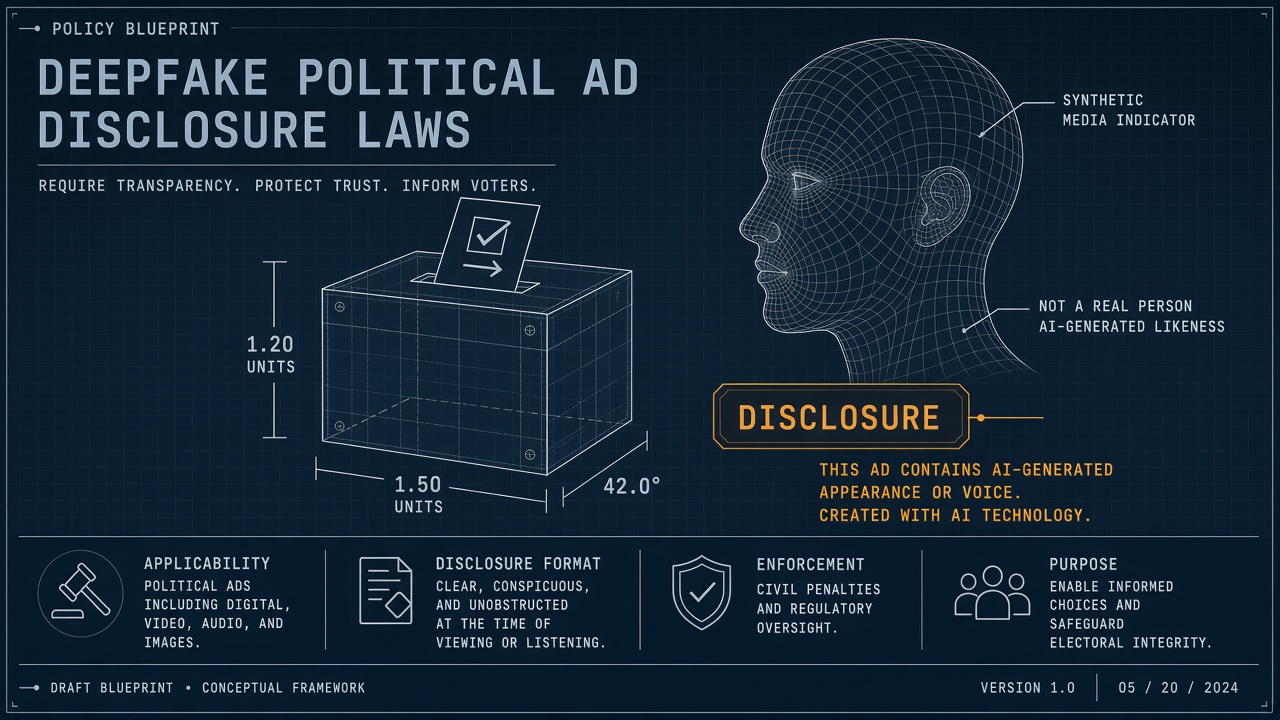
Synthetic video and audio in campaign ads moved from novelty to compliance risk in 2026. State legislatures passed disclosure mandates, targeted prohibitions, and candidate likeness protections at a pace federal lawmakers could not match. Meanwhile, platforms layered their own political ad labeling rules on top of uneven state statutes. Campaigns, PACs, and creative agencies need a map of what must be labeled, what may be banned outright, and where enforcement still depends on voluntary platform policy.
Deepfake political ad laws in 2026 span federal proposals, state statutes, and platform terms. Compare detection and labeling tooling via AI misinformation resources and review how AI image generator workflows embed metadata for compliance teams.
Federal Proposal Status in 2026
No federal law requiring AI-specific disclaimers in political advertisements was in force as of September 2026. Existing Federal Election Campaign Act disclaimer rules identify who paid for an ad, not whether generative AI created imagery or audio. The Supreme Court's June 2026 decision on party coordinated expenditure limits left FEC guidance in flux pending quorum restoration, but that ruling did not add synthetic media labels.
Active federal proposals include:
- H.R. 9922 (AI Transparency in Elections Act of 2026): Introduced July 23, 2026 by Rep. Morelle and referred to the House Administration Committee. Would amend FECA to require a prominent in-ad statement when generative AI produced any image, audio, or video footage.
- Prior 118th Congress bills (H.R. 3044 / S. 1596): Companion measures that would have added AI-generated image and video disclaimers to FECA. They informed later drafting but did not become law.
Constitutional scrutiny remains a live issue. Courts applying exacting scrutiny to disclosure laws may require narrow tailoring. Campaign lawyers should monitor committee action on H.R. 9922 but plan compliance around state law and platform rules today, not hypothetical federal text.
State Law Roundup for Election Deepfakes
More than 30 states had enacted some form of AI election media regulation by mid-2026, falling into disclosure, prohibition, and likeness protection categories. Requirements vary by medium, timing relative to an election, and whether private parties may sue.
| Category | What it requires | Example states |
|---|---|---|
| Disclosure mandates | Clear audio or visual label that content is AI-generated; some require metadata tags | New Mexico, Mississippi, Colorado, Washington |
| Targeted prohibitions | Ban deceptive synthetic media impersonating candidates near elections | Minnesota, Maryland, Texas |
| Likeness rights | Private right of action when AI depicts a person without consent | Montana, Virginia |
| State-only enforcement | No private lawsuit; attorney general or election authority acts | Maryland (varies by provision) |
| Blocked or pending | Courts enjoined or delayed provisions | California and Hawaii (blocked); Massachusetts (no 2026 law) |
Penalties range from civil fines to criminal charges depending on state text and intent to deceive voters. Campaign counsel should pull the statute for each state where media will run, including down-ballot races that cross media markets.
Platform Labeling Policies
Major social and video platforms require political ad libraries, identity verification, and in some cases synthetic media labels that exceed state minimums. YouTube, Meta properties, and TikTok each maintain political advertising policies with disclosure fields for who paid and, increasingly, whether AI altered creative.
Platform enforcement gaps persist:
- Organic posts: Policies focus on paid political ads; unpaid viral deepfakes may evade ad-library review.
- Cross-border targeting: Ads served from outside a regulated state may still reach voters there.
- Metadata loss: Re-uploads strip C2PA or platform tags, complicating provenance chains.
- Audio-only creative: Visual disclaimer rules do not always map cleanly to podcast or radio cuts distributed online.
Treat platform ad centers as a second compliance layer: upload proof of disclosure, retain export logs, and document which employee certified labels before spend went live.
Campaign Compliance Checklist
Before publishing synthetic or materially altered political creative, campaigns should complete a jurisdiction scan, counsel review, and technical labeling pass. Use this checklist as a starting point, not legal advice.
- Inventory media types: List every state and platform where video, audio, static image, or translated variants will appear.
- Classify AI use: Note whether generative tools created footage, altered existing footage, or only assisted scripting and editing.
- Apply disclaimers: Add readable on-screen and spoken labels per state law; embed metadata tags where Colorado-style rules apply.
- Check prohibitions: Confirm impersonation or deception bans in Minnesota, Maryland, Texas, and similar states before using candidate likeness.
- Retain records: Store prompts, edit timelines, vendor contracts, and approval emails for discovery or ethics complaints.
- Monitor takedowns: Assign counsel to respond if depicted candidates exercise likeness rights or state officials issue cease orders.
- Train vendors: Require creative shops to flag AI steps in work orders so disclaimers are not afterthoughts.
Frequently Asked Questions
Is there a federal deepfake political ad law today?
Not as of September 2026. FEC disclaimers cover sponsorship, not AI generation. H.R. 9922 would add AI transparency language but remained in committee after introduction in July 2026.
Do satire ads need disclaimers?
Depends on state text and platform policy. Some statutes exempt parody clearly not intended to deceive; others focus on viewer perception. Counsel should review before distribution near an election.
What if only the background is AI-generated?
Several state laws trigger on any substantially AI-generated image, audio, or video footage in the ad, not only synthetic candidates. Document every generative step and label when statutes require it.
Which rule wins if platform and state differ?
Comply with the stricter applicable requirement. Platforms may reject ads that meet state minimums but fail internal synthetic media policies, and vice versa in edge cases. Plan for both.