Oral history archives grow faster than small teams can transcribe. A two-hour interview may require eight to twelve hours of manual transcription and coding before it becomes searchable for researchers. An AI oral history transcription workflow accelerates first drafts and thematic tagging while preserving the standards that make interviews citable: accurate quotes, speaker attribution, informed consent, and rich metadata. Historians, journalists, and community archives increasingly pair AI transcription services with AI research assistants for qualitative coding, but the Oral History Association (OHA) principles still govern what may be published and how narrators control their stories.
What Oral History AI Workflows Must Preserve
Oral history AI workflows must preserve narrator voice, consent boundaries, and verifiable transcripts before any thematic analysis reaches publication or public archive. Unlike generic meeting transcription, oral history treats each interview as a curated primary source. Errors in a single word can misrepresent lived experience. AI assists labor; human editors remain accountable for the archival record.
| Stage | AI contribution | Human gate |
|---|---|---|
| Transcription | First-pass speech-to-text | Word-level audit against audio |
| Speaker ID | Diarization suggestions | Confirm interviewer vs narrator labels |
| Thematic coding | Code proposals, quote extraction | Adjudicate definitions, resolve ambiguity |
| Metadata | Draft fields from intake forms | Librarian review before ingest |
| Access control | Flag segments near embargo terms | Enforce consent and redaction |
Transcription Accuracy
Transcription accuracy for oral history requires verbatim or lightly cleaned style decisions made upfront, then enforced through listen-and-correct passes on every AI-generated segment. OHA and regional archival guidelines distinguish verbatim transcripts (every filler, pause notation) from edited readability versions. Pick one primary archival format; derivative public versions should reference the preserved master.
Modern AI transcription engines handle clear one-on-one interviews well but struggle with overlapping speech, heavy accent variation, code-switching, and field recordings with background noise. Upload lossless audio when possible (WAV or FLAC). Split long sessions at natural breaks to stay within model duration limits. Timestamp alignment lets editors jump to disputed words quickly.
Accuracy Checklist
- Verify proper nouns, place names, and non-English terms against intake notes.
- Preserve narrator phrasing; do not grammatically "fix" distinctive speech patterns without policy.
- Mark unclear audio with [inaudible] rather than guessing.
- Compare emotional emphasis; flat text can mislead qualitative readers.
- Log AI model version and date in processing metadata for reproducibility.
Speaker Identification
Speaker identification separates narrator speech from interviewer questions, co-interviewers, and background voices so quotes attribute correctly in publications. Automatic diarization assigns speaker labels (Speaker A, Speaker B) without knowing roles. Human editors map labels to named roles and lock the mapping in the transcript header.
Group interviews and family oral histories introduce crosstalk. Some archives transcribe only the primary narrator's lines in detail and summarize group affirmations. Document that editorial choice in the finding aid. For legal depositions or journalism, stricter verbatim rules may apply; oral history archives often accept principled cleaning when narrators review drafts.
Thematic Coding With LLMs
Thematic coding assigns conceptual labels to transcript segments so researchers can compare experiences across interviews without reading every hour of audio. Traditional qualitative software (NVivo, ATLAS.ti, Taguette) supports human-coded schemes. LLMs can propose initial codes from a codebook, suggest new emergent themes, and extract illustrative quotes with line references.
Best practice follows established qualitative methods: define codes before bulk automation, use inter-rater checks on a sample, and never treat model-assigned themes as ground truth without adjudication. Prompts should include the project research question, exclusion criteria, and examples of correctly coded paragraphs. Ask the model to cite start and end timestamps or line numbers so humans verify quickly.
Academic AI research on LLM-assisted qualitative coding reports time savings with mixed reliability on nuanced emotional themes. Sensitive topics (trauma, legal risk) warrant 100% human coding or dual review on every tagged segment.
Codebook Template Elements
- Code name and definition (one paragraph, unambiguous)
- Inclusion and exclusion examples from pilot interviews
- Relationship to parent themes or theoretical framework
- Embargo or sensitivity flag if code reveals restricted content
Archival Metadata
Archival metadata makes interviews discoverable decades later: biographical fields, interview context, rights statement, language, series placement, and digital preservation checksums. AI can draft Dublin Core or MODS fields from intake questionnaires but cannot invent facts. Catalogers validate spelling of personal names and controlled vocabulary terms (Library of Congress subjects, local place authority files).
Link audio, transcript, abstract, photo releases, and consent PDFs in a single package with shared identifier. Note processing provenance: which transcription model, which editor, review date. Future researchers need to assess reliability if technology improves and re-transcription is considered.
Consent and Embargo
Consent and embargo workflows define what narrators permit now, later, or never: full open access, sealed until death, redacted segments, or restricted access for named groups. OHA's core principles stress shared authority between narrator and institution. AI must not train on sealed materials without explicit permission. Cloud transcription APIs require vendor review for data retention and subprocessors.
Build embargo tags into metadata at ingest. Automated thematic coding should skip or mask segments tagged restricted before any model sees them in a shared project folder. When narrators request review copies, deliver transcripts for correction before coding finalizes. Their edits override AI suggestions.
Consent Form Elements for AI Processing
- Permission to use automated transcription and coding tools
- Whether third-party cloud processors are allowed
- Right to review transcript before archive publication
- Embargo end dates and trigger events (e.g., upon narrator death)
- Withdrawal procedure and how derivatives will be handled
End-to-End Workflow
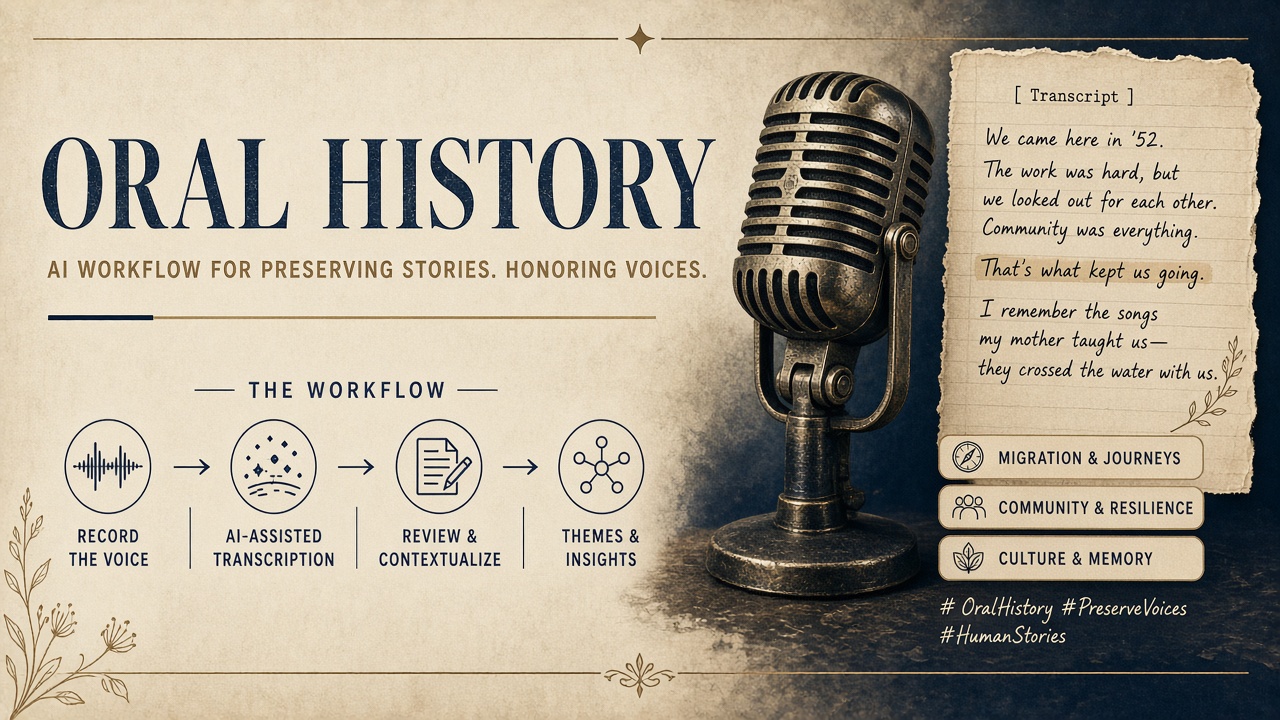
A complete oral history AI workflow runs from recorded interview to finding aid in six steps with explicit human approval between each.
- Intake: Signed consent, biographical form, recording to secure storage.
- AI transcription: Generate draft with speaker diarization.
- Human edit: Listen-through correction; narrator review if promised.
- Coding: Apply codebook with AI assist; adjudicate sample for reliability.
- Metadata: Cataloger validates fields; link all files.
- Access publish: Release per consent tier; update embargo scheduler.
Journalism vs Archive Standards
Journalists and podcast producers share transcription pain with archivists but optimize for faster publish cycles and different legal risk. Newsrooms may accept lightly cleaned transcripts for internal fact-checking while quotes in articles undergo manual verification against audio. Embargo rules follow source agreements, not decades-long archival tiers. Still document AI use for editorial standards committees and defamation review.
Community oral history projects led by neighborhoods or indigenous nations may require data sovereignty provisions: servers in-country, community-controlled access portals, and prohibition on commercial model training. Vendor contracts for AI transcription must allow deletion on request and specify zero retention for model improvement where required.
Quality Metrics and Audit Trails
Quality metrics track word error rate on sampled minutes, inter-rater agreement on codes, and time from interview to public finding aid. Set targets per project phase: pilot collections may tolerate higher WER with prominent disclaimers; flagship archives should approach professional human transcription accuracy after edit. Audit trails list every automated step, editor initials, and narrator sign-off date.
Multilingual and Translation Workflows
Multilingual interviews need language-tagged models and translators who review AI output in each language before cross-language thematic coding. Do not translate via AI alone before coding themes; nuance loss clusters false themes. Parallel transcripts (original plus translation) with linked timestamps preserve scholarly value.
Frequently Asked Questions
Is AI transcription acceptable for archives?
Many archives accept AI-assisted transcripts when human editors certify accuracy and processing is documented. Policies vary by institution. Check donor agreements and national library guidance before batch processing legacy collections.
How do Oral History Association standards apply to AI?
OHA emphasizes informed consent, narrator agency, and contextual interpretation. AI does not change those obligations. It adds transparency requirements about automated processing and vendor data handling.
Can LLMs replace human qualitative coders?
Not for final analysis in rigorous projects. LLMs accelerate first-pass coding and literature-style summaries. Human researchers validate themes, especially where power, trauma, or legal sensitivity appear.
What transcription tools work for long interviews?
Services listed under AI transcription vary by language support, diarization quality, and HIPAA or EU data residency options. Test on a pilot clip from your microphone setup before committing a full collection.
How long should narrator review take?
Allow two to four weeks standard, longer for elderly narrators or translated materials. Automate reminders but never publish before agreed review period ends unless consent waives it.
Should collections be re-transcribed when models improve?
Consider re-processing only with narrator or estate permission and archivist approval. Keep original transcripts as historical artifacts; version new derivatives clearly in metadata.
Projects that document AI steps in finding aids strengthen trust with researchers citing AI research methods papers and community stakeholders auditing how their stories are stored and discovered.
Accessibility and Public Programming
Transcripts power closed captions for exhibit videos and searchable portals for visitors who cannot visit reading rooms. AI-generated summaries for public programming must be reviewed for dignity and accuracy; avoid flattening complex lives into pull quotes. Offer narrators opt-out from specific public uses even when archive access is open.
Digital Preservation
Digital preservation pairs lossless audio masters with checksum-verified storage and format migration plans as codecs evolve. Transcripts are derivatives; if formats change, re-export from authoritative text sources rather than OCR-ing PDFs. Note which AI model produced each transcript generation so future archivists can assess whether re-transcription with improved models is warranted and ethically permissible under original consent.
Deaccession and Right to Be Forgotten
When narrators withdraw consent, archives must remove or restrict access across derivatives including coded datasets used for research. Document whether AI models trained on since-removed interviews require retraining exclusion lists. Legal counsel and ethics boards guide edge cases involving deceased narrators and family requests.
Grant and Funder Reporting
Funders increasingly ask how AI reduced cost per interview processed while maintaining quality. Report hours saved on transcription versus hours added for verification and narrator review. Honest accounting prevents unrealistic expectations in renewal proposals. Include diversity of narrators processed and any disparities in model accuracy across accents or languages, with mitigation plans for underperforming segments.
Teaching Oral History Students
University programs teaching oral history methods should train students on AI limitations alongside microphone technique and ethical interviewing. Assign exercises comparing raw AI transcripts to corrected versions so students learn error patterns. Emphasize that thematic coding with LLMs is hypothesis generation, not replacement for reading interviews deeply at least once in full.
Professional associations publish evolving guidance on technology in archives. Subscribe to Oral History Association updates and regional archival council bulletins before scaling AI across legacy collections that predate digital consent language.
Small community archives with volunteer staff benefit most from phased rollout: one pilot interview, full human review, then gradual batch processing once workflows stabilize and narrator consent forms cover automated tools. Patience at the pilot stage prevents costly reprocessing of an entire collection under the wrong settings.