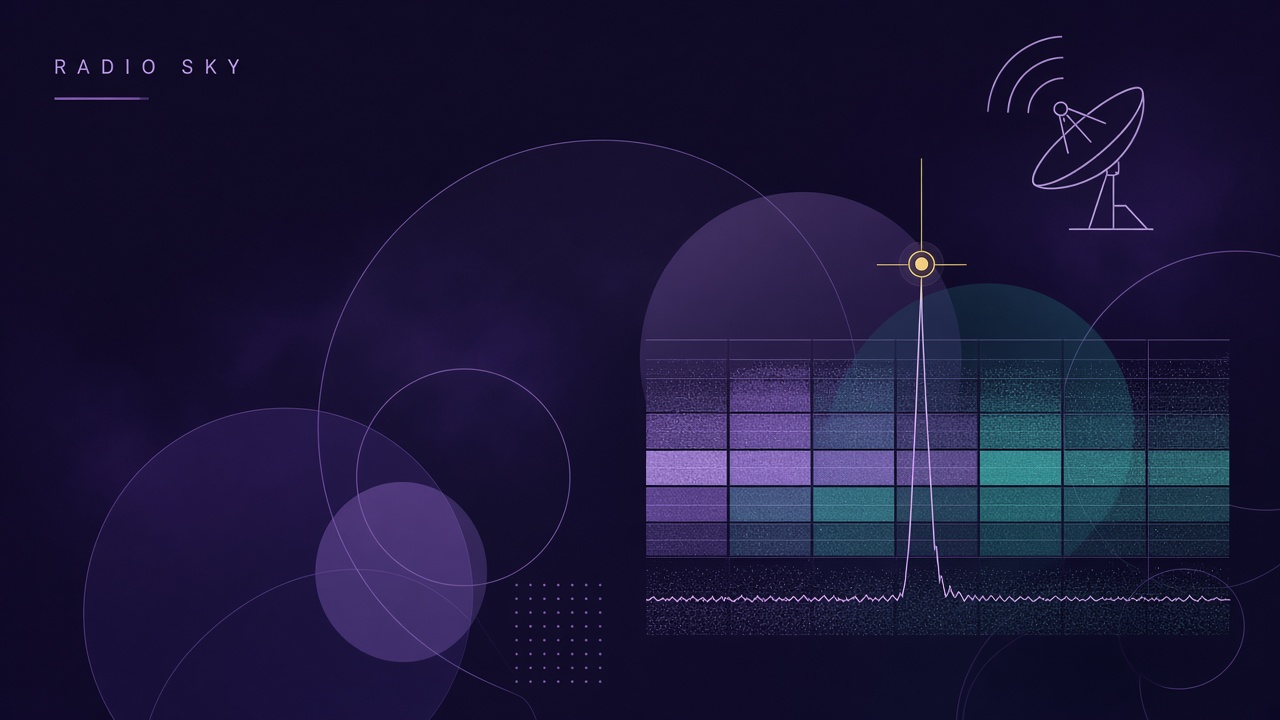
The radio sky is noisy. Cell towers, satellites, aircraft, and observatory electronics inject signals that mimic the narrowband carriers SETI researchers hope to find. Breakthrough Listen and successor surveys generate on the order of 10^11 spectrogram tiles from facilities such as the Green Bank Telescope and Parkes. Manual review is impossible at that scale. Machine learning pipelines including GLOBULAR clustering with HDBSCAN have reported roughly 93.1 percent hit reduction while preserving 99.3 percent of known event classes in validation studies, dramatically shrinking analyst workload. The classic turboSETI pipeline still underpins many searches, now augmented by anomaly detection and deep feature embeddings. The 1977 Wow! signal remains a cautionary tale: a compelling candidate without repetition rarely satisfies the burden of proof for technosignatures. Healthy skepticism is part of the science. Readers interested in AI research for anomaly detection or exploring popular AI tools for scientific data filtering should understand how feature engineering and false-positive control shape SETI results.
The Burden of Proof for Technosignatures
A credible technosignature must be narrowband, persistent or repeatable, exclude known human transmitters, and ideally appear across independent instruments or frequencies in ways RFI cannot easily fake. SETI does not claim detection from a single bright pixel in one spectrogram. Teams demand follow-up observations, ephemeris checks against satellite catalogs, and sometimes multisite coincidence within minutes. The Wow! signal at 1420 MHz matched expectations for a hydrogen-line beacon but never repeated despite decades of targeted reobservation, leaving it an unresolved anecdote rather than a confirmed detection.
AI SETI signal detection accelerates candidate triage but does not lower evidentiary standards. Models trained on labeled RFI teach the boundary between terrestrial leakage and astrophysical narrowband drift, yet adversarial RFI (new satellite constellations, 5G deployments) forces continuous retraining. Public release of filtered candidate lists invites independent verification, a strength of open science and a guard against overfitting to observatory-specific artifacts.
Breakthrough Listen Data Scale
Breakthrough Listen targets millions of nearby stars and galaxies with wide bandwidth recording, producing petabyte-scale archives sliced into billions of frequency-time pixels for algorithmic search. Each observation session yields raw voltage data transformed to power spectra at resolutions fine enough to resolve narrowband emitters drifting due to Doppler motion from Earth rotation and source kinematics. Storage and compute costs dominate project planning; ML filtering is as much an engineering necessity as a scientific choice. Pipelines run on clusters, emitting ranked candidate lists with metadata (sky position, frequency, drift rate, signal-to-noise).
| Pipeline stage | Purpose | ML role |
|---|---|---|
| FFT and spectrogram | Convert raw data to power vs frequency-time | Minimal; defines input tiles |
| turboSETI search | Find drifting narrowband peaks | Classic heuristic baseline |
| RFI classification | Label terrestrial interference | GLOBULAR, supervised CNNs |
| Anomaly ranking | Surface rare non-RFI patterns | Autoencoders, clustering |
| Human follow-up | Repoint telescope, verify | Final scientific gate |
Feature Engineering on Spectrograms
Effective models extract peak width, drift rate, persistence across integrations, band occupancy, and correlation with known satellite ephemerides before deep networks see raw tiles. Hand-crafted features remain competitive because RFI classes are diverse but structurally repetitive: constant-frequency carriers, swept radar, periodic pulsing from electronics. GLOBULAR applies graph and density-based clustering (HDBSCAN) on feature vectors to group hits into event tracks, achieving reported hit reductions near 93.1 percent with 99.3 percent event-class retention in published evaluations. That tradeoff matters: aggressive filtering that drops true astrophysical transients (pulsars, FRB-like events) would harm broader radio astronomy partnerships.
Convolutional networks on 2D spectrogram crops learn textures of interference stripes and sidelobe artifacts without explicit drift parametrization, but require large labeled sets from astronomer vetting sessions. Semi-supervised approaches cluster unlabeled hits, sending borderline cases to humans. Active learning prioritizes tiles near decision boundaries, maximizing scientist time efficiency.
turboSETI and Modern Successors
turboSETI implements efficient matched filtering for linear frequency drift, the signature expected from a transmitter on a rotating planet observed from a rotating Earth. It remains a workhorse because the physics-motivated search kernel is interpretable. ML layers wrap turboSETI outputs, scoring each hit rather than replacing the core search. Hybrid pipelines run turboSETI at scale, then neural or gradient-boosted classifiers discard RFI categories seen in training logs from the same telescope housing.
Open-source releases let independent groups reproduce filtering statistics on public Breakthrough Listen subsets, critical for verifying 10^11 spectrogram claims without proprietary data access. Benchmarks report precision-recall on labeled RFI corpora separately from blind injection tests where synthetic signals are hidden in real noise to measure end-to-end sensitivity.
Anomaly Detection and Healthy Skepticism
Unsupervised anomaly detectors surface outliers that lack training labels, useful for novel RFI or genuinely unusual astrophysical events, but prone to false alarms without rigorous follow-up. Autoencoders trained to reconstruct typical spectrograms flag high reconstruction error regions. Isolation forests score rare feature combinations. SETI teams treat anomaly hits as lowest priority unless they pass spatial and temporal coincidence checks. Media headlines about AI finding aliens almost always omit this vetting chain; responsible communication emphasizes null results and upper limits as scientific progress.
The Wow! signal illustrates confirmation bias risk: a single strong detection without repetition cannot distinguish a drifting RFI glitch from extraterrestrial origin. Modern surveys archive raw data for reanalysis when satellite catalogs update. Researchers in AI research collaborate with radio astronomers to co-author metrics that reward false-alarm reduction without hiding interesting transient science.
Radio frequency interference catalogs grow with every new satellite constellation and terrestrial transmitter standard. Breakthrough Listen pipelines ingest ephemeris data to flag signals that drift with known spacecraft Doppler curves. When a new constellation launches, retraining windows open within weeks as astronomers label fresh interference morphologies. AI SETI signal detection without updated RFI libraries would drown in false positives within a single observing season.
Drift rate search remains central because a transmitter on a rotating planet imprints a characteristic slope in frequency versus time when observed from a rotating Earth. turboSETI implements efficient kernels for this physics-motivated parameter space. Neural post-filters score turboSETI hits using spectrogram texture features GLOBULAR clusters into event tracks. Reported 93.1 percent hit reduction with 99.3 percent event retention means analysts review a smaller pile without losing most astrophysical transient classes used for pipeline validation.
Anomaly detection complements supervised RFI classifiers when new interference types lack labels. Autoencoders flag high reconstruction error tiles; isolation forests score rare feature combinations. SETI teams treat these outputs as low priority unless spatial coincidence and repeatability criteria pass. The Wow! signal cautionary tale reminds communicators that single-event hype undermines decades of careful upper-limit science. Public outreach should emphasize how ML enables broader surveys, not that every outlier is extraterrestrial.
Storage economics shape survey design: recording wide bandwidth at fine resolution multiplies bytes faster than compute. Filtering at ingest reduces archival cost while preserving raw voltages for reanalysis when algorithms improve. Open subsets of Breakthrough Listen data let students benchmark classifiers without accessing the full petabyte corpus. Injection challenges hide synthetic narrowband signals in real noise to measure end-to-end sensitivity, a gold standard beyond validation accuracy on RFI-only labels.
Multisite coincidence remains the strongest guard against local RFI masquerading as sky signals. Pipelines cross-match candidates observed within minutes at separated telescopes on the same sky position and drift rate. ML accelerates pre-filtering before expensive follow-up pointings. Until such coincidence occurs for a candidate that survives satellite ephemeris exclusion, the burden of proof for technosignatures stays unmet regardless of classifier confidence scores.
Frequently Asked Questions
Has AI found aliens?
No confirmed technosignature exists as of published peer-reviewed literature. AI reduces RFI contamination in candidate lists; it does not constitute detection without independent verification and repetition.
What was the Wow! signal?
A strong narrowband detection at Ohio State in 1977 near the hydrogen line. It did not repeat on follow-up despite targeted searches, so it remains an unexplained one-off, often cited in RFI versus signal debates.
Why 10^11 spectrograms?
Wide bandwidth, fine frequency resolution, and long integrations multiply tiles. Breakthrough Listen's survey design prioritizes completeness over real-time human review, necessitating automated filtering.
Can cell phones spoof SETI?
Observatories shield equipment and monitor local RFI. Consumer devices near the dish are controlled. Satellite downlinks and terrestrial transmitters dominate interference catalogs, not phones in visitor parking lots.
What is GLOBULAR?
A machine learning framework applying clustering (including HDBSCAN) to engineered features from SETI hits, reported to cut hits by about 93 percent while retaining most event classes in validation studies.
Do ML models miss weak signals?
Aggressive classifiers can suppress marginal candidates. Pipelines tune thresholds to balance analyst load and sensitivity, often running parallel conservative and aggressive modes for different science goals.
AI SETI signal filtering is ultimately a data quality problem at astronomical scale. Feature engineering encodes decades of observatory lore about how RFI manifests in drift-rate space. turboSETI ensures physics-aligned search kernels remain auditable. GLOBULAR-style clustering proves that most hits are redundant interference tracks, not hidden civilizations. The scientific payoff is cleaner upper limits on transmitter prevalence and faster turnaround when a truly weird candidate appears on multiple nights from multiple sites.
Future surveys on next-generation arrays will increase data rate further, making continual learning and satellite-aware RFI masks standard operations. Open benchmarks with injected synthetic technosignatures give ML researchers honest gradients without compromising live search integrity. Until repetition and multisite confirmation arrive, healthy skepticism remains the correct default stance for any single spectrogram sparkle.
Citizen science platforms that labeled Gravity Spy glitches for LIGO demonstrate how human pattern recognition scales when paired with ML, a model SETI replicates through volunteer vetting of candidate screenshots. SETI Zooniverse-era projects trained participants to recognize interference stripes, building labeled corpora faster than professional astronomers alone. Similar loops for radio tiles keep classifiers current as observatory hardware upgrades introduce new artifact families.
Upper limits on transmitter prevalence improve even when no technosignature is found. ML filtering lets surveys cover more stars at identical analyst headcount, tightening bounds on how common broadcasting civilizations might be at given power levels. That null-result science is as valuable as a headline detection would be, provided pipelines document sensitivity after RFI rejection so peers can reproduce limit curves.
Feature stores for SETI pipelines version drift-rate bins, bandwidth estimates, and signal-to-noise summaries alongside telescope metadata so models trained on Green Bank data do not silently fail on Parkes tiles with different sidelobe structure. Cross-telescope generalization is an active benchmark: a classifier that works on one dish housing may mislabel RFI from another until fine-tuned on a few thousand freshly labeled examples from the new site.
Breakthrough Listen public data releases include filtered candidate lists with provenance strings documenting which ML version produced each row. Reproducibility demands frozen preprocessing hashes because small FFT window changes shift peak locations enough to alter hit counts at the 10^11 spectrogram scale. Reviewers should treat pipeline version as seriously as telescope integration time when comparing claimed hit reduction percentages across papers.