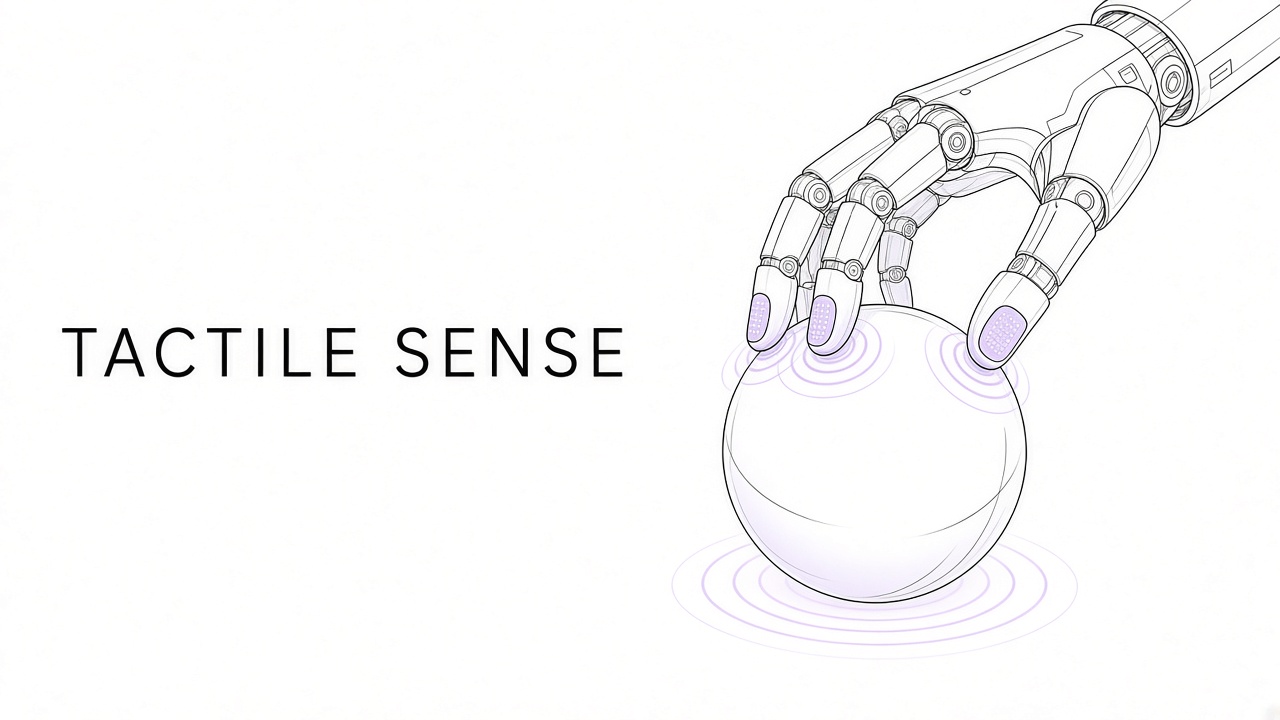
AI tactile sensing robot hands embed pressure, shear, and deformation sensors across fingers and palms so learning policies detect slip, regulate grasp force, and reorient objects in-hand, tasks where vision-only manipulation fails once contact hides the scene. Recent systems include the F-TAC Hand with 0.1 mm spatial resolution over 70 percent of the surface (Nature Machine Intelligence, 2025), T-Rex tactile-reactive VLAs trained on 100 hours of touch-rich data (2026), and TouchWorld hierarchical policies combining tactile world models with fast residual correction. Hardware spans GelSight-style optical elastomers, magnetic taxels, and fingertip force-torque arrays on Shadow, Allegro, and LEAP hand platforms. Researchers following AI research on embodied learning or AI research infrastructure for manipulation datasets should budget equal effort for touch logging and vision capture.
Limits of Vision-Only Manipulation
Cameras lose line of sight once fingers wrap an object, cannot measure contact force directly, and struggle with transparent or specular materials, leaving vision-only policies blind to slip until the object falls. Standard pick-and-place from overhead RGB-D works for rigid boxes in clutter; in-hand reorientation, deformable bag handling, and precision insertion need sub-millimeter contact cues. VLAs trained on video alone often overfit to approach trajectories and fail when friction or center-of-mass differs from training.
Sim-to-real gaps widen without touch: physics engines approximate contact as stiff springs with simplified friction cones. Real foam, cable insulation, and produce skins behave non-linearly. Closed-loop tactile feedback lets policies reduce grip when crush risk rises or increase torque when incipient slip appears in deformation maps.
T-Rex authors report contemporary VLAs either omit tactile streams or use static encoders that miss high-frequency transients critical for human-like dexterity. Their variable-rate Mixture-of-Transformer architecture with temporal tactile VQ-VAE addresses 300 Hz low-level control threads fed by 30 Hz multimodal observations.
Industrial insertion tasks (connector mating, snap fits) fail when vision estimates hole pose within millimeters but contact forces exceed plastic yield on first touch. Tactile search patterns (spiral, lateral slide) localize holes using force signatures humans perform by feel. Encoding those search policies as learnable residuals atop coarse vision approaches outperforms open-loop vision-only insertion in electronics assembly pilots.
Tactile Sensor Modalities
Commercial and research tactile sensors fall into vision-based elastomers (GelSight, DIGIT), piezoresistive or capacitive arrays, magnetic skin (ReSkin, uSkin), and six-axis force-torque cells at the wrist or fingertip. GelSight-class sensors illuminate a soft gel pad from the side and infer surface geometry from photometric stereo, achieving micron-scale spatial detail at 30 to 60 Hz. F-TAC Hand integrates 17 vision-based tactile units in six configurations where sensor covers double as structural finger shells, preserving Kapandji dexterity scores and 33 human grasp types.
| Modality | Output | Tradeoff |
|---|---|---|
| Vision-based elastomer | Deformation depth map, texture | Bulky fingertip, gel wear |
| Piezo / capacitive array | Pressure grid, lower res | Compact, drift calibration |
| Magnetic skin | 3D contact force field | Flexible, magnetic interference |
| F/T sensor | Net wrench at joint | No spatial slip map |
Multi-modal fusion stacks wrist F/T for macro force with fingertip skins for local slip. Durability remains a deployment bottleneck: gel punctures, adhesive delamination, and dust ingress on factory floors drive maintenance schedules vendors rarely headline in lab papers.
Taxel resolution trades off against coverage area: fingertip-only sensing misses palm contacts during power grasps on large objects, while full-hand skins increase wiring complexity. F-TAC's 70 percent surface coverage targets power-grasp stability where partial contact on the palm and fingers must be coordinated, not isolated fingertip taps alone.
Learning from Touch Datasets
Touch data scarcity limits generalization: collecting aligned vision, proprioception, wrench, and high-rate tactile streams across diverse objects remains expensive compared to internet-scale image datasets. T-Rex open-sources 100 hours recorded at 30 Hz observation bundles (three RGB streams, bimanual proprioception, SE(3) wrists, ten-fingertip deformation maps plus 6-axis wrenches) atop a 300 Hz control thread, emphasizing elementary motor primitives for data efficiency. TouchWorld trains hierarchical layers: a subtask planner, tactile world model predicting contact subgoals, visuo-tactile goal-conditioned actions, and high-frequency residual refinement.
Cross-sensor generalization efforts like FTP-1 target 3,000 hours across 21 sensor types to learn embeddings portable between hardware. Simulation touch (tactile GANs, finite-element soft contacts) helps pretrain but still mis-predicts stick-slip transitions; policies fine-tuned only in sim drop 20 to 40 percentage points on real hardware in published dexterous benchmarks unless real contact fine-tuning follows.
Dataset licensing and privacy matter when teleoperation captures human hand motion alongside tactile traces. Standardize HDF5 or LeRobot-compatible schemas early so teams merge collections without reprocessing pipelines per lab.
Imitation learning from human demos without tactile channels learns approach trajectories but misses force profiles humans apply unconsciously. Adding wrist F/T during kinesthetic teaching improves policy robustness at modest hardware cost. Reinforcement learning with tactile reward shaping (penalize slip events detected in deformation derivatives) converges faster than vision-only reward on insertion and cap-threading tasks in published ablations.
Sim touch via finite-element models of soft pads remains research-grade: runtime too slow for RL inner loops at scale. Distilled contact classifiers trained on sim then corrected with real slip labels bridge part of the gap until analytical contact models improve or GPU FE solvers reach real-time on finger-scale meshes.
In-Hand Reorientation Benchmarks
In-hand reorientation benchmarks score how reliably a policy rotates an object to a target pose without re-grasping from the table, separating contact-rich dexterity from open-loop pick metrics. T-Rex evaluates 12 tactile-reactive tasks (force-sensitive contact, deformable manipulation, bimanual force-deformation) with 16 randomized trials each, topping six VLA and dexterous baselines by over 30 percent average success. TouchWorld reports 65.0 percent success clean and 53.7 percent under human perturbations on six long-horizon tasks, beating the strongest baseline by 15.7 and 18.5 points respectively.
F-TAC Hand trials across 600 real-world grasps show statistically significant gains (P < 0.0001) over non-tactile policies on complex manipulation sequences. Community benchmarks (DexMV, In-hand Manipulation Benchmark, Meta rotating cube tasks) remain fragmented; compare methods only within the same hand morphology and sensor suite.
Benchmark progress rubrics for multi-stage tasks (open drawer, grasp tool, use tool) prevent policies from gaming single-step success metrics. T-Rex reports top rank on all 12 evaluated tasks with 16 trials each; reproducibility requires publishing randomization seeds, object sets, and maintenance logs for gel pads worn during long evaluation campaigns.
Humanoid Hand Hardware Landscape
Humanoid hand hardware spans research platforms (Shadow Dexterous Hand, Allegro, LEAP), industrial three-finger grippers with optional tactile tips, and new biomimetic designs integrating full-surface sensing like F-TAC. Shadow and Allegro offer 16 to 20 DOF with third-party GelSight or DIGIT mounts; cost and fragility limit factory deployment. LEAP Hand lowers price for academic labs. Industrial parallel jaws from Robotiq and Schunk add modest tactile options for insertion tasks without full anthropomorphic kinematics.
Humanoid whole-body programs (Figure, Tesla Optimus, Agility Digit) pressure vendors to shrink tactile electronics into production-grade finger volumes with IP-rated sealing. Until then, dual-arm stations with instrumented research hands remain the proving ground for tactile VLAs before transfer to simpler end effectors on assembly lines.
Bimanual coordination multiplies tactile streams: ten fingertips on two hands produce twenty high-rate deformation maps plus wrist wrenches. T-Rex records such bimanual bundles to learn coordinated force sharing when lifting deformable bags or twisting bottle caps. Single-arm deployments may omit half the contact information bimanual policies exploit, explaining performance gaps when papers transfer to one-arm factory cells without retraining.
Policy deployment must match control bandwidth: reading 17 vision tactile sensors at full resolution may saturate USB3 hubs; edge JPEG compression or region-of-interest inference reduces load at the cost of missing micro-slip at the contact patch edge.
N0-TWAM and related tactile world-action modeling efforts extend foundation-model thinking to contact dynamics, mining large teleoperation corpora for predictive touch embeddings. Early results suggest cross-task transfer within the same hand morphology but not across unrelated end effectors without adapter layers. Industrial integrators should plan per-gripper fine-tuning budgets when swapping tools on the same arm cell.
GelSight and DIGIT remain the reference modalities in academic leaderboards; startups ship magnetic and piezoelectric skins targeting longer life in abrasive environments. When specifying RFP requirements, define minimum spatial resolution, sample rate, and replaceable-wear-part cost per million cycles rather than brand names alone.
Teleoperation for data collection scales with skilled operators who can demonstrate diverse contact modes (slide, roll, squeeze) on standardized object sets. Automated curriculum generators that randomize friction pads, fill levels, and COM offsets reduce human hours per terabyte of touch logs, following patterns established in large-scale robot learning consortiums.
Frequently Asked Questions
Can simulated touch replace real sensors?
Simulation helps pretrain but real contact physics diverges on slip and compliance. Plan for real-world fine-tuning hours proportional to task difficulty.
How much do tactile hands cost?
Research Shadow setups exceed $100,000 with sensing; DIGIT sensors run near $1,000 per fingertip. Production humanoid tactile hands lack stable public pricing in 2026.
How durable are GelSight-style sensors?
Gel pads wear with cycles and puncture on sharp features. Budget spare skins and calibration routines for production pilots.
Do VLAs need tactile to beat baselines on contact tasks?
On force-sensitive and deformable tasks, recent tactile-native VLAs show large gains. Overhead picking may still succeed vision-only with simpler grippers.
Which humanoid hands support tactile now?
Shadow, Allegro with DIGIT, LEAP, and F-TAC represent the research frontier. Factory humanoids increasingly announce tactile roadmaps; verify shipping SKUs versus lab prototypes.
Is tactile data harder to label than video?
Yes. Contact events, slip onset, and force targets need instrumentation or skilled teleoperators. Automate labeling via proprioceptive thresholds where possible.
Where to follow tactile robotics research?
Watch Nature Machine Intelligence, CoRL, and RSS proceedings. Broader embodied AI context appears under AI research on manipulation and world models.
Can off-the-shelf grippers add touch later?
Many parallel jaws accept aftermarket fingertip skins or F/T sensors with adapter plates. Retrofit cost is lower than replacing the entire hand but wiring and calibration still require integration engineering. Plan cable routing through the wrist before assuming a drop-in tactile upgrade path on deployed arms.