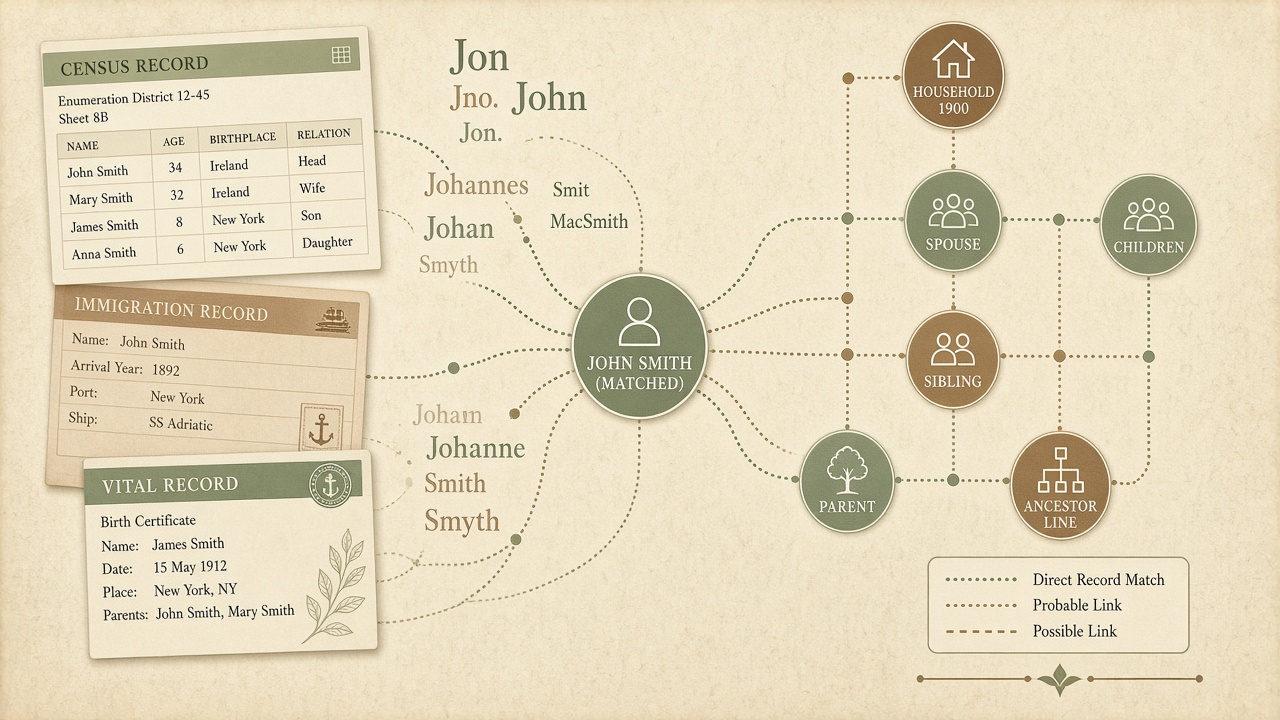
AI genealogy record matching applies entity resolution to connect the same person across census sheets, parish baptisms, immigration manifests, and user-built trees even when names are misspelled, dates drift by a year, or OCR introduced typos. FamilySearch exposes non-exact Person Matches APIs with likelihood scores, while SourceLinker lets volunteers compare household context before attaching sources. Academic Census Tree projects trained XGBoost models on millions of hand-validated links between United States census decades. Power users combine hints, DNA clusters, and manual adjudication because no algorithm should auto-merge living relatives without consent. Researchers browsing AI chatbot tools for document Q&A or exploring popular AI tools should treat genealogy matching as probabilistic, never as infallible proof.
The Document Fragmentation Problem
Historical ancestors appear as disconnected snippets: an 1880 census row, a church burial indexed in Latin, a ship manifest anglicized at Ellis Island, and a descendant's typed family group sheet. Each record captured a moment with inconsistent spelling, missing middle names, and approximate ages. Without linking, researchers duplicate profiles, attach wrong parents, and propagate errors across collaborative trees. Fragmentation worsens when archives digitize parish books with handwriting models that confuse similar letters.
Machine learning excels at weighing weak signals together: surname phonetics, birth year within tolerance, spouse co-occurrence, and children's names matching patronymic patterns. A lone "Jon Smyth" might be ambiguous; the same name beside "Mary Smyth" and three children listed in the 1910 household strongly suggests the "John Smith" profile already on the tree.
Fuzzy Name and Date Matching
Fuzzy matchers score edit distance on given names, apply Soundex or metaphone keys to surnames, and allow birth dates to slide within configurable windows when census ages round to five-year buckets. FamilySearch Read Person Matches by Example accepts GEDCOM X payloads describing a person plus optional parents, spouses, and children. Relationships with stable internal IDs improve precision because isolated name collisions drop out. Returned matches include ResultConfidence fields; low-confidence hints should queue for manual review, not automatic attachment.
OCR errors introduce systematic substitutions: "rn" misread as "m," "cl" as "d." Genealogy-specific pipelines often run custom dictionaries of known parish abbreviations before matching. Date fields parsed from free text ("about 1843") need normalized uncertainty intervals rather than exact equality tests.
| Feature | Matching signal | False match risk |
|---|---|---|
| Surname variants | Phonetic keys, transliteration tables | Common names in dense cities |
| Household co-residence | Shared address, family roles | Boarders with similar names |
| Age / birth year | Tolerance bands, census rounding | Age misreporting on manifests |
| Parish locality | Jurisdiction hierarchy, gazetteer IDs | Same-name parishes in one country |
Graph Linking Across Archives
Graph linking treats persons, households, and events as nodes with edges for parentage, marriage, and residence, then propagates confidence when multiple records reinforce the same cluster. The Census Tree research pipeline combined FamilySearch user attachments, machine-learned links, and transitivity rules: if person A matches B in 1900 and 1910, and B matches C in 1910 and 1920, implied links between A and C receive boosted scores after conflict filtering.
FamilySearch's 1910 census initiative paired automated tree suggestions with volunteer hint queues. By late 2021, roughly 59 percent of enumerated individuals had profiles; millions more hints awaited SourceLinker review. Graph methods reduce duplicate profiles when siblings are added one census at a time.
DNA ThruLines and Document Triangulation
Commercial DNA features such as ThruLines propose ancestors by combining segment sharing with other users' trees, which may themselves contain unverified merges. Treat genetic suggestions as hypotheses to test against parish and census documents, not as proof. Cluster diagrams help prioritize which document hints to pursue first, especially when brick walls involve common surnames in port cities. Always record which DNA match led you to a record so you can unwind the chain if the paper trail fails.
Adoptees and unknown parent searches raise consent issues distinct from nineteenth-century record linking. Automated matching that surfaces biological relatives can outpace emotional readiness. Platform policies vary on contacting matches; researchers should follow community guidelines and local privacy law before messaging strangers based on algorithmic confidence alone.
Conflicting Tree Merge Suggestions
Merge suggestions collide when two researchers built correct branches that diverge on one mistaken parent link, or when an algorithm proposes combining cousins who share names and birth years. Never accept merges based on a single shared field. Compare source images side by side. Check godparents in Catholic registers, witnesses on marriage licenses, and occupational notes. FamilySearch duplicate detection for tree persons uses the same non-exact philosophy as record hints; resolving duplicates requires human judgment about which conclusions survive.
When Ancestry, MyHeritage, or other platforms surface "member connect" suggestions, the underlying entity resolution differs from FamilySearch APIs. Export GEDCOM fragments cautiously and document why a link was rejected so future researchers do not reopen settled questions.
Privacy of Living Individuals
Living people deserve stricter gates: many platforms hide their details by default, and GDPR plus platform terms restrict publishing identifiable data about relatives who never consented. Automated matching can accidentally surface a living sibling when attaching a public census to a private profile. Before accepting hints that reveal adoption or non-paternal events, contact affected family members. DNA-informed matches carry additional sensitivity; segment triangulation can expose relationships users intended to keep private.
Redact birth years and locations for living persons in shared trees. Use AI chatbot assistants only on anonymized excerpts when asking third-party models to summarize documents, because prompts may log personal data.
Parish Archives and OCR Pipelines
Parish registers predate civil vital records in much of Europe and Latin America; baptism, marriage, and burial entries were handwritten in Latin or local dialects with inconsistent spelling. Digitization projects apply handwriting recognition tuned to clerical scripts, then human indexers correct obvious errors. Matching engines must understand godparent names, marginal notes, and duplicate baptism entries for infants who died young. A child indexed twice under slightly different spellings should collapse into one person node with two source citations, not two competing profiles.
Cross-border migration breaks simple locality blocking. An ancestor born in Galicia may appear in Hamburg departure lists, New York arrival manifests, and Midwest census rows within a decade. Entity resolution scores improve when each record carries standardized place IDs from gazetteers rather than free-text village names that OCR garbled.
Census Tree Machine Learning Lessons
The Census Tree project used millions of FamilySearch hand-linked census pairs between 1900, 1910, and 1920 United States enumerations to train gradient boosting models, then validated samples with manual sheet checks and transitivity tests. Reported false positive rates near twelve percent on predicted links remind researchers that even research-grade pipelines need adjudication. Blocking strategies matter: comparing every John Smith in Manhattan against every other John Smith is computationally explosive; blocking on birth year decade and ward reduces candidates before fuzzy scoring runs.
Women change surnames at marriage, complicating longitudinal links. Genealogy-specific models weight spouse co-occurrence and children's surnames heavily because maiden names disappear from later census rows. Machine learning hints from vendors remain proprietary, but the public lesson is consistent: combine multiple weak signals, then let humans attach sources in tools designed for household-level review like SourceLinker.
FamilySearch Power User Workflow
A disciplined workflow treats hints as tickets: verify household context in SourceLinker, attach sources with citations, then merge duplicates only after image review.
- Build minimal profiles with birth, death, and residence events sourced to one record each.
- Work hints from highest confidence downward; skip vague name-only suggestions.
- Use Read Person Matches by ID against the historical records collection for targeted gaps.
- Attach entire census households when appropriate so relationships stay coherent.
- Run duplicate reports quarterly; resolve conflicts before exporting GEDCOM.
- Document rejected hints in research logs to train your future self, not the vendor model.
Third-party tree sync tools that auto-accept every hint can pollute your master database within a weekend. Schedule weekly review sessions instead of real-time merges. When collaborating with cousins, agree on a single canonical profile per ancestor and link others as research notes rather than duplicating events across competing IDs.
Immigration records add alias complexity: manifests anglicized Eastern European surnames, while naturalization papers restored older forms. Entity resolution should treat aliases as first-class attributes linked to one person ID rather than separate profiles that later require painful merges. Ship departure dates versus arrival dates also confuse naive date matchers; store event types explicitly.
Academic researchers using linked census microdata must cite matching methodology in publications because downstream econometric results shift when false positive rates change. Hobbyists benefit from the same skepticism: one wrong 1870 link propagates to dozens of DNA matches and distant cousin messages. Slow research beats fast wrong trees.
Parish marriage banns often list both parties' home parishes even when the ceremony occurred elsewhere, giving matchers a second locality anchor when census residence fields disagree. Burial registers note age at death, useful for resolving birth year conflicts when baptism records are missing. Always attach the full household image when citing census sources so future reviewers see context the algorithm weighted.
Frequently Asked Questions
How does DNA evidence compare to document matching?
DNA confirms biological relationship segments but rarely names the exact ancestor without documentary corroboration. Use genetic clusters to prioritize which fuzzy document matches to test first, especially across missing parish registers.
Does Ancestry use the same algorithms as FamilySearch?
Commercial platforms run proprietary entity resolution tuned to their record sets and member trees; APIs and confidence scores are not interchangeable. Cross-platform research still requires manual verification of each attachment.
What GDPR rules affect European parish records?
GDPR limits processing identifiable data about living individuals and may restrict publishing recent civil registers online. Researchers in the EU should prefer archives with lawful bases for publication and avoid republishing restricted extracts on public trees.
How should adoption cases be handled in automated hints?
Disable or scrutinize hints that would overwrite adoptive parent links with biological record matches unless the family has chosen to document that story publicly. Sensitive events need explicit notes and consent, not silent merges.
Can AI fix OCR errors before matching?
Handwriting and OCR correction models reduce typos but can hallucinate plausible names that never existed. Always compare model output to the scanned image before using corrected text as matching input.
Can developers build custom matchers on FamilySearch APIs?
FamilySearch developer APIs expose Person Matches by ID and by Example for tree and user tree collections; historical records matching via example POST is more limited. Respect rate limits and attribution requirements when embedding hints in third-party apps.
How do you disambiguate common surnames?
Add spouse, parents, children, occupation, and narrow locality filters until only one household cluster remains plausible. If two candidates tie, wait for a confirming record rather than forcing an early merge.