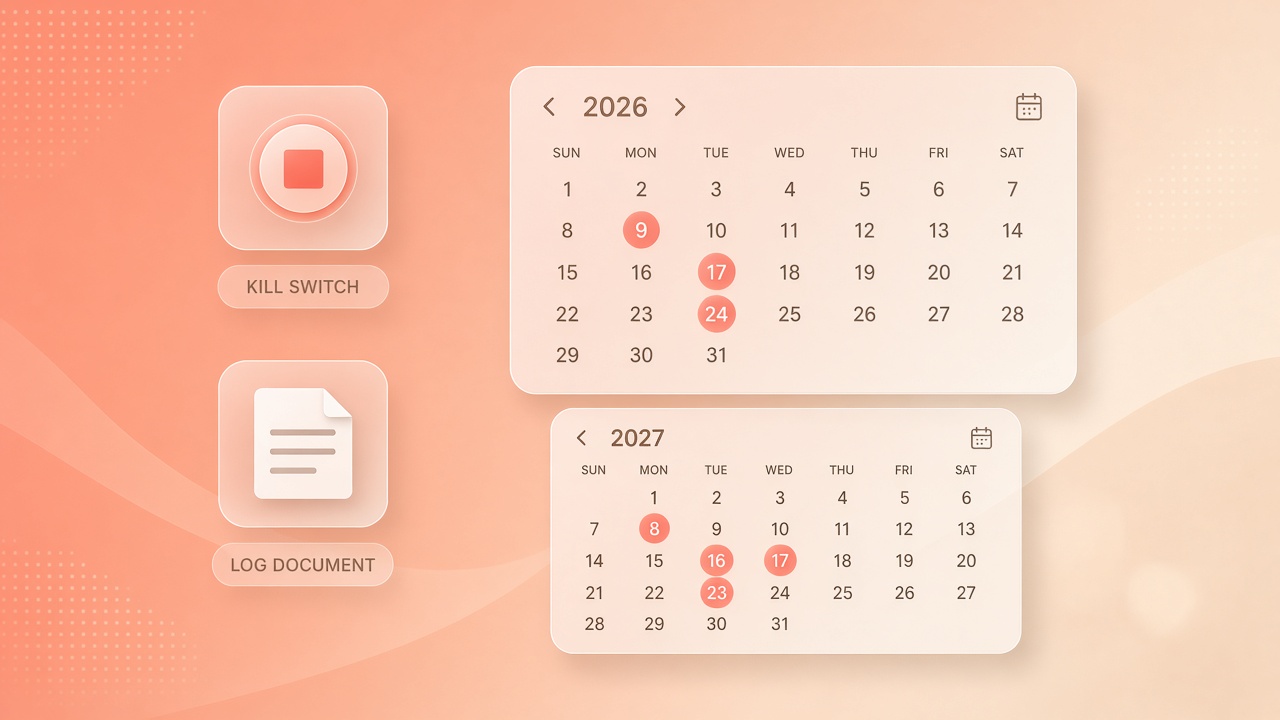
Autonomous AI agents that call APIs, browse the web, and execute multi-step workflows entered enterprise production stacks in 2025 and 2026. Regulators responded with logging mandates, human override requirements, and transparency duties that treat agents as high-risk systems when they influence consequential decisions. The EU AI Act sets the most detailed calendar. Article 50 transparency rules became enforceable on August 2, 2026. High-risk Annex III obligations for standalone systems now target December 2, 2027 after the Digital Omnibus amendment. Enterprises deploying agents in the EU operate on two clocks: immediate transparency work and longer-run governance buildout.
This guide maps AI agent governance deadlines by region, explains logging and human-in-the-loop requirements, covers cross-border deployment issues, and offers an implementation playbook for teams building on AI chatbot and AI code agent platforms.
Key AI Agent Governance Deadlines in 2026-2027
The EU AI Act applies in phases; agent teams must track both enforceable dates and planning baselines after legislative amendments. Missing early transparency duties triggers fines up to 15 million euros or 3% of global turnover under Article 99, with national authorities instructed to consider proportionality for smaller firms.
| Obligation | Primary articles | Enforcement date |
|---|---|---|
| Transparency to users | Article 50 | August 2, 2026 |
| High-risk Annex III agents (standalone) | Articles 8-15, Annex III | December 2, 2027 (Digital Omnibus baseline) |
| Embedded high-risk in regulated products | Annex I integration | August 2, 2028 |
| GPAI provider duties | Chapter V | August 2, 2026 (enforceable; RFIs began September 2026) |
US federal agent rules remain sector-specific as of September 2026. Financial regulators expect model risk management for algorithmic trading agents. California companion and safety bills address consumer harms rather than enterprise agent orchestration. UK ICO guidance on agentic AI is expected in winter 2026 without a standalone agent statute.
The Digital Omnibus amendment adopted in June 2026 reset high-risk timelines but did not eliminate preparation duties. Article 50 transparency for AI-generated content and chatbot interactions remains enforceable from August 2, 2026. GPAI provider obligations also became enforceable on that date, triggering EU AI Office RFIs to more than 30 providers in September 2026. Agent vendors building on GPAI models must trace which upstream documentation satisfies deployer due diligence while implementing local logging and oversight for their orchestration layer. Autonomous agent oversight teams should maintain a living calendar that separates statute dates from omnibus planning baselines and mark internal readiness reviews quarterly through 2027.
Logging and Traceability Requirements
Article 12 requires high-risk AI systems to technically allow automatic recording of events over the system lifetime. For agents, logs must capture tool calls, prompts, intermediate reasoning artifacts where stored, outputs, anomalies, and substantial modifications. Manual post-hoc documentation does not satisfy the automatic recording duty.
Articles 19 and 26 set a six-month minimum retention period for logs, with longer retention where sector rules apply. Financial services firms may integrate agent logs into existing regulatory recordkeeping. Deployers must maintain operational logs under their control even when using vendor-hosted agents.
Draft standards prEN 18229-1 and ISO/IEC DIS 24970 address AI logging formats but were not finalized as of mid-2026. Enterprises should implement structured JSON logs with immutable storage, per-user attribution, and correlation IDs across agent steps now rather than waiting for harmonized schemas.
Agent compliance timeline work should map each tool invocation to an identity, timestamp, input hash, output summary, and policy decision. When agents chain ten tool calls before a human-visible answer, regulators expect reconstructability without manual detective work. Behavioral drift detection belongs in operational monitoring logs: if an agent begins calling unfamiliar APIs after a model update, logs must flag the change for human review. Help Net Security's April 2026 analysis noted penalties up to 15 million euros or 3% of global turnover for Article 99 violations, with national authorities instructed to consider proportionality for smaller firms. Agent regulation 2026 conversations in Brussels emphasize that deployers cannot outsource logging entirely to SaaS vendors without contractual guarantees on retention and access during investigations.
Human-in-the-Loop and Kill-Switch Mandates
Article 14 requires humans to monitor high-risk systems, override or disregard outputs, and interrupt operation through a stop control. Agents without a halt path fail deployer obligations. Dual verification applies in some biometric and law-enforcement contexts.
Human oversight must be meaningful, not ceremonial. Designated staff need training, authority, and interfaces to pause agents without filing IT tickets. Document competence, escalation paths, and after-action reviews when overrides occur. Kill switches should operate at the orchestration layer, not only by revoking API keys hours later.
| Control | Agent implementation | Priority rank |
|---|---|---|
| Stop control | Global pause button halting tool execution within seconds | 1 |
| Override | Human can reject agent plan before irreversible actions | 1 |
| Monitoring dashboard | Live view of agent tasks with anomaly alerts | 2 |
| Credential scoping | Least-privilege tokens per agent workflow | 2 |
Cross-Border Agent Deployment Issues
Agents routed through US infrastructure serving EU users remain subject to EU deployer duties when decisions affect people in the Union. Data residency alone does not determine applicability. Classification as high-risk depends on use case, not model origin.
Multi-region teams should maintain a single agent inventory with jurisdiction tags, role allocation (provider vs deployer), and evidence packs per market. Vendor contracts must clarify who maintains Article 12 logging infrastructure and who responds to regulator requests. Shadow IT agents built by employees on personal accounts create compliance gaps that blocking tools alone cannot close without discovery and training.
A US-headquartered company serving EU customers through US cloud regions still faces deployer obligations when agent decisions affect people in the Union. Conversely, EU providers exporting agents to US financial clients must map SEC and FINRA expectations onto EU documentation. Colorado SB 26-189 consequential decision rules may capture hiring or lending agents even when EU high-risk deadlines shift to 2027. Cross-border deployment issues therefore require legal review per use case, not per server location. Maintain data processing agreements that specify log export formats and regulator response SLAs before agents touch production customer data.
Agent Governance Implementation Playbook
Use 2026 as preparation year even when high-risk enforcement shifts to 2027. Regulators and enterprise customers already ask for transparency and logging evidence during procurement.
- Inventory all agents, tools, and data sources; classify Annex III relevance.
- Implement Article 50 disclosures for EU-facing conversational agents immediately.
- Deploy structured logging with six-month minimum retention and integrity controls.
- Build human override and kill-switch paths tested in tabletop exercises.
- Update procurement templates with AI Act logging and oversight clauses.
- Train operators and document oversight competence before December 2027 high-risk date.
Microsoft Copilot agent updates and OpenAI Agents API launches in 2026 accelerated enterprise adoption before logging infrastructure caught up. Platform vendors now publish agent governance templates mapping Article 12 events to cloud observability stacks. Buyers should demand exportable log schemas compatible with SIEM tools and legal hold workflows. Agent compliance timeline planning belongs in 2026 budgets even when legal deadlines shift, because EU customers and US financial regulators already ask for evidence during RFP stages.
Frequently Asked Questions
Do all AI agents count as high-risk under the EU AI Act?
No. High-risk classification depends on Annex III categories such as employment, education, credit, or law enforcement. General productivity agents may face Article 50 transparency only, but many enterprise deployments touch high-risk domains.
Is August 2026 or December 2027 the compliance date for agents?
Article 50 transparency applies from August 2, 2026. Annex III high-risk duties for standalone systems follow the December 2, 2027 baseline under the Digital Omnibus amendment. Plan for both dates.
What logs must agents retain?
Article 12 requires automatic logs covering risk situations, substantial modifications, post-market monitoring data, and operational monitoring by deployers. Retain at least six months unless sector rules require longer.
Who is responsible when a vendor hosts the agent runtime?
Provider and deployer obligations differ. Deployers remain responsible for use-case compliance, oversight, and operational logs under their control. Contracts should assign logging infrastructure duties explicitly.
Are US companies outside the EU affected?
Yes, when agents serve EU users or influence decisions in the Union. US-only deployments follow US sector rules but may still face customer contractual requirements aligned with EU standards.
What is an agent kill switch under EU rules?
Article 14 expects deployers to halt agent operation without relying solely on revoking API keys hours later. Kill switches should stop tool execution at the orchestration layer within seconds and preserve logs of the interruption event.
How does agent compliance timeline differ for embedded medical AI?
High-risk AI embedded in regulated medical products follows the August 2, 2028 baseline under the Digital Omnibus, later than standalone Annex III agents. Healthcare teams must track both dates when agents wrap diagnostic models.
Vendor Contract Clauses for Agent Governance
Procurement teams should embed agent governance deadlines into SaaS contracts before December 2027 high-risk enforcement. Minimum clauses include log export rights, human override APIs, incident notification SLAs, and cooperation with regulator requests affecting your deployment.
- Require Article 12-compatible event logs with six-month retention minimum.
- Mandate kill-switch endpoints documented in technical annexes.
- Assign provider vs deployer logging duties explicitly in data processing agreements.
- Obtain model change notifications when agent behavior may shift after foundation model updates.
- Reserve audit rights to sample agent traces during annual vendor reviews.
Agent vendors marketing EU readiness should provide conformity roadmaps, not marketing badges alone. Cross-reference vendor claims against artificialintelligenceact.eu timeline updates after Digital Omnibus adoption. Autonomous agent oversight maturity separates enterprise-ready orchestration platforms from demo-grade agents that lack halt controls.
Artificialintelligenceact.eu timeline summaries should sit on every agent product manager's desk through 2027. Align internal sprint planning with Article 50 August 2026 transparency deliverables even when high-risk Annex III dates shift. Run quarterly tabletop exercises where operators practice halting live agents during simulated anomalies. Document training hours for human overseers because deployer competence evidence matters in EU supervisory interviews. Agent compliance timeline slippage internally is harder to explain than statutory delays everyone shares.
EU AI Act Agent Calendar Summary
| Workstream | Start by | Owner |
|---|---|---|
| Agent inventory and classification | Q3 2026 | AI governance lead |
| Article 50 user disclosures | August 2026 | Product and legal |
| Logging and retention architecture | Q4 2026 | Engineering and security |
| Human override testing | Q1 2027 | Operations |
| High-risk conformity files | Before December 2027 | Compliance and vendors |
Use this calendar in steering committees to prevent teams from treating December 2027 as the only relevant date. Autonomous agent oversight failures discovered during 2026 EU transparency enforcement can damage customer trust before high-risk conformity assessments begin. Kill switch drills should produce written evidence stored with other AI Act records.
Logging and traceability requirements extend to vendor subprocessors running agent tools on your behalf. Require subprocessors to stream security events to your SIEM with agent correlation IDs. Human-in-the-loop mandates fail when only engineering leads can pause agents; train business operators with documented authority. Cross-border deployment issues multiply when agents invoke tools hosted in US regions processing EU personal data; map transfers before launch. AI agent governance deadlines 2026 summaries should appear in quarterly risk committee packs with RAG status per workstream.
Implementation playbook success metrics include mean time to halt during drills, log completeness scores sampled weekly, and percentage of agents with assigned human overseers. Treat missing kill switches as production blockers for EU-facing high-risk workflows even during the 2027 planning window. Agent regulation 2026 news will keep shifting dates; controls are the durable investment.