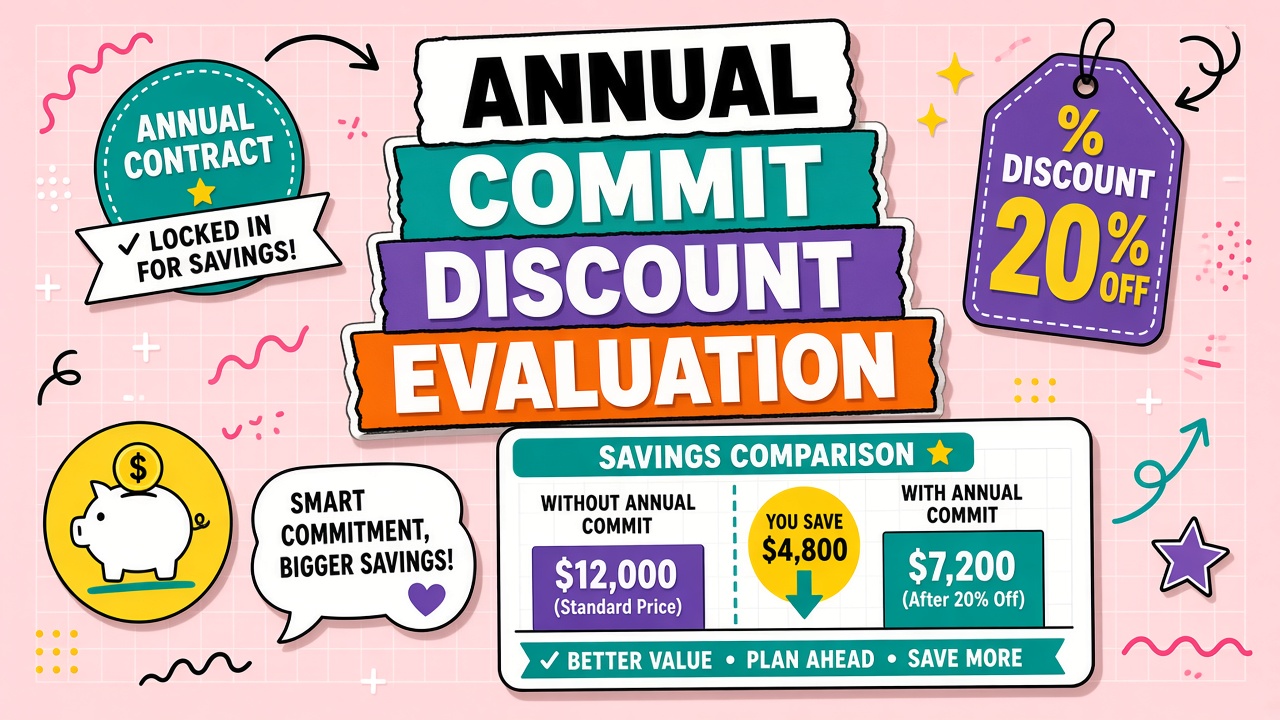
The vendor offers twenty percent off if you prepay annual credits or seats. Finance likes predictable spend; engineering worries usage will shift when models improve or projects cancel. Evaluating an ai annual commit discount requires break-even math, forecast error analysis, and clear-eyed reading of true-down and exit clauses.
AI pricing moves faster than traditional SaaS. Commits made sense for stable CRM seats; token consumption can swing tenfold when a feature ships. Teams buying AI design and AI writing platforms should stress-test commits against scenario usage drops, not only growth.
Discount Structures: Credits, Seats, and Rate Cards
Annual discounts appear as prepaid credits, discounted per-seat fees, or locked rate cards on token tiers. Each structure behaves differently under usage change.
Prepaid credits reward volume but may expire or forbid refund. Seat commits reward headcount stability but punish layoffs or tool consolidation. Rate card locks help when list prices rise but may block cheaper new models until renegotiation.
Compare effective discount to cash cost of capital. Twenty percent off is not twenty percent benefit if you prepay twelve months early and could have invested elsewhere or stayed monthly during uncertainty.
Stack discounts carefully: annual plus volume tier plus startup program may have exclusions. Read which discounts are mutually exclusive in order forms.
Forecast Error Risk on Annual Commits
Forecast error is the primary risk in AI annual commits. Model your committed amount at fifty, eighty, and one hundred twenty percent of baseline forecast. If break-even only works at one hundred twenty percent, the commit is speculative.
Include model-mix risk: cheaper models may reduce spend without reducing value, leaving prepaid credits unused. Include adoption risk: pilots fail, champions leave, regulators block features.
Document who owns forecast sign-off: product, engineering, finance. Commits signed on sales optimism without engineering validation are a recurring source of shelfware credits.
True-Down and True-Up Clauses
True-up clauses bill you for usage above commit; true-down clauses rarely return cash for unused commit. Negotiate rollover of unused credits, mid-term top-up at same discounted rate, or partial credit toward next year instead of forfeiture.
Some enterprise agreements allow quarterly true-down within bands. Ask explicitly. Standard click-through annual plans often forfeit unused balances with no mercy.
Map true-up triggers to internal alerts. Hitting true-up unexpectedly means forecast failed or usage spiked without cap governance.
When Monthly Is Safer
Stay monthly when usage is volatile, vendor landscape is shifting, or you are pre-product-market-fit. Early-stage teams exploring multiple writing vendors should not lock annual until one workflow wins evals.
Regulated pivots, merger integration, and hiring freezes are also monthly signals. Flexibility has a price; pay it when uncertainty dominates.
Hybrid approach: annual commit for stable baseline (core chat seats) plus monthly overage for experimental API keys. Matches how cloud providers blend reserved and on-demand capacity.
Break-even walkthrough (example)
- Monthly run rate: $10,000; annual prepay offer: $96,000 (20% off $120,000)
- Break-even vs monthly: prepay wins if you would have spent at least $96,000 in 12 months
- If usage drops 30% mid-year, monthly would have cost ~$84,000; prepay loses $12,000 unless credits roll
- Add exit cost: unused credits forfeited vs partial refund per clause
- Decision: commit only if low scenario still exceeds $96,000 or rollover protects downside
Break-Even Calculation Walkthrough
Monthly spend run rate: twelve thousand dollars. Annual commit offers fifteen percent discount on prepay of one hundred thirty-six thousand eight hundred dollars versus twelve monthly payments of twelve thousand (one hundred forty-four thousand total). Nominal savings: seven thousand two hundred dollars. Subtract expected unused credits of five thousand dollars if usage forecast is uncertain. Subtract estimated exit fee of three thousand dollars if pilot workflows may migrate. Adjusted savings: negative eight hundred dollars. Monthly wins despite headline discount.
Risk Factors Checklist
Model deprecation forcing premium tier migration. Headcount reduction leaving prepaid seats idle. Merger doubling duplicate tools. Regulatory change blocking data residency region tied to commit. Vendor bankruptcy or acquisition changing product roadmap. Score each risk low, medium, high before signing. High aggregate risk pushes toward shorter commit or smaller prepay block.
AI Prepay Savings: Real vs Nominal
Nominal savings use list price math. Real savings use expected utilization times exit option value. Finance should see both numbers side by side. Procurement negotiates on nominal; CFO approves on real.
Commit vs Monthly Decision Matrix
Choose annual commit when: usage variance below twenty percent for two quarters, single primary vendor for workflow, exit costs modeled and acceptable, true-down rights negotiated, and executive sponsor accepts forecast error risk. Choose monthly when: pilots active, multi-vendor routing experiments, M and A integration, or regulatory uncertainty about data residency product availability.
Hybrid commits split production and R and D as described earlier. Document decision in procurement memo with break-even table attached. Future you will forget why monthly was rejected; the memo prevents repeating debate from scratch at renewal.
AI Annual Contract Discount Negotiation Tips
Bring consolidated spend map and growth forecast. Ask for true-down, price lock exhibit, and credit rollover within contract year. Trade longer term for stronger true-down, not only for headline discount. Vendors accept smaller discount with clean exit more often than finance expects.
Operational Checklist
Assign a single owner for monthly refresh. Publish assumptions where finance and engineering both edit. Tie forecast or policy changes to ticket IDs. Review variance before month close, not after invoice payment. Run tabletop exercises when vendors announce pricing or deprecations. Keep archived exports for audit comparison quarter over quarter.
Document decisions in plain language any new hire can follow. Operational discipline matters as much as spreadsheet formulas or contract clauses. Teams that treat AI spend as unplannable noise get unplannable invoices. Teams that treat spend as a managed metric catch drift early and negotiate from data.
Cross-Functional Alignment
Platform owns technical tags and caps. Finance owns forecast and chargeback posting. Procurement owns contract language. Product owns workflow rollout dates that drive usage. Security owns trial data classification. Weekly five-minute sync during rollout quarters prevents each function optimizing locally while global spend drifts. Alignment is boring work that prevents exciting overage surprises.
Common Mistakes to Avoid
Mistake one: single org-wide average hiding squad spikes. Mistake two: ignoring human review labor in ROI or unit economics. Mistake three: annual commit sized on peak pilot week. Mistake four: alerts configured without owners. Mistake five: sunset without migration support. Mistake six: treating free tier as production. Mistake seven: streaming timeouts fixed by disabling streams without root cause. Mistake eight: duplicate responses patched in UI only while webhooks still double-write. Avoiding these patterns saves more than marginal token discounts.
Metrics to Track Monthly
Track spend variance versus plan, tag coverage percentage, alert acknowledgment time, dispute count, unused license count, cost per usable output where applicable, stream completion rate for customer-facing apps, and duplicate side effect rate for integrated workflows. Pick three metrics primary for your pillar; log the rest as secondary. Review trend not single points. A metric without owner and target is dashboard decoration.
Share metrics with department leads in language they can act on. Finance sees dollars. Engineering sees error rates and timeouts. Product sees adoption and quality. Same underlying data, different emphasis, one source of truth export from vendor and internal logs reconciled monthly.
Executive Summary Template
Open with one sentence on risk addressed. Follow with current state metric, target metric, and date. List top three actions this quarter with named owners. Close with decision requested: approve cap, approve contract clause, approve sunset, or approve pilot extension. Executives approve decisions, not methodology essays. Link appendix with exports for auditors rather than pasting tables into email.
Refresh executive summary monthly during volatile adoption phases; quarterly when stable. Stale summaries erode trust faster than honest bad news. If variance is unfavorable, say so early with remediation plan attached.
Implementation Timeline
Week one: assign owners and export baseline data from vendor admin or application logs. Week two: draft spreadsheet, policy, or runbook sections relevant to your pillar. Week three: pilot with one squad and fix tagging or alert noise. Week four: publish org-wide with office hours. Month two: first variance or true-up review and adjust assumptions. Month three: executive summary with decisions made from metrics, not only spend totals.
Skipping the pilot week creates alert fatigue and mistrust in chargeback numbers. Investing four weeks upfront pays back when finance, security, and engineering reference the same artifacts instead of rebuilding from scratch each quarter. Treat this as operational infrastructure parallel to the AI features themselves.
Frequently Asked Questions
We may acquire a company with its own AI contracts. Impact?
Duplicate commits across entities waste spend. Model consolidation timeline before signing org-wide annual deals. Ask vendors about contract assignment and credit transfer during M&A diligence.
Usage dropped after layoffs. Any recourse?
Unless true-down is negotiated, recourse is limited. Future lever: shorter terms, smaller commits, or credits applicable to new products. Document loss for next negotiation cycle.
Vendor deprecated our committed model. Now what?
Seek rate parity on replacement models and extension of commit term without penalty. Deprecation should not force list-price migration mid-contract.
Can we commit to only part of spend?
Yes. Baseline commit plus monthly burst is common. Negotiate discounted rate on overage up to a cap rather than unlimited list-price overage.
Review this guide quarterly against your vendor admin console and finance exports. Interfaces change; caps move; new premium toggles appear inside familiar SKUs. A quarterly thirty-minute review keeps policy, forecast, and contract language aligned with what the product actually bills. Assign the review to a named role, not a mailing list.
When in doubt, measure for two weeks before committing annually or sunsetting a vendor. Short measurement windows beat long debates. Export logs, tag them, compute the metric or variance, then decide. Data ends internal stalemates that otherwise consume more payroll than the AI line item under discussion.
The Bottom Line
Commit vs monthly ai pricing decisions need scenario break-even, clause literacy, and honesty about forecast confidence. Annual discounts reward stable, proven usage; they punish surprise pivots. Negotiate rollover and true-down before prepaying.