The fastest way to burn your best practitioners is to name them "AI champion" and leave the job undefined. They become unpaid help desk for login errors, prompt therapy for every department, and the scapegoat when a vendor change breaks workflows. Meanwhile, adoption stalls because nobody else owns feedback intake.
An AI tool champion program gives structure: clear separation from admins and security, selection criteria with term limits, scheduled office hours, and recognition that does not rely on heroics. This guide provides a role charter, cadence recommendations, and burnout guardrails. Explore tools in AI productivity tools and AI automation tools after champions know which workflows they represent.
Champion vs Admin vs Security
Three roles often collapse into one overloaded person. Split them so champions teach workflow adoption, admins own tenants and billing, and security owns data classification and policy exceptions.
| Role | Owns | Does not own |
|---|---|---|
| Champion | Workflow tips, office hours, feedback to owners | SSO config, invoice approval, legal sign-off |
| Admin | Seats, integrations, vendor tickets | Writing SOPs alone without workflow owner |
| Security | Data tiers, exceptions, audit responses | Daily prompt coaching for every team |
Selection Criteria and Term Limits
Champions should be credible peers who perform the workflow weekly, not the loudest AI enthusiast or the most available volunteer. Rotate terms so knowledge spreads and burnout resets.
Selection checklist
- Workflow credibility: Performs the job at least weekly in production.
- Documentation habit: Willing to publish tips and capture failure modes.
- Boundary respect: Escalates policy questions instead of improvising.
- Manager support: Ten to twenty percent time protected on calendar.
- Backup named: Deputy champion for absences and continuity.
| Program element | Recommended setting |
|---|---|
| Term length | Two quarters with optional one-quarter extension |
| Ratio | One champion per prioritized workflow or twenty-five users, whichever is smaller |
| Protected time | Two to four hours weekly blocked for office hours and doc updates |
Role Charter Outline
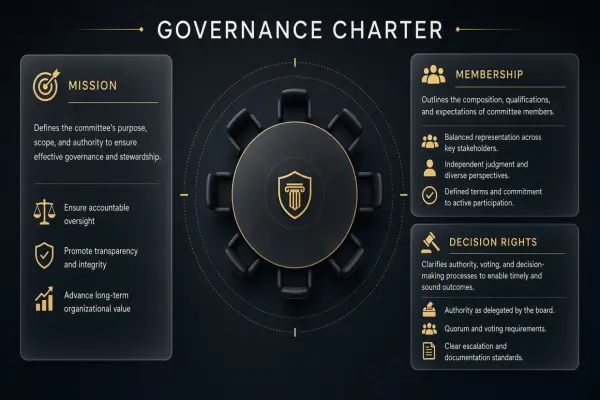
Publish a one-page charter per champion. Signed by the workflow owner and the champion's manager. Ambiguity here creates shadow IT support duties.
- Mission: Accelerate adoption of workflow X with documented quality bar.
- Scope: Teams and tools covered; explicit out-of-scope list.
- Activities: Office hours, tip posts, pilot feedback, monthly metrics review attendance.
- Escalation: When to route to admin, security, vendor, or workflow owner.
- Success measures: Voluntary reuse, penetration, quality trends, not ticket volume closed.
- Term and recognition: End date, handoff steps, how contribution appears in reviews.
Office Hours and Feedback Intake
Office hours are structured, not open-ended "ask me anything" sessions. Champions demo one workflow tip, review one failure mode from the log, and collect feedback into a single intake form. Random Slack pings are not intake.
Office hour cadence
| Rollout phase | Cadence | Format |
|---|---|---|
| Weeks 1-4 | Twice weekly, thirty minutes | Live demo plus Q&A; recording optional |
| Months 2-3 | Weekly, thirty minutes | Tip plus office hours queue from form |
| Steady state | Biweekly, twenty minutes | Async FAQ doc updated; live for edge cases |
Feedback intake fields
- Workflow name and tool used
- Input type (sanitized description)
- Failure mode category: access, policy, quality, integration
- Severity: blocked, degraded, cosmetic
- Desired outcome in one sentence
Champions route automation-heavy questions to owners evaluating AI automation tools, but they do not become integration engineers unless that is explicitly in charter scope.
Recognizing Champions Without Burnout
Recognition should not substitute for protected time. Combine visible credit with workload boundaries: no champion on-call for vendor outages, no expectation of instant Slack response, and a hard cap on weekly hours documented in the charter.
Recognition options that scale
- Review language: Manager cites champion contributions with metrics improved.
- Learning budget: Small stipend for courses tied to workflow quality.
- Internal talks: Twenty-minute lunch learn with prep time counted.
- Handoff bonus: Credit for documentation quality at term end.
Avoid leaderboard rankings by tickets answered. That rewards heroics and hides systemic fixes champions should escalate instead of personally patching forever.
Launching the Champion Program in Thirty Days
Do not announce a network of champions before one workflow has a charter. Use this rollout sequence.
- Week 1: Identify one pilot workflow owner and draft charter with manager sign-off.
- Week 2: Name champion and deputy; block calendar for office hours; publish intake form.
- Week 3: Run first two office hours; collect feedback; escalate systemic blockers to admin.
- Week 4: Retrospective with workflow owner; decide second workflow or expand hours.
Program health metrics (not champion ticket counts)
| Metric | Healthy signal | Unhealthy signal |
|---|---|---|
| Workflow penetration | Rising on eligible cases | Flat despite heavy champion hours |
| Doc contributions | New tips or checklist updates monthly | Same three Slack answers repeated |
| Escalation quality | Blockers close with owner actions | Champion personally patches forever |
| Champion hours | Stable within charter cap | Weekly overtime without manager notice |
Handoff and Succession Between Terms
Every charter ends with a two-week handoff window. Outgoing champions publish a single "state of workflow" note: top tips, open escalations, failures to watch, and links to updated docs. Incoming champions shadow one office hour before solo facilitation. Skipping handoff resets adoption to zero every rotation.
Distributed Teams and Policy-Sensitive Environments
Distributed teams need rotating office hour times and recorded tips with transcripts. Policy-sensitive environments (union shops, regulated industries) should align charter language with labor agreements and official comms channels. Champions share approved patterns; they do not negotiate policy.
Champion Program RACI Snapshot
Use this table in the program wiki so champions stop absorbing admin and security work by default.
| Activity | Champion | Admin | Security | Workflow owner |
|---|---|---|---|---|
| Office hours | R/A | C | I | C |
| SSO outage | I | R/A | C | I |
| Data exception request | I | C | R/A | C |
| SOP prompt update | C | I | C | R/A |
| Pilot metrics review | C | I | I | R/A |
R = responsible, A = accountable, C = consulted, I = informed. Champions consult on automation patterns tied to AI automation workflows; they do not own vendor contracts or policy exceptions.
Frequently Asked Questions
How many champions do we need?
Start with one champion and one deputy per prioritized workflow. Add capacity when office hour wait time exceeds one week or intake backlog grows without systemic fixes. More champions without charter clarity multiplies confusion.
Is a champion the same as a power user?
No. Power users optimize personal speed. Champions optimize team repeatability through docs, office hours, and feedback loops. Some power users make poor champions if they skip checkpoints others must follow.
Should champions receive extra pay?
Protected time and review credit are minimums. Stipends help when charter duties exceed ten percent weekly for multiple quarters. Unpaid indefinite support drives attrition and hidden resentment.
What if a champion advocates a tool that fails pilot metrics?
Champions recommend patterns, not renewals. Workflow owners decide adopt or reject on written metrics. Failed pilots are program success when they prevent shelfware, not champion failure.
When do we sunset the champion program?
When workflows are documented in SOPs, penetration is stable, and office hours attendance drops below threshold for two months. Transition to workflow owners and L&D. Sunsetting is success, not abandonment.
Async Champion Support Model
Distributed teams cannot rely on live office hours alone. Pair synchronous sessions with an async layer:
- Weekly tip post: One workflow tip with screenshot and checkpoint reminder.
- FAQ doc: Updated within forty-eight hours of repeated intake themes.
- Recorded walkthrough: Ten minutes max; transcript linked from SOP.
- Office hour rotation: Alternate AM and PM friendly times each week.
Async content reduces duplicate Slack answers and lets champions protect focus time for deep workflow fixes. Track FAQ views and repeat questions; rising repeats mean the SOP or integration needs owner attention, not another champion hour.
Manager Expectations for Champion Managers
Champions fail when managers treat the role as invisible extra work. Managers should block charter hours, attend one office hour per term, and credit documented contributions in performance reviews. Managers also stop champions from becoming permanent integration engineers by routing vendor work to admins.
Manager checklist each month
- Champion protected hours still on calendar.
- Intake backlog reviewed; systemic items assigned to owners.
- Charter scope unchanged without workflow owner approval.
- Deputy attended at least one session as backup.
- Burnout signals addressed (overtime, repeated escalations).
Productivity programs scale when AI productivity champions feed structured feedback into SOP updates instead of answering the same login question indefinitely.
Union and Regulated Workplace Notes
In union or highly regulated workplaces, align the champion charter with official communication channels and collective bargaining rules before announcing the program. Champions share approved workflows; they do not negotiate policy or bypass works council requirements. Document voluntary participation and protected time in writing so the role is clearly job-related, not off-the-books labor.
Program sponsor role
Assign an executive sponsor who appears quarterly, not daily. The sponsor removes organizational blockers, attends one office hour per year, and protects charter time in headcount planning. Sponsors who only appear for launch speeches leave champions exposed when cross-team conflicts arise.
Deputy champion duties
Deputies cover office hours during PTO, maintain the FAQ when the champion is in deep project work, and lead handoff documentation at term end. Deputies are succession candidates, not note-takers only. Rotate deputies into facilitation at least once per quarter so knowledge does not live in one person. Pair deputies with workflow owners during monthly metrics reviews so escalation paths stay clear when champions rotate.
The Bottom Line
Structure AI champion programs with separate admin and security roles, written charters, term limits, scheduled office hours, structured feedback intake, and recognition tied to protected time. Champions spread repeatable adoption across AI productivity workflows without becoming unpaid vendor support. Define the job, measure program health by workflow outcomes, and rotate terms before burnout becomes your adoption strategy.