Personalized cancer vaccines aim to teach a patient immune system to attack tumor-specific neoantigens: mutated peptides displayed on major histocompatibility complex (MHC) molecules that healthy cells do not present. Designing those vaccines traditionally chains bioinformatics pipelines, structural biology, and iterative lab validation across weeks. Radical Numerics, launched in June 2026 with a $50 million seed round led by Emergence Capital, previewed Omnii, a multimodal genome language model (gLM) with roughly two million base pair context, DNA, RNA, protein, epigenomic, and structure modalities. In September 2026 the company reported post-training Omnii for end-to-end cancer vaccine design: from tumor sequences through MHC class I and II presentation prediction, immunogenicity ranking, and mRNA cassette generation. Results remain computational; no animal, manufacturing, or human clinical validation has been published. Researchers in AI healthcare or browsing popular AI tools should understand pipeline stages, neoantigen heterogeneity limits, and why early access invites collaboration rather than clinical deployment claims.
Why Cancer Vaccines Suit Generative AI
Neoantigen vaccines are inherently personalized: every tumor mutational landscape and patient HLA allele set differs, producing a combinatorial design problem that sequence models can score rapidly. Unlike single-target kinase inhibitors, vaccine design must prioritize peptides that are both presented on MHC and likely to provoke T-cell responses while avoiding self-tolerance to wild-type sequences. Multiple weak predictors historically disagreed on which mutations matter. A unified gLM that reads DNA, amino acid context, tertiary structure hints, and functional genomics could reason across modalities humans stitch manually in spreadsheets.
mRNA delivery platforms such as Moderna and BioNTech proved clinical feasibility of rapid manufacturing once targets are chosen. The bottleneck shifted to target selection and cassette optimization under expression and stability constraints. Generative models that write mRNA sequences directly close the loop from variant call to manufacturable construct, at least in silico.
Multimodal Biology Omnii Reads
Omnii 3 fuses DNA tokens, amino acid sequences, three-dimensional protein structure representations, and functional genomics signals inside a multi-hybrid architecture with mid- and post-training alignment. Radical Numerics founders include Eric Nguyen and Michael Poli, contributors to Evo and Evo 2 generative genomics models from Arc Institute research lineage. Omnii reportedly surpasses CADD, Evo 2, and sequence-to-function baselines on core genetics tasks, especially noncoding and regulatory regions where disease variants hide. A two million token context window allows long haplotype reasoning relevant to complex loci.
| Pipeline task | Biological question | Omnii post-training focus |
|---|---|---|
| Variant to peptide | Which mutations produce altered peptides? | Sequence reasoning across tumor DNA |
| MHC presentation | Will peptide bind patient HLA? | Class I and II presentation prediction |
| Immunogenicity | Will T cells respond? | Rank candidates by immune activation likelihood |
| mRNA design | What cassette encodes selected targets? | Generative mRNA sequence optimization |
Patient Tumor to mRNA Candidate Pipeline
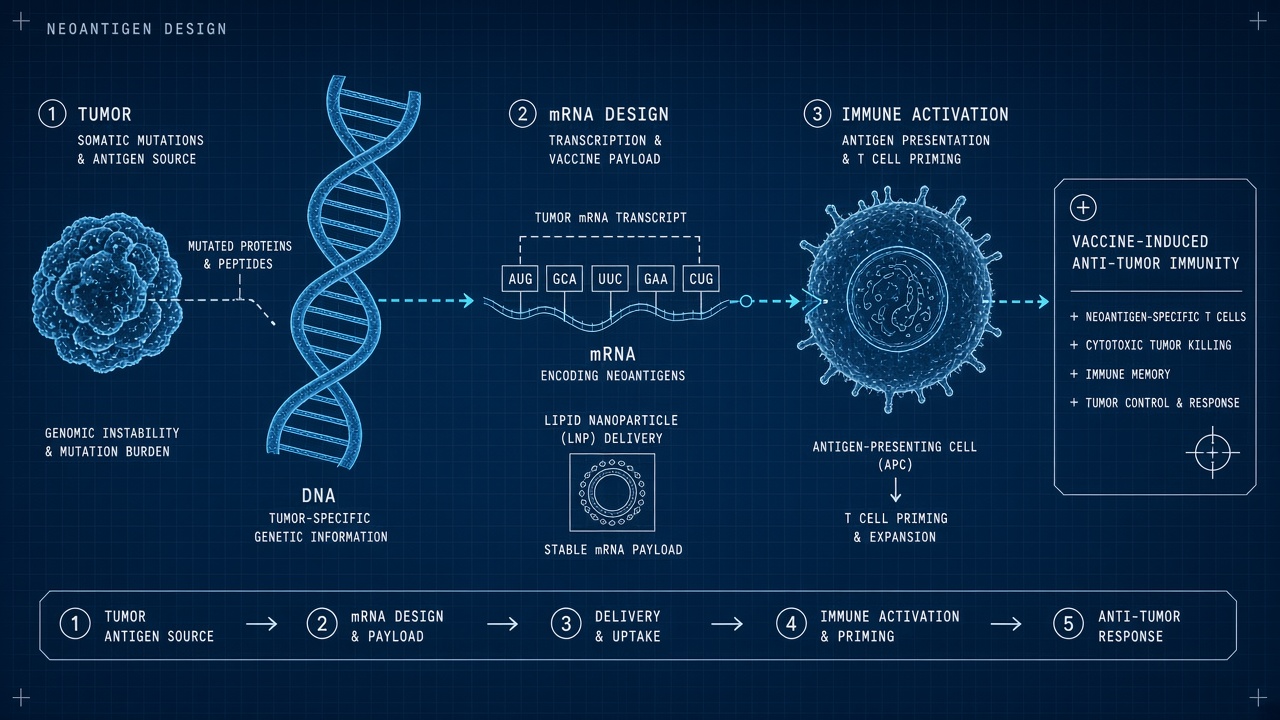
The intended Radical Numerics workflow ingests tumor variant calls and patient MHC allele sequences, predicts which mutated peptides will display on MHC molecules, ranks immunogenic candidates, and writes an optimized mRNA cassette encoding the selected neoantigens. For each candidate peptide, Omnii evaluates presentation jointly with patient HLA context rather than treating binding and immunogenicity as independent scores glued together post hoc. The company states performance is state of the art on public immunology datasets while acknowledging that real-world post-training data will likely matter for clinical translation.
Early access is open to cancer vaccine researchers who want to plug Omnii into existing neoantigen pipelines. Collaborators can test whether unified modeling reduces false positives that waste manufacturing slots on peptides never presented at the cell surface. No peer-reviewed clinical trial readout accompanies the September 2026 blog announcement.
Validation on Public Immunology Data
Published claims rest on computational benchmarks against public presentation and immunogenicity datasets, not on tumor regression in mice or humans. Radical Numerics emphasizes alignment training to make Omnii behave as a reliable scientific instrument rather than a hallucinating chatbot. Independent replication by academic labs will determine whether gains hold on held-out tumor exomes from diverse ancestries. Variant calling errors upstream still poison downstream vaccine designs regardless of model quality.
The June 2026 seed financing also funds biodefense applications: detecting synthetic pathogens and attributing engineered sequences. Cancer vaccine design demonstrates benign use of the same core model, important for dual-use governance conversations as biological design models grow more capable.
Open Problems: Heterogeneity and Expression
Tumor heterogeneity means subclones present different neoantigens; a vaccine targeting trunk mutations may miss escaping branches, while overly narrow targeting may cover too few cells. RNA expression filters eliminate silent mutations never translated into protein, yet single-cell data sparsity complicates decisions. Immunosuppressive microenvironments blunt T-cell activity even when antigens are correct. Omnii does not replace spatial transcriptomics, T-cell receptor sequencing, or manufacturing QC.
mRNA cassette design must balance codon optimization, secondary structure, and innate immune sensing motifs. Generative models can propose sequences that score well in silico yet fail stability assays. Animal studies remain the gate for immunogenicity confirmation before any personalized vaccine reaches patients in trials.
Frequently Asked Questions
Are Omnii cancer vaccines in clinical trials?
No public clinical or animal validation has been reported as of the September 2026 announcement. The offering is computational early access for researchers.
How does Omnii differ from Evo 2?
Omnii adds multimodality, longer context, alignment training, and task-specific post-training for applications like vaccine design. Evo 2 focused on generative DNA modeling at scale.
What is a neoantigen?
A peptide derived from tumor-specific mutations that MHC molecules display to immune cells. Effective vaccine targets are presented and recognizable as foreign.
Who can access Omnii?
Radical Numerics invites cancer immunology and vaccine development groups to apply for early access through their website. Terms and data use agreements apply.
What did the seed round fund?
The $50 million June 2026 seed round led by Emergence Capital supports Omnii development, Nvidia Blackwell compute, and partnerships in diagnostics and biodefense.
Will AI lower vaccine cost?
Better target selection could reduce wasted manufacturing runs, but GMP mRNA production and clinical trial costs dominate economics. AI shortens design cycles; it does not eliminate regulation.
Omnii cancer vaccine AI design compresses a fragmented bioinformatics chain into one post-trained genome language model, a compelling research direction with clear caveats. Until animal and clinical data arrive, treat rankings and mRNA outputs as hypotheses for lab validation. For the AI healthcare ecosystem, Omnii illustrates how multimodal gLMs move from variant interpretation toward therapeutic writing, with biodefense and diagnostics riding the same foundation.
Neoantigen pipeline integrators should log model versions alongside HLA typing assays and tumor sequencing depth so retrospective studies can correlate failures with input quality rather than blaming the model alone. Radical Numerics emphasis on collaboration signals that post-training data from vaccine trials will likely differentiate commercial performance more than public benchmark leaderboard positions.
Dual-use governance matters: models that design immunogenic peptides for cancer can inform pathogen surveillance research and, in adversarial scenarios, risky biological design. Radical Numerics parallel biodefense program with a U.S. national lab partner reflects awareness that powerful gLMs require access controls and monitoring as capable as their medical promise.
Competing neoantigen pipelines from BioNTech, Gritstone, and academic labs traditionally chain NetMHCpan-style binders, expression filters, and clonal fraction thresholds before manufacturing. Omnii cancer vaccine AI design proposes replacing that chain with one post-trained model, but integrators will benchmark against incumbent stacks on shared tumor exomes before switching production logic. Head-to-head studies on melanoma and pancreatic cohorts with published outcomes will determine adoption speed.
MHC class II epitopes help CD4 T cells support durable responses; Radical Numerics blog emphasizes both class I and II presentation prediction in post-training. Many early personalized vaccine trials focused on class I CD8 targets alone; unified modeling may improve epitope spread across helper and cytotoxic lineages when validated experimentally. Single-cell RNA-seq from tumor biopsies still informs which antigens are actually translated, a filter Omnii cannot infer from DNA alone without expression inputs.
Manufacturing personalized mRNA batches under GMP costs hundreds of thousands of dollars per patient in early trial phases. AI that eliminates one failed manufacturing run by catching non-presented peptides pays for compute quickly at scale. Conversely, overconfident rankings that skip useful subclonal targets waste clinical opportunity. Conservative ensemble strategies may keep human immunologists in the loop selecting final epitope lists from Omnii top twenty rather than top five until validation matures.
Radical Numerics scientific advisors include Eric Horvitz, George Church, and Andrew Weber, signaling intent to bridge machine learning rigor, synthetic biology ethics, and biodefense policy. Patrick Collison participation among pre-seed investors highlights Silicon Valley interest in biology foundation models alongside Arc Institute Evo lineage. Omnii two million base pair context supports long-range regulatory reasoning relevant to noncoding driver mutations affecting antigen processing pathways.
Researchers signing early access agreements should clarify publication rights and whether Radical Numerics may use feedback data for further post-training. Cancer vaccine design partnerships with diagnostics firms mentioned at seed announcement may combine liquid biopsy variant calls with Omnii ranking in pancreatic cancer screening workflows, though those integrations remain speculative until public technical papers detail APIs and latency on Blackwell clusters referenced in funding announcements.
Neoantigen vaccines for microsatellite-stable colorectal tumors with moderate mutational burden sit in a middle ground where target selection is hardest: too few mutations for abundant epitopes, too many for exhaustive lab validation. Omnii ranking quality on these borderline exomes will determine whether unified models outperform heuristic filters. Clinical oncologists should view September 2026 announcements as hypothesis generators for translational research groups, not patient-facing treatment options.
Immunotherapy combinations pairing personalized vaccines with checkpoint inhibitors may widen the therapeutic window when presentation predictions identify cryptic epitopes released by interferon signaling. Omnii multimodal inputs could eventually incorporate tumor microenvironment transcriptomics if Radical Numerics extends modalities beyond current previews. Until then, wet-lab immunologists remain the integrators connecting computational rankings to bench experiments and IND-enabling toxicology studies required before first-in-human dosing.
Public neoantigen challenge datasets from TCGA and IEDB provide reproducibility anchors when independent labs evaluate whether Omnii post-training generalizes beyond Radical Numerics internal holdouts. Transparent release of evaluation code would accelerate trust comparable to open weights debates in large language models, though biological design models face stronger dual-use export controls than general chatbots.
Patients reading headlines about genome language model cancer vaccine design should distinguish research-stage computational pipelines from FDA-approved products. Informed consent for tumor sequencing already raises questions about secondary use; adding vaccine design AI introduces another layer clinics must explain when banking exomes for research biobanks. Transparent patient education materials should describe computational ranking as experimental research, not a promise of individualized treatment availability. Academic collaborators should pre-register evaluation protocols before accessing early Omnii builds to avoid selective reporting of favorable tumor exomes in conference abstracts. Wet-lab replication remains the only path from ranked epitopes to investigational new drug filings.