A marketing team discovers their AI image generator produced misleading product visuals that reached thousands of customers before anyone noticed. Legal asks whether this is a consumer complaint, a privacy breach, or a reportable AI incident. Without a decision framework, teams either over-notify regulators and erode credibility, or under-report and face enforcement when the gap surfaces during audit.
AI incident regulatory reporting is the process of determining when failures involving AI tools require notification to market surveillance authorities, sector regulators, or contractual counterparties beyond standard data breach notification. This guide covers incident response leads, legal counsel, and compliance officers managing tools across AI design workflows and production systems. Requirements vary by jurisdiction, sector, and whether your organization acts as provider or deployer under the EU AI Act.
Incident Types: Harm, Bias, Outage, Data
Classify AI incidents into four categories: harm incidents (physical, financial, or reputational injury), bias and fairness incidents (discriminatory or systematically skewed outputs), availability incidents (outages affecting regulated operations), and data incidents (unauthorized access, leakage, or training data contamination). Each category maps to different regulatory triggers. A single event may span multiple categories; document primary and secondary classifications.
| Incident type | Example | Typical regulatory angle |
|---|---|---|
| Harm | Incorrect medical triage suggestion, wrongful denial of service | EU AI Act serious incident, sector safety rules |
| Bias | Hiring assistant systematically down-ranks protected groups | Employment law, fundamental rights, EU AI Act |
| Outage | API failure halting fraud detection for twelve hours | Operational resilience, contractual SLA breach |
| Data | Prompt logs exposed containing customer PII | GDPR breach notification, state privacy laws |
EU AI Act Serious Incident Definition
Under the EU AI Act, a serious incident means an incident or malfunction directly or indirectly leading to death or serious harm to health, serious disruption of critical infrastructure, infringement of EU fundamental rights obligations, or serious harm to property or the environment. Deployers of high-risk AI systems must immediately notify the provider, then importers, distributors, and market surveillance authorities. Article 73 reporting timelines apply when the provider cannot be reached: fifteen days normally, two days for widespread infringement or critical infrastructure disruption, and ten days when death is involved.
Triage Severity Matrix
Assign severity levels P1 through P4 at intake: P1 involves death, serious injury, or critical infrastructure; P2 involves regulatory reportable harm or large-scale data exposure; P3 involves contained harm or internal-only impact; P4 is operational nuisance without regulatory trigger. P1 and P2 activate legal and executive notification within one hour. P3 requires documented investigation; P4 closes through standard IT incident process unless patterns escalate.
Cross-Reference Privacy Breach Tests
Run every AI data incident through both AI-specific reporting logic and privacy breach notification tests: unauthorized access to personal data, likely risk to rights and freedoms, and jurisdictional seventy-two-hour GDPR deadlines where applicable. An AI incident and a privacy breach can occur simultaneously but require separate notifications to different authorities. Document both decision paths in the incident record.
| Test | Privacy breach path | AI regulatory path |
|---|---|---|
| Personal data involved? | Yes triggers GDPR/CCPA analysis | May be relevant but not sufficient alone |
| High-risk AI system? | Not determinative for breach | Yes enables Article 26/73 obligations |
| Harm to individuals? | Elevates breach severity | May define serious incident |
| Authority to notify | Data protection authority | Market surveillance or sector regulator |
Dual Notification Coordination
When both paths trigger, assign a single incident commander to coordinate timing, consistent factual statements, and cross-references between filings. Contradictory narratives between DPA notification and market surveillance report invite investigation. Privacy counsel and product counsel should review both drafts before submission.
Sector-Specific Reporting: Finance and Health
Financial institutions face additional AI incident reporting under operational resilience frameworks; healthcare organizations must evaluate FDA adverse event rules, HIPAA breach notification, and clinical decision support reporting obligations. Sector rules may require notification even when general AI regulations do not. Map your AI tool inventory to sector-specific trigger tables during governance setup.
Financial Services Triggers
Banks and insurers using AI for credit decisions, fraud detection, or trading must evaluate whether incidents constitute reportable operational disruptions under DORA, national banking authority guidance, or internal materiality thresholds. A twelve-hour outage of an AI fraud model blocking legitimate transactions may trigger operational resilience reporting even without data loss. Document model role in critical business services during business impact analysis.
Healthcare Triggers
Healthcare deployers must assess whether AI-assisted diagnostic or triage errors constitute reportable adverse events, whether PHI exposure triggers HIPAA breach notification, and whether the system qualifies as a medical device under applicable jurisdiction. Clinical AI incidents often require notification to institutional review boards, device manufacturers, and patients in addition to regulators. Never conflate IT incident severity with clinical harm severity.
| Sector | Regulator or framework | Example AI incident trigger |
|---|---|---|
| Finance | DORA, national banking authority | Critical AI service unavailable beyond RTO |
| Healthcare | FDA, HIPAA, institutional policy | AI triage error causing care delay |
| EU cross-sector | EU AI Act market surveillance | Serious incident in high-risk system |
| Consumer products | FTC, consumer protection authority | Deceptive AI-generated marketing at scale |
Documentation and Timeline
Maintain an incident record capturing discovery timestamp, classification, affected systems, data classes, harm assessment, notification decisions, authority contacts, submission timestamps, and remediation status. EU AI Act deployer obligations include retaining logs for at least six months. Incident documentation becomes evidence during regulatory follow-up and litigation discovery.
Reporting Timeline Checklist
- T+0: Incident detected; severity assigned; incident commander named.
- T+1 hour: Legal and privacy engaged; containment actions documented.
- T+4 hours: Preliminary harm and data assessment; provider notified if vendor-caused.
- T+24 hours: Regulatory notification decision documented with rationale.
- T+72 hours: GDPR breach notification to DPA if required.
- T+15 days: EU AI Act Article 73 report if serious incident confirmed and provider unreachable.
- T+30 days: Root cause analysis and corrective action plan completed.
Evidence Preservation
Preserve model version, prompt logs, system configuration, user actions, and vendor communications under legal hold before remediation destroys forensic data. Teams using AI image generator tools should capture the exact generation parameters and source prompts when misleading outputs cause consumer harm. Chain of custody matters when regulators request reproduction steps.
Notification Templates
Pre-draft regulator notification templates for each jurisdiction and sector covering incident description, affected system identification, causal hypothesis, immediate actions, and contact details. Templates accelerate filing during crisis; legal must customize facts per incident. Store templates in the incident response playbook, not in individual email drafts.
Vendor Notification Obligations
Contractual AI vendor agreements should require vendors to notify your organization within twenty-four hours of incidents affecting your data, model behavior, or service availability. Vendor notification timelines run parallel to, not instead of, your regulatory obligations. Document vendor notification receipt in the incident record. If the vendor fails to notify within contract SLA, escalate to procurement and legal for breach-of-contract assessment.
Customer Notification Requirements
Beyond regulators, assess whether contractual SLAs, privacy policies, or sector rules require customer notification when AI incidents affect their data or services. Customer notification may be required even when regulatory reporting is not. Coordinate customer communications with legal before public statements. Template customer notification letters during incident playbook development, not during the incident.
Post-Incident Regulatory Follow-Up
After initial notification, regulators may request supplemental reports, root cause analysis, corrective action plans, and evidence of remediation within defined follow-up windows. EU AI Act Article 73 requires providers to investigate and perform risk assessment following serious incident reports. Deployers must cooperate with provider investigations and maintain independent documentation of their own assessment and remediation steps.
Corrective Action Documentation
Document corrective actions with: root cause, scope of affected users or decisions, remediation steps implemented, validation that remediation is effective, and preventive controls added. Regulators evaluate whether corrective action addresses systemic risk, not just the single incident. Model retraining, prompt guardrail updates, access revocation, and process changes each require separate documentation with before-and-after evidence.
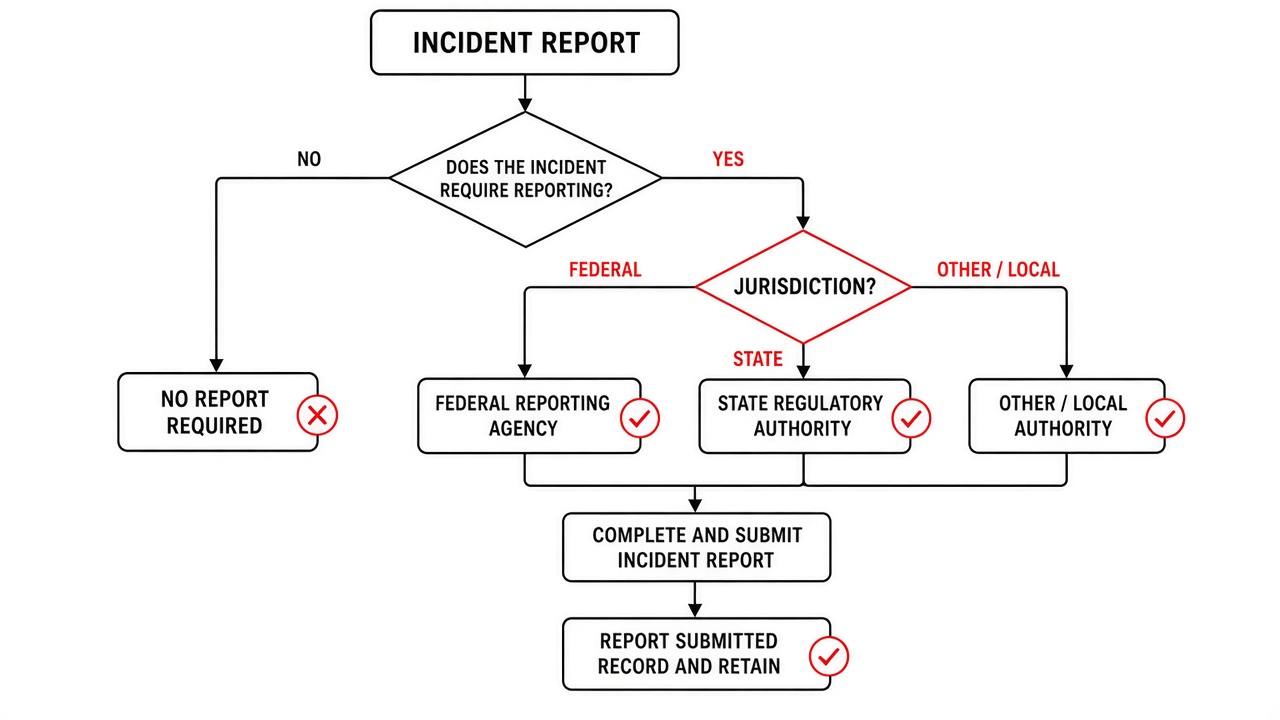
Decision Tree for Reporting
Answer four questions in sequence: (1) Does the incident involve a regulated high-risk AI system? (2) Does it meet serious incident or sector-specific harm thresholds? (3) Does personal data exposure trigger privacy breach notification? (4) Do contractual obligations require customer notification? A yes on any path initiates the corresponding workflow. Multiple yes answers run in parallel with coordinated messaging.
Provider vs Deployer Obligations
Providers report serious incidents under Article 73; deployers notify providers immediately under Article 26 and may inherit Article 73 obligations when providers are unreachable. Know your role per system in the AI inventory register. SaaS customers are typically deployers; organizations fine-tuning and distributing models may be providers. Role confusion delays mandatory notifications.
Frequently Asked Questions
Do near-misses require regulatory reporting?
Near-misses without actual harm generally do not trigger mandatory regulatory notification, but document them in internal incident logs and trend analysis for governance review. A bias detection alert that blocked discriminatory output before deployment is a control success, not a reportable incident. Repeated near-misses in the same system may indicate a reportable risk under Article 79 deployer duties.
Who reports when a vendor-caused AI incident affects our customers?
Notify the vendor immediately per contract; your organization remains responsible for customer and regulator communication when you deployed the system under your authority. Deployer obligations under the EU AI Act do not transfer to the vendor because the incident originated upstream. Pursue vendor contractual remedies separately from regulatory compliance.
Does a misleading AI-generated marketing image require regulator notification?
Consumer deception at scale may trigger advertising standards authority complaints and FTC scrutiny, but typically not EU AI Act serious incident reporting unless the system is classified high-risk and harm thresholds are met. Still notify affected customers, correct published materials, and document the incident. Teams using AI design tools for customer-facing assets should treat misleading outputs as brand risk events with legal review.
How do we handle incidents affecting users in multiple countries?
Notify market surveillance authorities in each Member State where the serious incident occurred; for privacy breaches, notify the lead supervisory authority and affected data subjects per GDPR one-stop-shop rules where applicable. Maintain a jurisdiction contact registry updated quarterly. Cross-border incidents require legal counsel in each relevant jurisdiction before filing.
Tabletop Exercises and Playbook Testing
Run semi-annual tabletop exercises simulating AI incidents across harm, bias, outage, and data categories to test decision trees, notification timelines, and cross-functional coordination before real incidents occur. Include legal, privacy, security, communications, and business unit representatives. Document exercise findings and update playbooks within thirty days. Regulators and enterprise customers increasingly ask whether organizations have tested AI incident response procedures.
Playbook Components
- Incident classification matrix with severity definitions and examples.
- Regulatory contact registry by jurisdiction and sector.
- Pre-drafted notification templates for each authority type.
- Escalation tree with named alternates and contact methods.
- Evidence preservation checklist for AI-specific artifacts.
- Communication approval workflow for internal and external statements.
- Vendor notification procedures and contractual SLA references.
Creative AI Incident Scenarios
Design exercises around realistic scenarios for creative AI tools: mass publication of AI-generated product images with factual errors, deepfake content in customer communications, or design asset copyright infringement discovered post-publication. Teams using AI design and image generation tools face reputational harm incidents that may not trigger traditional security incident playbooks. Extend classification matrices to cover brand and consumer harm categories.
Regulatory Landscape Overview
AI incident reporting obligations emerge from multiple frameworks simultaneously: EU AI Act Articles 26 and 73 for high-risk systems, GDPR for personal data breaches, sector-specific rules in finance and health, and emerging national AI safety reporting requirements. Your decision tree must account for overlapping obligations. A single incident may require coordinated filings to a data protection authority, market surveillance authority, and sector regulator within different timelines.
Internal Escalation Before External Filing
Before external regulatory filing, escalate internally through: incident commander, privacy officer, general counsel, CISO, and executive sponsor for incidents rated P1 or P2. Executive awareness before regulator contact prevents leadership surprises during follow-up calls. The internal escalation chain operates independently from but in parallel with regulatory notification timelines.
Prepared Reporting Beats Reactive Scrambling
AI incident regulatory reporting succeeds when teams classify harm, bias, outage, and data incidents consistently, cross-reference privacy breach obligations, apply sector-specific triggers for finance and health, and maintain documentation timelines regulators expect. Build the decision tree before the incident, not during the crisis call with counsel.