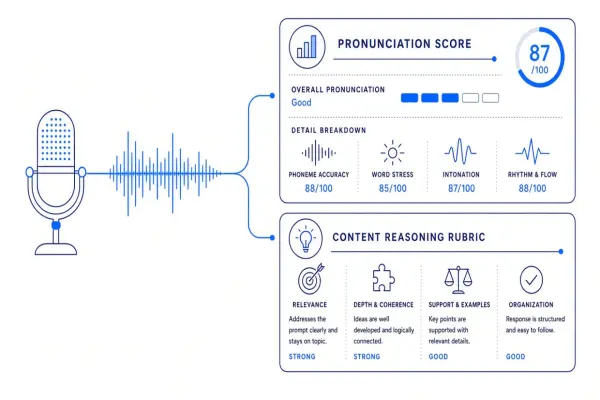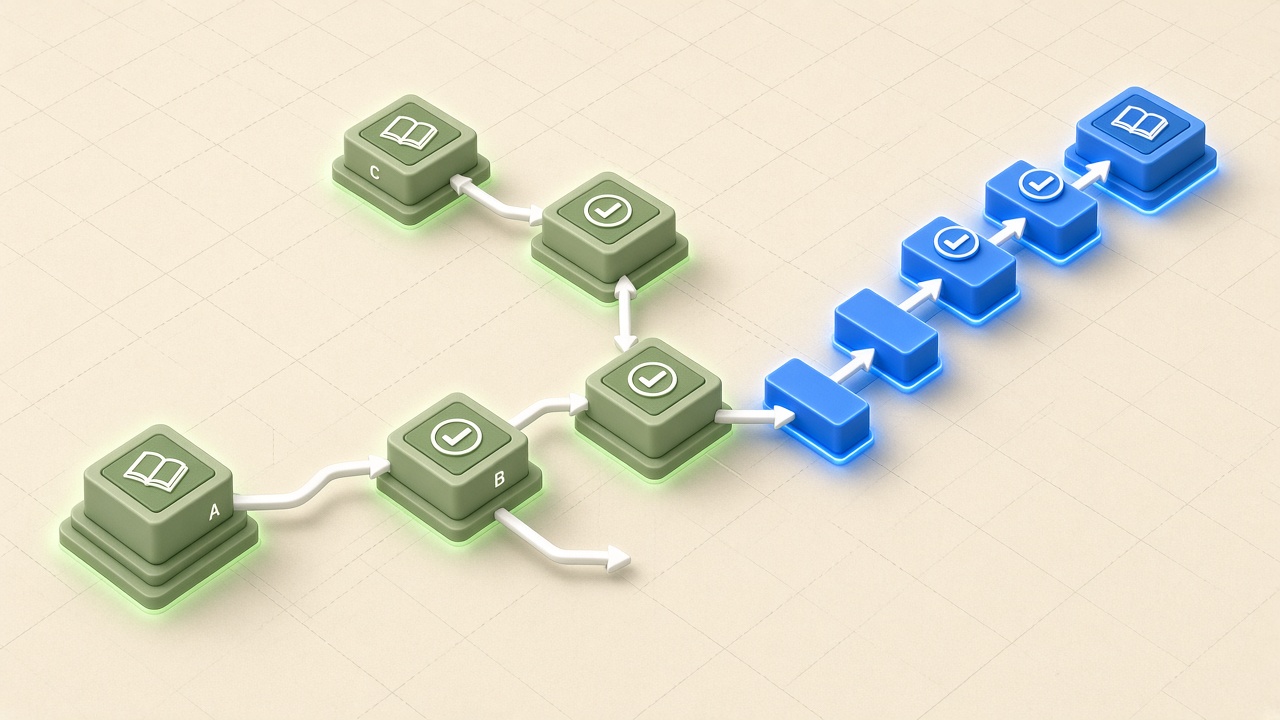
Adaptive learning pathways with AI use knowledge tracing models to estimate what a learner knows after each interaction, then select the next exercise, hint, or review item to maximize mastery per minute spent. Platforms from DreamBox Math and Knewton alta to corporate LMS plugins share the same loop: observe response, update a latent mastery state, recommend content. The difference between marketing "personalization" and real adaptivity lies in whether sequencing changes based on inferred knowledge or only on a static difficulty slider. Product and curriculum teams evaluating AI chatbot tutors should ask which tracing family powers recommendations and what evidence backs claimed learning gains.
Carnegie Learning's MATHia and ALEKS represent another branch: cognitive tutors with explicit problem-step guidance plus knowledge component modeling. The unifying idea remains the same: estimate latent skill state, pick the next item maximizing expected learning per minute, and revisit skills before forgetting. Marketing language conflates "AI tutor chat" with this harder sequencing problem; buyers should demand architecture diagrams, not only demo videos.
What Adaptivity Means Beyond Difficulty Sliders
True adaptive pathways reorder skills based on prerequisite mastery, forgetting curves, and item difficulty, not merely by serving harder questions after a streak of correct answers. A difficulty slider increases numeric challenge while leaving the skill graph fixed. Adaptive systems maintain a vector of skill probabilities (fractions, linear equations, word problems) and may insert remediation on a weak prerequisite even when the learner is "level 10" on a gamified map. DreamBox Math advertises continuous formative assessment that drives in-the-moment lesson changes for K-8 math; Knewton's API returns prioritized module lists with justifications tied to goal completion criteria.
Spacing and interleaving belong in adaptivity. Cognitive science shows mixed practice beats blocked practice for long-term retention. Good platforms schedule reviews just before predicted forgetting, not only when a unit ends. Corporate L&D suites sometimes bolt chatbots onto static SCORM paths; without tracing, the chatbot answers questions but does not reshape the assignment queue.
Transparency helps adoption. When learners see why the system offered a review (weak on distributing negatives last Tuesday), trust rises. Opaque "AI picked this" messaging feels arbitrary. Educators need override tools to pin mandatory standards while letting adaptivity fill gaps.
Bayesian Knowledge Tracing Basics
Bayesian Knowledge Tracing (BKT) models each skill as a hidden binary state (learned or not) with parameters for initial knowledge, learning rate, slip (guess), and guess (lucky correct), updated after every attempt using Bayes' rule. Classic BKT is interpretable: teachers can read P(mastery) per knowledge component. It scales poorly on raw implementations but modern RNN-cell formulations run within an order of magnitude of optimized C++ while allowing extensions like multidimensional item response theory and automatic skill discovery from problem text.
Extended BKT adds forgetting, latent student ability, and discovered skill assignments. Research comparing BKT extensions to Deep Knowledge Tracing found that when BKT incorporates forgetting and ability, predictive AUC gaps shrink dramatically, suggesting DKT's early advantage came partly from modeling regularities BKT omitted, not from mystical deep representations alone.
BKT fits regulated K-12 procurement where explainability matters. Districts under ESSA evidence rules cite DreamBox's "Strong" Evidence for ESSA rating. Interpretable mastery dashboards support parent conferences without neural network opacity.
Deep Models on Interaction Logs
Deep Knowledge Tracing (DKT) and successors use recurrent or attention networks over entire interaction sequences to predict the next response correctness, capturing complex temporal patterns BKT's Markov assumptions miss. Piech et al.'s original DKT applied LSTMs to MOOC clickstreams. Newer DKT2 integrates xLSTM, Rasch item difficulty, and Item Response Theory outputs for richer state vectors. Self-Attentive Knowledge Tracing (SAKT) and Dynamic Key-Value Memory Networks (DKVMN) compete on benchmark AUC, though empirical reviews warn that hyperparameter tuning and metric choice swing rankings more than architecture logos suggest.
Deep models shine on large proprietary logs (millions of attempts) where feature engineering per skill is costly. They risk overfitting small courses and offer weak causal claims: predicting the next click is not proving a pathway caused learning. Production systems often ensemble BKT-style interpretable layers with neural encoders, as in Deep-IRT hybrids.
| Model family | Strength | Trade-off |
|---|---|---|
| BKT and extensions | Interpretable mastery per skill | Needs careful skill tagging |
| DKT / DKT2 / SAKT | Rich sequence patterns at scale | Opaque, data hungry |
| IRT + BKT fusion | Generalizes to new students | Heavier setup |
| Rule-based pathways | Simple, auditable | Weak personalization |
Content Sequencing and Spacing Effects
After mastery estimation, pathway engines map skills to a content graph, enforce prerequisites, inject spaced reviews, and balance novelty with consolidation. Knewton recommendations consider goal structure, content alignment tags, difficulty parameters, and pedagogical policies (mastery learning versus exploratory browsing). DreamBox ties teacher-assigned standards to adaptive lesson pools so adaptivity stays curriculum-aligned. MOOC platforms historically used unit-linear paths; newer cohorts embed tracing to reduce dropout on prerequisite gaps.
Mastery thresholds trigger advancement: commonly 0.85 to 0.95 probability correct on a skill before unlocking dependents. Set too low, learners advance with holes; too high, frustration rises. Adaptive engines should expose threshold tuning per district policy. Spacing schedules use half-life regression or simplified Leitner boxes at scale.
Content authoring burden remains the hidden cost. Tracing only works when items tag skills precisely. Auto-skill discovery from item text (neural BKT extensions) reduces manual Q-matrix work but needs validation by subject experts before high-stakes placement.
K-12, Corporate, and MOOC Deployment Models
K-12 adaptive math (DreamBox, i-Ready, ALEKS) emphasizes standards-aligned item banks and teacher assignment controls; corporate L&D uses skills graphs tied to job roles; MOOCs historically lag unless cohort size justifies tracing infrastructure. DreamBox Reading Plus places students via Insight assessments measuring motivation, vocabulary, comprehension, and silent reading fluency before adaptive paths begin. Corporate platforms map compliance modules (cybersecurity phishing drills) with forced sequencing regardless of prior mastery, a simpler graph than open-ended upskilling on data science topics where prerequisites branch widely.
MOOC providers experimenting with tracing must handle massive dropout: adaptivity helps only learners who return. Cohort-based certificates with weekly deadlines pair better with BKT reminders than self-paced archives where 90 percent never finish week two.
Evidence Reviews on Learning Gains
Randomized and quasi-experimental studies report modest but meaningful effect sizes for well-implemented adaptive math and literacy platforms, while poorly integrated deployments show null results. DreamBox cites multiple third-party studies linking consistent usage to improved state test scores; Reading Plus claims up to 2.5 grade levels of reading growth in one school year under heavy usage assumptions. Comparative reviews of Carnegie Learning, DreamBox, Smart Sparrow, and Knewton emphasize that platform choice matters less than implementation fidelity, teacher training, and time-on-task.
Skeptical analyses note DLKT models sometimes beat simple logistic baselines by small margins once hyperparameters are fairly tuned. Always demand effect sizes, sample demographics, and dosage (minutes per week). Adaptive pathways amplify good content and expose bad content faster; they do not fix misaligned standards.
Corporate L&D evidence is thinner publicly. Vendor case studies report faster compliance completion, but independent RCTs are rare. Pilot with skill assessments before and after, not only completion rates.
Implementation Pitfalls for Districts
Adaptive platforms fail quietly when teachers skip dashboard review, students rack up minutes on easy items, or content tags do not match state standards. A 2025 comparative review of Carnegie Learning, DreamBox, Smart Sparrow, and Knewton noted that bias, data privacy, and teacher role clarity determine outcomes more than algorithm brand names. Districts should budget professional development days for reading mastery heatmaps, not only software licenses.
Equity checks matter: if adaptive systems route struggling students into endless remediation without enrichment, engagement collapses. Cap consecutive review items and inject challenge problems once mastery crosses a floor. English learners may need bilingual glossaries independent of math tracing; adaptivity on numeracy should not assume reading speed on word problems equals math ability.
Vendor churn is real: Knewton's consumer alta product history shows adaptive engines outlive brand names. Contract exit clauses should let districts export item response data and skill tags if switching platforms.
Future of Tracing and LLM Tutors
Large language model tutors add natural language hints but still need tracing layers to decide which exercise to assign next; chat alone is not a pathway engine. Emerging research combines xLSTM-based DKT2 with generative explanations: the tracer flags weak fraction division, the LLM produces a worked example, the tracer verifies improvement on the next item. Product teams labeling themselves "adaptive AI" should disclose whether sequencing uses verified tracing or prompt-based guesswork.
Open datasets like ASSISTments and EdNet enable researchers to benchmark new models; production platforms rarely publish proprietary logs. Skeptical buyers should ask for AUC or RMSE on held-out district data during pilots, not only national marketing studies.
Regulators watching AI in education (EU AI Act high-risk classifications for certain admissions uses) may require explainable mastery traces. BKT-first stacks ease compliance narratives; pure neural tracers may need post-hoc explanation layers or human review gates before high-stakes placement decisions.
Summer slide and pandemic recovery programs leaned heavily on adaptive math minutes; districts reporting gains also increased teacher coaching time, reminding buyers that software amplifies instruction rather than replacing it.
Frequently Asked Questions
How do adaptive pathways differ in K-12 versus higher ed?
K-12 products emphasize standards alignment, COPPA/FERPA compliance, and teacher dashboards (DreamBox, i-Ready). Higher ed often uses Knewton alta-style courseware with integrated textbooks and remediation loops tied to credit-bearing quizzes.
Do corporate LMS adaptive features use knowledge tracing?
Many use rules (complete A before B) or popularity rankings. True tracing appears in specialized upskilling vendors and some LinkedIn Learning-style recommendation engines, but verify before assuming neural personalization.
Can MOOCs personalize at scale?
Large open courses historically lacked per-learner pathways; tracing deployments increase infrastructure cost. Cohort-based MOOCs with smaller N benefit most.
Should new products start with BKT or DKT?
Start BKT or IRT-BKT when interpretability and small data matter. Add deep sequence models once logs exceed hundreds of thousands of labeled interactions and privacy review allows centralized training.
Do teachers become obsolete?
No. Adaptivity handles item selection; teachers handle motivation, misconception diagnosis, and social learning. Best deployments pair adaptive homework with discussion sections.
What student data do tracing models store?
Typically item IDs, timestamps, correctness, hints used, and inferred mastery vectors. Districts should review retention and whether vendors train global models on local students.
How can schools prove efficacy?
Run matched cohort pilots with pre/post assessments, control for minutes of usage, and publish results regardless of direction. Ask vendors for independent studies, not only marketing PDFs.
Should parents see mastery dashboards?
Transparency builds trust when scores are explained as practice estimates, not fixed labels. Avoid sharing raw traces that discourage students labeled perpetually below grade level without growth metrics.
Should adaptive homework differ from in-class work?
Many districts assign adaptive practice at home while keeping teacher-led instruction non-adaptive for pacing unity. Ensure home pathways still align with weekly classroom objectives so parents are not confused by divergent topic orders.