Your product team renames a feature, updates pricing, and archives last year's documentation. The chatbot still retrieves old passages about deprecated APIs and answers confidently with outdated numbers. The language model is fine. The vector index is stale. Embeddings captured meaning at index time. When source documents change without a refresh, semantic search drifts away from reality.
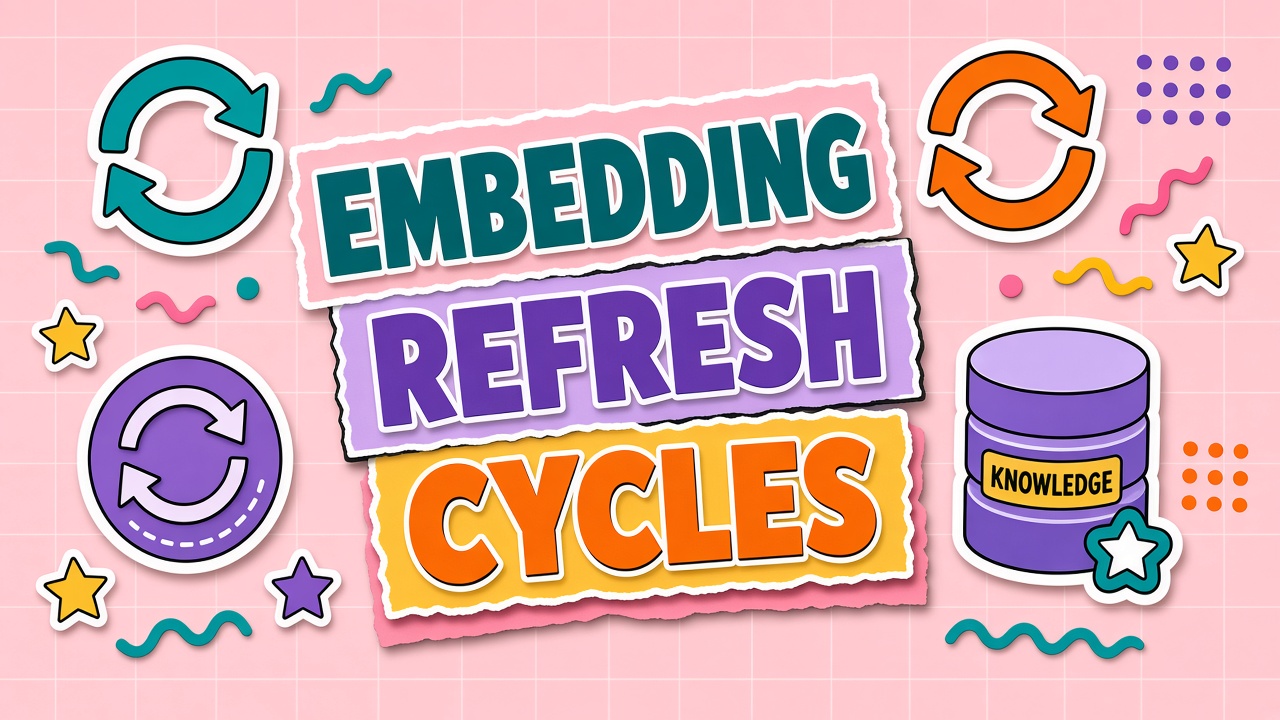
Embedding refresh is the scheduled or event-driven process of re-embedding documents and updating vector indexes so retrieval stays aligned with current content. Pinecone, Weaviate, Qdrant, pgvector, Elasticsearch dense vectors, and managed RAG platforms on AWS and Azure all depend on refresh cycles, whether or not the vendor labels them explicitly. Teams building AI automation workflows and AI API integrations with retrieval should plan refresh strategy alongside chunking and embedding model choice. This guide covers what refresh means, when stale embeddings break answers, cycle design tradeoffs, and operational checks before production launch.
Embedding refresh sits alongside chunking strategy and embedding model selection as one of three retrieval decisions that determine long-term answer quality. Teams that nail chunk size on day one but never refresh still lose to competitors who reindex on every meaningful doc change with a simpler chunk policy.
Treat refresh jobs as production traffic with SLAs, on-call rotation, and dashboards. When indexing fails overnight, morning users should not be the first monitoring system you have.
What Embedding Refresh Means for Vector Search
Embeddings are numeric vectors that represent semantic meaning. When you index a document, an embedding model converts each chunk into a vector stored in a search index. Queries are embedded with the same model and matched by similarity. Refresh means repeating that conversion after content or model changes.
Refresh is not the same as retraining the LLM. The generative model weights stay fixed. Only the retrieval layer updates. That separation keeps knowledge current without the cost and risk of fine-tuning on every wiki edit.
Common triggers that require refresh
- Document edits: Any change to text, metadata, or access permissions affecting searchable content.
- Embedding model upgrade: Switching from one embedding model to another invalidates all existing vectors.
- Chunking policy change: Different split sizes produce different passages that need new embeddings.
- Source connector drift: Failed sync jobs leave indexes missing new files or still holding deleted ones.
- Language or locale expansion: New locales may need dedicated embedding models or multilingual indexes.
| Refresh scope | What gets rebuilt | Typical duration |
|---|---|---|
| Incremental | Changed or new chunks only | Minutes to hours depending on edit volume |
| Full reindex | Entire corpus re-embedded and replaced | Hours to days for large libraries |
| Blue-green index swap | New index built offline, traffic switched atomically | Same as full reindex plus cutover planning |
When Stale Embeddings Break Retrieval Quality
Staleness shows up as wrong answers that look authoritative because the model synthesizes outdated chunks fluently. Support teams report "the bot lied" when retrieval returned deprecated policy text the model treated as ground truth.
Symptoms operators should monitor
- Answers cite URLs or product names that no longer exist.
- Retrieval scores stay high while human reviewers mark responses incorrect.
- New documentation never appears in bot answers despite successful CMS publish.
- Deleted sensitive content still surfaces in internal search assistants.
- After an embedding model upgrade, similarity scores drop across the board without code changes.
AI API products with managed RAG sometimes hide index lag behind marketing claims of "real-time sync." Ask for measured sync latency from document publish to searchable embedding, not only connector availability lists.
Search vector search AI tools with refresh automation in mind. Manual reindex buttons do not scale when product docs change daily.
Refresh Cycle Strategies: Full Reindex vs Incremental Updates
Cycle design balances freshness, cost, and operational risk. Small teams often start with nightly full jobs. Mature platforms move to incremental updates triggered by webhooks from CMS, ticket systems, or object storage events.
| Strategy | Pros | Cons |
|---|---|---|
| Scheduled full reindex | Simple to reason about; clears orphaned chunks | Expensive at scale; stale until job completes |
| Event-driven incremental | Lower cost; fresher answers for hot documents | Complex deduplication; missed events cause silent gaps |
| Hybrid weekly full plus incremental | Balances cost with orphan cleanup | Two pipelines to monitor and alert on |
Embedding model versioning
Changing embedding models requires a full reindex. Vectors from different models are not comparable in the same index. Production cutovers often build a parallel index, evaluate retrieval quality on a golden question set, then swap traffic. Teams using AI automation platforms should store model name and version in index metadata for debugging and rollback.
Cost and API rate limits
Re-embedding one million chunks consumes embedding API tokens and vector database write units. Budget refresh jobs against provider rate limits. Batch during off-peak hours. Cache content hashes so unchanged files skip re-embedding even during full corpus scans.
Embedding Refresh in RAG and Automation Contexts
RAG chatbots are the most visible consumers of embedding refresh, but the same discipline applies wherever vectors power matching: ticket routing, duplicate detection, semantic caching, and recommendation feeds inside AI automation products. When any of those pipelines read from an stale index, downstream automations act on wrong matches silently.
Automation workflows that branch on semantic similarity need explicit refresh SLAs in runbooks. If a nightly job rebuilds the index but daytime edits land hourly, triggers scheduled between those windows operate on outdated embeddings. Event-driven refresh aligned to CMS webhooks, Git pushes, or ticket closure events closes that gap without full daily reindex cost.
Multi-tenant and per-customer indexes
B2B products often isolate each customer's corpus in separate indexes or namespaces. Refresh jobs must scope updates per tenant so one customer's bulk upload does not block another's incremental sync. Monitor queue depth per tenant and cap concurrent re-embed jobs to protect shared embedding API quotas.
API-first products that expose embeddings as a service should publish refresh status in developer docs: last index build time, documents pending, and error counts. Teams building on your AI API cannot debug retrieval quality when index freshness is invisible.
Operational Checklist for Production Refresh Pipelines
Refresh pipelines fail quietly when observability is weak. Treat indexing as a first-class service with alerts, not a background script that runs when someone remembers.
- Content hashing: Skip unchanged documents using SHA hashes of normalized text.
- Dead letter queues: Capture failed embeds for retry instead of dropping silently.
- Index health metrics: Track document count, last successful sync, and lag from source modified time.
- Golden eval set: Run automated retrieval tests after each major refresh or model change.
- Rollback plan: Keep previous index snapshot or version until new index passes eval gates.
- Access control sync: Refresh metadata when permissions change, not only when body text changes.
Measuring freshness with synthetic probes
Maintain a set of probe documents with known unique phrases inserted after each publish test. Automated jobs query the index for those phrases and alert if retrieval fails within your SLA window. Probe queries catch connector failures faster than waiting for user complaints about wrong answers.
Frequently Asked Questions
How often should we refresh embeddings?
Match refresh frequency to content change rate. Static policy PDFs may need weekly jobs. Active product docs and ticket knowledge bases often need hourly incremental updates or near-real-time webhooks. Measure staleness incidents, then tune.
Do managed RAG tools refresh automatically?
Many do for connected sources, with caveats. Verify which file types sync, maximum file size, delete propagation, and whether permission changes trigger reindex. "Automatic" rarely means instant without documented latency bounds.
What happens when documents are deleted?
Orphan vectors persist until explicitly removed. Incremental pipelines must delete stale chunk IDs from the vector store. Full reindexes clean orphans but are costly. Deletion sync is a common gap in DIY RAG stacks.
Do we need refresh if we only change chunk size?
Yes. Chunk boundaries change which text gets embedded. Old vectors no longer represent the new passages. Plan a full reindex when chunking strategy changes materially.
Does hybrid search reduce refresh urgency?
Keyword layers help when exact terms changed but semantics stayed similar. Hybrid search does not fix wrong numeric values or removed policies in vector-only matches. Refresh remains essential for accurate RAG.
How much does embedding refresh cost at scale?
Cost scales with corpus size, chunk count, embedding model price per token, and refresh frequency. Incremental refresh with content hashing usually costs an order of magnitude less than nightly full reindex on large libraries. Model upgrades that force full rebuild are the most expensive events; budget them explicitly in roadmap planning.
How do we monitor refresh pipeline health?
Track lag from source modified timestamp to indexed embedding, failed job counts, queue depth, and probe query success rate. Alert when lag exceeds SLA or when document counts drop unexpectedly, which often signals deletion sync failures rather than genuine corpus shrinkage.
Keeping Vector Search Trustworthy Over Time
Embedding refresh is the maintenance discipline that keeps retrieval-augmented systems honest. Without it, the best LLM and the best embedding model still answer from yesterday's knowledge base.
Teams wiring AI automation and AI API retrieval should define refresh triggers, monitor index lag, and test with golden questions after every model or chunking change. Search vector search platforms on EliteAI.tools for connector coverage and reindex controls, not only embedding quality benchmarks. Fresh indexes are what turn semantic search from a demo into a system users can trust months after launch.
Schedule embedding refresh reviews in the same cadence as security patches and dependency upgrades. Stale retrieval is a silent regression: users blame the model while the fix is operational, not a prompt tweak.