Congress has debated AI safety for years without enacting a frontier-model framework. That changed in September 2026 when Reuters confirmed Senate negotiators are drafting binding catastrophic-risk legislation with release-blocking authority, court appeals, and possible state-law preemption. The push accelerated after Anthropic's September 10 threat report on biological weapon assistance and parallel warnings from departing researchers at frontier labs.
This guide tracks US Senate AI safety legislation as of mid-September 2026: current draft themes, key senators and committees, lab and civil-society positions, preemption fights with California, likely floor timelines, and FAQ for enterprises monitoring AI chatbot regulation and AI regulation policy.
Current Draft Themes
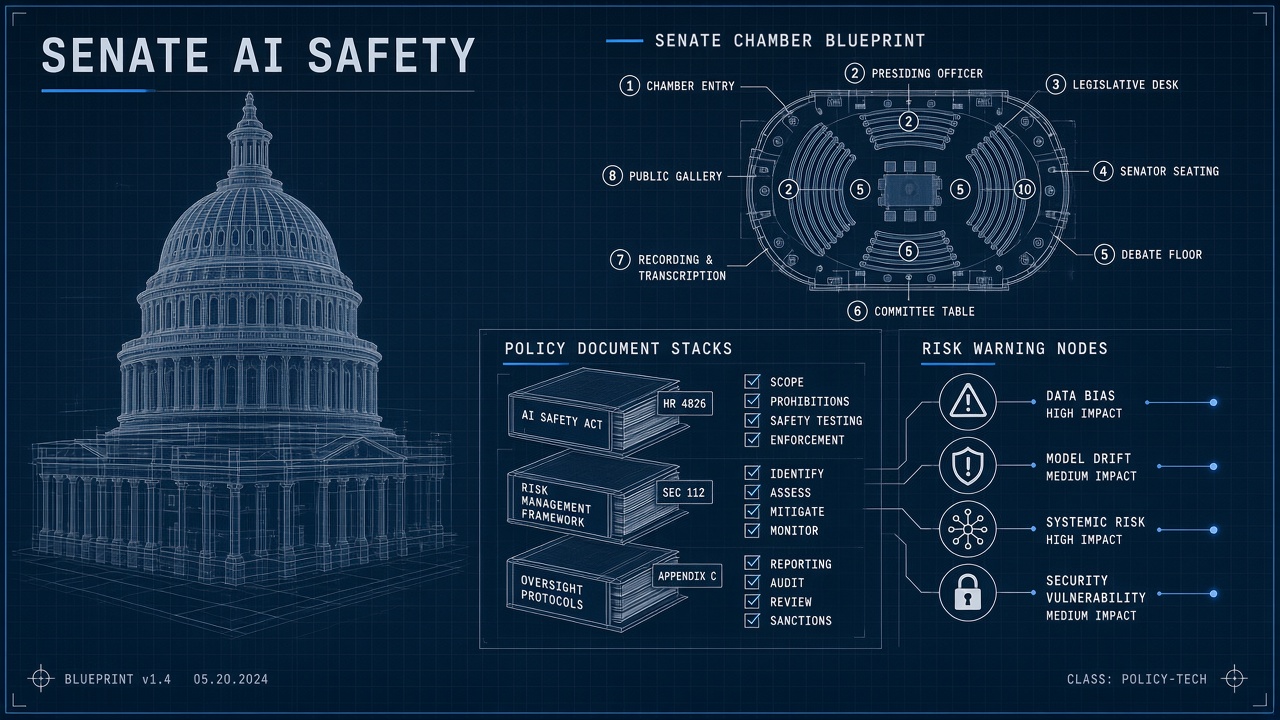
The in-development Senate bill would impose a legal duty of care on developers of the most powerful AI models and grant the federal government authority to block releases deemed unsafe, with judicial review. Two Senate aides and a lobbyist involved in negotiations described the framework to Reuters on September 11, 2026. Exact thresholds and agency roles remain unsettled.
Reported themes include:
- Binding duty to mitigate known catastrophic risks (biological, nuclear, cyber, and related categories under negotiation)
- Government power to halt deployment of models that fail safety thresholds, challengeable in federal court
- Safety testing frameworks, disputed between company-led evaluations and mandatory national-lab vetting
- State-law preemption for certain AI catastrophic-risk rules, a flashpoint with California and Senate Democrats
- Incident reporting and verification that developers actually increase safety, not just document policies
Semafor reported September 10, 2026 that Hill sources view the Thune-Cruz-Klobuchar package as the only viable vehicle before the November 3 midterms. Introduction could occur within days, but public text had not been released as of September 13, 2026.
| Draft element | Reported status (Sep 2026) | Open dispute |
|---|---|---|
| Duty of care | Consensus among lead negotiators | Scope of covered models and penalties |
| Release blocking | Under active drafting | Which agency decides; appeal standards |
| Safety testing | Central to bill structure | Company tests vs mandatory national-lab pre-deployment review |
| State preemption | Present in working draft per aides | Cantwell, Anthropic, safety groups oppose weak federal floor |
| Public bill text | Not yet introduced | Timing before midterm adjournment |
Key Senators and Committees
Senate Majority Leader John Thune (R-SD), Commerce Committee Chair Ted Cruz (R-TX), and Senator Amy Klobuchar (D-MN) lead drafting, giving the effort both floor scheduling power and Commerce jurisdiction. Klobuchar told Semafor she is working toward bipartisan guardrails and that Congress must act now. Cruz posted on X that the bill will address catastrophic biological and nuclear risks.
Senate Commerce ranking member Maria Cantwell (D-WA) is the most visible internal critic. She warned September 10, 2026 that a weak federal standard must not preempt stronger state protections and demanded pre-deployment testing by national laboratories and security agencies, not company self-reporting alone. Nextgov reported that Cantwell's camp requires mandatory fixes before down-dais Democrats can support the Cruz-Thune-Klobuchar product.
Other markers include Senator Bernie Sanders (I-VT), who plans legislation banning superintelligence and pausing development, and Representative Ro Khanna (D-CA), who posted a five-step federal plan including certification, liability, and a new AI agency. Progressive proposals sit outside the bipartisan Senate core but shape public expectations if the main bill stalls.
Lab and Civil Society Positions
Frontier labs are engaging negotiators while civil-society and safety groups split over testing independence and preemption. OpenAI Chief Global Affairs Officer Chris Lehane wrote September 9, 2026 that several serious AI safety proposals circulate on Capitol Hill and Congress must act before adjournment. OpenAI now supports mandatory federal rules, a shift from earlier voluntary-commitment emphasis.
Anthropic's September 10 threat report stated newer models can no longer be assumed below the threshold for meaningfully assisting biological weapons development, intensifying calls for government verification. Semafor reported that Cantwell, Anthropic, and some safety organizations resist preemption language that would cap state enforcement, while other sources say major labs continue good-faith negotiations.
Industry counter-proposals emphasize capability-based regulation limited to frontier developers, court due process for release blocks, and harmonization with NIST frameworks. Smaller developers and open-source advocates warn against sweeping duties that chill research far from the frontier.
Preemption vs State Law Tension
California's September 2026 signing of SB 813, AB 1405, and Adam's Law intensifies the preemption debate because the Senate draft may block state enforcement of overlapping catastrophic-risk rules. Governor Newsom simultaneously urges national action and defends state leadership. Enterprises face a split compliance horizon: strong California companion-chatbot and auditor-registry rules today, uncertain federal overlay tomorrow.
Reuters reported preemption would target certain model-risk categories, with examples including AI-enabled biological weapons design assistance. It is unclear whether companion-chatbot child safety laws, deepfake rules, or procurement standards would be preempted. Cantwell's public stance is that preemption without rigorous national testing equals a race to the bottom.
Compliance teams should maintain dual trackers: California statutes with firm effective dates, and federal draft summaries from committee aides. Contract clauses should specify renegotiation triggers when federal law passes.
Likely Timeline to Floor Vote
The Senate has roughly three weeks of scheduled session before the November 3, 2026 midterms; the House has about one week, making pre-election passage uncertain but not impossible. Semafor sources described the Thune-Cruz-Klobuchar bill as the only viable option before a new Congress in January 2027.
Plausible sequence if momentum holds:
- Late September 2026: bill introduction and Commerce markup negotiations
- October 2026: stakeholder amendments on testing and preemption
- October 2026: potential floor time if Cantwell bloc accepts testing language
- Post-midterm lame duck: secondary window if September slips
- January 2027: reset under new Congress if no bill passes
Failure before adjournment does not kill federal AI safety permanently, but it leaves California, Colorado, and other state regimes as the primary enforceable frameworks through at least early 2027.
Frequently Asked Questions
Has the Senate AI safety bill been introduced?
Not as of September 13, 2026. Reuters and Semafor confirmed negotiations and draft themes, but no public bill text or committee hearing record existed yet. Monitor Congress.gov once a bill number is assigned.
Who supports mandatory national-lab testing?
Senator Cantwell, parts of the Democratic Commerce staff, and several safety groups support mandatory pre-deployment testing by federal scientists. Lead negotiators reportedly prefer company-run tests presented to the Commerce secretary, a gap Nextgov flagged September 11, 2026.
Will the bill ban open-source models?
Public reports focus on frontier developers with catastrophic-risk duties, not blanket open-source bans. Sanders's separate superintelligence ban proposal is outside the bipartisan core. Final text could still affect weight release thresholds.
How does this relate to the 2023 AIRIA Act?
Klobuchar and Thune co-authored the Artificial Intelligence Research, Innovation, and Accountability Act of 2023, which did not pass. Staff say the 2026 bill will be fundamentally different, with Cruz's involvement and post-2025 incident pressure shaping a catastrophic-risk focus.
What should enterprises do now?
Map frontier model dependencies, monitor Commerce draft leaks, maintain California compliance programs, and prepare governance artifacts (red-team logs, incident playbooks, third-party audit plans) that satisfy either company-led or government-led testing scenarios.