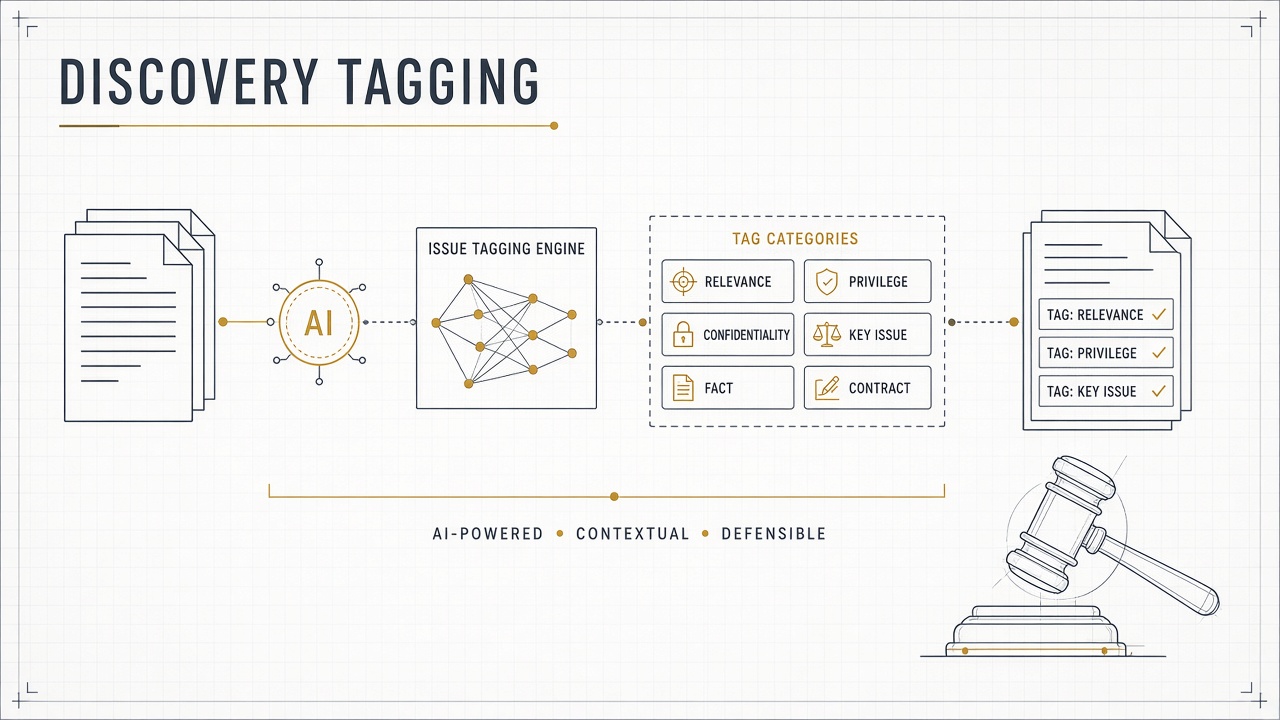
Legal discovery review queues grow when matters produce email, chat, contracts, and work product in volumes that exceed manual issue coding capacity. Reviewers must apply consistent issue tags, flag privilege, and document decisions defensibly for production and potential challenge. Inconsistent tagging slows privilege logs, confuses deposition prep, and increases cost when teams re-review the same documents under new issue theories.
An ai workflow legal discovery tagging routine defines issue tag sets and privilege rules, surfaces AI suggestions with confidence scores, routes documents through attorney review queues with override authority, applies quality control sampling, and maintains audit logs for productions. AI proposes codes; attorneys and contract reviewers decide final tags. Litigation teams often pair tagging assist with AI chatbot tools for internal playbook queries and AI writing assistants for privilege log descriptions after attorney-confirmed tags are locked.
Define Issue Tag Set and Privilege Rules
Discovery tagging workflows start with a matter-specific issue tag taxonomy and written privilege rules approved by case counsel before AI models suggest codes on document text. Tags should map to claims, defenses, and deposition topics in the case assessment memo. Privilege rules distinguish attorney-client communications, work product, common interest materials, and non-responsive categories with escalation paths for ambiguous items.
Tag definitions need plain-language descriptions reviewers apply consistently, including inclusive examples and boundary notes where tags overlap. Privilege playbooks specify sender domains, matter numbers, and keywords that trigger mandatory attorney review rather than auto-tagging. Taxonomies version when issue theories change after amended pleadings or new witnesses.
- Publish tag dictionary with ID, name, definition, and example document types.
- Document privilege categories and mandatory human review triggers.
- Align tags with discovery request buckets and production specifications.
- Train reviewers on taxonomy before AI suggestions appear in queue.
- Version taxonomy changes with effective date and re-review scope rules.
| Element | Purpose | Owner |
|---|---|---|
| Issue tag dictionary | Consistent relevance coding | Case counsel |
| Privilege playbook | Attorney-client and work product rules | Privilege lead |
| Confidentiality designations | Protective order compliance | Discovery counsel |
| Hot document criteria | Escalation to senior attorneys | Case team lead |
Taxonomy Change Control
When issue theories shift, counsel defines whether prior tags require re-review or forward-only application to new documents. AI reprocessing scope should follow written change control to avoid silent bulk tag changes without attorney awareness.
AI Suggestions With Confidence Scores
AI models suggest issue tags and privilege flags with confidence scores and short rationales tied to quoted text spans, presented as proposals reviewers accept, modify, or reject. Low-confidence suggestions route to experienced reviewers or attorneys by default. High-confidence suggestions still require human confirmation before production unless counsel explicitly approves a limited auto-apply pilot with tight guardrails.
Confidence thresholds should be calibrated per matter on a seed set of attorney-coded documents. Scores without calibration mislead reviewers into trusting numeric precision. Display suggested tags alongside alternative candidates when the model spreads probability across related issues.
- Show top suggested tag, confidence percentage, and supporting text excerpt.
- Suppress auto-apply on privilege categories regardless of score.
- Log model version and taxonomy version with each suggestion batch.
- Refresh calibration after major document influxes such as new custodian collections.
- Never present AI suggestions as final codes in production exports.
Embedding and Keyword Hybrids
Many platforms combine semantic embeddings with keyword rules from the privilege playbook for more stable suggestions on routine corporate email. Counsel reviews false positives on privilege triggers monthly so inboxes are not over-quarantined.
Attorney Review Queue and Overrides
Documents meeting privilege triggers, hot criteria, or low-confidence relevance scores enter attorney review queues where licensed counsel override AI suggestions with binding codes. Contract reviewers may code responsiveness on non-privileged material per counsel protocol, but privilege calls remain attorney-owned unless jurisdiction and court rules permit otherwise.
| Queue type | Entry criteria | Decision maker |
|---|---|---|
| Privilege escalation | Playbook trigger or AI privilege flag | Attorney |
| Hot document | Key custodian or topic hit | Senior case attorney |
| Low-confidence relevance | Score below matter threshold | Lead reviewer or attorney |
| Standard responsiveness | High-confidence non-privileged | Trained reviewer with QC |
Overrides capture reviewer ID, final tags, time spent, and optional comment linking to issue definition. Bulk accept of AI suggestions should still record per-document confirmation events for audit defensibility.
Collaboration With Writing Tools
After tags lock, teams may use writing AI to draft privilege log entries from attorney-approved descriptions, not from raw model guesses. Log text must match final privilege determinations exactly.
Quality Control Sampling
Quality control sampling re-reviews a statistically meaningful subset of coded documents to measure agreement with attorney standards and AI suggestion acceptance accuracy. QC failures trigger targeted retraining conversations and possible taxonomy clarifications, not blame on individual reviewers alone.
- Define sample size by review population and risk tier of the matter.
- Include stratified samples across custodians, tag types, and confidence bands.
- Measure false positive and false negative rates on privilege and key issue tags.
- Document corrective actions when error rates exceed matter thresholds.
- Re-sample after taxonomy or model version changes.
Reviewer Calibration Sessions
Calibration sessions where attorneys and reviewers code the same document set reduce drift before QC finds systemic errors. AI suggestion panels may be hidden during calibration to test human judgment independently.
Audit Log for Productions
Production exports require immutable audit logs showing document IDs, final tags, privilege decisions, producing user or system, timestamp, and hash or export batch ID. Logs support clawback analysis, opposing counsel challenges, and internal investigations into accidental productions. AI suggestion history remains linked but distinct from final attorney-approved codes.
Audit entries should capture overrides explicitly: original AI suggestion, reviewer action, and final code. Production specifications map exported fields to tag dictionary versions active on production date. When documents are withheld as privileged, logs link to privilege log row numbers without exposing privileged text in operational dashboards.
- Retain audit logs per matter retention schedule and litigation holds.
- Restrict log access to case team and eDiscovery administrators.
- Validate export counts against review platform reports before delivery.
- Record opposing party production receipt acknowledgments when exchanged.
- Test restore procedures for audit data annually in enterprise deployments.
Post-Production Monitoring
After production, monitor for clawback requests and inconsistent tag usage in downstream deposition exhibits. Patterns of override on similar documents may indicate taxonomy gaps worth amending with counsel approval.
Matter Playbooks and Reviewer Support
Case teams should publish matter playbooks that link tag definitions to key custodians, date ranges, and known hot topics so reviewers and AI calibrations start from shared facts. An internal chatbot grounded in the playbook and protective order terms helps reviewers ask boundary questions without exporting document text to public models. Playbook updates require counsel sign-off and version stamps tied to taxonomy revisions.
After productions, use writing assistants only on attorney-approved tag sets when drafting customer-facing status updates or joint defense group summaries. External communications must not preview privilege determinations still in QC queues.
Frequently Asked Questions
Can we train models on our case data?
Training on matter data requires counsel approval, client consent where applicable, platform agreements prohibiting cross-matter learning, and isolation from vendor global models when confidentiality demands it. Prefer matter-specific fine-tuning or few-shot prompts with ephemeral processing over pooling sensitive content into shared training corpora.
How does cross-border discovery affect tagging?
Data residency and privacy laws may restrict where document text is processed for AI suggestions; route processing to approved regions and redact personal data per GDPR or local rules before analysis. Tagging decisions still follow US or forum procedural rules for the matter, but infrastructure choices need privacy officer input.
What if privileged material was produced?
Clawback procedures under FRE 502 or agreed orders govern remediation; audit logs identify which reviewer or system path approved the production. AI suggestion alone does not establish waiver if attorneys never confirmed the tag. Post-incident review examines QC sample rates and privilege playbook gaps.
Does AI tagging reduce review cost?
AI may prioritize documents and accelerate consistent coding, but cost savings materialize only when attorney oversight, QC, and taxonomy maintenance stay disciplined. Re-review from sloppy tags often erases gains. Measure cost per produced document and error rates, not model confidence alone.
Tagging Defensible for Production
Legal discovery issue tagging improves when taxonomies and privilege rules are defined upfront, AI suggestions show confidence with human override, attorneys own privilege calls, QC sampling catches drift, and audit logs support productions and clawback response. The workflow succeeds when produced sets withstand scrutiny, not when the model appears confident on screen.