Course development timelines compress while stakeholders want richer media and tighter alignment to job performance. Instructional designers stall when outlines sprawl and assessments drift from stated outcomes.
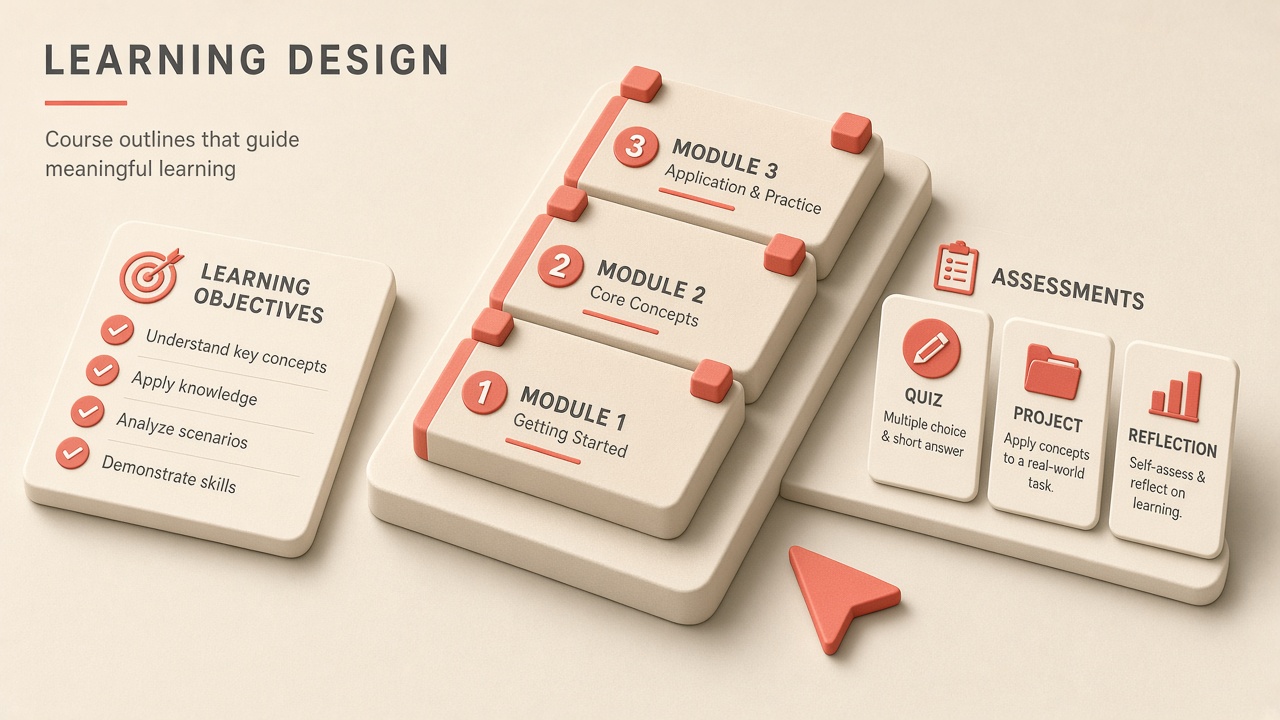
An AI workflow for instructional design starts with measurable learning objectives, drafts module outlines and activities, generates assessment items for human review, and runs accessibility and UDL checks before LMS export. Learning objectives drive all AI drafts; the model does not invent curriculum goals. Pair drafting with AI writing assistants for learner-facing copy and AI productivity tools for storyboard and asset tracking.
Define Measurable Learning Objectives
Write learning objectives in observable behavior terms with conditions and criteria before any AI outline prompt runs. Bloom's taxonomy levels should be explicit. Vague goals like "understand security" produce unusable AI modules.
- Each objective: actor, action verb, condition, and mastery standard.
- Map objectives to job tasks validated by SMEs, not model guesses.
- Limit objectives per module; overcrowding breaks assessment design.
- Document prerequisites and assumed prior knowledge.
- Stakeholder sign-off on objectives before outline generation.
| Weak objective | Measurable objective |
|---|---|
| Know phishing risks | Identify phishing indicators in sample emails with 90 percent accuracy |
| Understand the sales process | Complete CRM stage updates for a mock deal within policy guidelines |
| Learn compliance basics | Select correct escalation path for three scenario-based compliance cases |
Objective Traceability
Maintain an objective ID scheme referenced in every outline row, activity, and assessment item. AI outputs without IDs get rejected in review. Traceability proves accreditation alignment and simplifies LMS updates.
Draft Module Outlines and Activities
AI drafts module sequences: introduction, instruction, practice, and summary tied to specific objective IDs. Instructional designers edit for cognitive load, modality mix, and time budgets. Activities must match objective level; recall drills alone fail application objectives.
- Feed approved objectives and duration constraints into the prompt.
- Request activity types: reading, video, simulation, discussion, job aid.
- Designer removes redundant content and aligns with brand templates.
- SME reviews technical accuracy of examples and scenarios.
- Prototype one module before scaling AI drafts across the course.
Use writing assistants for learner-facing script polish after structure is locked. Voice consistency matters less than objective alignment in early drafts.
Modality Selection
Choose modalities based on objective type: demonstrations for psychomotor skills, branching scenarios for judgment, reference cards for performance support. AI defaults to text-heavy outlines unless prompted for variety.
Assessment Item Generation With Review
Generate assessment items mapped to objective IDs, then run a dedicated SME and designer review pass before any item enters the item bank. AI produces plausible distractors that teach misconceptions if unchecked.
| Review gate | Checker focus | Reject if |
|---|---|---|
| Designer alignment | Item maps to one objective | Objective not covered or double-mapped |
| SME accuracy | Facts, policies, calculations | Outdated procedure or trick question |
| Editorial clarity | Reading level, bias-free stem | Ambiguous correct answer |
| Accessibility | Alt text for images in items | Color-only cues or missing alternatives |
Item Bank Governance
Tag AI-generated items with source prompt version and review date; retire items when content changes. High-stakes exams require psychometric review beyond this workflow. Document that AI items are drafts until SME approval.
Accessibility and UDL Checks
Run WCAG-aligned checks and Universal Design for Learning passes on outlines before development spend locks in. AI drafts often omit captions, keyboard paths, and multiple means of representation.
- Perceivable: transcripts, alt text plans, contrast notes for UI mockups.
- Operable: keyboard navigation for interactions, time limit accommodations.
- Understandable: plain language targets, glossary for domain terms.
- Robust: LMS-compatible formats, avoid proprietary-only widgets.
- UDL: offer choice in practice activities where objectives allow.
Productivity workflows track remediation tickets from accessibility review. Block LMS export until critical issues close or receive documented exceptions with compliance approval.
Media Accessibility
Video storyboards include caption scripts and audio descriptions in the outline phase, not after filming. AI can draft caption text from scripts; humans time and review for accuracy.
Pilot and Iterate
Pilot one module with representative learners before full course build; collect data on time-on-task and assessment performance. AI accelerates iteration on outlines when pilots reveal confusion points. Do not scale AI-generated content without pilot signal.
Stakeholder Signoff
Learning sponsors sign objective and outline documents before assessment generation at scale. Late stakeholder changes after AI bulk drafts waste more time than upfront alignment.
Storyboard Handoff From Outline
Outlines include storyboard notes per screen: on-screen text, narration, interaction, and estimated duration. AI drafts storyboard tables from module outlines; media producers validate feasibility. Missing handoff fields cause rework when video teams interpret prose differently than designers intended.
Localization Planning Early
Mark modules that need translation in the outline phase with locale list and expansion factor for text-heavy languages. AI translation of assessments requires in-country reviewer sign-off before item bank merge. Do not generate English items and translate later without adjusting scenario cultural context.
Performance Support Layer
Job aids and checklists derived from course outlines should be planned alongside modules, not as an afterthought. AI can draft one-page aids from objective lists; SMEs verify steps match live systems. Performance support extends learning impact beyond the LMS completion event.
LMS Metadata Planning
Define completion rules, certificate triggers, and recertification intervals in the outline document before build. AI cannot infer your LMS tenant quirks. Metadata errors surface at launch when learners complete modules but records stay incomplete.
Version Control for Course Assets
Store outlines, assessments, and media scripts in version control with change logs tied to objective IDs. When policies change, search by objective ID to find affected items rather than rereading entire courses manually.
Facilitation Guides for Live Sessions
When outlines include live virtual sessions, AI drafts facilitator guides with timing, poll questions, and breakout instructions mapped to objectives. Facilitators edit for platform limits in Zoom, Teams, or Webex. Guides include backup activities if technology fails so learning time is not lost.
Rubric Design for Performance Tasks
Application-level objectives need rubrics before AI generates example submissions or peer review prompts. SMEs define proficiency levels; AI fills exemplar responses per level for calibrator training. Rubrics publish with courses so graders score consistently across cohorts.
Analytics Instrumentation for Learning Data
Outline documents list xAPI or SCORM events to capture for completion, assessment scores, and retry counts. Learning analytics teams review instrumentation before build. AI cannot infer your reporting warehouse schema; IDs specify event names aligned to objective IDs for downstream dashboards.
Structured Review Cycles
Schedule alpha review on outlines, beta review on storyboards, and gold review on pilot modules with explicit checklists per gate. AI output moves forward only when checklists pass. Skipping gates to save time produces accreditation findings and costly rework in production LMS tenant environments.
Frequently Asked Questions
How do accredited programs differ?
Accredited programs require documented alignment matrices, SME credentials, and sometimes external reviewer approval before launch. AI drafts must not replace accreditation evidence. Maintain audit folders with objective approvals, review logs, and version history. Check accreditor rules on AI-generated assessment items.
What should IDs verify before LMS export?
Validate SCORM or xAPI packaging, objective metadata fields, completion rules, and accessibility files in a staging LMS course. AI cannot confirm your tenant's gradebook behavior. Run a learner smoke test with keyboard-only navigation and screen reader sampling on one module.
Can AI write full course scripts without ID review?
No; learner-facing copy requires SME fact-check and editorial review even when objectives are correct. Models hallucinate procedures in technical training. Use AI for structure and first drafts, not publish-ready scripts.
How do we protect assessment integrity?
Rotate items, avoid publishing exact exam banks in AI tools, and use proctoring policies appropriate to stakes. Item generation prompts should run in enterprise environments. Leaked prompts recreate exams. Randomize pools in the LMS after human-approved items enter production.
Objectives First, AI Second
Instructional designers scale course development when measurable objectives anchor every AI draft, assessments pass structured review, and accessibility gates precede LMS export. The workflow serves learning outcomes, not faster pages of content.