Add it up. A Midjourney standard plan runs $30 a month. Runway's Standard tier sits at $15, with the better video credits gated behind the $35 Pro plan. ElevenLabs for voice and music starts at $22. Toss in a face-swap or lip-sync tool at $20, and a dedicated upscaler at $10, and the monthly bill for a single freelance creator clears $100 without much effort. Stretch that across a small studio with three seats, and you're staring at $312 a month for tools that, on a slow week, sit idle.
That number is the whole story, really. Most creators don't generate at a constant rate. You batch. A client brief lands, you produce forty images and six video clips in two days, then nothing for a fortnight. But the subscriptions keep charging. You're renting a Ferrari to drive to the corner shop twice a month.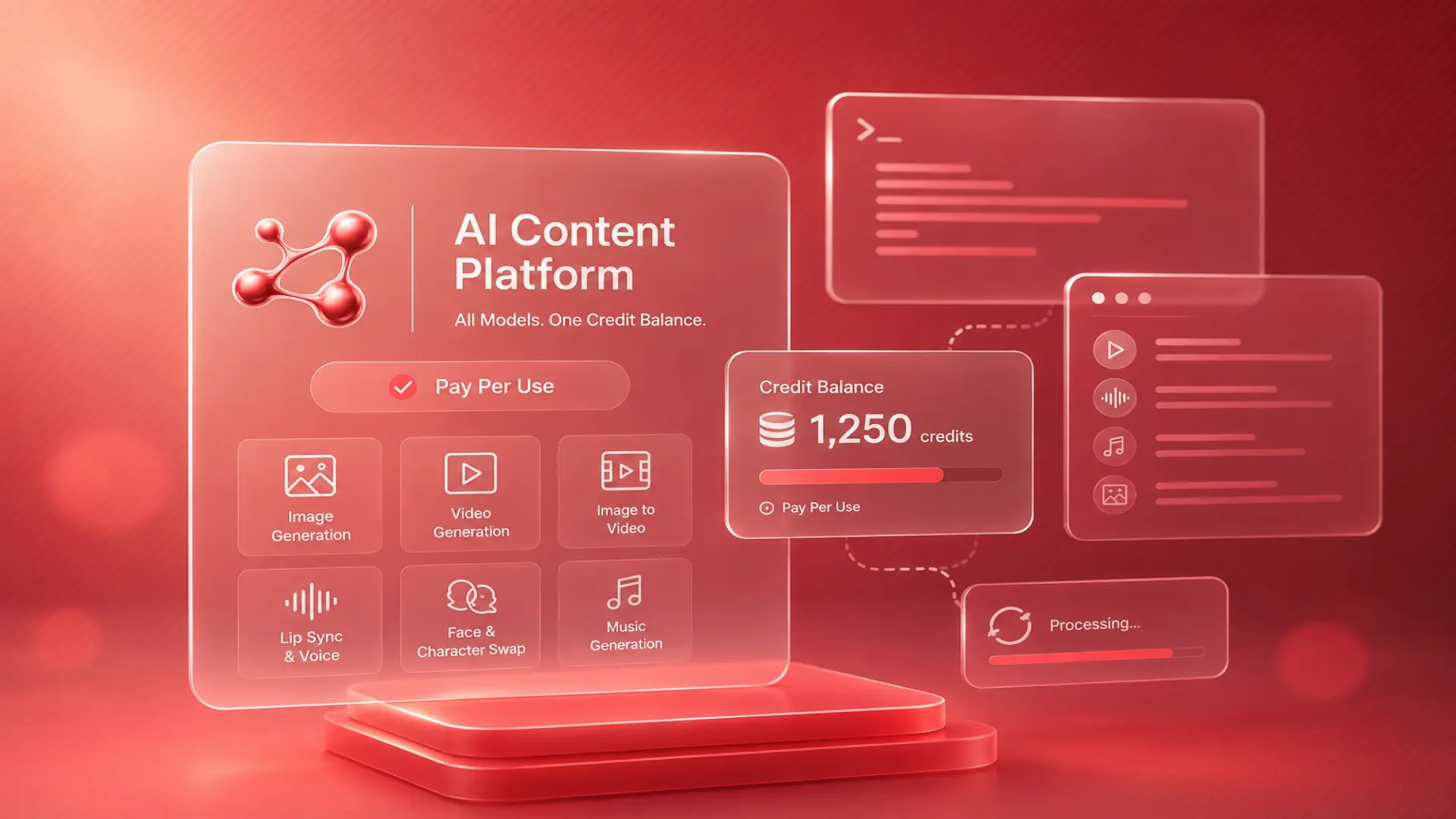
Subscription fatigue is a math problem before it's a mood
People talk about "subscription fatigue" like it's an emotional thing. The annoyance of another card charge, another login, another app to remember. And sure, that's part of it. But the sharper issue is utilization. When you pay a flat $30 for image generation, your effective cost per image depends entirely on how much you produce. Generate 600 images that month, and each one costs a nickel. Generate 20, and each one costs a dollar fifty. The price never matches the work.
Pay-per-generation flips that. You buy credits, you spend them when you create, and an unused balance just waits. No use-it-or-lose-it pressure. No guilt about the quiet weeks. For anyone whose output is lumpy — which is most freelancers and a lot of marketing teams — the credit model tends to win on raw cost, often by a wide margin.
There's a catch worth naming. Heavy daily users sometimes do better on a flat plan, because unlimited-ish usage at a fixed price rewards volume. If you're pumping out 500 generations a day, a subscription can be cheaper. The honest framing isn't "credits always beat subscriptions." It's "match the pricing model to your actual usage curve, and stop paying for capacity you don't touch."
The stack keeps growing, and that's the real tax
Cost is only half the pain. The other half is sprawl. Two years ago, you needed maybe two tools. Now the task list has multiplied: text-to-image, image-to-video, lip sync, face swap, character swap, music generation, voice cloning, upscaling, background removal. Each one is its own signup, its own billing, its own quirks, its own export format that doesn't quite line up with the next tool in the chain.
And the models underneath keep churning. Flux for stills. Kling, Veo, and Sora for video. Stable Diffusion variants for the open-source crowd. Suno for music. Keeping up with which model does what — and re-subscribing every time a better one ships — is a part-time job nobody signed up for.
The fragmentation is the hidden cost most teams never put on a spreadsheet," says Priya Venkataraman, a creative-operations lead who consults for mid-market agencies. "I've watched a four-person team waste an afternoon a week just moving files between tools and reconciling six different invoices. Consolidation doesn't just save money. It buys back hours, and hours are the thing nobody has.
Consolidation is the trend, not a single product
This is where the all-in-one, pay-per-use platforms come in. The idea is straightforward: one account, one credit balance, and access to a wide menu of models for every task — instead of a drawer full of separate subscriptions. You generate an image with one model, animate it with another, add a lip-synced voice with a third, and it all draws from the same wallet. The friction of moving between vendors mostly disappears.
Platforms like JAI Portal AI content platform show what this looks like in practice — 500-plus models spanning images, video, image-to-video, lip sync, face and character swap, and audio, all on pay-per-use credits with no monthly lock-in, commercial rights included, and no watermarks baked into the output. It's not the only one chasing this model, and that's the point. The category is converging on the same answer: give creators breadth without forcing them to subscribe to breadth they won't always use.
The free-credits-on-signup pattern matters more than it sounds, too. Ten free credits, or whatever the number, let you actually test the model quality before spending a cent. Compare that to the old way — entering card details for a free trial, then forgetting to cancel and eating a $30 charge. The credit model is just more honest about the exchange. You pay for what you make.
What to actually check before you consolidate
Not every all-in-one platform is worth the switch, and the marketing all sounds identical. A few things separate the real ones from the reskinned API wrappers. First, model freshness. Are they running current models, or did they stop updating in 2024? Second, the credit-to-output ratio. Some platforms quote cheap-sounding credit packs but burn through them fast on high-res video, so do the per-generation math, not the per-pack math. Third, commercial licensing and watermarks — non-negotiable if you're doing client work. A free image you can't legally sell isn't free. It's a liability.
And read the fine print on credit expiry. The whole appeal of pay-per-use is that your balance waits for you. If credits evaporate after 30 days, you've just bought a subscription with extra steps.
The direction here feels fairly set. As models keep multiplying and specializing, no single creator can reasonably subscribe to all of them, and no subscription can keep pace with a field that ships a new state-of-the-art model every few weeks. The platforms that aggregate — that let you pay per generation and swap models as the leaderboard shifts — are positioned for exactly the messiness ahead. Whether the winners end up being today's names or ones not launched yet, the stack-of-subscriptions era is quietly ending. The next year or two will probably decide who gets to consolidate it.