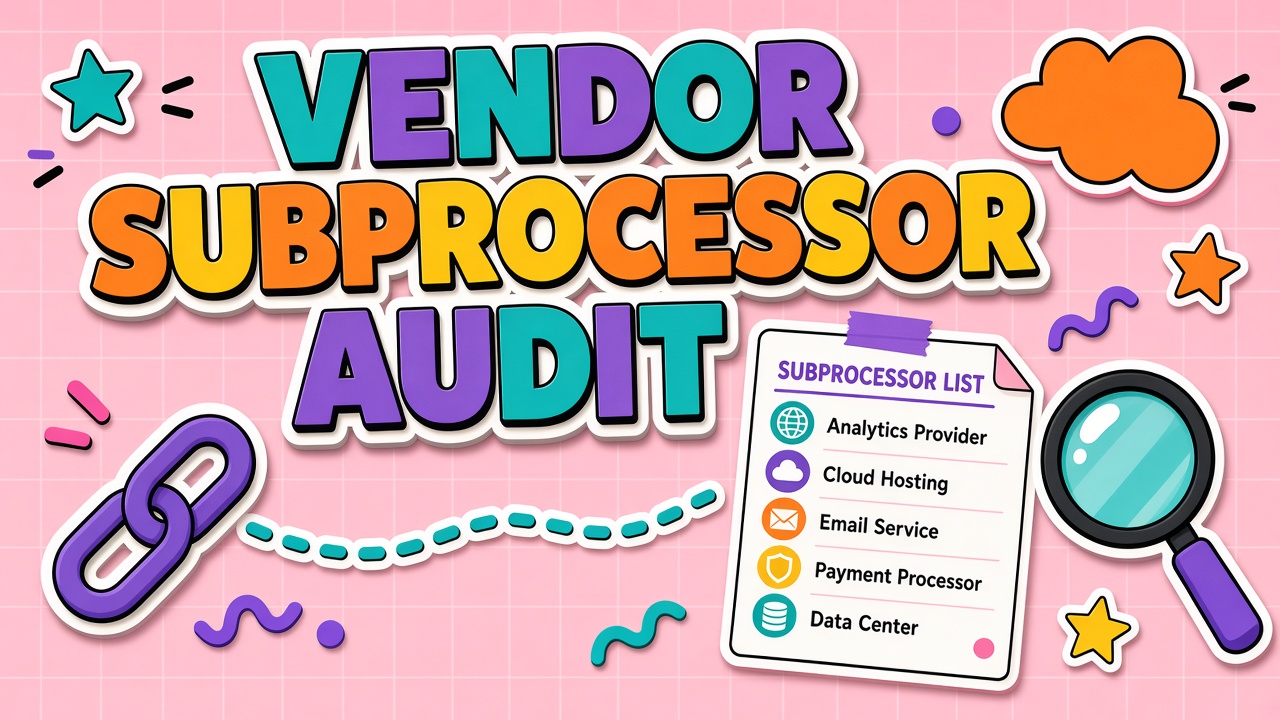
Your AI vendor signs a DPA listing three subprocessors. Six months later, inference moves to a new cloud region, moderation shifts to another API, and analytics adds a warehouse you never approved. An AI vendor subprocessor audit keeps third-party risk visible as stacks change faster than annual procurement cycles.
Use this guide when onboarding AI API providers and automation vendors platforms that route prompts through model hosts, CDNs, and safety classifiers you do not see on the pricing page.
Compare vendor subprocessor lists to your own customer-facing DPA annex quarterly. Customers may restrict subprocessors you accepted internally without notifying account teams. Customer success needs diff summaries in plain language, not forwarded vendor PDFs.
Certifications expire; track SOC report end dates on vendor records. An annual subprocessor review that ignores stale certs gives false comfort. Request updated reports 30 days before expiry when vendors delay publication.
Plugin and marketplace modules for API platforms often add subprocessors outside core lists. Enterprise tenant policy should block unapproved plugins by default with exception process mirroring steering intake.
Definition: Subprocessor vs Affiliate
A subprocessor processes personal data on behalf of the vendor under written instructions (hosting, embeddings, support tools with ticket content). An affiliate is a related corporate entity; data sharing with affiliates may be controller-to-controller, not subprocessing. Contracts should clarify which list governs each party and whether affiliates can access customer payloads.
Open-source model weights hosted on your own cloud are not vendor subprocessors; the cloud provider is yours to manage. Confusion arises when vendors resell another company's API without naming the underlying model operator.
Minimum Documentation Package
Request this package at onboarding and refresh annually or on change notice:
- Contractually binding subprocessor list with service description per party
- Data residency and processing locations per subprocessor
- SOC 2 / ISO reports or equivalent for critical subprocessors
- Flow-down DPA terms confirmation
- Incident history relevant to subprocessors (summarized)
- Model change log when subprocessor swap affects model version or region
For API vendors, ask specifically which subprocessors see prompt content vs metadata only. Billing analytics may be lower risk than inference hosts.
Change Notification Workflows
Define internal steps when the vendor publishes subprocessor updates:
- Subscribe to vendor trust portal email and RSS if available
- Ticket auto-created in GRC queue with 30-day review clock
- Privacy and security assign risk tier (low: analytics; high: new country or new content processor)
- Object or accept before effective date per contract
- Update RoPA and customer-facing subprocessor disclosures if you publish them
| Review frequency | Vendor tier | Trigger |
|---|---|---|
| Continuous | Critical production AI | Any subprocessor change notice |
| Annual | Standard enterprise SaaS | Contract anniversary |
| On adoption | Pilot / department tool | Before production data |
Geographic and Certification Review
Map subprocessors to approved regions. New APAC host may violate data residency commitments in your customer contracts. Verify certifications are current (report date within 12 months) and scope covers the service you use, not only corporate HQ.
Image pipelines for generators may include content moderation subprocessors in jurisdictions with different government access laws. Document transfer mechanisms (SCCs, etc.) for each hop.
Subprocessor Risk Scoring Model
Score each subprocessor on data sensitivity handled, geographic alignment, certification freshness, and incident history. High scores trigger steering review even within objection windows. Low scores batch into annual attestation unless notification changes geography or purpose.
Customer DPA Alignment
B2B customers may restrict subprocessors contractually. Your approved vendor list must intersect customer allowances before processing their data through AI tools. Customer success should receive diff summaries when vendor subprocessors change so downstream notices go out within contractual SLAs.
Risk Tiering Subprocessors
Not every subprocessor needs equal scrutiny. Tier 1 (processes prompt content): annual cert review, change objection rights exercised. Tier 2 (metadata only): biennial review. Tier 3 (corporate HR systems of vendor): note existence, no content access.
API gateways for AI APIs may add edge CDNs that cache requests. Confirm whether caching applies to POST bodies with prompts; misconfigured caches are a hidden subprocessor storing personal data.
Image pipeline subprocessors
Image generators route through GPU clouds, safety classifiers, and thumbnail CDNs. Request data flow diagrams specific to image bytes, not generic SaaS diagrams reused from text products.
Exit plan when subprocessors change
If you object to a new subprocessor and negotiation fails, document migration timeline to alternate vendor or self-hosted model. Procurement should not be surprised at contract termination clause activation.
Subprocessor Register Internal
Maintain an internal register aggregating subprocessors across all AI vendors processing company or customer data. Steering reviews the register quarterly for concentration risk: single model host appearing under many vendors, or geography clusters violating policy.
Register entries link to customer impact analysis: which customer DPAs allow each subprocessor, which require notification on change. Customer success uses the register to batch customer notices instead of reactive emails after each vendor diff.
Evidence Retention for Subprocessor Reviews
Retain vendor subprocessor lists, diff reports, objection decisions, and certification PDFs for the same period as vendor contracts plus audit lookback. Regulators and customers request historical subprocessors active on specific dates, not only current lists.
Store hashes or version IDs of lists to prove which version was active when data was processed during incident investigations spanning multiple vendor changes.
Frequently Asked Questions
What about open-source models?
If you self-host, subprocessors are your cloud and ops vendors. If vendor hosts open weights for you, they remain responsible for listing inference infrastructure subprocessors.
Resellers white-labeling another API?
Require full chain transparency to the model operator. Reseller-only SOC reports are insufficient if they never touch payload data.
What if we object to a new subprocessor?
Contracts often allow termination without penalty if objection is unresolved. Plan migration paths before objection deadlines expire.
Must we republish subprocessors to our customers?
Many B2B contracts require you to maintain an accurate subprocessor list downstream. Sync vendor changes to your public trust page.
Is there a standard request letter?
Use a short email template: company name, services in scope, request for annex, certifications, regions, and change notification mechanism. Attach your security questionnaire for efficiency.
Incident-Driven Subprocessor Reviews
When any vendor or subprocessor breach notification arrives, expand review beyond the affected party: map data categories you sent through that hop in the last retention window. Incident-driven reviews often reveal shadow integrations still feeding the same subprocessor under a different product name.
Maintain objection decision log with dates, outcomes, and customer notifications sent. Regulators and enterprise customers ask what you did when notified, not whether you read the email.
Annual reviews for automation vendors should include plugin marketplaces and optional modules enabled in tenant admin. Core vendor list may be clean while unvetted plugins add subprocessors silently.
Renewal Negotiation Leverage
Subprocessor audit findings feed renewal negotiations: objection history, certification gaps, and incident summaries strengthen requests for region pinning or alternative hosts. Procurement should not treat subprocessor review as legal-only paperwork disconnected from commercial terms.
Document walk-away criteria when subprocessors remain unacceptable. Without criteria, teams accept risk indefinitely because migration feels harder each quarter.
Subprocessors in RFP and Contract Negotiation
Include subprocessor transparency requirements in RFP scoring. Vendors who refuse to name inference hosts before contract signature score poorly for regulated bids. Negotiate objection rights and termination triggers upfront, not after go-live.
Maintain a living spreadsheet shared between procurement, privacy, and security with last review date per vendor. Stale reviews older than 18 months trigger automatic re-audit ticket.
Continuous monitoring vs point-in-time audit
Subscribe to vendor trust portal RSS or webhook if available. Assign on-call rotation for subprocessor change emails so notices are not buried in individual inboxes during holidays. A missed 30-day objection window can lock you into an unacceptable host for a year.
Compare subprocessor lists across vendors in the same category during renewal season. If every API provider routes through the same GPU host, your portfolio concentration risk is higher than any single vendor datasheet suggests. Diversify or negotiate dedicated tenancy where contracts allow.
Mapping Data Flows to Subprocessors
Architecture diagrams should label which subprocessors touch payload content versus metadata only. Audits often reveal logging vendors receiving full prompts while teams believed only model hosts processed content. Accurate maps drive meaningful objection decisions.
Schedule subprocessor reviews before peak seasons when vendor change notifications historically cluster. Retail and tax vendors often update subprocessors before peak; objection windows overlap with blackout periods if reviews are only annual.
Procurement should bundle subprocessor review into renewal checklists alongside pricing and SLA terms. Separating legal review from commercial timeline causes last-minute acceptances under renewal deadline pressure.
Engineering should validate subprocessor maps against packet captures or vendor architecture docs during onboarding. Sales subprocessor PDFs sometimes omit logging or moderation hops present in production traffic.
Compare subprocessor audit findings across vendors to detect concentration risk when multiple tools route through the same model host or logging provider. Concentration may justify diversification even when each vendor list looks acceptable alone.
Maintain objection letter templates legal pre-approves so procurement can respond within vendor notice windows without drafting from scratch under time pressure.
Log subprocessor objection outcomes in the vendor record even when you accept changes. Acceptance with conditions documents risk decisions for future audits and renewal negotiations.
Refresh subprocessor snapshots after vendor mergers; merged entities often change subprocessors without clear rename notices.
Audit Subprocessors on a Schedule
Auditing AI vendor subprocessors is ongoing hygiene: define terms, collect evidence, react to changes, map geography and certs. API and image stacks hide the longest chains; treat change notices as production incidents waiting to happen. Keep your API vendor reviews in the same cadence as your core ERP, not as ad-hoc checkbox exercises.