Your coding assistant sends the same 8,000-token system prompt and repository context on every API call. Your writing tool includes a fixed brand style guide and product knowledge base before each user message. The bill shows full input token charges every time, even though most of the prompt never changes between requests.
Prompt caching in AI APIs is a provider feature that stores and reuses the computed state of a repeated prompt prefix across requests. Instead of reprocessing identical leading tokens on every call, the API recognizes a cache hit on the shared prefix and only charges full price for new suffix tokens (the user message, tool results, or fresh instructions). Anthropic, OpenAI, and other major providers now offer prompt caching on supported models because long system prompts and RAG context blocks are expensive to re-encode on every turn. This guide explains cached prefix versus fresh suffix, which content blocks qualify for caching, how cost math changes, design patterns that maximize cache hits, and how to debug misses in multi-tenant apps. Developers building with AI coding tools and AI writing assistants should structure prompts with caching in mind from the first integration.
Cached Prefix vs Fresh Suffix: How Prompt Caching Works
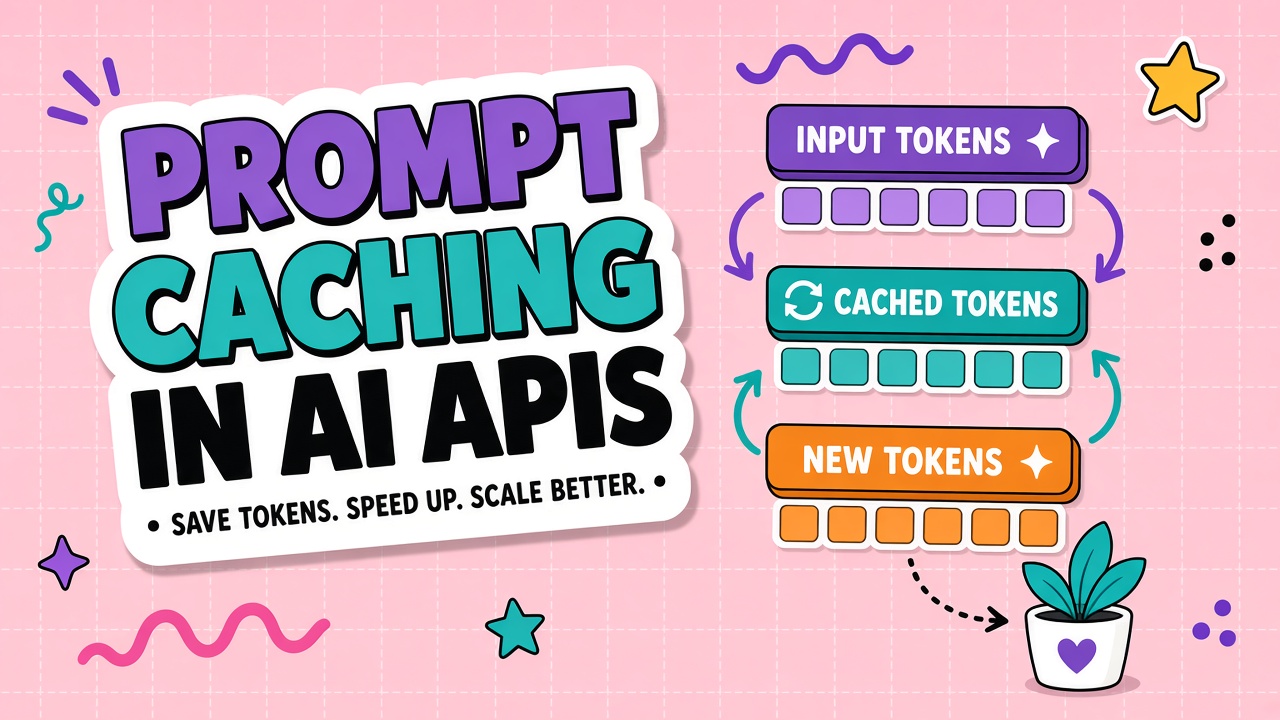
Prompt caching splits each request into a stable prefix and a variable suffix. The prefix is everything identical across calls: system instructions, tool definitions, retrieved documents that do not change, few-shot examples. The suffix is everything unique per request: the latest user message, session-specific variables, or dynamic tool outputs from the current turn.
On the first request, the provider processes the full prompt and may write the prefix into a cache. On subsequent requests where the prefix matches byte-for-byte (or meets provider-specific matching rules), the API reuses the cached prefix state. Input billing typically applies a reduced rate to cached prefix tokens and full rate to uncached suffix tokens. Latency on cache hits often drops because the model skips recomputing attention over the entire prefix.
What must match for a cache hit
- Exact prefix content: Any character change in the cached block breaks the match for most providers.
- Minimum token threshold: Providers set minimum prefix lengths (often 1,024 tokens or more) before caching activates.
- Model and endpoint: Cache entries are usually scoped to a specific model version and API endpoint.
- Cache key placement: Some APIs require marking cacheable blocks explicitly; others infer from prompt structure.
Which Content Blocks Are Cacheable
Static, high-volume prefixes benefit most. Dynamic per-user content at the start of the prompt prevents caching for everything that follows unless you reorder the prompt.
| Content block | Cacheable? | Notes |
|---|---|---|
| Static system prompt | Yes | Ideal cache candidate when identical across all users |
| Tool and function schemas | Yes | Large JSON tool definitions amortize well over many calls |
| Shared knowledge base (RAG) | Sometimes | Works when the same retrieved chunks repeat; per-query retrieval usually is not cacheable |
| Few-shot examples | Yes | Fixed example sets in the prefix cache reliably |
| Per-user memory or profile | Rarely | Unique per user; place after static prefix or accept no cache on that block |
| Chat history | Partially | Growing history changes the prefix every turn unless you cache only stable early turns |
Cost Math: When Caching Pays Off
Prompt caching reduces input token cost on repeated prefixes. Providers typically charge a lower rate for cache read tokens and may charge a higher one-time rate for cache write tokens when the prefix is first stored. Output token pricing is unchanged. Savings appear only when the same prefix is reused enough times before the cache entry expires.
Rough decision framework: estimate prefix token count (P), requests per hour (R), cache TTL in minutes (T), and the provider's cached versus uncached input price ratio. If P is large (several thousand tokens), R is high, and your static content truly repeats, caching often cuts input spend materially. If P is small or changes every request, caching adds complexity without meaningful savings.
Watch for hidden costs: cache write surcharges on the first hit, cold starts after TTL expiry, and engineering time to restructure prompts. Compare monthly bills with caching enabled versus disabled on a representative traffic sample before assuming automatic savings.
Design Patterns: Static Prompts and Shared Knowledge
Prompt structure determines cache hit rate. Put stable content first and volatile content last. This ordering is the opposite of how many teams naturally build prompts when they prepend user context at the top.
Static system prompt at the root
Keep one immutable system block: role definition, safety rules, output format, tool-use instructions. Never embed timestamps, request IDs, or user names in this block. Inject per-request variables only in the suffix after the cache breakpoint.
Shared knowledge base block
For products where all users query the same corpus (internal handbook, API reference), attach the full reference as a cached prefix. For per-tenant corpora, maintain one cached prefix per tenant with identical document snapshots. When documents update, accept a cache miss until the new prefix is written.
Separate tool schemas from conversation
Agent frameworks often resend large tool JSON on every turn. Mark tool definitions as cacheable and keep message history in the uncached suffix. Some teams split "tools available" from "tools called this turn" to maximize stable prefix length.
Coding assistant context
Repository snapshots that change infrequently during a session can sit in a cached block. File contents that change on every keystroke belong in the suffix or in a separate uncached attachment. Teams using AI coding assistants should test whether their IDE plugin structures context for cache breakpoints or resends everything verbatim.
How Anthropic, OpenAI, and Others Differ on Caching
Prompt caching is not standardized across providers. Anthropic documents explicit cache control breakpoints in the Messages API. OpenAI offers cached input pricing on supported models with usage fields in the response object. Minimum token thresholds, write surcharges, TTL values, and which models support caching all vary. Read the current billing page for each provider before modeling savings in a spreadsheet.
Some teams route traffic through gateways like LiteLLM that normalize cache metadata across providers. Gateways add convenience but can obscure provider-specific cache breakpoint requirements. Validate cache hits at the raw API layer first, then add abstraction.
Debugging Cache Misses in Production
Cache misses are silent unless you log them. API responses from major providers include fields indicating cache creation, cache read token counts, and uncached token counts. Pipe those fields into your observability stack.
Common causes of unexpected misses
- Whitespace or ordering drift: Serializing JSON with different key order breaks byte-level matching.
- Timestamps in prompts: "Current date: ..." at the start of the system message invalidates the entire prefix.
- Multi-tenant leakage risk: Sharing one cache across tenants requires identical prefixes; per-user content in the prefix forces per-user cache entries.
- TTL expiry: Idle periods longer than the cache lifetime require a fresh write on the next request.
- Model version bumps: Upgrading model IDs typically invalidates existing cache entries.
Semantic caching is a separate technique: matching paraphrased queries at the application layer rather than identical prefixes. Teams can combine prompt caching (provider layer) with semantic caching (app layer) for different savings opportunities. Neither replaces the other.
Prompt Caching in Agent and Multi-Turn Loops
Agent workflows that loop over tool calls resend growing context each iteration. Caching helps when tool definitions and system instructions stay fixed while only tool results and user messages change. Structure each loop so the static prefix remains byte-identical across iterations. Growing tool result history usually belongs in the uncached suffix, which means cache savings diminish as agent runs lengthen. Cap agent loop length or summarize tool outputs to keep suffix size manageable.
Frequently Asked Questions
How long do prompt cache entries last?
TTL varies by provider and is often in the range of several minutes to an hour of inactivity, with some offerings extending longer for frequently accessed prefixes. Read your provider's current documentation for exact TTL values. High-traffic prefixes that receive regular requests tend to stay warm longer than rarely used ones.
Is prompt caching safe in multi-tenant applications?
Cache entries are scoped by provider infrastructure, not visible across customer accounts on reputable platforms. Still, never place one tenant's private data in a prefix shared with another tenant's requests. Structure caches per tenant or per shared corpus, and audit that user-specific secrets never enter a globally cached block.
Does prompt caching replace RAG?
No. Caching optimizes cost and latency for repeated identical context. RAG selects relevant documents per query from a large corpus. You might cache a fixed RAG result set when the same chunks apply to many users, but dynamic retrieval per question still needs a fresh suffix each time.
How do I debug why caching is not working?
Log cache read and write token counts from API responses. Diff prompts between a hit and a miss request. Check prefix length against minimum thresholds. Remove dynamic values from the cached section. Confirm you are using a model and API version that supports caching on your endpoint.
Does caching help AI writing assistants?
Yes when the product sends a stable brand voice guide, style rules, or product catalog on every generation request. AI writing assistants with large fixed context benefit most. Per-article unique briefs in the prefix reduce hit rates unless the brief sits after the cached style block.
Structuring APIs for Prompt Cache Efficiency
Prompt caching reuses expensive prefix tokens across requests, cutting input cost and latency when your prompt structure repeats stable content. Place static system instructions, tool schemas, and shared reference material before dynamic user input. Monitor cache hit rates in production, respect TTL and model-version boundaries, and isolate tenant data in separate cache scopes. For AI coding and AI writing integrations, prompt caching is often the highest-leverage billing optimization after model routing.