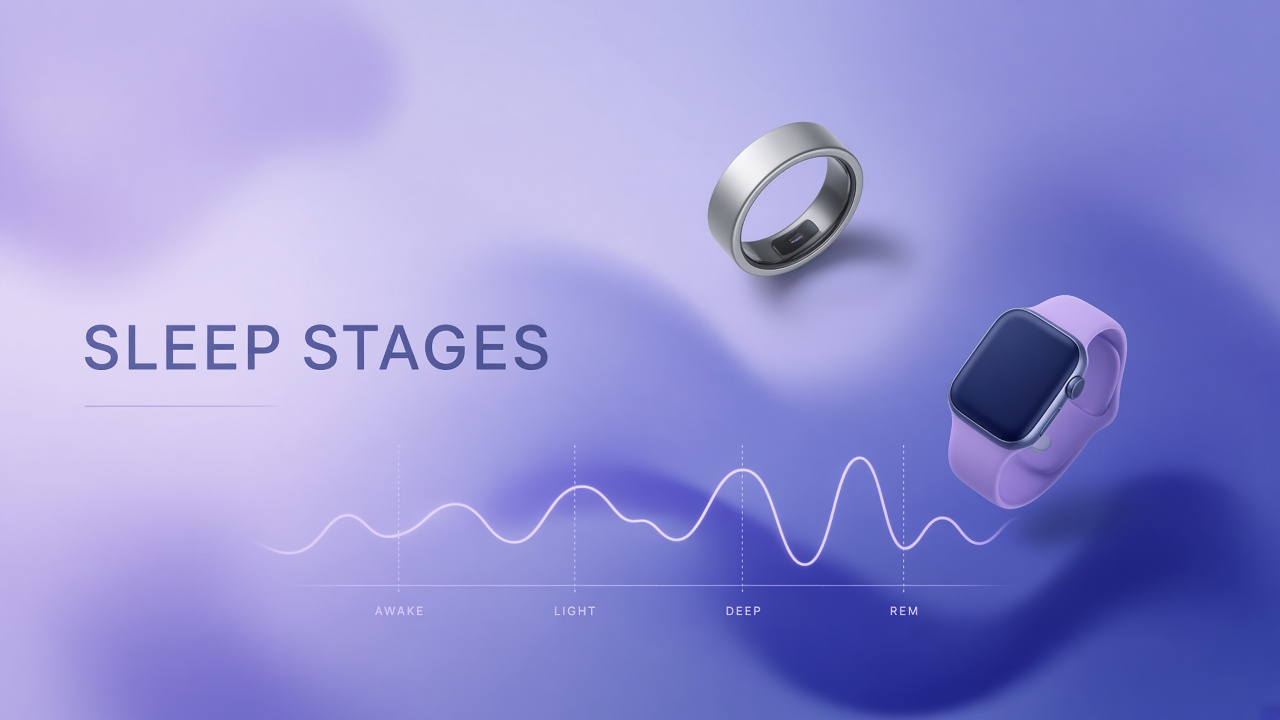
AI sleep stage classification on wearables estimates wake, light sleep, deep sleep, and REM from accelerometer motion and photoplethysmography (PPG) heart signals, running compact neural networks on the device or phone overnight. Clinical polysomnography (PSG) uses scalp EEG, eye electrodes, and chin EMG to score 30-second epochs; consumer rings and watches proxy those stages with autonomic and movement features. Validation studies in 2025-2026 report Cohen's kappa roughly 0.53 to 0.66 for four-class wrist staging against PSG, with performance dropping in severe sleep apnea cohorts. Smart-ring models combining PPG-derived instantaneous heart rate with accelerometer zero-crossing features reach macro-average recall near 0.772 for four-class staging in subject-independent cross-validation. Readers interested in AI healthcare applications or AI research tools should treat consumer hypnograms as wellness estimates, not diagnostic PSG replacements.
Sleep Stages Clinicians Care About
Clinicians classify sleep into wake, N1, N2, N3 (slow-wave deep sleep), and REM using EEG criteria; consumer devices usually collapse N1 into light sleep and report a four-stage hypnogram. N3 supports physical restoration and memory consolidation; REM supports emotional processing and dreaming with rapid eye movements and muscle atonia. N1 is a brief transitional stage often hard to detect even in PSG. Apnea events fragment sleep architecture, reducing restorative N3 and REM minutes independent of how well a wearable classifies undisturbed epochs.
A hypnogram plots stage labels across the night. Wellness apps summarize total sleep time, sleep efficiency (asleep divided by time in bed), and REM or deep percentages. Clinicians reviewing suspected narcolepsy, REM behavior disorder, or treatment response to CPAP need epoch-level EEG scoring, not wrist-derived proxies alone.
American Academy of Sleep Medicine scoring manuals define epoch rules using EEG spectral content, chin EMG tone, and EOG deflections. Consumer algorithms approximate those rules with proxy features. Wake during sleep maintenance insomnia may show low movement (failing accelerometer wake detection) while PPG still resembles light sleep autonomics, producing false sleep stage assignments. Understanding this gap prevents users from dismissing clinical symptoms because a ring reported high sleep scores.
Sleep architecture changes across lifespan: children have more deep sleep; older adults show fragmented REM. Population-trained models may bias young athletic users toward "excellent" deep sleep percentages while mischaracterizing elderly users. Personalization research directly addresses that heterogeneity by finetuning on individual night histories.
Sensor Signals Wearables Actually Use
Wrist wearables primarily fuse triaxial accelerometry (movement and respiration-induced motion) with PPG-derived heart rate and heart rate variability; smart rings emphasize stable PPG contact, while watches add sporadic skin temperature on premium models. Accelerometers detect large body movements marking wake and micro-arousals. During stable sleep, rhythmic cardiorespiratory coupling modulates PPG amplitude and inter-beat intervals. REM shows relatively low movement with heart rate variability patterns distinct from deep sleep's steadier autonomic profile. N1 resembles light sleep in autonomic features, which is why five-stage consumer staging often underperforms four-stage collapse.
| Signal | Carries information about | Limitation |
|---|---|---|
| Accelerometer | Wake vs sleep, restless periods | Poor REM vs quiet wake discrimination alone |
| PPG / IHR | REM vs deep sleep autonomic differences | Motion artifacts, arrhythmias, poor fit |
| RR intervals | Respiratory sinus arrhythmia during sleep | Apnea disrupts rhythm; confounds staging |
| Skin temperature | Circadian phase (some devices) | Not standard across all consumer SKUs |
On-Device vs Cloud Inference
Leading wearables run sleep staging on-device with models from tens of thousands to a few hundred thousand parameters so inference completes within battery budgets without uploading raw PPG overnight. A 2025 IEEE Transactions on Instrumentation and Measurement study describes smart-ring models with 503k parameters for PPG instantaneous heart rate features and 133k for accelerometer zero-crossing mode features, achieving strong macro-average recall when fused. On-device execution preserves privacy and functions offline; cloud post-processing appears in research prototypes and some phone companion apps that retrain personalization layers after sync.
Temporal context matters: U-Net-inspired architectures processing multi-hour segments outperform single-epoch classifiers because sleep stage sequences follow transition rules (you rarely jump from wake directly to deep sleep). Input windows of 1024 epochs (roughly 8.5 hours at 30-second resolution) improved accuracy in wrist-worn consumer sleep technology validation studies.
Spectral preprocessing of PPG (deriving heart rate variability bands, respiratory coupling features) outperformed raw waveform or hand-crafted statistic inputs in peer-reviewed comparisons. Zero-crossing mode accelerometer features capture movement periodicity cheaply on microcontroller-class hardware. Class balancing strategies address REM rarity: REM occupies roughly 20-25% of adult sleep minutes but carries outsized user interest, so models may overweight REM recall in loss functions at the expense of light sleep precision.
Cloud inference variants upload compressed feature vectors after wake, enabling larger models than on-ring SRAM allows. Tradeoffs include battery (radio transmit), privacy (health data leaves device), and offline camping scenarios. Apple, Garmin, Oura, and Samsung differ in disclosed architecture details; buyers should prefer vendors publishing third-party PSG validation or open methods papers over marketing-only "advanced AI" claims.
Validation Studies and Error Modes
Independent validation against polysomnography shows Cohen's kappa roughly 0.58 to 0.64 on healthy-ish cohorts, with kappa falling toward 0.30 to 0.36 in very severe sleep apnea (AHI at or above 50 events per hour) when training data under-represent high-AHI nights. A 2026 medRxiv analysis of 552 nights (wrist PPG plus accelerometer) reported five-stage kappa 0.586 on a sleep-lab dataset and 0.446 on a hospital dataset; four-stage collapse improved kappa to 0.632 and 0.525 respectively. Performance declined monotonically with apnea severity; ablation training that reduced high-AHI representation worsened very severe subgroup kappa from 0.365 to 0.303.
Chest-worn cardiorespiratory patches validated in home longitudinal monitoring (RESTORE study, 17 participants, 10 nights) achieved 77.1% accuracy and Cohen's kappa 0.679 for four-class staging after transfer learning, closer to clinical utility but still not equivalent to EEG gold standard. Personalization finetuning wrist PPG models on three or more home nights with wearable EEG pseudo-labels improved staging in 82.5% of subjects, with largest gains for younger participants and insomnia patients.
Common error modes include misclassifying quiet wake as light sleep, underestimating REM in apnea (desaturations mimic autonomic patterns), and smoothing over brief arousals that clinicians count toward sleep fragmentation indices.
When Not to Trust Consumer Sleep Scores
Do not use consumer wearables to diagnose sleep apnea, insomnia disorders, narcolepsy, or periodic limb movements; wellness scores can mislead when symptoms persist despite "good" app metrics. FDA-cleared devices exist for specific indications (for example, some ring-based apnea screening workflows), but general-purpose sleep stage percentages lack regulatory diagnostic claims. Shift workers, parents of newborns, and people on beta-blockers violate training population assumptions. Off-wrist wear, loose bands, and tattooed skin degrade PPG.
If snoring, witnessed apneas, morning headaches, or excessive daytime sleepiness occur, pursue clinical PSG or home sleep apnea testing regardless of wearable sleep scores. Consumer trends help track bedtime regularity and rough sleep duration changes week over week; they do not replace actigraphy interpreted by sleep medicine physicians.
Training data composition biases real-world performance. Models trained predominantly on mild sleep apnea cohorts degrade on very severe apnea (AHI at or above 50) because desaturation and arousal bursts disrupt PPG patterns the network learned as deep or REM signatures. Clinical deployment would stratify validation by comorbidity prevalence matching the intended user population, a lesson from the 2026 medRxiv cohort analysis of 552 nights across sleep lab and hospital datasets.
Wellness workflows still deliver value: consistent bedtimes, reducing alcohol before sleep, and tracking whether a new exercise routine correlates with more deep sleep minutes on trend lines. The appropriate mental model is longitudinal self-experimentation with noisy labels, not nightly truth from a clinical hypnogram.
Shift workers and jet lag violate circadian assumptions baked into population models. Morning chronotypes scoring "poor" sleep after a late social night may reflect correct wake detection rather than algorithm failure. Temperature-derived circadian phase estimators on premium watches may eventually feed stage classifiers, but peer-reviewed validation lags marketing feature announcements.
Research accelerometer-only staging (preprint literature reports macro-F1 near 0.69) suffices for coarse sleep-wake detection but struggles with REM without PPG autonomics. Buyers choosing budget trackers should expect wake-sleep trends, not reliable REM percentages. Mid-tier and premium devices adding PPG justify REM claims only when vendors cite independent PSG studies with published kappa or F1 metrics.
Export formats (Apple Health, Google Fit, FHIR sleep observations) propagate consumer stage labels into electronic health records when users enable sharing. Clinicians may misinterpret wellness hypnograms as clinical data unless provenance metadata distinguishes PSG-scored epochs from algorithmic estimates. Healthcare integrators should gate wearable sleep imports behind explicit patient consent and data-quality flags. Sleep coaching apps that prescribe behavior change from REM percentages alone risk overfitting noise; trend smoothing across two-week windows reduces false alarm fatigue.
Frequently Asked Questions
Can wearables diagnose sleep apnea?
Some FDA-cleared workflows screen for apnea risk using oximetry or specialized algorithms, but generic REM and deep sleep percentages do not diagnose apnea. Severe apnea degrades staging accuracy in validation studies. Confirmatory testing requires clinical sleep studies.
How accurate is REM detection on watches and rings?
PPG-heavy models detect REM better than accelerometer-only pipelines because REM retains autonomic signatures with minimal movement. Smart-ring studies report four-class macro recall near 0.772 when fusing PPG and accelerometer features. Individual nights still deviate from PSG, especially with apnea or medication effects.
Ring vs watch: which stages sleep better?
Rings offer more stable PPG contact on the finger; watches add accelerometer diversity and sometimes temperature. Published kappa values overlap broadly across form factors when PPG quality is good. Fit and wearing compliance matter more than shape alone.
Does personalization help?
Yes. Finetuning general models on three or more nights of paired wearable EEG or PSG labels improved staging in most subjects in 2025 personalization research, with significant gains for REM fragmentation metrics. Manufacturers increasingly ship on-device adaptation after an initial baseline week.
Can AI detect insomnia from wearables?
Wearables estimate time in bed versus asleep (sleep efficiency), a correlate of insomnia, but cannot distinguish psychophysiological insomnia from delayed sleep phase without clinical interview. Low efficiency warrants discussion with a clinician, not self-diagnosis from an app badge.
Clinical vs wellness use: what is the difference?
Wellness products optimize engagement trends and rough stage charts without diagnostic claims. Clinical tools require validation protocols, regulatory clearance, and integration with physician interpretation. Treat consumer hypnograms as directional feedback for AI healthcare literacy, not medical records.
What models run on-device?
Lightweight CNNs, temporal U-Nets, and recurrent hybrids with 133k to 503k parameters typify published smart-ring architectures. Vendors rarely disclose full architectures; peer-reviewed papers on PPG plus accelerometer fusion provide the most transparent benchmarks for comparison shopping.