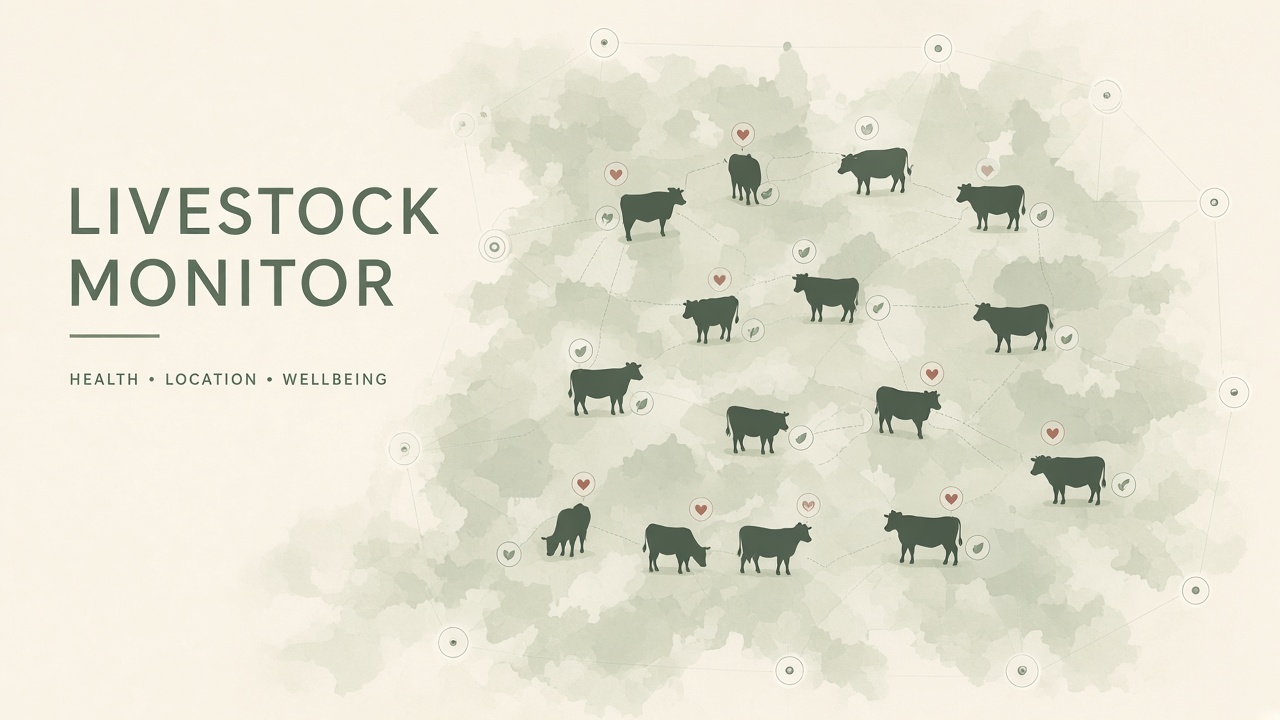
A sick cow often hides illness until milk production drops, feed intake falls, or the whole pen shows symptoms. Manual pen walks catch obvious lameness and down cows but miss subtle fever, early mastitis, or estrus windows that last only hours. Labor shortages on large dairies and beef feedlots make twice-daily visual checks harder to sustain. Precision livestock health monitoring AI combines barn cameras, thermal sensors, accelerometer ear tags, and edge inference to flag individual animals before herd-wide outbreaks and missed breeding cycles.
Dairy cooperatives, beef nutrition teams, and veterinary telehealth startups all ask whether camera analytics justify capital expense against labor savings and treatment costs. Product teams exploring AI chatbot interfaces for farm operations should ground answers in published edge deployments and peer-reviewed accuracy figures, not generic IoT marketing claims. More research explainers sit on the EliteAI.tools blog index.
What Precision Livestock Monitoring AI Means in Plain Language
Precision livestock monitoring AI is the use of computer vision, thermal imaging, acoustic sensors, and machine learning classifiers to track individual animal identity, behavior, body condition, and physiological proxies continuously in commercial barns, feedlots, or pasture systems. The goal is early intervention: treat one cow with mastitis before the bulk tank somatic cell count fails a processor contract, or schedule artificial insemination when estrus behavior peaks instead of guessing from calendar dates alone.
Unlike consumer pet cameras, agricultural systems must handle mud, steam, crowding, night lighting, shifting sun angles, and thousands of animals across seasons. Models trained on clean research pen photos often fail when transferred to working dairies with variable equipment layouts and mixed breeds. Precision monitoring is not autonomous veterinary diagnosis: it is a triage layer that routes suspicious animals to human inspectors.
| Signal | Typical sensor | Health insight |
|---|---|---|
| Posture and gait | Overhead RGB camera | Lameness, estrus standing, lying time |
| Body condition | Side-view camera, depth optional | Nutrition stress, calving readiness |
| Temperature proxy | Thermal plus RGB fusion | Fever screening before rectal checks |
| Activity bursts | Accelerometer ear tag | Estrus, illness lethargy |
How the Monitoring Pipeline Works
A precision livestock monitoring pipeline ingests multimodal barn data, detects and tracks each animal, classifies behavior or physiology, applies confidence thresholds, and routes alerts to mobile dashboards or farm management software. Edge devices run inference locally when barn connectivity is poor; ambiguous frames may offload to cloud GPUs for second-pass classification. The architecture mirrors industrial computer vision but must tolerate occlusion, identity swaps when cows crowd, and continuous model drift as seasons change.
Edge-cloud frameworks like Dairy DigiD
Dairy DigiD is a published edge-cloud framework that integrates YOLOv11 object detection with DenseNet121 physiological classification on NVIDIA Jetson hardware. INT8 quantization and TensorRT acceleration compress models about 73% with under 1% accuracy loss, enabling roughly 24 frames per second inference while holding 94.2% classification accuracy across four physiological classes. A confidence-based offloading rule keeps routine detections on the edge and sends uncertain frames to cloud analysis, balancing latency against compute cost. Validation across ten commercial dairy farms in Atlantic Canada reported mAP@50 of 0.947 under seasonal lighting variation. Active learning via Roboflow cut annotation effort about 65%, which matters because labeled barn video is the bottleneck, not GPU purchase price.
Thermal RGB fever screening with CattleFever
The University of Arkansas CattleFever project fuses thermal and RGB cameras to estimate body temperature without rectal probes on every animal. After building a calf thermal dataset, the system reached within about 1 degree Celsius of rectal readings in controlled trials. Thermal imaging captures radiant heat from skin and coat surfaces, so environmental humidity, wind, and wet hair introduce error that models must correct. Facial recognition in crowded pens remains an active research gap: fever triage works best when animals pause at a choke point such as a water station or sorting gate where identity and angle are stable.
Behavior detection and body condition scoring
Overhead YOLO models on a Nestlé-affiliated commercial dairy classified standing, lying, grazing, and estrus behaviors with mean average precision around 91.11% using YOLOv8-L despite occlusions and weather shifts across 2,956 annotated frames. Estrus detection is time-sensitive: standing heat may last only 12 to 18 hours, so missed frames directly translate to missed breeding windows. Separately, EdgeBCS-YOLO targets beef body condition scoring with 88.9% mAP@50 on motion-blurred footage and 33.35 FPS on Jetson Orin NX. Manual body condition scoring is subjective and infrequent; automated BCS can flag nutrition stress weeks before visual pen walks notice weight loss, but only if managers adjust rations when alerts fire.
Identity tracking and continuous labeling
Detection without stable identity produces anonymous alerts that herdsmen cannot act on. Multi-object tracking algorithms associate bounding boxes across frames, while RFID ear tags or facial embeddings disambiguate cows at waterers. Seasonal coat changes, mud, and horn growth degrade re-identification accuracy, so production systems combine visual tracking with tag reads at fixed points. Labeling pipelines use active learning to prioritize frames where the model is uncertain, reducing annotation labor as Dairy DigiD demonstrated with Roboflow. Budget for ongoing labeling, not a one-time dataset upload.
Alert routing and veterinary workflow integration
Raw model scores are not farm decisions. Production deployments map confidence tiers to workflows: low-confidence thermal spikes queue for next pen walk, medium-confidence lameness flags sort cows to a hoof trim chute, and high-confidence estrus alerts push to breeding technician phones. Integration with herd management software (DairyComp, PCDart, or equivalent) links alerts to animal ID, lactation stage, and treatment history so veterinarians see context before recommending antibiotics. Without workflow design, accuracy metrics from papers never convert to fewer sick days or higher pregnancy rates.
- Install calibrated cameras and optional thermal sensors at choke points with stable lighting.
- Collect and annotate barn video across seasons; use active learning to prioritize hard frames.
- Train detection (YOLO-family) and classification heads (DenseNet or similar) on farm-specific data.
- Deploy quantized models on edge hardware; define confidence thresholds for cloud offload.
- Integrate alerts with herd management software and veterinary review protocols.
- Measure recall on treated cases monthly; retrain when breed mix, pen layout, or season shifts.
Published Evidence and Industry Deployments
Evidence spans peer-reviewed edge-cloud dairy trials, university fever-camera pilots, and commercial farm behavior studies, but few systems publish multi-year return on investment across mixed breeds and geographies. Reported metrics are task-specific: estrus mAP does not translate directly to pregnancy rate gains without management follow-through and skilled insemination timing.
Dairy DigiD represents the strongest barn-scale deployment narrative: ten Atlantic Canada commercial dairies, 24 FPS edge inference on Jetson, 94.2% physiological classification accuracy, and mAP@50 of 0.947 for detection under seasonal lighting. The framework demonstrates that INT8 quantization can shrink models without collapsing accuracy, which is essential when barns cannot host rack-mounted GPUs. CattleFever adds a complementary signal: thermal RGB fusion within about 1 degree Celsius of rectal temperature on calves in research barns, suggesting fever triage before manual checks is feasible though not yet standard of care.
Commercial estrus monitoring on a Nestlé-affiliated dairy achieved 91.11% mAP with YOLOv8-L across four behavior classes, validating overhead cameras for standing heat detection in working pens. EdgeBCS-YOLO extends automation to beef nutrition with 88.9% mAP@50 and 33.35 FPS on Jetson Orin NX, fast enough for chute-side scoring on moving cattle. Investors and operators should demand confusion matrices disaggregated by breed, season, and camera angle, not single global accuracy numbers that hide failure modes in untested barn layouts.
Economic and welfare context
Mastitis costs the U.S. dairy industry billions annually in discarded milk, antibiotics, and labor. Early detection reduces bulk tank penalties and improves animal welfare when sick cows are treated before systemic infection spreads. Precision monitoring also supports antibiotic stewardship programs: treat individuals identified by fused behavior and thermal signals rather than prophylactic whole-herd doses. Regulatory frameworks in most jurisdictions still treat these systems as farm equipment aids, not veterinary diagnostic devices, unless vendors make explicit disease diagnosis claims that trigger medical device review.
Return on investment calculations should include avoided emergency vet calls, reduced antibiotic spend, higher conception rates from estrus alerts, and labor hours redirected from routine pen walks to targeted inspections. Few vendors publish audited multi-year ROI across mixed breeds; Dairy DigiD's ten-farm Atlantic Canada validation is a useful benchmark for detection accuracy but not a guaranteed payback schedule. Operators should run six-month pilots with baseline somatic cell counts, pregnancy rates, and treatment logs before scaling camera infrastructure across every barn.
Limits, Risks, and Ethical Guardrails
Models trained on Holstein-heavy datasets may underperform on Brahman, mixed breed, or heavily horned cattle unless retrained on local video. A 94.2% classification accuracy figure computed on defined physiological classes in the Dairy DigiD study does not guarantee detection of every rare disease on every farm. False positives still trigger unnecessary vet visits and sorting stress; false negatives miss animals that learned to hide symptoms behind pen mates.
- Environmental noise: Steam, dust, and night lighting degrade camera and thermal readings.
- Identity errors: Crowded pens cause track swaps that attach alerts to the wrong cow.
- Connectivity gaps: Cloud offload fails during outages unless edge queues alerts locally.
- Data ownership: Ag-tech contracts may let vendors train on your herd video for competitors.
- Automation without review: Sorting gates acting on algorithm output alone risk animal stress.
Ethical guardrails require human review before automated gates sort animals, clear data ownership terms in vendor contracts, and worker privacy policies when cameras cover staff areas alongside pens. Animal welfare audits should include algorithm override logs: how often did herdsmen dismiss alerts, and were dismissals correct? Pair automation with ethologist review when changing pen flow based on model scores alone.
International deployments add breed, housing, and regulatory variation that North American papers rarely address. European dairies with loose housing and robotic milking present different occlusion patterns than tie-stall barns in Atlantic Canada. Transfer learning from Dairy DigiD weights helps but does not replace local validation on your breed mix and barn geometry before capital commitment.
Worker surveillance is a separate risk when barn cameras cover alleys staff walk daily. Clear policies on who accesses footage, retention periods, and whether video is used for performance monitoring prevent trust breakdowns between management and herdsmen. Animal welfare groups increasingly ask whether automated sorting increases throughput stress; document that alerts trigger human review before gates move animals to hospital pens.
Who Should Use This and Who Should Wait
Large dairies with stable pen layouts, beef feedlots with chute infrastructure, and cooperatives with veterinary partnerships should pilot edge vision on one barn with measured recall on treated cases. Pasture-only herds without power for cameras, smallholders without bandwidth to label video, and operators who will not adjust rations or breeding schedules based on alerts should wait until simpler ear-tag activity systems prove value.
| Audience | Recommendation | Caveat |
|---|---|---|
| Large dairy with fixed pen layout | Pilot Dairy DigiD-style edge vision with vet validation | 94.2% accuracy is class-specific, not all diseases |
| Beef feedlot nutrition team | Deploy EdgeBCS-YOLO on exit chutes with human spot checks | No value without ration changes when BCS drops |
| Breeding-focused commercial dairy | Add overhead estrus detection; target 91% mAP baseline | mAP gains require skilled insemination follow-through |
| Calf fever screening program | Trial CattleFever thermal RGB at water stations | Within 1°C is triage, not regulatory diagnosis |
| Pasture-only or smallholder farm | Start with accelerometer ear tags before camera mesh | Full vision stack needs power, labeling, and IT support |
Frequently Asked Questions
Does 94.2% classification accuracy mean sick cows are always caught?
No. The metric reflects performance on defined physiological classes in the Dairy DigiD study across ten Atlantic Canada dairies, not guaranteed detection of every disease on every farm. Recall for rare conditions may be lower than headline accuracy. Measure treated-case recall monthly on your barn before trusting vendor slides.
Should inference run on edge or cloud?
Edge handles routine detection at barn bandwidth limits near 24 FPS on Jetson; cloud second-pass helps ambiguous frames when latency allows. Dairy DigiD uses confidence-based offloading for this hybrid pattern. Require local alert queuing when internet fails so fever flags are not silently dropped.
Can thermal cameras replace rectal temperature checks?
CattleFever research systems approach within about 1 degree Celsius of rectal readings on calves but are not yet standard of care for regulatory or treatment decisions. Use thermal as triage at choke points; confirm with clinical exams before antibiotic protocols.
What does 91.11% estrus mAP mean for breeding programs?
It means YOLOv8-L correctly localized and classified estrus-related behaviors on the Nestlé-affiliated dairy test set at that mean average precision; it does not automatically raise pregnancy rates. Breeding technicians must still inseminate within the standing heat window. Pair detection alerts with skilled timing.
Are AI livestock monitors regulated as medical devices?
Most jurisdictions treat them as farm equipment or software aids, not veterinary devices, unless vendors make explicit diagnostic claims. Review local animal health, data privacy, and worker surveillance rules before deployment. Cameras covering staff areas need separate consent policies.
How much labeled video is required to deploy?
Commercial estrus studies used a few thousand annotated frames; broader health classifiers need ongoing active learning as seasons change. Dairy DigiD reported 65% annotation effort reduction via active learning, but continuous labeling budget remains essential for production accuracy.
Conclusion
Precision livestock health monitoring AI moves from lab mAP scores to barn-scale edge-cloud systems that detect behavior, score body condition, and approximate fever with published accuracy in defined conditions. Dairy DigiD delivers 94.2% physiological classification at 24 FPS across ten Atlantic Canada dairies; CattleFever thermal RGB fusion approaches within 1 degree Celsius of rectal temperature on calves; Nestlé-affiliated estrus monitoring reaches 91.11% mAP with YOLOv8-L; and EdgeBCS-YOLO scores beef body condition at 88.9% mAP@50 and 33.35 FPS on Jetson Orin NX. Treat vendor accuracy claims as task-specific, validate on your breed and barn layout, integrate alerts with veterinary workflow, and keep humans in the loop before automated gates act on algorithm output alone.