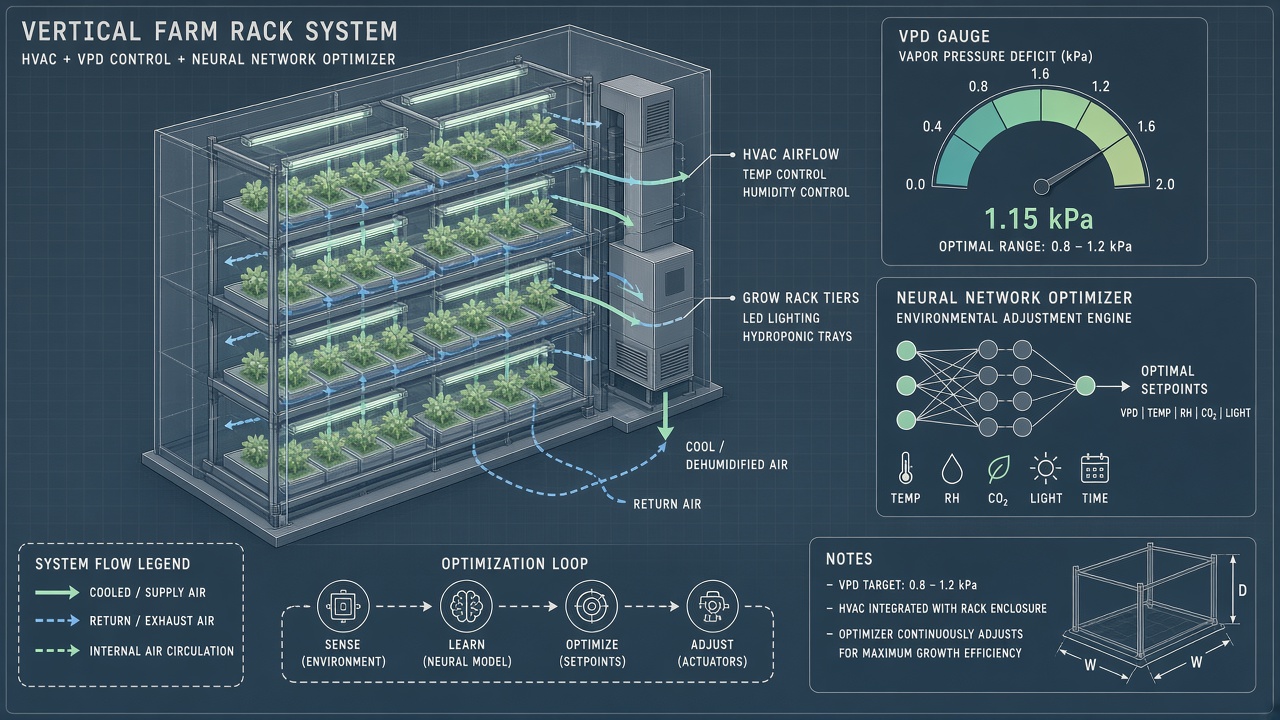
Vertical farms and greenhouses burn electricity when independent PID loops fight each other: dehumidifiers heat the room while chillers cool it back down, and compressors cycle endlessly without stabilizing what plants actually experience at the leaf surface. Cultivation teams set temperature at 22°C and relative humidity at 65% as separate targets, then wonder why transpiration swings and mold risk persist. Vertical farm AI climate control optimization replaces reactive setpoints with cascading architectures that optimize vapor pressure deficit (VPD), the humidity-temperature pair plants respond to, while minimizing HVAC energy draw.
Cultivation engineers, sustainability officers, and indoor agriculture investors compare AI climate platforms against legacy greenhouse controllers and ask whether savings survive a full grow cycle. Teams browsing AI chatbot tools for facility operations should verify multi-year field deployment data, not simulation-only reinforcement learning papers. Additional explainers appear on the EliteAI.tools blog index.
What Vertical Farm AI Climate Control Means in Plain Language
Vertical farm AI climate control is the use of machine learning, IoT sensor networks, and cascading control theory to coordinate temperature, humidity, CO2, and airflow so crops stay in target VPD bands while HVAC systems consume less energy. VPD measures the drying force on leaf stomata in kilopascals; holding VPD stable often matters more than holding temperature alone at a fixed Celsius value. When VPD drifts, plants close stomata, slow growth, or become vulnerable to pathogens regardless of what the wall thermostat displays.
Legacy controllers treat temperature and relative humidity as independent loops. Because warm air holds more moisture, adjusting one variable shifts the other, causing oscillation and wasted compressor cycles. AI layers predict disturbances from irrigation evaporation, door openings, sun load through glazing, and LED heat output, then select setpoints on the VPD constraint surface that satisfy crops with minimum mechanical work. The shift is from chasing two coupled numbers to optimizing one biologically meaningful variable with an energy objective.
| Control layer | Function | Typical bandwidth |
|---|---|---|
| Outer VPD loop | Neural optimizer picks T/RH pairs | Minutes |
| Inner PID loops | Track actuator setpoints | Seconds |
| Edge autonomy | Local control if cloud drops | Continuous |
| Fleet learning | Cross-facility model updates | Daily to weekly |
How the Climate Control Pipeline Works
The pipeline streams sensor telemetry to edge controllers, forecasts plant-environment response, optimizes energy-minimal setpoints on the VPD surface, and executes through industrial HVAC protocols with operator guardrails. Progressive autonomy models let facilities move from anomaly alerts to supervised auto-tuning to bounded autonomous optimization. Control logic runs locally at the edge; cloud tiers enable fleet dashboards and model updates without requiring internet uptime for safety-critical loops.
IOGRUCloud and VPD-centric cascading control
IOGRUCloud documents seven-plus years of operation across more than 30 commercial controlled environment agriculture (CEA) sites in eight U.S. climate zones. A 7-3-3 neural network optimizer selects temperature-humidity combinations along the VPD iso-curve that minimize predicted HVAC energy. Inner PID loops with neural self-tuning track those setpoints on seconds-scale bandwidth while the outer optimizer updates on minutes-scale bandwidth. Reported fleet aggregates include 30 to 38 percent HVAC energy reduction versus conventional independent PID baselines, 68 to 73 percent improvement in VPD stability (sigma dropping from roughly 0.15 to 0.25 kPa to 0.04 to 0.08 kPa), and 60 to 67 percent faster recovery after disturbances such as irrigation spikes or door openings. Case studies span a 40,000 square foot desert facility and a 120,000 square foot continental-climate facility with before-after metering.
Privacy-preserving fleet learning with HierFedCEA
HierFedCEA applies hierarchical federated learning so competing growers share model improvements without exposing raw cultivation recipes. A global physics tier captures universal thermodynamics and HVAC response, crop-cluster tiers encode cultivar-specific VPD mappings, and local tiers adapt to equipment quirks without sensor logs leaving the facility. Simulations calibrated from the same multi-year IOGRUCloud deployment suggest convergence in 40 to 60 communication rounds and cold-start commissioning within about 14 days for new sites joining the fleet. Differential privacy budgets on sensitive tiers reduce the risk that shared weights encode proprietary light recipes or nutrient schedules, though legal review remains essential for competitive cultivation data.
Physics-aware diffusion models with ADAPT
ADAPT uses conditional diffusion indoor environmental world models with heat-balance regularization for transferable HVAC control in conventional buildings. On SemiBuildingSim and Sinergym benchmarks, integrating the world model with reinforcement learning cut HVAC energy about 7.3 percent and occupant discomfort about 30.2 percent versus strong baselines, with smaller degradation under cross-season transfer than purely data-driven world models. Vertical farms may adopt similar physics-aware predictors as hybrid layers atop VPD optimizers: the diffusion model forecasts how irrigation mist, LED heat, and outdoor air exchange will shift temperature and humidity over the next control horizon, letting the optimizer pick setpoints that preempt oscillation rather than react to it.
Sensor calibration and actuator integration
AI climate control fails when VPD sensors drift or when actuators cannot execute optimized setpoints. IOGRUCloud reports commissioning across more than 50 equipment manufacturers via eight industrial protocols including BACnet and Modbus, with integration timelines of one to five days when equipment profiles exist. New facilities with custom HVAC layouts need longer calibration. Operators should meter HVAC circuits separately from LED lighting before trusting headline energy savings: a 38 percent HVAC cut means little if grow lights dominate total kilowatt-hours.
Progressive autonomy and hard safety limits
Production deployments typically stage autonomy from L1 anomaly alerts through L4 bounded optimization where the neural optimizer adjusts setpoints within operator-defined envelopes. Hard limits on minimum ventilation rate, maximum CO2 enrichment, and absolute temperature floors sit outside model control and cannot be overridden by fleet learning updates. Document override logs for food safety audits when climate control touches post-harvest cold rooms or wash-pack areas. Edge autonomy ensures these limits enforce even when cloud connectivity drops mid-grow.
- Instrument rooms with calibrated temperature, humidity, and CO2 sensors at canopy height.
- Establish baseline HVAC energy metering separate from lighting circuits.
- Deploy edge controllers integrated with existing BACnet or Modbus actuators.
- Configure outer VPD loop with crop-specific target bands and neural optimizer constraints.
- Enable inner PID loops with neural self-tuning to track optimized T/RH setpoints.
- Optionally join federated fleet tiers for cross-site learning; audit privacy terms before sharing weights.
Published Evidence and Industry Deployments
The strongest evidence comes from IOGRUCloud multi-year CEA fleet data across more than 30 facilities in eight U.S. climate zones rather than single-season greenhouse pilots or simulation-only studies. Seven years of operational telemetry supports claims that VPD-centric cascading control sustains energy savings and stability gains across desert, continental, and coastal humidity regimes. HierFedCEA extends the same deployment narrative with federated learning that preserves grower privacy while accelerating cold-start commissioning to about 14 days for new sites.
Reported fleet aggregates are substantial but not universal: 30 to 38 percent HVAC energy reduction, VPD sigma improving from roughly 0.15 to 0.25 kPa down to 0.04 to 0.08 kPa, and disturbance recovery 60 to 67 percent faster after irrigation or door events. ADAPT contributes complementary evidence from building simulation benchmarks where physics-aware diffusion world models achieve 7.3 percent HVAC energy reduction and 30.2 percent discomfort reduction versus strong RL baselines, with better cross-season transfer than naive data-driven models. CEA operators should treat ADAPT as research-grade augmentation until comparable multi-year field metrics exist for vertical farm cultivars.
Crop and tariff variability
Lettuce rooms with continuous harvest tolerate tighter VPD bands than vine crops with flowering stages that need different humidity targets. Energy savings also depend on local electricity tariffs: facilities with time-of-use pricing benefit when optimizers shift dehumidification to off-peak hours without violating crop VPD envelopes. IOGRUCloud case studies across climate zones suggest the architecture generalizes, but crop-specific retuning of outer loop targets remains necessary when switching cultivars within the same facility.
Desert facilities face high latent loads when make-up air is hot and dry; continental sites battle winter infiltration that spikes heating demand. The 30 to 38 percent HVAC reduction range across eight climate zones suggests the VPD-centric optimizer adapts outer loop constraints to local disturbance profiles rather than shipping one national setpoint table. Operators in humid coastal zones should still verify dehumidifier capacity matches optimizer assumptions before enabling L4 bounded autonomy.
Limits, Risks, and Ethical Guardrails
Autonomous HVAC changes can destroy entire crop rooms if sensors drift, if models trained in lettuce rooms deploy in high-humidity vine crops without retuning, or if federated weights encode equipment assumptions that do not match local chillers. A 30 to 38 percent HVAC savings figure aggregated across 30-plus sites does not guarantee identical results in a single-room pilot without baseline metering and crop-matched VPD targets.
- Sensor drift: Uncalibrated humidity probes corrupt VPD calculations silently.
- Lighting dominance: HVAC cuts shrink when LEDs are the primary kilowatt-hour load.
- Fleet learning leakage: Shared weights may still encode cultivation tactics despite privacy tiers.
- RL simulation gap: ADAPT benchmarks are buildings, not canopy transpiration models.
- Worker safety: CO2 enrichment and minimum ventilation must stay outside model override.
Ethical guardrails require hard safety limits on ventilation and CO2 that AI cannot override, transparent override logs for food safety audits, and worker training before enabling higher autonomy levels. Sustainability reporting should separate HVAC savings from total facility carbon footprint: a 35 percent chiller reduction does not offset diesel backup generators or embodied carbon in rack steel. Competitors joining federated fleets need legal review of weight-sharing terms even when raw sensor logs never leave the building.
Climate change adds outdoor disturbance frequency that seven-year IOGRUCloud datasets may underrepresent in future decades: heat domes, wildfire smoke infiltration, and grid instability during peak cooling demand. Edge autonomy and conservative safety envelopes become more important as facilities depend on AI optimizers during operator shortages, not only during normal commissioning.
Food safety auditors increasingly ask how climate logs support traceability when pathogen outbreaks trace to wash-pack humidity excursions. AI platforms that timestamp every setpoint change and operator override simplify root-cause analysis compared to legacy controllers with sparse logging. Pair HVAC optimization with canopy-level microclimate sensors when mold risk is the primary crop threat: wall-mounted probes miss hot spots between LED fixtures where VPD can diverge from room averages.
Who Should Use This and Who Should Wait
Multi-site vertical farm operators with top-line HVAC operating expense, calibrated sensors, and BACnet integration support should adopt VPD-centric cascading control with measured baselines. Research greenhouses that require fixed manual protocols for phenotyping comparability, single-room pilots without energy metering, and facilities where vendors demand rip-and-replace without return on investment models should wait until field-proven platforms match their equipment profile.
| Audience | Recommendation | Caveat |
|---|---|---|
| Multi-site vertical farm operator | Deploy IOGRUCloud-style VPD cascading with fleet metering | 30 to 38% savings are fleet aggregates, not guarantees |
| Competing CEA brands in one region | Evaluate HierFedCEA federated tiers after legal review | Shared weights are not zero competitive risk |
| Research greenhouse | Use VPD outer loop for reproducible phenotyping | Fixed manual protocols may conflict with auto-tuning |
| Legacy tomato greenhouse | Integrate via BACnet if profiles exist; stage L1 to L3 autonomy | Novel HVAC layouts extend commissioning beyond five days |
| RL-first climate vendor evaluator | Benchmark against ADAPT-style physics world models in sim | 7.3% sim savings lack IOGRUCloud-scale field years |
Frequently Asked Questions
Why use VPD as the primary setpoint instead of temperature?
VPD captures the combined effect of temperature and humidity on transpiration, reducing cross-coupling fights between independent PID loops. IOGRUCloud deployments report VPD sigma improving from roughly 0.15 to 0.25 kPa down to 0.04 to 0.08 kPa after elevating VPD to the outer optimization loop.
Are 30 to 38 percent HVAC savings guaranteed?
No. Figures come from documented multi-facility IOGRUCloud aggregates over seven-plus years versus conventional PID baselines; your crop, climate zone, and tariff structure will differ. Meter HVAC separately from lighting before trusting vendor presentations.
Must climate control run in the cloud?
IOGRUCloud executes control logic locally at the edge; cloud tiers enable fleet learning, dashboards, and federated weight aggregation. Facilities should require autonomous fallback with hard safety limits when internet fails mid-grow.
Does HierFedCEA federated learning expose grow recipes?
HierFedCEA shares tiered model weights, not raw sensor logs, with differential privacy budgets on sensitive tiers. Legal review still matters for competitive cultivation data even when telemetry stays on-premise.
Is reinforcement learning ready for commercial vertical farms?
RL with ADAPT-style physics-aware diffusion world models shows 7.3 percent HVAC energy reduction in building simulators; most commercial CEA evidence still centers on cascading neural optimizers with years of field data. Treat pure RL vendors as higher risk until they publish comparable fleet metrics across 30-plus sites.
How long does commissioning take?
Reported IOGRUCloud integrations range from one to five days when equipment profiles exist across more than 50 manufacturers; HierFedCEA cold-start targets about 14 days for new fleet sites. Budget operator training alongside hardware install and verify sensor calibration before enabling higher autonomy levels.
Conclusion
Vertical farm AI climate control optimization matures when VPD-centric cascading architectures, edge autonomy, and optional federated fleet learning replace warring PID loops. IOGRUCloud documents seven-plus years across more than 30 CEA facilities in eight U.S. climate zones with 30 to 38 percent HVAC energy reduction, substantially tighter VPD stability, and faster disturbance recovery. HierFedCEA adds privacy-preserving cross-site learning with about 14-day cold-start commissioning, while ADAPT demonstrates 7.3 percent HVAC savings in physics-aware diffusion simulation benchmarks. Validate savings on your own meters, keep hard safety limits outside model control, retune outer VPD targets per cultivar, and treat simulation-only RL as complementary research until it matches field-proven CEA platforms.