Google Cloud expanded Vertex Agent Builder throughout 2026 with Agent Development Kit (ADK) 2.0, tighter Gemini 3.8 model bindings, and enterprise security controls for regulated workloads. The vertex agent builder 2026 release cycle positions Google as a direct competitor to OpenAI's Agents API and Microsoft Copilot Studio for teams that want managed orchestration inside Google Cloud rather than a third-party agent framework.
This analysis summarizes verified 2026 feature additions from Google Cloud blog posts and ADK release notes, explains how Gemini models attach to agent graphs, reviews VPC and data residency options, and compares pricing assumptions against OpenAI's agent stack. Figures below reflect Google-published materials as of September 2026 and should be validated against your own workload before procurement.
2026 Feature Additions to Vertex Agent Builder
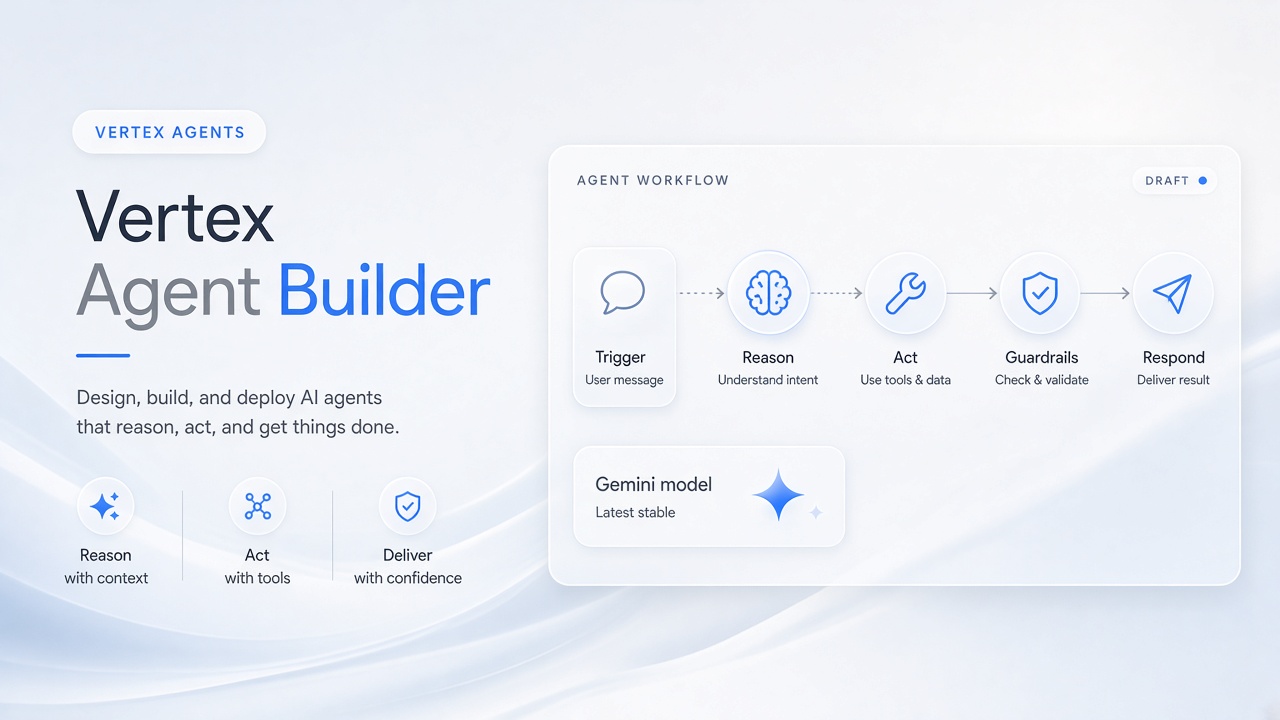
Vertex Agent Builder in 2026 centers on ADK 2.0, a graph-based workflow engine that blends deterministic steps with LLM-driven routing inside a single execution runtime. Google shipped ADK 2.0 General Availability for Python in May 2026 and followed with ADK Go 2.0 in June, giving teams a production-grade path from prototype agents to governed multi-step workflows on Vertex AI Agent Engine.
The headline capability is structured workflows: developers compose agents as nodes and edges rather than relying solely on open-ended tool loops. ADK 2.0 supports fan-out and fan-in patterns, conditional routes, loop-back edges for iterative refinement, and built-in human-in-the-loop (HITL) checkpoints that pause execution until an operator approves or edits intermediate output. Google positions this as the reliability layer that pure autonomous agents lack.
| 2026 capability | What changed | Enterprise relevance |
|---|---|---|
| ADK 2.0 graph engine | Nodes, edges, join barriers, dynamic RunNode routing | Predictable multi-agent flows with auditable paths |
| LLM agent modes | Chat, Task, and SingleTurn delegation modes | Specialized sub-agents without context bleed |
| Human-in-the-loop | First-class HITL primitive with durable state resume | Compliance gates before external actions |
| Agent Engine Sandbox | Computer-use sandbox integration (ADK 1.31+) | Isolated browser and desktop automation |
| A2A task stores | Persistent task storage for agent-to-agent handoffs | Long-running workflows across services |
Vertex AI Agent Builder console updates in 2026 added visual graph inspection for ADK workflows, session replay for debugging tool calls, and tighter integration with Cloud Logging and Cloud Trace. Teams building AI chatbot flows can deploy the same graph to a managed endpoint without rewriting orchestration logic for production.
How ADK 2.0 Differs From Prior Vertex Releases
ADK 1.x focused on single-agent tool use and callbacks; ADK 2.0 adds a workflow runtime that separates execution routing from language processing. In practice, a freight-quote agent can call a deterministic pricing API as a FunctionNode, fan out to three research sub-agents in parallel, join results at a barrier node, and only invoke an LLM for synthesis. Errors in deterministic steps surface as standard exceptions rather than ambiguous model refusals.
Gemini Model Bindings for Agents
Vertex Agent Builder in 2026 defaults to Gemini 3.8 family models with per-node model selection, grounding connectors, and function-calling schemas shared across ADK and the Vertex console. Google agent orchestration teams can bind Flash for high-QPS tool loops, Pro for planning nodes, and Flash Cyber for security-tuned subgraphs without leaving the Agent Builder project.
Model bindings are declared at the agent or node level in ADK. A coordinator agent in Chat mode can delegate to sub-agents in Task or SingleTurn mode, each with its own Gemini endpoint and temperature settings. Grounding options include Google Search, Vertex AI Search over enterprise corpora, and Chronicle connectors for security workflows. Function calling uses JSON schema validation consistent with the Gemini API.
| Gemini tier | Agent use case | Binding notes |
|---|---|---|
| Gemini 3.8 Flash | High-volume chat, classification, tool loops | Lowest latency tier; pairs with Flash-Lite preview |
| Gemini 3.8 Pro | Planning, multi-step reasoning, synthesis nodes | Higher cost; use sparingly in graphs |
| Flash Cyber | SOC triage, threat intel summarization | Stricter filters; Chronicle and SCC connectors |
| Gemini Live preview | Voice and real-time multimodal agents | ADK live session support for streaming endpoints |
Teams using AI code assistants can attach Gemini to repository-aware tool nodes that call Cloud Source Repositories or third-party Git providers through standard ADK tool interfaces. Google recommends pinning model versions per environment and running eval suites when upgrading from Gemini 2.5 to 3.8 bindings, because tool-calling behavior can shift between generations.
Security and VPC Options
Enterprise Vertex Agent Builder deployments in 2026 support VPC Service Controls, Customer-Managed Encryption Keys (CMEK), Private Service Connect endpoints, and IAM-scoped agent identities for tool access. Regulated customers can keep agent traffic off the public internet and restrict which Cloud APIs each agent service account may invoke.
Agent Engine runs inside your Google Cloud project boundary. Session data, tool outputs, and HITL approval records can be logged to Cloud Logging with organization-level retention policies. Google added agent-specific audit events in 2026 that record graph node transitions, model invocations, and external tool calls with correlation IDs for SIEM ingestion.
- VPC Service Controls: Perimeter around Vertex AI, Secret Manager, and connected data stores
- Workload Identity Federation: Agent tools authenticate to external systems without long-lived keys in code
- Model Armor: Prompt and response filtering layer compatible with agent endpoints
- Access Transparency: Logs when Google personnel access customer content (where enabled)
- Regional residency: Deploy agents in EU, US, or other supported regions with data locality controls
Security teams should treat agent tool definitions as part of the attack surface. ADK graphs that call external MCP servers or custom HTTP tools need the same supply-chain review as any integration. Google documents recommended patterns for signing tool manifests and restricting outbound URLs from sandboxed agent nodes.
Pricing Overview and OpenAI Comparison
Vertex Agent Builder pricing in 2026 combines Gemini token charges, Agent Engine compute minutes, grounding query fees, and optional provisioned throughput commitments. There is no separate per-agent seat license; costs scale with model usage and managed runtime hours. OpenAI's Agents API bills similarly through model tokens plus tool execution, but pricing tables differ by provider tier and enterprise contract.
| Cost component | Vertex Agent Builder | OpenAI Agents API (indicative) |
|---|---|---|
| Model inference | Gemini 3.8 Flash/Pro per-million-token list rates | GPT-6 class models per-million-token list rates |
| Orchestration runtime | Agent Engine instance hours | Included in API usage; hosted options vary |
| Grounding | Google Search and Vertex AI Search query fees | Web search tool surcharges where enabled |
| Enterprise discount | Committed use and EDP on Google Cloud spend | Volume tiers and enterprise agreements |
Multi-agent graphs amplify token spend because each node may invoke the model independently. ADK 2.0's deterministic nodes reduce cost when teams move classification, validation, and API calls out of LLM steps. Google published TCO guidance in 2026 recommending Flash for all nodes except explicit reasoning stages; teams ignoring that pattern often see 3x to 5x higher bills than necessary on comparable OpenAI workflows.
Provisioned throughput on Vertex AI offers predictable latency for agent workloads with sustained QPS. Enterprise discounts through committed use discounts (CUDs) and enterprise discount programs (EDPs) apply to combined Google Cloud spend, which can make Vertex attractive for organizations already running BigQuery, GKE, and Chronicle alongside agents. Teams should model agent costs as a pipeline: ingestion grounding, coordinator model calls, sub-agent invocations, and output validation each add token and compute line items.
OpenAI enterprise customers often negotiate bundled API credits and reserved capacity. Direct comparison requires normalizing for model capability tier, average context length, tool-call frequency, and grounding volume. A customer service agent resolving 500 tickets daily with 8 tool calls each will look very different from a coding agent running single long-context sessions. Run both platforms on identical eval sets before signing multi-year commitments.
Deployment Paths on Vertex AI
Google offers three primary deployment paths for ADK-built agents in 2026. Agent Engine provides fully managed hosting with autoscaling, session persistence, and integrated monitoring. Self-hosted ADK on Google Kubernetes Engine suits teams that need custom networking or co-location with existing microservices. Cloud Run deployments work for lighter agents with bursty traffic patterns. Most enterprise customers evaluating google agent builder capabilities start on Agent Engine and migrate only when specific infrastructure constraints require self-hosting.
Agent Engine Sandbox integration, added in ADK 1.31 and refined through 2026, supports computer-use workflows where agents interact with browser or desktop environments in isolated sandboxes. Security teams should review sandbox egress policies carefully because computer-use agents require broader network permissions than text-only chatbots. Google documents recommended VPC configurations for sandbox workloads alongside standard Agent Engine endpoints.
OpenAI Agents API Feature Parity Notes
OpenAI's Agents API emphasizes hosted tool execution, file search, and computer use through the Responses API. Vertex differentiates with native Google Cloud service connectors (BigQuery, Cloud Storage, Chronicle) and ADK graph workflows that OpenAI addresses through custom orchestration layers. Teams already on Azure or AWS may still choose OpenAI models via third-party gateways, but lose integrated VPC controls that Vertex provides natively. Feature parity shifts quarterly; procurement teams should run bake-offs on their specific tool chains rather than comparing marketing checklists.
Gemini agent orchestration through Vertex also benefits from provisioned throughput discounts when teams commit to sustained QPS on Flash endpoints. OpenAI offers reserved capacity for enterprise customers but pricing mechanics differ. Finance teams modeling 12-month TCO should include grounding query volume, Agent Engine runtime hours, and egress charges for tool calls to external APIs on both platforms.
Google Cloud's 2026 agent documentation emphasizes eval-driven development: teams define success metrics per graph node, run regression suites on model upgrades, and use session replay to debug failed tool calls. This operational maturity separates production agent programs from demo-grade prototypes. Vertex Agent Builder console updates added side-by-side session comparison and node-level latency breakdowns to support these workflows.
Frequently Asked Questions
What is Vertex Agent Builder?
Vertex Agent Builder is Google Cloud's managed environment for designing, deploying, and operating AI agents on Vertex AI. In 2026 it integrates ADK 2.0 graph workflows, Gemini model bindings, grounding connectors, and enterprise security controls in a single Google Cloud project.
How does ADK 2.0 relate to Vertex Agent Builder?
ADK is the open-source Agent Development Kit that defines agent logic, tools, and workflows. Vertex Agent Builder provides the managed runtime (Agent Engine), console, monitoring, and Gemini endpoints that host ADK graphs in production without custom infrastructure.
Can I use Vertex agents without Gemini models?
Vertex Agent Builder is optimized for Gemini. ADK supports other model providers in self-hosted setups, but managed Agent Engine features such as grounding, Model Armor, and console debugging are built around Gemini endpoints on Vertex AI.
How does Vertex Agent Builder compare to OpenAI Agents API?
Both offer tool use, multi-step orchestration, and hosted runtimes. Vertex differentiates with ADK 2.0 graph workflows, deep Google Cloud IAM and VPC integration, and Gemini-specific grounding. OpenAI differentiates with GPT model access, Responses API features, and a larger third-party tool ecosystem. Choice often follows existing cloud commitments.
What migration path exists from ADK 1.x?
Google documents ADK 2.0 as largely additive. Teams opt into the workflow graph packages while keeping existing single-agent code running. Go and Python each have migration guides covering context API changes and unified agent.Context signatures introduced in the 2.0 runtime.
Which industries adopt Vertex Agent Builder first?
Financial services, retail, logistics, and security operations lead 2026 adoption based on Google Cloud case studies. Regulated industries value VPC Service Controls and CMEK. High-QPS consumer chat applications favor Flash bindings for cost control. Evaluate your industry's compliance requirements before selecting a managed agent platform.
Does Vertex Agent Builder support MCP?
ADK supports MCP tool connectors in self-hosted and Agent Engine configurations. Teams connecting external MCP servers should apply supply-chain security review because tool metadata can change at runtime. Google recommends allowlisting approved MCP endpoints and monitoring tool schema drift in production agents.