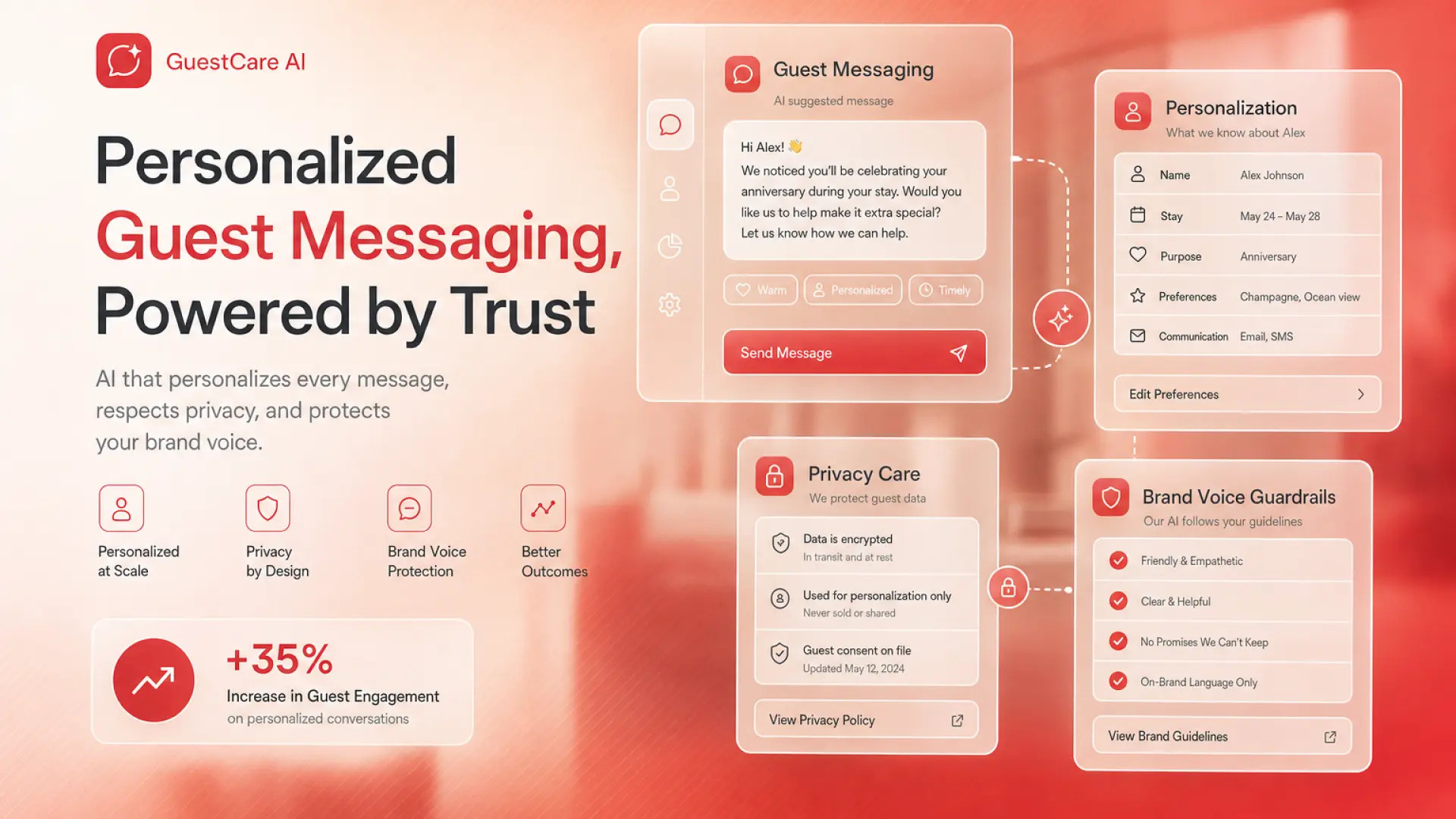
Guests expect instant answers about check-in, amenities, and local recommendations while hotels run lean front desks. AI hospitality guest services can personalize pre-arrival emails and handle routine chat, but brand voice, payment data boundaries, and escalation paths must be designed before launch. A chatbot that sounds off-brand or mishandles a billing dispute damages loyalty faster than no bot at all.
This guide maps journey touchpoints, PII and payment rules, multilingual communication, and CSAT measurement. Explore AI automation for workflow triggers and AI research tools for competitive benchmarking, but deploy guest-facing AI through hospitality-specific platforms with PMS integration.
Pre-Arrival, In-Stay, and Post-Stay AI Touchpoints
Map AI to each journey phase with different data access and escalation rules. Pre-arrival handles FAQs and upsells; in-stay handles service requests and complaints; post-stay handles surveys and rebooking nudges. One bot persona across phases simplifies training but risks over-sharing reservation details in channels that lack authentication.
| Phase | AI role | Escalation trigger |
|---|---|---|
| Pre-arrival | Directions, parking, early check-in policy | Special requests, rate disputes |
| In-stay | Housekeeping, maintenance tickets, hours | Safety, billing, anger keywords |
| Post-stay | Survey, lost-and-found, loyalty offers | Charge disputes, injury claims |
PII and Payment Data Boundaries
Never collect card numbers or government IDs in AI chat logs; route payments to PCI-compliant flows. Guest PII in prompts may train vendor models on consumer tiers. Enterprise hospitality AI contracts must prohibit training on guest data and define retention for conversation logs.
- Tokenize loyalty numbers in integrations; do not paste full profiles into prompts.
- Redact passports and payment artifacts from transcripts used for QA.
- Apply regional privacy rules (GDPR, CCPA) to marketing follow-ups from chat.
- Limit staff access to guest chats on need-to-know basis.
Multilingual Guest Communication
Deploy models with verified quality in your top guest languages and keep human translators on escalation for complaints and legal topics. Automatic translation of brand phrases can flatten tone; maintain approved glossaries for property names, package titles, and policy statements.
Measuring CSAT Impact
Track containment rate, escalation time, CSAT by channel, and revenue on AI-suggested upsells separately. A high containment rate with falling CSAT means the bot resolves tickets poorly. Compare properties with and without AI in matched seasons before rolling chain-wide.
Staff Enablement and Handoff Quality
Front desk staff need context-rich handoffs when AI escalates: guest preferences, prior attempts, and sentiment summary without dumping raw chat logs. Train staff to continue conversations without asking guests to repeat information. Measure guest satisfaction on escalated threads separately from fully automated resolutions.
Revenue Management Integration
AI upsell suggestions must sync with revenue management rate fences and real-time availability. Do not offer upgrades the PMS cannot fulfill. Misquoted rates create legal and loyalty damage worse than no upsell attempt. Connect chat to inventory for room categories and packages before enabling promotional automation rules.
Brand Voice and Content Governance
Maintain approved phrase libraries, banned claims lists, and tone examples per brand tier. Luxury properties need formal warmth; select-service brands need brevity. Monthly QA samples fifty chats per property for off-brand upsell pressure or incorrect amenity descriptions. Update libraries when renovations change pool hours, restaurant partners, or parking policies.
Social and review response drafts from AI need human approval before posting on public channels. Never argue with guests in automated replies. Escalate one-star patterns to general manager within one hour. Link research on competitor messaging only for internal strategy decks, not guest-facing copy paste.
Accessibility and Inclusive Design
Chat widgets must work with screen readers; offer phone and in-person alternatives prominently. Do not rely on color-only status indicators for reservation changes. Caption video pre-arrival tours. Train bots to recognize accessibility accommodation requests and route to trained staff, not generic FAQ loops.
Crisis and Reputation Events
Disable promotional automation during local emergencies, outages, or on-property incidents. Pre-write crisis holding messages legal approves annually. Switch bot to informational-only mode with single escalation path. Coordinate with PR before any AI-generated guest blast during sensitive events.
Group and Event Business
Group sales and banquet events need separate bot flows with human sales manager handoff for contracts over threshold dollar amounts. AI can answer capacity FAQs from function sheet data synced nightly. Do not quote attrition or cancellation terms without human review. Wedding and conference segments benefit from curated templates, not open-ended generation.
Technology Stack and PMS Integrations
Guest AI sits between PMS, CRM, ticketing, and channel manager; define source of truth per data element before go-live. Room status comes from PMS. Marketing preferences come from CRM. Maintenance tickets flow to engineering CMMS. Broken integrations cause bots to confirm amenities that closed last month. Staging environment must mirror production rate codes and room types weekly during peak renovation seasons.
Webhook failures should alert operations, not fail silently into generic apologies. Retry with exponential backoff; after three failures route guest to human with apology and callback promise. Log correlation IDs across systems for post-incident review. API rate limits from PMS vendors may throttle high-volume event weekends; pre-scale read replicas or cache static property facts with TTL under one hour for non-rate data.
Franchise vs Managed Operations
Brand standards flow from franchisor; managed properties need local GM override on bot tone and escalation thresholds. Franchisees may choose approved vendor from brand list but configure local restaurant partners and parking rules. Corporate audits should sample chats across properties monthly. Flag properties with high escalation rates for retraining, not only low containment.
Housekeeping and Maintenance Operations
In-stay bots creating housekeeping and engineering tickets must set realistic ETAs from workforce management system, not generic promises. Sync room status: dirty, clean, inspected, out-of-order. Maintenance bots should triage urgency: no hot water escalates immediately; missing coat hanger does not. Close loop with guest message when ticket completes.
Spa, F&B, and Outlet Reservations
Outlet booking bots need live inventory from spa and restaurant systems separate from room PMS. Cross-sell spa package only when therapist schedule confirms availability. Allergen questions on restaurant menus route to human; AI must not guess ingredients. Dress code and age restrictions for venues belong in curated FAQ, not generated text.
Long-Stay, Residential, and Extended Stay
Extended stay guests need different bot flows: weekly housekeeping schedule, lease-like terms, and utility allowances where applicable. Do not apply nightly hotel cancellation policy language to thirty-day stays. Authenticate long-stay guests before discussing renewal rate; rate may be contractual not BAR.
Voice, IVR, and Call Center Integration
Voice AI for central reservations must hand off to human with screen pop showing chat history if guest switched channels. Test accent and background noise on property phones. IVR deflection to chat should send SMS link with session token, not require re-entry of confirmation number three times.
The Bottom Line
Effective AI hospitality guest services span the full journey with phase-appropriate data access, strict PII and payment boundaries, multilingual quality controls, and honest CSAT measurement. Automate routine answers; escalate emotion, safety, and money to humans. Invest in integrations and staff handoffs equal to bot tuning effort.
Frequently Asked Questions
How does AI interact with OTA bookings?
Guests from OTAs may lack loyalty profiles. Authenticate with confirmation number and surname before sharing reservation details. Do not promise OTA rate changes the hotel cannot honor; escalate to reservations when channel rules conflict with direct-booking policies.
OTA messaging APIs differ by channel; some prohibit automated replies with upsell. Map channel-specific rules in bot configuration. When guest asks to modify dates on Booking.com reservation, route to dedicated OTA desk rather than PMS modify flow that could double-book.
Can AI access full loyalty history?
Only through secured API fields required for the request. Avoid dumping entire stay history into prompts. Tier benefits and points balances should come from PMS read APIs with audit logging.
Lifetime stay counts and complaint history are sensitive; restrict to supervisor roles in staff console. Bots may acknowledge tier status generically without reciting every past stay unless guest asks for specific folio detail after authentication.
Should the bot act as concierge for local recommendations?
Yes for general suggestions from curated partner lists. Disclose sponsored relationships. Do not guarantee availability at third-party venues. Escalate complex itinerary planning to human concierge at luxury tiers.
Refresh partner lists quarterly. Remove closed venues promptly; stale recommendations generate social media complaints. Weather-dependent activities need seasonal toggles in knowledge base, not year-round bot claims.
What keywords force immediate human takeover?
Configure rules for safety, discrimination, injury, harassment, charge dispute, and explicit requests for manager. Sentiment models supplement keywords but should not be the only trigger.
Test keyword lists in multiple languages if you serve international guests. False positives on angry-but-resolved guests should still offer human option without locking bot entirely. Review escalation transcripts weekly with front office manager for coaching opportunities.