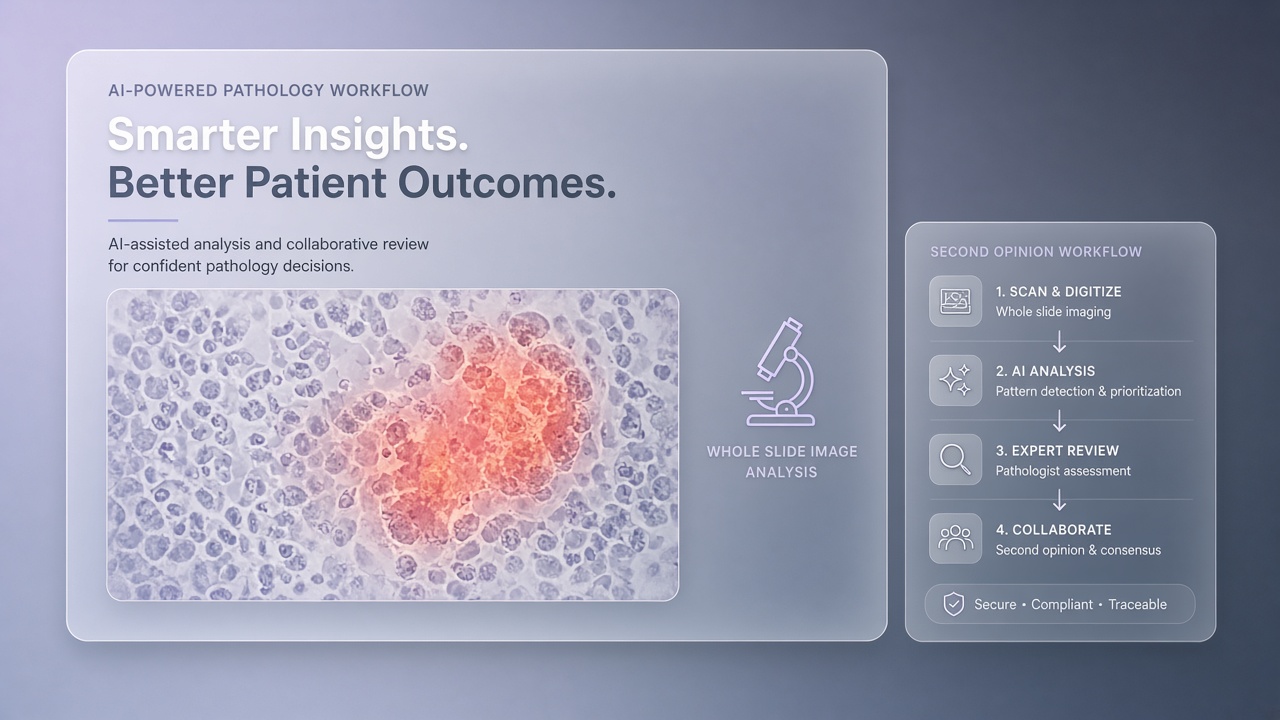
AI pathology second opinion workflows digitize glass slides into whole-slide images (WSIs), run cleared algorithms that highlight suspicious regions, and return results to pathologists through laboratory information systems for documented human final diagnosis. Paige Prostate received FDA De Novo authorization (DEN200080, September 2021) as a second-read device: after a pathologist reviews a prostate core biopsy and records cancer, no cancer, or defer, activating the algorithm may flag a coordinate the pathologist missed. The CONFIDENT-P trial (2024) showed AI-assisted prostate cancer detection reduced immunohistochemistry use by roughly 45 to 59% while maintaining safety. Hospitals adopting AI healthcare pathology tools must integrate scanners, viewers, LIS interfaces, and medicolegal audit trails before algorithms touch clinical cases.
Digitization of Histology Workflows
Digital pathology replaces microscope-only review with high-resolution scanning of hematoxylin and eosin (H&E) slides at 20x or 40x magnification, producing gigapixel WSIs viewable on calibrated monitors. Scanning adds a physical step: glass slides move from tissue processing through staining, then into whole-slide scanners from vendors such as Philips, Leica, or Hamamatsu. NHS and US academic centers accelerated adoption during COVID-19 to enable remote reporting when pathologists could not share benches. NICE MedTech guidance notes that partial digital labs may need additional clinical-grade scanners depending on existing infrastructure.
Storage and networking requirements are substantial. A single prostate biopsy case may generate multiple WSIs totaling several gigabytes. Cloud or on-premise PACS-style archives must meet HIPAA, GDPR, or local health data rules. Pathologists need color-calibrated displays and ergonomic viewers that pan and zoom without lag. AI cannot run until this foundation exists; rural hospitals without scanners cannot deploy heatmap algorithms regardless of software licensing.
Workflow redesign affects turnaround time. Same-day scanning queues, quality control for out-of-focus or air-bubble artifacts, and backup plans when scanners fail are operational realities AI vendors rarely emphasize in sales decks. Successful programs treat digitization as a laboratory transformation project, with AI as a downstream accelerator.
Multi-site health systems standardize scanner models and color profiles so AI models trained on one campus generalize to affiliates. Without harmonization, a heatmap algorithm tuned on Philips scanners may underperform on Leica-acquired slides from a merged hospital. Vendor-neutral DICOM workflows and periodic color calibration audits reduce domain shift that silently degrades AI sensitivity.
AI Heatmaps and Case Prioritization
Convolutional and transformer models trained on thousands of annotated WSIs output pixel-level probability maps or case-level risk scores that prioritize review queues and draw attention to carcinoma-suspicious regions. Paige Prostate Detect overlays a mark at the coordinate with greatest carcinoma likelihood when the pathologist activates the tool after initial review. Heatmaps are statistical, not linked to Gleason grading or tumor measurement. Other products target breast, colorectal, and lymph node metastasis detection with similar human-in-the-loop framing.
Case prioritization applies AI before full human read in some European deployments with CE-IVD marking, routing high-probability cancer slides to senior pathologists first during backlog surges. Sensitivity and specificity trade-offs depend on threshold tuning: aggressive thresholds catch more cancers but increase re-review workload. CONFIDENT-P demonstrated that AI-assisted workflows can reduce costly IHC stains when morphologic H&E review plus algorithm flagging provides sufficient confidence.
Heatmap interpretability studies ask whether pathologists actually look at flagged coordinates or habitually dismiss overlays after false alarms. Eye-tracking research in digital pathology labs shows learning effects: experienced users integrate heatmaps faster than trainees but may also develop automation bias if vendor sensitivity is miscalibrated on their scanner fleet. Quarterly calibration with known positive control slides helps maintain appropriate alertness to true discordant flags.
| Workflow mode | When AI runs | Pathologist role | Example regulatory status |
|---|---|---|---|
| Second read | After pathologist initial diagnosis | Re-examine flagged region if discordant | Paige Prostate FDA De Novo (US) |
| Concurrent assist | During primary slide review | Uses heatmap alongside H&E | CE-IVD/UKCA in EU/UK for some products |
| Triage / prioritization | Before assignment to pathologist | Orders worklist by AI risk score | Varies; often research or limited clearance |
| Research only | Retrospective or non-clinical | No diagnostic claim | IRB-governed studies |
Integration With Laboratory Information Systems
LIS and LIMS integration automates slide identification, de-identification, image transmission to AI platforms, and return of results via accession-linked URLs so pathologists reopen the correct WSI with algorithm overlays in the viewer. Implementation is site-specific: each hospital's LIS vendor (Epic Beaker, Sunquest, Cerner PathNet, custom solutions) exposes different HL7 FHIR or proprietary interfaces. Paige deployments documented in deployment safety case literature describe automatic eligibility detection for H&E prostate biopsies, metadata stripping for cloud processing, and reassociation of AI output to the case record.
Failure modes include mismatched accession numbers, scanner barcodes that do not sync with LIS orders, and partial digitization where only some slides in a cassette are scanned. IT teams should run end-to-end test cases with synthetic patients before go-live. Latency targets matter for same-day urology clinics: cloud round-trips add seconds to minutes per slide depending on bandwidth.
Researchers documenting AI research on digital pathology should distinguish integration prototypes from production interfaces validated under ISO 13485 quality systems. A Jupyter notebook that reads DICOM files is not equivalent to a bidirectional LIS hook tested under hospital change control.
Regulatory Cleared vs Research Algorithms
FDA-cleared or authorized algorithms carry defined intended use, validation datasets, and labeling that pathologists must follow; research algorithms lack diagnostic claims and cannot legally drive clinical decisions without IRB oversight. Paige Prostate's FDA labeling specifies Philips Ultra Fast Scanner images viewed in Paige FullFocus, prostate core biopsies only, and mandatory pathologist final diagnosis. Using the same model on breast WSIs or a different scanner without bridging studies exceeds cleared intended use. CE-IVD and UKCA marks in Europe may permit concurrent read modes not authorized in the United States for the same product family.
Academic heatmap papers on TCGA or Camelyon datasets demonstrate AUROC values above 0.95 for cancer detection tasks, but those models were not trained under design control, lack prospective clinical trials, and may fail on scanner domains absent from training. Hospitals tempted to deploy GitHub models risk patient harm and liability exposure. Vendor contracts should specify algorithm version, update policies, and performance monitoring obligations.
Predetermined change control plans, increasingly discussed in FDA AI/ML guidance, allow manufacturers to update models within validated bounds. Pathology labs must receive release notes and re-validate viewer behavior when vendors ship new weights.
Medicolegal Documentation Practices
Medicolegal safety requires logging whether AI was activated, the algorithm version, overlay screenshots or coordinates, pathologist agreement or override, and the final signed diagnosis independent of software output. FDA's Paige workflow explicitly states final cancer diagnosis rests on histologic findings, not algorithm output alone. Malpractice defenses weaken if a pathologist ignores a true-positive AI flag without documented rationale. Conversely, blind reliance on AI without independent review violates standard of care when the device is labeled as assistive.
Quality assurance programs should sample AI-assisted cases for consensus review, tracking discordance rates between AI and expert panels. Deployment safety case methodology from UK work on Paige Prostate identifies hazards such as scanner color profile drift, monitor miscalibration, and workflow deviations from training conditions during regulatory trials.
Rural hospitals considering AI second reads gain access to subspecialist-level pattern flags but remain liable for local sign-out. Telepathology arrangements may combine AI triage with remote expert consultation, doubling documentation requirements across jurisdictions with different licensure rules.
Continuing education for pathologists should cover AI limitations: stain batch variation, necrotic debris mimicking malignancy, and small foci below scanner resolution. Simulation exercises where pathologists review cases with and without heatmaps build calibrated trust. CAP and RCPA competency frameworks are beginning to include digital pathology and AI literacy modules for residency programs.
International deployment adds complexity when FDA-cleared US workflows differ from EU concurrent-read CE markings for the same vendor product. Multinational health systems must maintain separate SOPs per jurisdiction and avoid routing EU-scanned slides through US-only cloud regions without data residency agreements.
Frequently Asked Questions
Will AI replace pathologists?
No cleared workflow replaces pathologists. AI assists detection and triage; sign-out, grading, synoptic reporting, and multidisciplinary tumor board input remain human responsibilities.
Which cancer types have cleared AI?
Prostate H&E biopsy detection has the most visible FDA De Novo example. Breast, colorectal, and lymph node products hold CE-IVD or are in trials. Availability varies by country and scanner compatibility.
Can rural hospitals use AI pathology?
Only after digitization infrastructure exists. Cloud AI can offset subspecialist shortages if bandwidth and data agreements are in place. Scanner capital cost remains the main barrier.
What does AI pathology cost?
Pricing combines per-slide software fees, scanner leases, storage, and IT integration. CONFIDENT-P showed IHC reduction can offset reagent costs in high-volume prostate biopsy labs, but ROI depends on local reimbursement.
How accurate are pathology AI models?
Prospective trial metrics vary by task and threshold. Published prostate detection studies report high sensitivity for assisting missed cancers, but performance drops on out-of-distribution scanners without validation.
Is cloud processing HIPAA compliant?
Vendors offer BAA-backed GDPR and HIPAA compliant platforms with de-identified image transfer. Hospitals must complete security risk assessments before enabling cloud inference.
What if AI and pathologist disagree?
Standard of care follows pathologist judgment documented in the report. Discordant cases may trigger additional stains, second pathologist consultation, or QA review per laboratory policy.
Digital pathology adoption curves differ by subspecialty: dermatopathology and hematopathology maintain strong glass-slide cultures where AI heatmaps are less mature than prostate and breast applications. Laboratories planning five-year digitization roadmaps should sequence scanner purchases by subspecialty volume and malpractice risk, deploying AI second reads first on high-volume cancer screening lines where CONFIDENT-P-style IHC savings justify integration cost.
Peer review journals increasingly require authors to state whether AI assisted primary diagnosis or served as second read in pathology studies, mirroring radiology disclosure norms. Transparent reporting helps meta-analysts separate human-only from AI-augmented sensitivity estimates when hospitals compare vendor proposals.