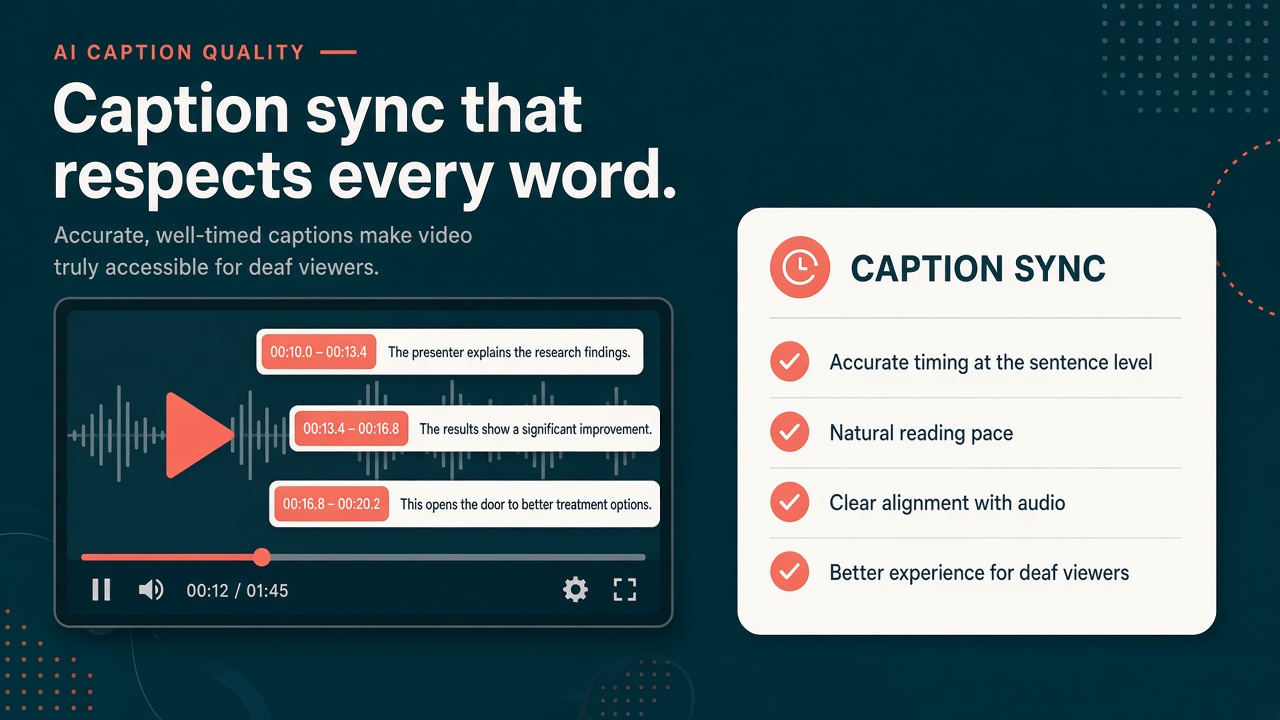
A deaf viewer joins a live webinar. Auto-generated captions appear three seconds after each sentence, drop speaker names, and render homophones as nonsense words. The presenter references a chart on screen, but no non-speech information appears. By the Q&A segment, the viewer has stopped reading and switched to a separate relay service. AI caption quality deaf community expectations differ sharply from what product dashboards optimize. Teams shipping speech-to-text in AI chatbot video features, lecture capture, and streaming platforms need standards grounded in deaf and hard-of-hearing (DHH) research, not vendor accuracy claims alone. More accessibility explainers live on the EliteAI.tools blog index.
Regulatory frameworks such as WCAG Success Criterion 1.2.4 and U.S. Federal Communications Commission (FCC) caption rules set baseline requirements, yet quantitative metrics like Word Error Rate (WER) often fail to predict subjective quality, especially for automatic speech recognition (ASR) output. Recent ACM ASSETS 2026 research (arXiv:2609.11408) surveyed 216 validated U.S. participants who rated 70 live-TV-derived clips across synchronized and delayed conditions. The findings show that caption latencies significantly impact the viewer experience and that common metrics correlate differently for human stenography versus ASR captions.
What AI Caption Quality Deaf Community Means in Plain Language
AI caption quality deaf community refers to the set of accuracy, timing, completeness, placement, and non-speech information standards that deaf and hard-of-hearing viewers expect when reading machine-generated or human-produced captions on video, live streams, and recorded media. Quality is not a single percentage score. Viewers evaluate whether captions preserve meaning, identify speakers, describe important sounds, stay synchronized with audio, and remain readable without blocking visuals.
The National Deaf Center summarizes FCC-aligned expectations in four areas: accuracy (correct spelling, grammar, and word choice), synchronization (captions appear when words are spoken), completeness (dialogue plus important non-speech sounds), and placement (consistent location that does not obscure key visuals). WCAG 2.2 Success Criterion 1.2.4 requires captions for live audio in synchronized media. The Described and Captioned Media Program (DCMP) Captioning Key, referenced by both FCC guidance and accessibility practitioners, adds typographic rules for line breaks, speaker identification, and sound labels.
| Quality dimension | Deaf community expectation | Common AI failure mode |
|---|---|---|
| Synchronization | Captions track speech in real time | Multi-second ASR buffering delay |
| Accuracy | Meaning preserved, names spelled correctly | Homophone errors, dropped negation |
| Non-speech information (NSI) | Music, tone, off-screen sounds labeled | Speech-only ASR with no sound tags |
| Speaker ID | Clear attribution in multi-speaker scenes | Merged lines without labels |
| Placement | Readable, non-blocking position | Overlapping lower-third graphics |
Non-speech information and divided preferences
Non-speech information (NSI) covers music descriptions, sound effects, speaker tone, and off-screen events that appear in brackets or italics in professional captions. A 2025 Frontiers in Computer Science survey of NSI captioning research found that DHH viewers want more control over NSI detail level than current broadcast systems provide. Hard-of-hearing participants sometimes prefer richer sound descriptions than deaf participants, who may find verbose NSI distracting in fast dialogue scenes. AI systems that treat captions as transcript-only text miss this nuance entirely.
How the Underlying AI Pipeline Works
Modern AI caption pipelines combine streaming automatic speech recognition, diarization for speaker separation, optional sound event detection, post-editing language models, and human review layers for live Communication Access Realtime Translation (CART) or post-production correction. Each stage introduces latency or error modes that metrics like WER may not capture.
Streaming ASR and latency budgets
Live caption engines buffer audio windows to improve recognition accuracy, then emit partial hypotheses that update as more context arrives. Tradeoffs are sharp: longer buffers reduce word errors but increase delay. The ASSETS 2026 study compared TV captions with typical 7 to 12 second delays against synchronized TV captions, ASR captions synchronized with audio, and ASR with roughly two-second delay. Participants rated understanding and quality; latencies significantly degraded experience even when word accuracy looked acceptable on paper. Product teams should treat end-to-end delay as a first-class metric beside WER.
WER, ACE2, and technology-neutral gaps
Word Error Rate counts substitutions, insertions, and deletions against a reference transcript. Automated Caption Evaluation (ACE) and ACE2 extend alignment-aware scoring. Prior ASSETS work on live television captions (arXiv:2404.10153) found moderate to high correlation between WER, ACE, and viewer ratings for traditional TV captions, but weaker correlation for ASR output. Metrics often strip punctuation, speaker labels, and NSI before scoring, which removes exactly the elements DHH viewers notice. The 2026 survey concludes that caption quality metrics are far from technology-neutral when ASR is involved.
Human CART and collaborative correction workflows
Collaborative CART correction pairs a realtime stenographer or respeaker with AI assist for glossary injection, name spelling, and post-session cleanup. In enterprise and educational settings, AI drafts a first pass; a certified realtime captioner or editor fixes errors during or after the event. Some platforms expose viewer-side correction requests where audience members flag bad lines. This hybrid model acknowledges that fully autonomous ASR cannot yet meet legal or educational equivalency standards for high-stakes communication.
| Pipeline stage | Technology | Quality lever |
|---|---|---|
| Audio capture | Microphone arrays, broadcast feeds | Clean source audio reduces ASR errors |
| Streaming ASR | Conformer, Whisper streaming variants | Domain-tuned language models |
| Diarization | Speaker embedding clustering | Speaker ID labels in output |
| Sound event detection | Audio tagging models | NSI bracket insertion |
| Human review | CART, post-edit QA | Legal and classroom equivalency |
Typical workflow steps
- Define event type (live lecture, broadcast, on-demand video) and regulatory bar (FCC, ADA, WCAG 1.2.4).
- Configure custom vocabulary for names, acronyms, and domain terms before the session starts.
- Run streaming ASR with measured end-to-end latency targets under three seconds for interactive settings when possible.
- Enable speaker diarization and optional NSI tagging with viewer-toggleable detail levels.
- Route output through collaborative CART correction for high-stakes or public-facing streams.
- Archive editable caption files (WebVTT, SRT) for post-event fixes and search indexing.
Real Deployments and Published Evidence
Broadcasters, universities, courts, and streaming platforms deploy mixtures of human stenography, respeaking, and ASR with varying quality outcomes. YouTube, Zoom, Microsoft Teams, and major learning management systems ship auto-captions that National Deaf Center guidance notes often reach only 60 to 70 percent accuracy in difficult conditions, insufficient for equivalent communication without human re-captioning.
The ASSETS 2026 large-scale survey (216 validated participants, 4,832 data points across caption conditions) provides the strongest recent evidence that DHH viewers rate TV and ASR captions similarly when delays and errors compound, and that metric correlations break down for ASR. Earlier ASSETS 2024 work on live TV established that FCC best practices on accuracy, synchronicity, completeness, and placement remain aspirational for many live broadcasts, with 7 to 12 second delays still common.
Professional captioning vendors and disability services offices increasingly advertise AI-first workflows with human-in-the-loop pricing tiers. Educational institutions under Section 504 and ADA obligations treat uncorrected auto-captions as insufficient for enrolled deaf students in many Office for Civil Rights interpretations. Courts and government agencies often mandate CART or sign language interpretation instead of raw ASR for legal proceedings.
Live versus on-demand expectations
On-demand video allows offline ASR plus editor review, which can approach broadcast quality if budgets exist. Live events cannot hide latency behind batch processing. Deaf viewers participating in interactive sessions need captions fast enough to raise hands, vote in polls, and follow rapid exchanges. A two-second ASR delay may be tolerable in a documentary; the same delay frustrates in a fast-paced game stream or emergency briefing.
Limits, Risks, and Ethical Guardrails
Shipping auto-captions as finished accessibility without disclosure misleads organizers and violates the spirit of equivalent communication. Risks include medical or legal meaning changes from single-word ASR errors, exclusion of deaf viewers who rely on ASL (captions are not a substitute for sign language interpretation when that is the requested accommodation), and bias against accented speech and domain jargon that WER averages hide.
- False confidence: Dashboard WER under 10 percent can still produce unusable captions with bad timing.
- NSI neglect: Speech-only pipelines erase music, laughter, and tone cues narrative comprehension needs.
- Privacy: Cloud ASR sends audio to third parties; sensitive meetings need on-premise or human alternatives.
- Labor displacement: Underpaying captioners while marketing AI as equivalent harms skilled workers and quality.
- One-size-fits-all: Ignoring split preferences between deaf and hard-of-hearing viewers on NSI density.
Ethical guardrails include labeling auto-captions clearly, funding human correction for public and educational content, co-design with deaf-led organizations, and publishing latency plus accuracy metrics separately for ASR versus human captions. WCAG 1.2.4 is a floor; community expectations often exceed legal minimums.
Who Should Use This and Who Should Wait
Internal comms teams, media companies, and platform engineers should treat AI captions as draft output with measured latency budgets and human escalation paths for live and high-stakes video. Casual social clips may tolerate uncorrected ASR if labeled. Legal, medical, and graded instructional content should wait for certified human captioning or collaborative CART correction unless rigorous QA proves equivalency.
| Use case | Recommendation | Guardrail |
|---|---|---|
| University lecture capture | ASR plus disability services review | Do not rely on YouTube auto-captions alone |
| Corporate all-hands live stream | CART or respeaker with AI assist | Measure end-to-end delay publicly |
| Marketing social clips | Post-edit ASR acceptable if reviewed | Fix brand names and hashtags |
| Court or medical recording | Wait for certified human captions | ASR alone is not equivalent communication |
Frequently Asked Questions
Does WCAG 1.2.4 require AI captions to be perfect?
WCAG 1.2.4 requires captions for live synchronized media but does not specify WER thresholds. Conformance still demands equivalent communication; deaf community standards and FCC best practices define practical quality beyond the bare criterion text.
Is low WER enough for deaf viewers?
No. ASSETS 2026 evidence shows WER, ACE2, and related metrics correlate weakly with DHH ratings for ASR captions. Latency, NSI, speaker ID, and placement matter as much as word accuracy.
How accurate are platform auto-captions?
Accuracy varies by audio quality, accent, and domain; National Deaf Center guidance cites 60 to 70 percent in difficult conditions for uncorrected auto-captions. Clean studio speech performs better; technical jargon and crosstalk degrade output quickly.
Must captions include sound effects?
FCC completeness standards and DCMP guidance expect important non-speech sounds to be described, but viewer preferences on NSI density vary. Configurable NSI levels are an active research direction.
When is CART required instead of ASR?
Legal proceedings, many classroom accommodations, and live events with ADA obligations often require human realtime captioning or sign language interpretation. Collaborative CART correction blends human skill with AI drafting for cost control without dropping standards.
What latency target should live AI captions aim for?
Research shows multi-second delays harm comprehension; interactive settings should push below three seconds end-to-end when feasible, far below legacy TV delays of 7 to 12 seconds. Measure delay from spoken word to visible caption, not model inference alone.
Do deaf and hard-of-hearing viewers want the same captions?
Preferences diverge on NSI detail, dynamic caption placement, and sound descriptions according to multiple ASSETS and Frontiers studies. Offer toggles rather than a single global style.
Conclusion
AI caption quality deaf community standards center on synchronized, complete, well-placed text that preserves meaning and context, not transcript error rates alone. ASSETS 2026 survey evidence (arXiv:2609.11408) demonstrates that caption latencies significantly impact the viewer experience and that WER-style metrics mislead for ASR. WCAG 1.2.4, FCC best practices, and DCMP guidance set regulatory and professional baselines; NSI and collaborative CART correction remain essential for equivalency. Teams should publish latency and human-review status, fund correction for high-stakes media, and co-design with deaf viewers instead of treating auto-captions as finished accessibility.