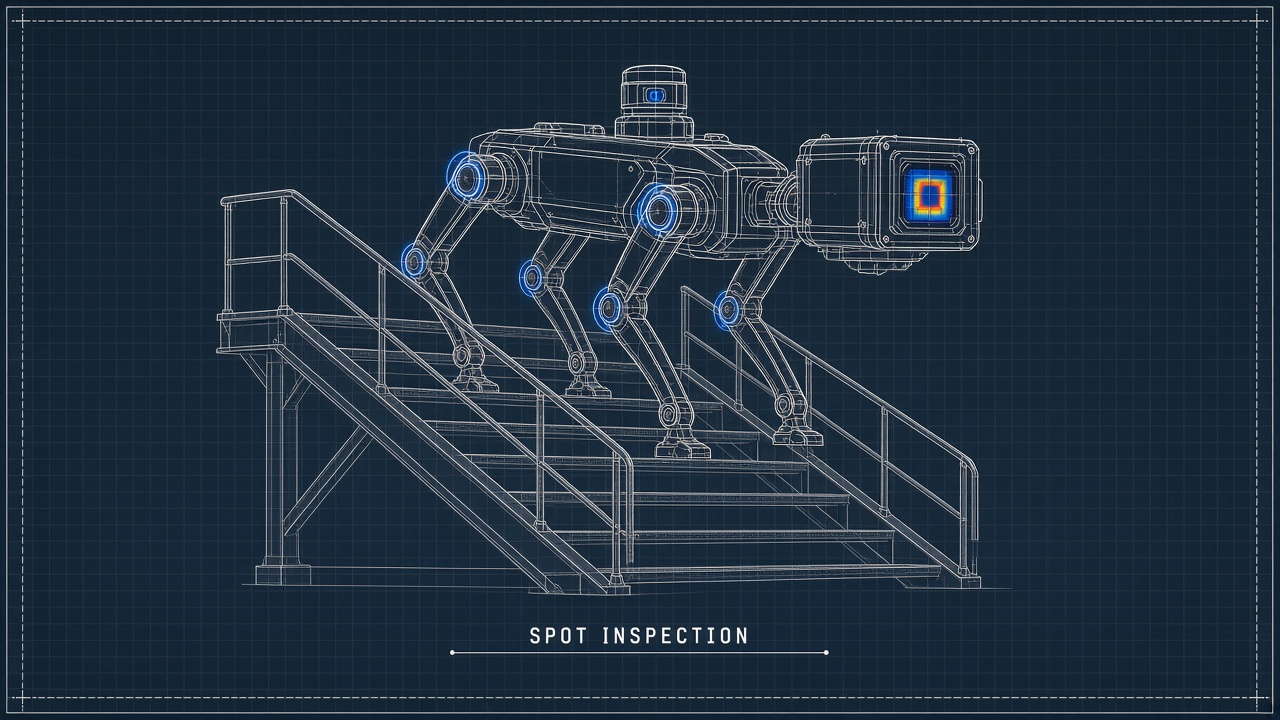
AI quadruped inspection robots such as Boston Dynamics Spot autonomously patrol factories, refineries, and utilities with sensor payloads that capture thermal, acoustic, visual, and gas data, then feed fleet software that flags anomalies before human rounds miss them. Legged mobility lets the same robot climb stairs, step over cables, and traverse grated walkways where wheeled AMRs stall. Orbit fleet software adds vision-language inspections powered by Google Gemini, dynamic thermal thresholds, and integrations with enterprise maintenance systems including IFS.ai. Operators evaluating AI research on embodied inspection or AI research infrastructure for industrial edge deployments should separate locomotion reliability from analytics accuracy when budgeting pilots.
Why Legs Beat Wheels on Stairs
Four-legged robots distribute weight across discrete foot contacts, re-planning step height and body pitch on each stride, while wheeled platforms require ramps, elevators, or flat floors to change elevation. Oil and gas sites, legacy chemical plants, and multi-level manufacturing halls were built for human walkers, not AGV lanes. Spot-class quadrupeds negotiate 30-degree slopes, narrow catwalks, and door sills that stop skid-steer or differential-drive robots. The tradeoff is lower top speed (roughly 1.6 m/s for Spot) and shorter runtime per battery swap than warehouse AMRs on smooth concrete.
Legged kinematics also recover from slips: controllers adjust footholds when a metal grate flexes or a wet step reduces friction. Wheeled robots often require extensive facility retrofit (floor markers, ramp networks) before first mission. For brownfield inspection, legs reduce capital construction but increase per-robot hardware cost versus commodity AMR bases.
Competitors including ANYbotics ANYmal, Unitree B2, and Ghost Robotics Vision 60 target similar niches with varying IP ratings and payload bays. Buyer due diligence should compare stair dimensions, explosion-proof requirements, and vendor support in the target geography, not gait videos alone.
Stair metrics matter: riser height, tread depth, and open-grate openings determine whether a quadruped can place stable footholds. Facility surveys should laser-scan critical routes before purchase orders, documenting obstacles (hose bundles, temporary barriers) that maps must update after each turnaround. Wheeled alternatives with stair-climbing attachments exist but trade climbing speed for simpler maintenance on flat sections.
Sensor Payloads: Thermal, Gas, Acoustic
Industrial quadrupeds mount pan-tilt-zoom cameras, radiometric thermal imagers, acoustic imagers, gas sniffers, lidar, and vibration sensors as swappable payload modules analyzed onboard or in fleet cloud software. Boston Dynamics Spot 5.2 adds partial discharge detection via Sorama L642 acoustic arrays for high-voltage equipment, visual vibration amplification for rotating machinery, and MFE gas detection covering 20-plus gas types streamed into Orbit during missions. Thermal inspections now support dynamic thresholding: Orbit statistically sets min/max temperature bands across samples instead of requiring every site to hand-tune limits.
AI visual inspections in Orbit 5.0 and later send Spot to capture images at map waypoints, then run vision-language prompts to answer questions like whether a fire extinguisher is present, a spill occurred, or a gauge reading changed. Analysis runs in Orbit after upload, not on-robot, keeping GPU requirements on the server side while the robot focuses on locomotion and sensing.
| Sensor type | Typical failure detected | Analysis location |
|---|---|---|
| Radiometric thermal | Overheating bearings, insulation loss | Orbit dynamic thresholds |
| Acoustic / ultrasonic | Air leaks, partial discharge, vibration | Edge or Orbit analytics |
| RGB + VLM prompts | Missing safety gear, spills, gauge drift | Orbit Gemini-powered AIVI |
| Gas detection | Toxic or flammable atmosphere | Real-time stream to Orbit |
Autonomy vs Teleoperation Split
Production deployments blend scheduled autonomous missions with remote teleoperation for novel obstacles, door handling, and recovery from falls, because full autonomy across every legacy facility remains rare. Spot missions are authored in Orbit as repeatable routes with inspection actions at waypoints. Operators preview Site View 360-degree histories to author or edit inspections without walking the plant. When a forklift blocks a aisle or a door is closed, staff teleoperate through tablet interfaces until the path clears, then resume autonomous segments.
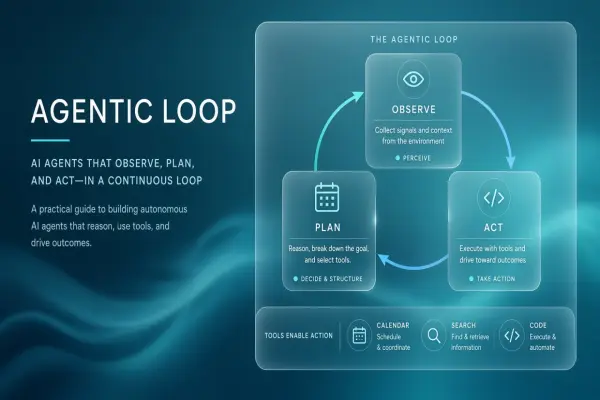
Spot 5.2 introduces agentic dispatch: external PLC or CCTV triggers can send Spot to investigate an alarm zone, connecting physical robotics to broader AI stacks via Orbit APIs. IFS and Boston Dynamics demonstrated November 2025 integration where Spot sensing feeds IFS.ai agentic workflows that decide maintenance work orders, closing the loop from anomaly to enterprise action.
Vision-language inspection outputs are probabilistic like text LLMs; Boston Dynamics documents that answers may not be 100 percent accurate on every frame. Safety-critical decisions (gas exceedance, arc flash risk) should retain hard thresholds and human escalation paths rather than relying solely on VLM captions.
EXACT-style repeatability matters for trend analysis: mounting cameras at the same pose each patrol lets Orbit difference images and flag subtle gauge needle drift. Operators should resist ad-hoc teleoperation shortcuts that skip waypoint poses, or baseline comparisons lose meaning. Acoustic partial discharge and visual vibration modules extend predictive maintenance beyond temperature alone, catching bearing defects before thermal signatures appear.
Rain-rated operation depends on payload sealing: standard RGB lenses fog; radiometric thermal may still function if housings stay dry inside. Facility planners sometimes route robots through covered walkways or schedule missions between weather windows rather than spec fully IP68 custom builds on first pilots.
Lease and RaaS Business Models
Most industrial buyers acquire quadrupeds through multi-year leases or robotics-as-a-service contracts that bundle hardware, software, payloads, and support rather than outright purchase, because platforms evolve quickly and missions require vendor updates. Boston Dynamics historically priced Spot around $75,000 for the base robot excluding payloads, with enterprise Orbit subscriptions and payload rentals layered on top. Lease structures spread capital over 36 to 60 months and include swap-out when new Spot revisions ship. Oil and gas majors often pilot one to three units per site before fleet expansion.
RaaS vendors may charge per mission, per kilometer patrolled, or flat monthly fees including teleoperation support. Compare total cost to unionized rounds plus outage risk: a single undetected bearing failure can exceed annual robot lease cost on critical compressors. Insurance and certification documentation (ATEX zones, SIL ratings) may add consulting fees not in headline lease rates.
Payload modularity affects lease tiers: a base Spot with RGB inspection costs less than packages bundling thermal, gas, acoustic, and lidar simultaneously. Phased rollouts start with visual rounds on flat routes, then add sensors as ROI cases justify upgrade spend. Residual value at lease end varies; some contracts allow purchase at fair market value after technology refresh cycles.
Worker Acceptance and Safety Training
Field adoption improves when unions and maintenance crews co-design patrol routes, retain override authority, and receive training that frames quadrupeds as sensor extensions rather than headcount replacements. Dog-like form factors help familiarity but also trigger anthropomorphism; clear status lights, audible beacons, and geofenced no-go zones near active hot work reduce unease. OSHA-style protocols treat robots as mobile equipment: lockout coordination when robots enter electrical rooms, buddy rules during first missions, and documented estop locations.
Rain and dust exposure depend on IP ratings: standard Spot is not submersible; outdoor refineries need environmental enclosures or sheltered routes. Battery swaps every 90 minutes typical for mixed stair and flat missions plan staffing for continuous patrols. Competitor ANYmal offers explosion-protection variants valued in EU chemical sites where U.S. Spot deployments may be limited by certification scope.
Change-management wins when robots deliver actionable tickets in the CMMS workers already use, with photos attached, instead of parallel dashboards maintenance teams ignore. Orbit CMMS integrations and the IFS.ai agentic loop exemplify that pattern.
Site View 360-degree histories in Orbit let reliability engineers compare current corridor conditions to prior weeks without re-walking the plant, useful after storms or shutdowns when rust, leaks, or unauthorized storage appear. Remote inspection authoring means SMEs in headquarters define new gauge-reading prompts while field robots execute captures overnight, shrinking the loop between regulation changes and deployed checklists.
Cybersecurity reviews treat quadrupeds as mobile IoT: Wi-Fi or LTE backhaul, over-the-air payload updates, and API keys into Orbit require network segmentation separate from OT control planes. Red-team exercises should include spoofed dispatch commands and stolen tablet teleoperation sessions, mitigated with mutual TLS and role-based mission approval workflows.
Total cost of ownership spans spare batteries, payload calibration, annual software renewals, and technician travel for fall recovery. Budget one FTE robotics coordinator per three to five units on large sites to maintain maps, tune thresholds, and liaison with operations during turnarounds when robot routes conflict with scaffolding or hot work permits.
Frequently Asked Questions
Can quadruped inspection robots operate in rain?
Light rain is often acceptable with wiped camera lenses; driving rain and standing water may trigger mission abort per vendor guidance. Specify IP rating and environmental accessories for outdoor stacks.
How long does the battery last?
Expect roughly 60 to 90 minutes of mixed mobility and inspection per charge on Spot-class hardware, shorter with heavy payloads or constant stair climbing. Swappable batteries enable near-continuous operation with a charging rack.
Who competes with Spot for industrial inspection?
ANYbotics ANYmal, Unitree quadrupeds, and wheeled-legged hybrids from some startups serve overlapping niches. Wheeled drones and fixed CCTV remain cheaper where terrain is flat. Match locomotion class to facility geometry.
How autonomous are these robots really?
Repeatable mapped missions run autonomously; novel environments need teleoperation or re-mapping. AI visual inspections analyze images after capture in Orbit, while gas and thermal alerts use deterministic thresholds alongside ML.
Can robots replace human inspectors?
They supplement rounds by covering overnight and hazardous zones with consistent sensor pose. Regulatory regimes still require certified human sign-off on many inspections; robots reduce misses and data gaps, not accountability.
What software manages fleets?
Orbit centralizes Boston Dynamics Spot and Stretch activity with enterprise dashboards, APIs, and Gemini-powered visual QA. Third-party FMIS integrations vary by site; confirm API access in contract negotiations.
Where to learn more on embodied inspection AI?
Follow vendor release notes and academic work on vision-language models for industrial QA. Broader context lives under AI research tags covering physical AI and fleet orchestration.
Do quadrupeds work in explosive atmospheres?
Standard Spot units are not ATEX-certified for Zone 1 gas atmospheres without specialized enclosures. ANYmal X and custom integrator packages target EU explosion-protection classes; confirm certification scope matches your facility zoning before deployment in refineries or chemical plants.