Fortune 500 companies moved AI agent pilots from slide decks into production throughout 2026, with public case studies emerging from logistics, networking, banking, healthcare, and retail. The fortune 500 ai agent pilots wave is less about generic chatbots and more about task-specific agents that automate repeatable workflows while keeping humans accountable for high-stakes decisions.
This synthesis draws on publicly reported outcomes from C.H. Robinson, Cisco, Goldman Sachs, CVS Health, and Capital One. It groups pilot categories, summarizes claimed metrics without endorsing unverified ROI hype, catalogs common failure modes, and highlights governance patterns that appear across successful rollouts. Treat vendor and executive claims as directional until validated on your own operations.
Pilot Categories in 2026
Fortune 500 agent pilots in 2026 cluster into five categories: customer operations, internal productivity, software engineering, finance and compliance, and industry-specific regulated workflows. Most organizations start with a narrow task before expanding agent scope, rather than deploying a general assistant to every employee on day one.
| Category | Example use case | Public reference |
|---|---|---|
| Logistics and operations | Automated freight quotes, routing, status updates | C.H. Robinson (Fortune, July 2026) |
| Enterprise productivity | Personalized assistants for all employees | Cisco rollout to ~90,000 staff (Fortune, July 2026) |
| Software engineering | Autonomous coding agents on legacy modernization | Goldman Sachs with Devin (Forbes, August 2026) |
| Healthcare operations | Prior auth, order status, contact-center assist | CVS Health with Salesforce Agentforce (TechTarget) |
| Fraud and risk | Multi-agent fraud call resolution | Capital One MACAW platform (SaaS Sentinel, August 2026) |
Customer-facing AI chatbot pilots remain common, but 2026 winners increasingly pair chat interfaces with backend agents that call internal APIs, retrieve structured data, and hand off to humans when confidence drops. CVS Health explicitly described a tactical, task-based approach rather than a broad "AI transformation" mandate.
Build vs Buy Patterns
Large enterprises split between in-house agent platforms and vendor suites, often mixing both within different business units. C.H. Robinson built hundreds of agents in-house with domain-expert engineers. Capital One developed MACAW on Meta's open-weight Llama models with proprietary fine-tuning. CVS Health partnered with Salesforce Agentforce Health for regulated healthcare workflows. Cisco built internal finance and investor-relations tools while selling networking products to hyperscalers building AI data centers.
Reported Outcomes and Metrics
Public case studies cite productivity gains, faster document drafting, and shorter customer handling times, but metrics vary widely by industry and measurement methodology. Independent verification is rare; most figures come from executive interviews or vendor co-marketing. Use them to identify themes, not as guaranteed benchmarks.
| Company | Claimed outcome | Caveat |
|---|---|---|
| C.H. Robinson | 45% productivity uplift since 2022; quotes in 31 seconds vs 20 minutes | CEO-reported; includes broader AI initiatives beyond agents |
| Cisco | 80-90% of MD&A first draft generated by AI | Finance workflow; human review still required |
| Goldman Sachs | 3-4x productivity vs prior AI tools on engineering tasks | CIO-reported; specific to Devin deployment scope |
| Capital One | MACAW handles millions of fraud calls annually | Scale metric; resolution quality not independently audited |
| CVS Health | Faster personalized data for contact-center agents | Early pilot; quantitative ROI not yet public |
C.H. Robinson's CEO noted token costs under $2 million against claimed hundreds of millions in benefits, a ratio that underscores why finance teams scrutinize agent economics. Organizations pursuing AI governance frameworks should require pilot teams to log cost per resolved task alongside accuracy and escalation rates.
Common Failure Modes
Fortune 500 agent pilots fail most often from scope creep, weak evaluation harnesses, missing human escalation paths, and underestimating integration debt with legacy systems. Public failures receive less press than success stories, but recurring patterns appear in analyst reports and post-mortems shared at industry conferences in 2026.
- Over-autonomy too early: Agents granted broad tool access before deterministic guardrails exist
- No ground-truth evals: Teams ship on demo prompts that do not reflect production edge cases
- Shadow integrations: Business units connect agents to SaaS tools outside security review
- Metric gaming: Measuring deflection rate while customer satisfaction and rework costs rise
- Talent pipeline risk: Engineering agents that eliminate junior tasks without reskilling plans
- Vendor lock-in: Pilots built on proprietary orchestration with no export path to internal platforms
Goldman Sachs' deployment sparked public debate about junior engineer displacement, illustrating reputational risk even when technical pilots succeed. Healthcare pilots like CVS face additional failure modes around PHI handling, consent, and state-level regulations that generic enterprise playbooks ignore.
Technical Failure Patterns
Multi-agent systems fail differently from single-model chatbots: coordination errors, duplicated work, and compounding hallucinations across agent hops are the dominant technical failure modes. Capital One addressed this by routing fraud calls through four specialized agents (understanding, reasoning, validation, explaining) rather than one monolithic model. Teams that skip explicit validation nodes often see error rates climb as agent chains lengthen.
Governance Patterns That Worked
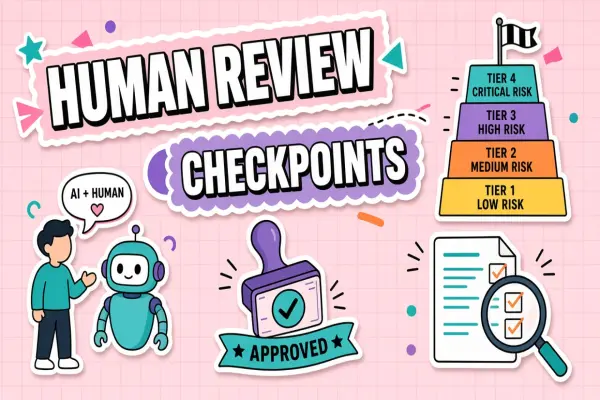
Successful Fortune 500 agent programs in 2026 share governance patterns: executive sponsorship with narrow initial scope, cross-functional review boards, logged tool permissions, and mandatory human approval for external actions. These patterns align with emerging AI governance requirements in regulated industries without blocking experimentation.
- Workflow mapping before automation: C.H. Robinson used Lean process mapping to eliminate waste, then automated only essential repeatable tasks
- Phased employee rollout: Cisco plans company-wide agent access but refined finance tools internally first
- Vendor partnership with feedback loops: CVS holds regular check-ins with Salesforce to close Agentforce Health gaps
- Open-weight plus proprietary data: Capital One customized Llama with internal fraud data rather than sending sensitive calls to closed APIs
- Audit trails for agent actions: Finance and healthcare pilots log every tool call with user and session identifiers
- Escalation SLAs: Agents must hand off to humans within defined time or confidence thresholds
Governance boards that treat agents as software releases, not experiments, appear to scale faster. That means versioned prompts, staged rollouts, rollback plans, and security review for any new tool or data connector. Teams skipping these steps often stall at pilot stage when a single incident triggers executive pause.
Customer Service Agent Pilot Patterns
Customer service remains the most common enterprise ai agents 2026 entry point. Salesforce reported that L'Oreal cut handling time 64% and Southwest achieved 45% case resolution in public partner materials, though independent verification is limited. Successful pilots combine retrieval over order history, policy documents, and CRM records with explicit escalation when confidence drops below threshold. Agents that only paraphrase help-center articles without transactional access rarely deliver measurable ROI.
Customer service ai agents in regulated industries add consent logging, PII redaction, and retention policies that generic SaaS chatbots omit. CVS Health's Agentforce Health pilot focuses on pulling insurance and pharmacy benefit data for human agents rather than fully autonomous resolution, reflecting healthcare risk tolerance. Banks like Capital One restrict autonomous actions on fraud calls while automating summarization and document preparation for human investigators.
Coding Agent Pilot Patterns
Goldman Sachs deployed Devin as a virtual software engineer alongside 12,000 human engineers for legacy modernization tasks. CIO Marco Argenti described the agent as scoping projects, writing, testing, and debugging code with reported 3-4x productivity versus prior AI coding tools. The bank expanded with Anthropic Claude for additional workflows. Coding agent pilots succeed when teams define bounded repositories, mandate human review on production merges, and measure defect rates rather than lines generated.
Coding agents introduce talent pipeline concerns. Industry analysts cited predictions of significant banking job displacement, particularly for junior engineers. Enterprises scaling coding agents should pair automation with reskilling programs and redefine junior roles around agent supervision, test design, and architecture rather than raw implementation volume.
Measuring Pilot Success Responsibly
Responsible measurement for agent pilot case studies tracks four dimensions: task completion rate, escalation rate, cost per resolved interaction, and downstream quality metrics (rework, complaints, security incidents). C.H. Robinson's quote-time reduction from 20 minutes to 31 seconds is compelling but context-specific to freight brokerage. Teams should not extrapolate logistics metrics to unrelated industries without running local pilots.
Finance committees increasingly require token cost reporting alongside productivity claims. Robinson's cited sub-$2 million token spend against hundreds of millions in benefits sets a benchmark ratio that may not transfer to organizations relying on closed frontier APIs at higher per-token rates. Build unit economics models before scaling from pilot to production.
Industry analysts at Gartner and Forrester published 2026 frameworks for agent readiness assessments covering data quality, API maturity, identity management, and observability. Fortune 500 teams using these frameworks report faster pilot-to-production transitions because stakeholders align on prerequisites before selecting use cases. Skipping readiness assessment often produces pilots that demo well but fail on integration depth.
Retail and consumer brands piloting agents for personalization face brand risk when agents hallucinate product details or policy exceptions. L'Oreal's reported handling-time reduction implies tight retrieval and human review on promotional claims. Consumer-facing agents need content moderation layers and brand voice guardrails that internal productivity agents may omit during early pilots.
Logistics and supply chain agents benefit from domain-specific training data that generic vendors cannot replicate. Robinson's CEO argued that 450 industry-expert engineers create a moat no third party can match at comparable cost. Organizations without deep domain data may achieve better ROI partnering with vertical SaaS vendors than building custom agents from general-purpose models alone.
Cisco's investor-relations AI tool illustrates a pattern where agents augment specialist workflows rather than replace them. The tool analyzes financial history alongside competitor earnings calls and anticipates analyst questions for specific individuals. This narrow, high-value use case avoids the failure mode of deploying a general assistant that employees ignore because it lacks context. Fortune 500 teams should inventory specialist workflows with structured inputs and measurable outputs before selecting pilot targets.
Change management receives less press than technology but determines pilot survival. Cisco's phased rollout starting in its new fiscal year gives IT and HR time to train employees on agent boundaries, escalation paths, and data handling rules. Pilots that drop agents on 90,000 employees without training produce shadow workarounds and security incidents that undermine governance programs before they mature.
Observability infrastructure separates scalable agent programs from fragile pilots. Production agents need tracing across tool calls, model invocations, and human handoffs with searchable logs for incident response. Capital One presented MACAW at NVIDIA GTC 2026 with emphasis on multi-agent tracing for fraud workflows. Teams without observability discover failures only when customers or auditors report them.
Frequently Asked Questions
Which Fortune 500 companies are running AI agent pilots?
Public 2026 case studies include C.H. Robinson, Cisco, Goldman Sachs, CVS Health, and Capital One, among others. Many additional Fortune 500 firms run undisclosed pilots through Microsoft Copilot, Salesforce Agentforce, or internal platforms.
What ROI do Fortune 500 agent pilots claim?
Reported figures range from 45% productivity gains (C.H. Robinson) to 3-4x engineering productivity (Goldman Sachs) and 80-90% first-draft automation (Cisco finance). These are company-reported and context-specific; independent audits are uncommon.
Why do enterprise agent pilots fail?
Common causes include excessive initial scope, missing evaluation data, inadequate human escalation, legacy integration complexity, and security incidents from unreviewed tool connectors. Multi-agent coordination errors amplify these risks.
Should enterprises build or buy agents?
Build when domain-specific data and workflows create a defensible moat, as C.H. Robinson and Capital One argue. Buy or partner when regulated industry templates, CRM integration, and faster time-to-value matter, as CVS Health did with Salesforce Agentforce Health.
How should governance teams oversee agent pilots?
Require logged tool permissions, human-in-the-loop for external actions, versioned prompts, security review for new connectors, and cost-per-task metrics alongside accuracy. Align pilot reviews with existing software change management rather than treating agents as ad hoc experiments.
What vendor platforms do Fortune 500 companies use?
Public 2026 references include Salesforce Agentforce (CVS), Microsoft Copilot ecosystem deployments, custom in-house platforms (C.H. Robinson, Capital One), and specialized coding agents (Goldman Sachs with Devin). Platform choice follows existing enterprise agreements and data residency requirements.
How long do agent pilots take to scale?
Timelines vary from months for narrow task agents to years for company-wide rollouts. Cisco announced fiscal 2027 company-wide agent access after internal finance refinement. CVS described a deliberate build-slowly approach to avoid technical debt. Expect 6-18 months from pilot to measurable production scale in most Fortune 500 contexts.
What technologies underpin Fortune 500 agents?
Public case studies reference proprietary models, open-weight Llama derivatives, Salesforce Agentforce, Microsoft Copilot, Anthropic Claude, Cognition Devin, and custom orchestration platforms. Technology choice follows data sensitivity, existing vendor relationships, and in-house engineering depth. No single stack dominates across industries.
Should smaller companies copy Fortune 500 pilots?
Adopt governance patterns and measurement discipline, not necessarily scale or technology choices. Smaller organizations lack 450-engineer teams but can run narrower pilots with faster iteration. Focus on one high-volume repeatable workflow with clear escalation paths before expanding agent scope.