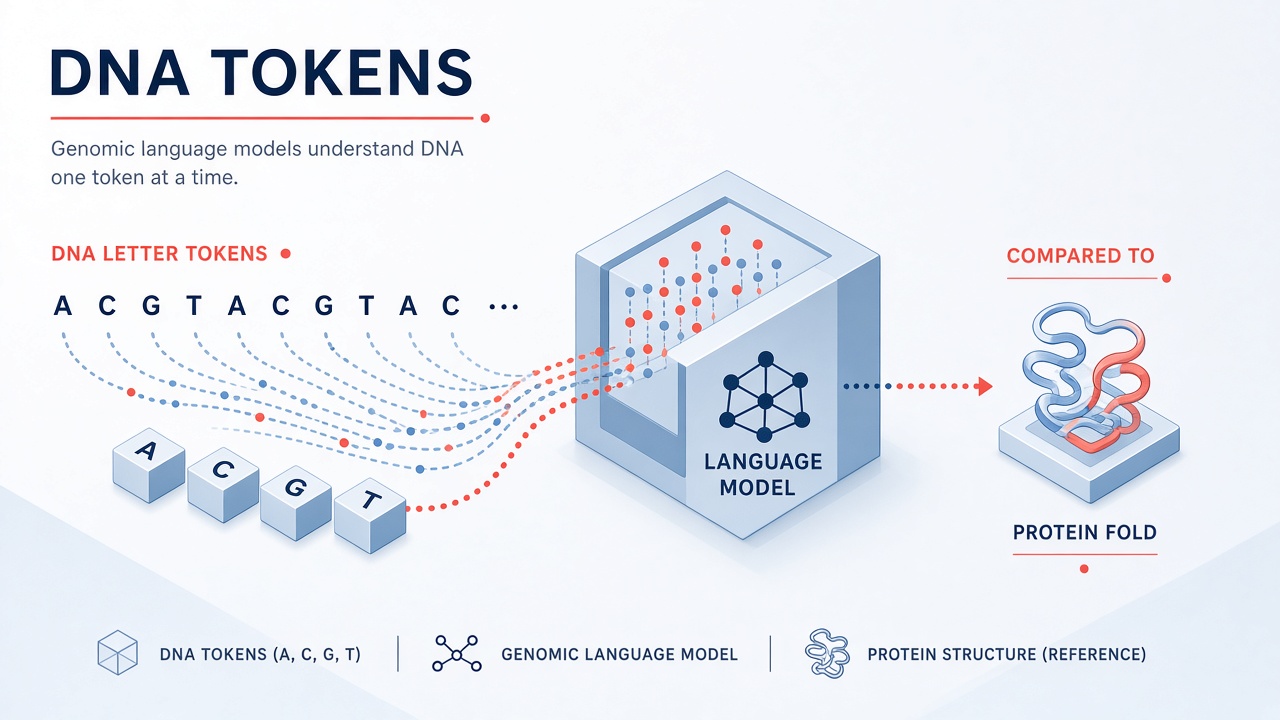
ChatGPT reads English. Evo reads DNA. Both are transformer-style models trained on next-token prediction, but genomic language models (genomic LMs) operate on nucleotide alphabets, phylogenetic context windows spanning billions of base pairs, and tasks like variant effect scoring rather than dialogue. Models such as Evo 2 (trained on roughly 9 trillion base pairs, published in Nature) and GPN-Star (phylogeny-aware genomic pretraining) sit alongside AlphaFold in the biological AI toolbox, yet serve different molecules and outcomes. This explainer maps how genomic language models explained for AI research teams differ from chat LLMs and where they surface in AI API pipelines.
What Is a Genomic Language Model?
A genomic language model is a transformer or hybrid sequence model pretrained to predict nucleotide tokens along DNA or RNA, then fine-tuned for variant scoring, annotation, or generative design. The "language" metaphor captures next-token training, not conversational ability. Outputs are likelihoods, embeddings, or sampled sequences subject to biological validators, not chat replies for patients.
DNA as Tokens, Not Words
Genomic LMs tokenize DNA and RNA sequences into k-mers, single nucleotides, or byte-pair equivalents, then predict the next token along a chromosome. Unlike natural language, the alphabet has four core letters (A, T, G, C in DNA) plus ambiguity codes. There is no punctuation; meaning emerges from reading frame, regulatory motifs, and three-dimensional folding context only partially visible in linear sequence.
| Tokenization style | Example | Tradeoff |
|---|---|---|
| Single nucleotide | A, T, G, C per token | Long contexts, fine resolution |
| k-mer (k=6) | ATCGAT as one token | Shorter sequences, motif capture |
| Byte-pair encoding | Learned merges on corpus | Compression vs interpretability |
Chat models ingest curated text with metadata (URLs, timestamps). Genomic models ingest reference genomes, metagenomic assemblies, and multispecies alignments. Context lengths reach millions of tokens in specialized architectures because regulatory elements separated by hundreds of kilobases still influence expression.
Training Data Sources and Scale
Evo 2's ~9 trillion base pair training corpus combines open reference genomes, metagenomic surveys, and synthetic augmentation across the tree of life. GPN-Star adds explicit phylogenetic trees so the model learns which mutations are plausible given evolutionary distance, not just which strings appear frequently in one species.
Reference vs Metagenomic Data
- Reference genomes: High-quality assemblies (human GRCh38, model organisms) anchor clinical interpretation.
- Metagenomics: Environmental samples expand diversity but introduce assembly noise models must tolerate.
- Multispecies alignments: Teach conserved versus divergent positions for variant effect priors.
Data licensing matters for commercial APIs: some genome builds restrict redistribution of derived embeddings. Teams exposing genomic LM inference should document which reference builds and consent frameworks apply.
Unlike chat LLMs trained on web crawl with messy duplication, genomic corpora use curated reference assemblies with explicit versioning (GRCh38 versus T2T-CHM13). Model releases should pin builds in model cards so clinical labs know whether a variant score references outdated coordinates. Migration between builds requires lift-over tools; LM embeddings do not transfer automatically across assemblies without re-embedding.
Context Length Challenges
Regulatory elements can sit hundreds of kilobases from promoters, forcing genomic LMs to implement sparse attention, sliding windows, or hierarchical pooling unlike 128k-token chat contexts. Evo 2's architecture choices reflect this: long-range coupling is a first-class training objective, not an afterthought enabled by yarn scaling alone. Teams porting chat inference stacks without modification often truncate loci and lose the very signal variant predictors need.
Tasks: Variant Prediction and Design
Genomic LMs support variant effect prediction (scoring whether a SNP or indel disrupts function), regulatory element annotation, generative sequence design for synthetic biology, and embedding search across loci. Typical workflows fine-tune a pretrained backbone on labeled ClinVar pathogenicity sets or massively parallel reporter assays (MPRAs).
Variant Effect Prediction
Models compute log-likelihood ratios between reference and alternate alleles; larger drops imply higher functional impact. Phylogeny-aware models like GPN-Star penalize mutations rare across orthologs even if they appear in human population databases at low frequency.
Variant Prediction in Practice
Variant effect prediction pipelines score SNPs and indels by comparing log-likelihood of reference versus alternate alleles under the genomic LM. ClinVar-labeled benchmarks remain the standard sanity check, but labs should also run prospective validation on variants of unknown significance their practice actually sees. Phylogeny-aware models penalize mutations that never appear in orthologs even when population frequency is low in humans, reducing false VUS calls on conserved residues.
Generative DNA Design
Conditional generation prompts specify desired expression tissue, GC content, or absence of restriction sites; the LM samples sequences optimized for laboratory synthesis constraints. This is not "DNA chatbots" in a consumer sense. Researchers iterate in notebooks with biological validators downstream.
Genomic LMs vs Protein Models
AlphaFold and its successors predict three-dimensional protein structure from amino acid sequences; genomic LMs model DNA and RNA linear sequence context for regulation and variation, not folded polypeptide geometry. The molecules differ, the token vocabularies differ, and the experimental validation differs (wet-lab cloning versus X-ray crystallography).
| Model class | Input | Primary output | Example |
|---|---|---|---|
| Genomic LM | DNA/RNA nucleotides | Likelihoods, embeddings, generated sequence | Evo 2, GPN-Star |
| Protein structure | Amino acids | 3D coordinates, confidence | AlphaFold 3 |
| Protein LM | Amino acids | Embeddings, fitness scores | ESM family |
| Chat LLM | Natural language | Text completions | GPT, Claude |
Pipelines often chain models: a genomic LM flags candidate regulatory SNPs; a separate assay validates expression; protein structure models engage only after translation. Do not ask Evo to fold proteins or AlphaFold to score noncoding variants without adapters.
Clinical Interpretation Workflow
In clinical genomics pipelines, genomic LM scores augment but do not replace ACMG/AMP variant classification frameworks. A typical flow: VCF annotation adds Evo or GPN-Star logits; curators weigh scores alongside population frequency, functional assays, and segregation data; reporting systems emit pathogenic/likely pathogenic/VUS labels only after human sign-off. Skipping curator review invites liability and misdiagnosis. The value is prioritization: LM scores rank which variants deserve expensive functional follow-up first.
Tool Landscape and APIs
Genomic LM tooling spans open weights on Hugging Face, notebook-first SDKs from model authors, and emerging hosted inference APIs with per-base-pair pricing. Most directories listing "AI for biology" still overweight chat wrappers; the high-leverage integrations are batch scoring jobs over VCF files and embedding stores for similarity search.
Integration Patterns
- Batch VCF scoring: Upload variant call sets; receive per-variant pathogenicity logits via REST or workflow engines (Nextflow, Cromwell).
- Embedding indexes: Store locus embeddings in vector databases for regulatory element search across cell types.
- Design loops: LM proposes sequences; oligo synthesis vendors return experimental readouts fed back as fine-tuning labels.
GPU memory scales with context length; million-token windows require specialized attention implementations distinct from consumer chat APIs. Budget planning should use base pairs processed per dollar, not tokens per dollar copied from GPT pricing pages.
Evaluating Vendor Claims
When a platform advertises "DNA foundation model" capabilities, ask for benchmark tasks (ClinVar AUROC, MPRA correlation), reference genome build, and whether phylogeny-aware training was used. Generic embedding APIs without variant-scoring endpoints may be repurposed protein LMs or shallow k-mer models. Request side-by-side comparisons on a held-out variant set your lab curates before contractual commitment.
Synthetic Biology Design Loop
Generative genomic LMs close the loop with oligo synthesis vendors: model proposes regulatory sequences, lab measures expression, results fine-tune adapters on the backbone. Unlike chat fine-tuning on user thumbs, biological fine-tuning uses quantitative readouts (FPKM, MFI) with clear measurement error bars. Teams familiar with MLOps for LLMs must add LIMS integration and biosafety review gates unique to DNA synthesis orders.
Frequently Asked Questions
Is there a DNA chatbot for consumers?
Not in the ChatGPT sense; "DNA chatbot" is shorthand for interactive sequence completion UIs used by researchers, not medical advice products. Clinical interpretation still requires genetic counselors and validated assays.
How do I access Evo 2?
Check the Nature paper authors' repositories and Hugging Face model cards for weights, licenses, and hardware requirements. Hosted APIs vary by provider and may restrict human clinical use.
What does phylogeny-aware mean for GPN-Star?
Training incorporates evolutionary trees so the model learns substitution patterns conserved across species, improving variant scoring for rare human mutations. Without phylogeny, models overfit to human population frequency alone.
Are genomic LM predictions FDA-approved diagnostics?
Generally no; most outputs are research-grade unless wrapped in a validated laboratory-developed test or IVD pipeline with explicit regulatory clearance. Treat scores as hypotheses.
How do genomic LMs relate to AlphaFold?
Complementary layers: genomic LMs address noncoding DNA and regulatory variation; AlphaFold addresses protein structure after translation. Joint pipelines are common in pharma discovery.
How expensive is training a genomic LM?
Trillion-base training runs require large GPU clusters comparable to mid-scale LLM pretraining, but inference for single-variant scoring can be batched efficiently on smaller hardware. Most teams consume pretrained checkpoints rather than training from scratch.
Why train on multiple species?
Cross-species pretraining improves conservation signal for pathogenicity prediction in human variants and supports agricultural applications in crop genomes. GPN-Star's phylogeny-aware objective formalizes this intuition.
Do genomic LMs handle RNA?
Many models accept RNA sequences (U instead of T) for splicing and noncoding RNA tasks; confirm modality support in model cards before deployment. Tokenization schemes may differ from DNA defaults.
Are DNA chatbots used in production medicine?
Production clinical genomics uses batch scoring pipelines and curator workstations, not conversational DNA chatbots. Research notebooks may expose chat-style interfaces for exploratory sequence completion, but diagnostic labels require validated workflows and human sign-off under CLIA and similar frameworks.
What does 9 trillion base pairs training imply?
Evo 2's ~9 trillion base pair corpus spans diverse organisms, enabling cross-species regulatory motifs impossible with single-genome models. Training cost rivals mid-scale LLM pretraining; most users fine-tune adapters rather than retrain from scratch. GPN-Star complements Evo-class models on variant tasks where phylogenetic conservation is the dominant prior.
Model Spotlight: Evo 2 and GPN-Star
Evo 2 (Nature, ~9 trillion base pairs pretraining) targets long-context genomic modeling and generative sequence tasks across the tree of life. GPN-Star adds phylogeny-aware objectives so variant scores respect evolutionary conservation. Neither replaces AlphaFold for protein folding; both complement protein-structure pipelines by scoring noncoding DNA and regulatory context. Tool buyers should map model choice to task: variant pathogenicity teams start with GPN-Star-style scorers; synthetic regulatory design teams explore Evo class generators with wet-lab validation loops.
Conclusion
Genomic language models apply transformer pretraining to nucleotide sequences at trillion-base scale, enabling variant effect prediction and generative DNA design distinct from chat LLMs and protein structure predictors. Evo 2 and GPN-Star represent the current frontier; integration happens through batch genomics pipelines and specialized APIs on the AI API layer, not general-purpose chat interfaces. Teams building biological AI products should tokenize nucleotides correctly, match model class to molecule (DNA versus protein), and validate every scored variant in the wet lab before clinical action. Browse AI research tools with explicit genomics task labels before adopting general chat APIs for variant work.