A client asks whether the proposal your team delivered was written by humans or generated by AI. Marketing publishes a blog post without disclosing that images came from an AI video tool. Legal discovers inconsistent labeling across departments: some decks say "AI-assisted," others say nothing, and one team stamps "100% human" on work that used AI transcription for every interview. Inconsistent transparency creates contractual liability and erodes customer trust.
An AI transparency labeling policy defines when and how employees mark work products that used AI assistance, using a consistent taxonomy across internal drafts and external deliverables. This guide helps legal, communications, and operations leaders implement labeling rules aligned with EU AI Act Article 50 transparency obligations for limited-risk systems and growing client contract requirements. The policy covers documents, media, code, and mixed-format deliverables.
Label Levels: None, Assisted, Primarily AI
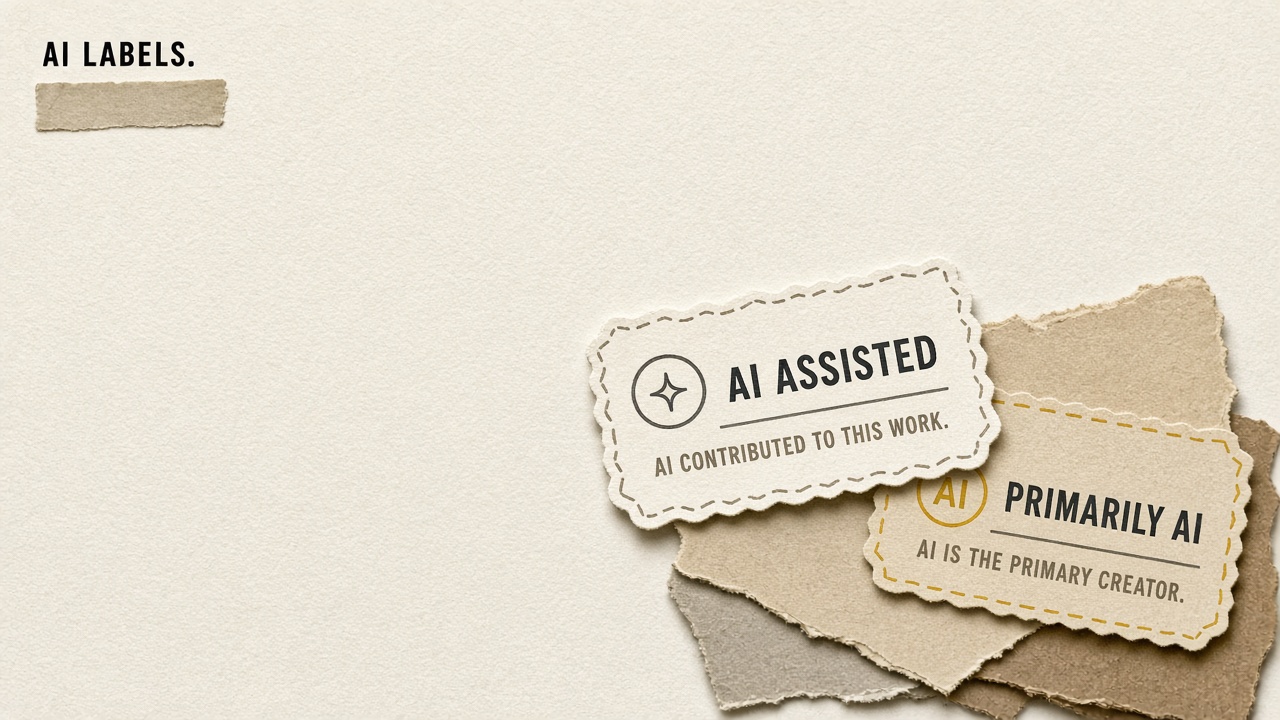
Use three label levels: None (no AI involvement beyond trivial edits), Assisted (human-directed work with meaningful AI contribution), and Primarily AI (AI generated the majority of content with light human review). Every deliverable gets exactly one label before external distribution or client handoff. Ambiguous cases default to the higher transparency level.
| Label | Definition | Example | Display text |
|---|---|---|---|
| None | Human-created; AI used only for trivial edits | Spell-check on manually written report | No label required |
| Assisted | Human authored structure; AI drafted sections or assets | Human-edited AI draft of marketing copy | "AI-assisted" |
| Primarily AI | AI generated most content; human reviewed | AI-generated product descriptions with spot edits | "Primarily AI-generated" |
Classification Decision Guide
Ask two questions: (1) Did AI produce more than thirty percent of the final content by word count, pixel area, or runtime? (2) Would removing AI contribution require rewriting rather than editing? If yes to either, classify at least Assisted. If AI produced more than seventy percent with human review limited to factual correction, classify Primarily AI. Teams producing AI video content should measure runtime contribution, not just script word count.
Internal Metadata Fields
Beyond visible labels, record internal metadata: tool name, model version, date of generation, human reviewer name, and review outcome (approved, revised, rejected sections). Metadata supports audit response and incident investigation without exposing technical detail on client-facing documents. Store metadata in document properties, DAM systems, or project management fields.
Where Labels Appear on Documents
Place labels in the document footer or cover page for PDFs and slide decks, in video end cards or lower-thirds for media, in README headers for code repositories, and in email signatures when AI-generated attachments accompany the message. Labels must be visible without opening hidden metadata panels. Client-facing materials use plain language; internal drafts may use abbreviated tags.
Placement by Format
| Format | Label placement | Minimum visibility |
|---|---|---|
| PDF / Word | Footer on every page or cover page block | 10pt minimum font |
| Slide deck | Cover slide and closing slide | Readable at presentation distance |
| Video / audio | Opening or closing three seconds | On-screen text or spoken disclosure |
| Web content | Byline area or article footer | Same visibility as author byline |
| Code | File header comment or README | Visible to next developer |
External vs Internal Labeling
External deliverables require full label text; internal working documents may use shorthand tags (AI-A, AI-P) until finalization, then convert to full labels before client release. Never remove labels when converting from internal to external versions. EU AI Act Article 50 expects deployers to inform individuals when they interact with or receive AI-generated content in applicable categories.
Exceptions for Trivial Edits
AI use qualifies as trivial and requires no label when limited to grammar correction, formatting suggestions accepted without content change, autocomplete of single words or phrases, or standard transcription cleanup that does not alter meaning. Trivial edit exceptions do not cover AI transcription that summarizes, redacts, or restructures interview content. When in doubt, label Assisted.
- Spell-check and grammar tools: no label (None level).
- Autocomplete in email or docs: no label if under ten words per message.
- AI translation of human-written source: Assisted label on output.
- AI summarization of meeting notes: Assisted label minimum.
- AI image background removal on human-designed layout: Assisted if visible in final.
- Full AI draft of any client-facing section: Assisted or Primarily AI.
Threshold Documentation
Document quantitative thresholds in the policy appendix so teams apply exceptions consistently across departments. Legal should review thresholds annually as tool capabilities evolve. A grammar checker in 2024 behaves differently from a rewriting assistant in 2026; revisit trivial edit definitions when vendors add generative features to productivity tools.
Training and Enforcement
Require labeling policy training at onboarding and annually; enforce through spot audits of client deliverables, manager attestation in project closeout checklists, and corrective action for repeated non-compliance. Training covers classification examples, placement rules, and client contract obligations. Track completion in the LMS with audit export.
Enforcement Escalation
First violation: coaching and retraining; second violation within twelve months: manager notification and mandatory re-certification; third violation: disciplinary review per HR policy. Unlabeled client deliverables discovered during legal review trigger immediate correction and root cause analysis. Willful mislabeling (marking Primarily AI work as None) escalates directly to disciplinary review.
Quality Review Gate
Add labeling verification to the quality review gate before external publication: reviewer confirms label level, placement, and metadata completeness alongside factual accuracy review. Marketing, legal, and client services should share a single review checklist template. Automated pre-flight checks in DAM systems can block export without a label field populated.
Labeling for Video and Audio Content
Video and audio deliverables require both on-screen or spoken disclosure and metadata tags in the asset management system because viewers may encounter content outside the original labeled context. Teams producing AI video content should apply labels at the beginning and end of every published clip, including social media cuts and conference presentation excerpts. Synthetic voice narration qualifies as Assisted minimum even when visuals are human-created.
Transcription and Interview Content
Raw AI transcription of interviews is Assisted; AI-generated summaries of those transcripts are Primarily AI unless a human substantially rewrites the summary. Client deliverables containing transcribed quotes must label Assisted even when the underlying interview was human-conducted. Fact-checking AI transcriptions against source audio does not reduce the label below Assisted.
Social Media Distribution
When AI-assisted content is distributed on social platforms, include disclosure in the post caption or platform-specific AI content labels where available. Platform-native AI labels (YouTube altered content, Meta AI info) supplement but do not replace internal policy labels. Marketing maintains a platform-specific disclosure guide mapping internal label levels to each channel's requirements.
Contract and Regulatory Alignment
Map internal label levels to client contract disclosure clauses and regulatory requirements so the same taxonomy satisfies MSAs, EU AI Act transparency duties, and industry-specific rules. When client contracts require stricter disclosure than internal policy, the contract wins. Maintain a clause library linking contract language to internal label definitions.
Template Library and Brand Standards
Publish approved label templates in brand guidelines: footer text strings, slide master elements, video end-card graphics, and document cover page blocks for each label level. Designers and content creators apply templates rather than inventing disclosure language per deliverable. Brand standards include font, color, size, and placement specifications matching the placement rules table.
Localization Considerations
Translate label text for deliverables in non-English markets; maintain a glossary of approved translations for "AI-assisted" and "Primarily AI-generated" in each supported language. EU markets may require local-language disclosure under Article 50 transparency obligations. Legal reviews translations before publication in regulated jurisdictions.
Frequently Asked Questions
What if a client contract prohibits AI-generated deliverables?
Flag the contract restriction in the project record; prohibit AI use beyond None-level trivial edits for that engagement; document human-only attestation at delivery. Do not rely on internal labeling when the contract bans AI entirely. Legal should maintain a registry of AI-restricted clients accessible to project managers during kickoff.
How do we label mixed media deliverables with both human and AI components?
Apply the highest applicable label to the deliverable as a whole and add component-level notes in metadata when AI contribution varies significantly across sections. A report with human-written analysis and AI-generated charts gets Assisted label with metadata noting "charts: Primarily AI." Video with human narration over AI-generated B-roll gets Assisted with end-card disclosure of AI visuals.
Do internal-only documents need labels?
Internal documents require shorthand labels when shared across teams or archived for more than ninety days; personal drafts in progress need no label until shared or finalized. Internal transparency prevents downstream teams from unknowingly republishing AI content as human-authored. Wiki and knowledge base articles always require labels.
How does labeling apply to code written with AI assistants?
Label code repositories Assisted when AI generated significant functions or modules; None when AI provided only autocomplete or documentation suggestions; document in README and commit messages for audit trail. Open-source releases may have additional license implications; legal reviews AI-generated code before external publication regardless of label level.
Cross-Functional Rollout Plan
Roll out the labeling policy in three phases: phase one trains legal, marketing, and communications; phase two adds product and engineering; phase three covers all remaining departments with role-specific examples. Each phase includes live workshop, policy acknowledgment, and spot-check audit thirty days after launch. Department champions answer day-to-day classification questions so legal is not the bottleneck for every label decision.
Tooling Integration
Integrate label fields into document templates, DAM metadata schemas, project management custom fields, and CMS publishing workflows so labeling happens at creation time, not as a post-delivery afterthought. Frictionless tooling compliance beats policy memos employees forget. Require label selection before file upload to client-facing shared drives.
EU AI Act Transparency Alignment
EU AI Act Article 50 requires deployers to inform individuals when they interact with or receive content from certain AI systems; internal labeling taxonomy should map directly to Article 50 disclosure categories for EU-facing deliverables. Legal counsel determines which systems fall under Article 50 in your deployment context. Primarily AI labels on customer-facing content align with transparency obligations for limited-risk systems. Document the mapping between internal labels and regulatory disclosure requirements in the policy appendix.
Audit and Spot-Check Program
Compliance or internal audit samples ten client deliverables per quarter across departments, verifying label presence, correct classification, and metadata completeness. Spot-check findings feed back into training content and policy clarifications. Departments with repeated mislabeling receive mandatory refresher training and manager accountability review.
Consistent Labels Build Defensible Transparency
An AI transparency labeling policy succeeds when three label levels are defined clearly, placement rules cover every deliverable format, trivial edit exceptions are documented with thresholds, and training plus enforcement make compliance routine. Align internal taxonomy with client contracts and regulatory expectations so one labeling system satisfies legal, commercial, and ethical obligations. Publish the policy alongside template files so adoption requires copying standards, not interpreting prose from memory. Review label definitions annually as AI tool capabilities evolve and client contract language changes.