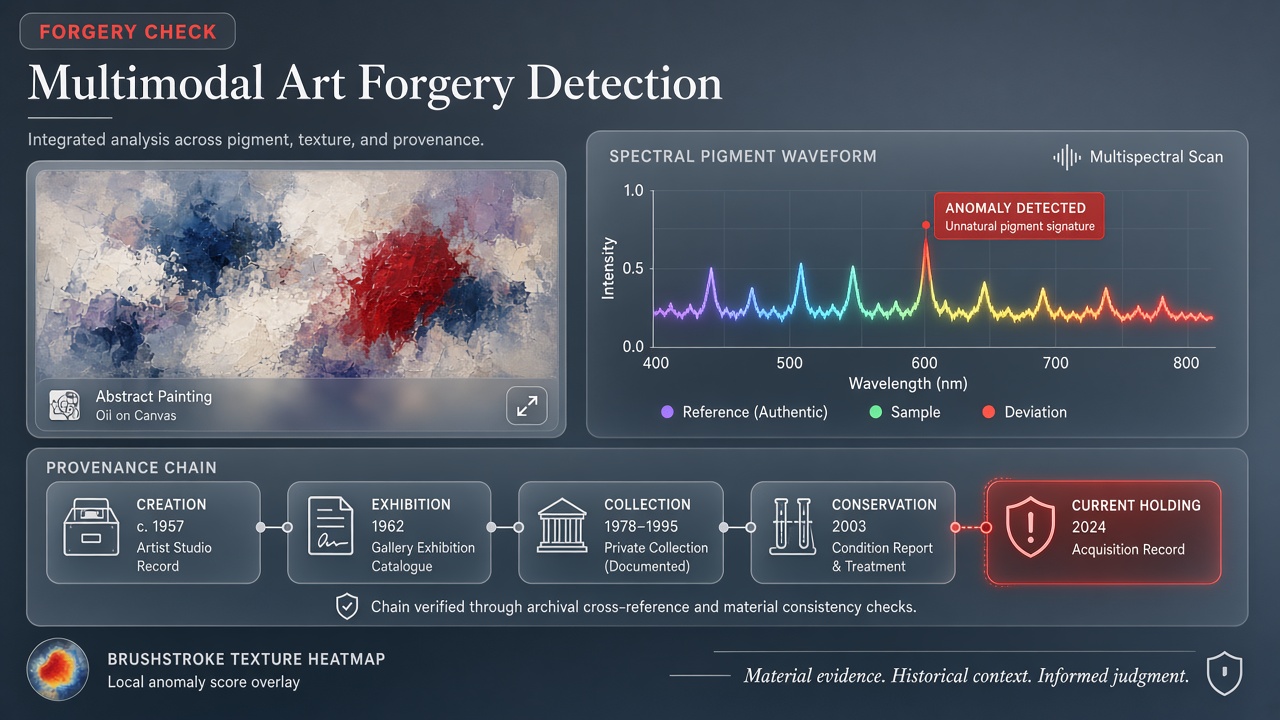
AI art forgery detection combines non-invasive pigment spectroscopy, brushstroke and craquelure CNN features, provenance graph anomaly scoring, and vision transformers that separate real, AI-generated, and imitated works, yet auction houses still require human connoisseurs for final attribution. High-stakes fraud incentives push skilled forgers to source period canvases and historical pigments, so multimodal fusion beats any single signal. Labs such as those serving Christie's and Sotheby's due diligence increasingly request machine-readable spectral cubes alongside high-resolution imaging. Collectors comparing generative tools should also review AI image generator ethics and AI image generator workflows that blur lines between imitation and counterfeit.
High-Stakes Art Fraud Economics
Single paintings trade for tens of millions of dollars, so a convincing forgery yields enormous profit relative to material cost, funding sophisticated studios that study artist technique and archival gaps. Famous cases involve fabricated provenance documents, artificial aging, and workshop assistants mimicking masters. Insurance underwriters and lenders demand technical screening before financing transactions. AI tools lower per-work screening cost but cannot eliminate adversarial adaptation: when a detector ships, forgers train against public features.
NFT markets added a parallel fraud surface where token provenance does not guarantee physical canvas authenticity. Multimodal pipelines must treat on-chain metadata as one graph layer among many, cross-checking against exhibition histories, conservation reports, and pigment timelines. A smart contract cannot prove a Rothko was painted in 1958.
Litigation relies on expert testimony, not neural network softmax scores. Courts expect explainable evidence: which pigment peak indicates titanium white inconsistent with claimed decade, which brushstroke patch diverges from cataloged exemplars. Models should output heatmaps and spectral plots archivable for discovery, not black-box verdicts.
Non-Invasive Pigment Spectroscopy
X-ray fluorescence (XRF), reflectance imaging spectroscopy (RIS), and macro-Raman mapping identify elemental and molecular signatures of pigments and binders without sampling the paint layer. Anachronistic pigments trigger fraud flags: certain cadmium reds, phthalocyanine blues, and modern titanium whites postdate many attributed works. Hardware-registered multimodal platforms now co-register 3D topography, visible RIS cubes, and Raman maps on micrometer grids, letting conservators align spectral anomalies with specific brush passes.
Pigment analysis alone is insufficient when forgers grind historical minerals or reuse old canvases. Spectroscopy must combine with stylistic and documentary evidence. Machine learning on spectral cubes can cluster unknown works against reference libraries built from authenticated museum pieces, but library bias toward Western oil painting underrepresents Asian ink traditions and contemporary mixed media.
Contemporary artists using modern cadmium pigments legitimately complicate chronology classifiers trained only on pre-1950 museum cores. Multimodal art forgery detection must ingest artist statements, studio invoices, and pigment supplier catalogs as graph nodes, not treat every modern molecule as fraud. Context-aware models downgrade anomaly scores when declared contemporary authorship aligns with spectral results.
Brushstroke CNN heatmaps help juries understand why experts disagree: one patch may show Veronese-like handling while another matches a studio assistant. Painting-level aggregation then yields intermediate probabilities rather than forced binary verdicts, matching how connoisseurship actually proceeds in contested attribution cases before courts or auction committees.
Portable XRF guns enable fair-floor triage, yet spot readings miss subsurface repaints. Full RIS sweeps are slower and require museum cooperation. AI art forgery detection workflows should document which modalities were acquired; absence of Raman data is not proof of authenticity.
Brushstroke and Craquelure CNN Features
Convolutional and transformer models extract micro-textural brushstroke patterns and craquelure networks from high-resolution patches, comparing localized features to authenticated works by the same artist. A 2025 Frontiers study authenticated a disputed Paolo Veronese Holy Family painting using a shallow CNN on RGB, grayscale, and edge-map patches with sliding-window expansion, achieving 94.51 percent patch classification accuracy and painting-level heatmaps showing stylistic coherence in genuine works versus fragmentation in mismatched comparisons.
ArtUnmasked combines spectral artifact detection (SPAI-ViT-Tiny), TagMatch artist filtering, and DINOv3-CLIP patch correspondence to separate real, AI-generated, and imitated artworks, with a custom 24K imitation dataset for evaluation. DINOv2 self-distilled transformers reported 99.01 percent accuracy separating real from AI-generated art in a January 2026 Scientific Reports study, though lab conditions differ from dusty attic discoveries.
Style CNNs struggle when iconography differs: comparing portraits to landscapes shares little brushwork context. Domain-specific datasets restricted to similar subjects reduce false cues from composition rather than execution. Craquelure can be forged with controlled drying and mechanical cracking; treat texture features as supportive, not decisive.
| Signal layer | Typical sensor | Forgery clue example |
|---|---|---|
| Pigment chemistry | XRF, RIS, Raman | Modern titanium white in pre-1920 attribution |
| Brushstroke texture | High-res imaging + CNN or ViT | Inconsistent impasto direction vs cataloged works |
| AI vs human origin | DINOv2, SPAI spectral artifacts | Generative high-frequency patterns in prints |
| Provenance graph | Auction, customs, exhibition records | Timeline gap or impossible transit between sales |
Provenance Graph Anomaly Detection
Provenance graph models represent owners, galleries, shipments, and exhibitions as nodes and edges, flagging cycles, date inversions, and missing customs entries that suggest laundered stories. Christie's and Sotheby's due diligence teams cross-check consignor paperwork against stolen art registries and sanctions lists. Graph neural networks can score how unusual a chain is relative to authentic works from the same artist period, but document forgery remains a threat: a perfect graph with fake PDFs defeats naive parsers.
Multimodal fusion weights pigment and style signals higher when provenance is thin, and elevates documentary scrutiny when spectral results are ambiguous. Insurance appraisals increasingly request structured provenance JSON alongside multispectral TIFF archives for reproducibility during later disputes.
NFT provenance adds wallet nodes but often omits physical custody edges. Hybrid models should link token mint events to conservation imaging timestamps, rejecting claims of continuous museum storage when spectral evidence shows recent repainting.
Adversarial Adaptation by Forgers
Skilled forgers study published authentication features, sourcing period supports, mixing historically plausible pigments, and using apprentices trained to copy brush rhythm. Adversarial adaptation turns any public detector into a training target. Research models reporting 99 percent AI-art separation may not survive generative model updates six months later. Continuous retraining on seized forgeries and confirmed fakes from law enforcement partnerships helps, but data sharing is legally sensitive.
Imitation differs from counterfeit intent: art students copy masters legally; fraud begins when copies enter market with false attribution. ArtUnmasked explicitly triages imitated versus AI-generated versus authentic tiers so galleries can label homages appropriately. Multimodal systems should output calibrated uncertainty, not binary fake labels, when evidence conflicts.
Generative AI image generator tools lower the cost of superficial style mimicry for prints and digital sales, increasing volume of low-quality fakes while master forgers still target oil painting channels. Detection pipelines must segment threat models: spectral CNNs for canvas works, SPAI artifacts for digital uploads.
Court admissibility hearings may challenge whether a DINOv2 heatmap constitutes scientific evidence or illustrative opinion. Legal teams should pair model outputs with blinded conservator studies and duplicate spectral readings from independent labs. Christie's and Sotheby's due diligence reputations depend on this dual track: fast AI triage plus slow expert consensus before catalog copy claims authorship.
Insurance appraisals increasingly discount works lacking multimodal dossiers, nudging collectors toward documented conservation history. When provenance graphs include gaps during wartime looting eras, anomaly detectors flag elevated risk even if pigments appear period-correct. Ethical sellers welcome transparent uncertainty scores; fraudsters push for single-number authenticity labels that multimodal systems rightly refuse to provide.
Museums lending works internationally should attach portable spectral summaries so receiving institutions rerun compatible classifiers without reshooting fragile surfaces. Shared feature vectors, not raw trade secrets, enable cross-institution fraud alerts when the same suspicious canvas appears under new titles in different jurisdictions months apart. Standardizing those vectors across Christie's, Sotheby's, and museum labs remains an industry coordination challenge beyond any single model paper.
Conservation departments at major houses increasingly publish multispectral acquisition protocols so consignors know which modalities a work will face before shipment. Standardizing XRF grid density, RIS wavelength range, and macro-Raman exposure limits makes multimodal AI art forgery detection comparable across seasons even as model weights update. Buyers should ask whether screening included subsurface imaging or only front-facing hyperspectral cubes vulnerable to skilled overpainting.
Art fair rapid screening sometimes uses handheld XRF plus tablet CNN apps for triage, reserving full laboratory fusion for flagged lots. That tiered approach balances throughput with depth, but risks false negatives when forgers confine anachronistic pigments to small retouch zones smaller than gun footprint. Multimodal fusion algorithms should weight missing modalities explicitly rather than silently averaging toward authentic priors.
Frequently Asked Questions
Can AI authenticate a painting alone?
No. Courts and major auction houses require integrative expert reports. AI supplies probabilistic evidence layers; connoisseurs and conservators render final opinions.
Do NFTs change forgery detection?
Tokens prove ownership of a digital asset, not physical pigment history. Screen both on-chain metadata and material science when works claim dual physical-digital status.
Will insurers rely on neural networks?
Insurers may use AI triage to set investigation depth, but policies still hinge on human expert sign-off and documented modality coverage (XRF, RIS, imaging resolution).
How do forgers defeat pigment tests?
They reuse old canvases, grind historical minerals, or limit testing to surface glazes while hiding modern paint beneath. Multimodal cross-section imaging reduces but does not eliminate risk.
Are AI-generated prints forgeries?
Legally depends on fraud intent and trademark. Technically, SPAI and DINOv2 classifiers flag many generative prints, yet models need frequent updates as generators evolve.
What data do auction houses share?
Due diligence is confidential per consignment. Published research datasets rarely include recent market works, biasing academic models toward museum collections.
Where should I follow art forensics AI?
Heritage science journals and fraud investigation bulletins cover new sensors. For generative art intersections, monitor AI image generator policy updates alongside conservation AI papers.