Insurance carriers face a persistent tension: members and regulators expect faster claim decisions, while wrongful denials trigger appeals, bad press, and state enforcement actions. Artificial intelligence can classify incoming claims, extract policy fields, and route files to the right adjuster queue in seconds, but automation without guardrails amplifies denial errors at scale. This AI insurance claims triage workflow guide maps triage stages, confidence scoring, human review triggers, regulatory fairness requirements, and the fraud versus speed balance, with links to AI automation patterns and AI writing tools for correspondence drafting.
What Claims Triage Means
Claims triage is the first operational stage after intake: sorting each submission by complexity, coverage questions, fraud signals, and regulatory sensitivity before a human or automated system makes a coverage decision. Triage is not the same as adjudication. A triage model might label a property claim as "straightforward water damage with complete documentation" or "potential subrogation with missing police report." The label determines queue priority, specialist assignment, and whether straight-through processing is allowed.
Carriers that skip structured triage either over-staff simple claims or under-resource complex ones. AI enters when rule engines alone cannot parse unstructured adjuster notes, photos, and medical narratives at volume. Productive deployments treat the model as a routing layer with explicit confidence thresholds, not as an autonomous denier.
Triage Stages: From Intake to Queue
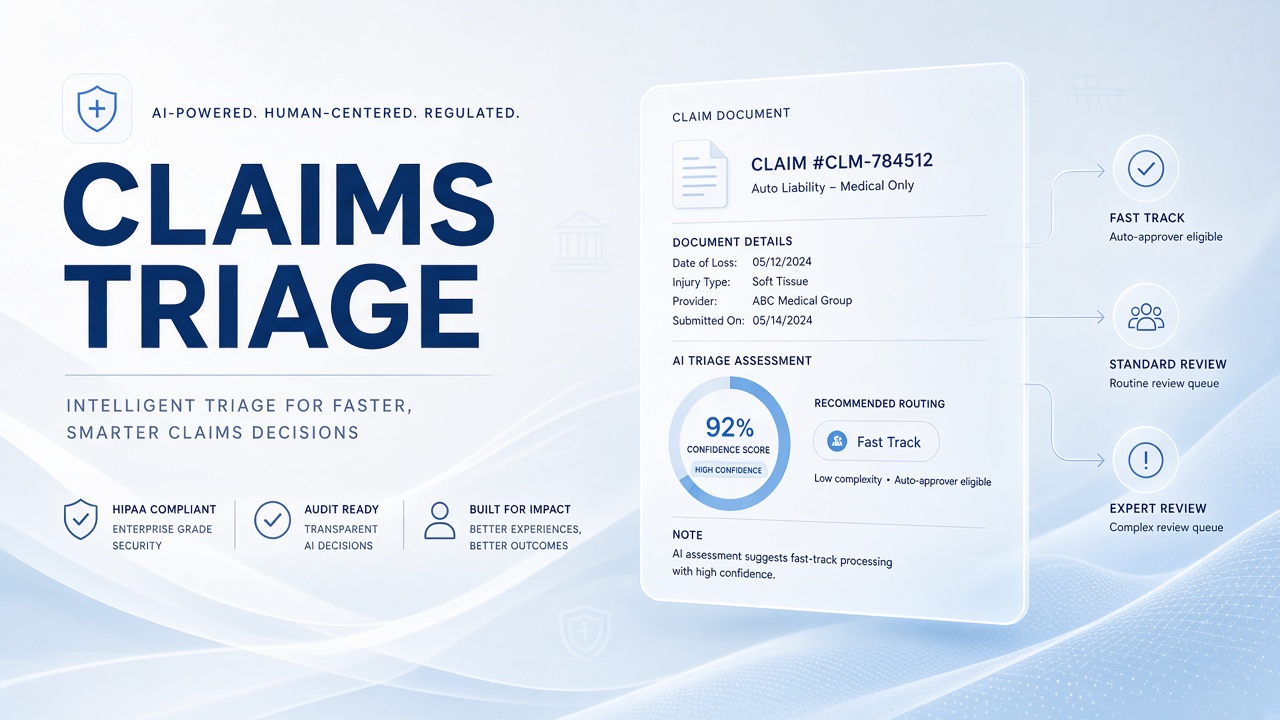
A production triage pipeline moves each claim through intake normalization, entity extraction, risk scoring, route assignment, and optional straight-through processing before any final payment or denial letter. Each stage emits structured metadata the next stage consumes.
- Intake normalization: Convert PDFs, portal uploads, EDI 837 files, and call-center notes into a canonical schema. OCR and layout models handle scanned forms; LLMs summarize free text with source pointers.
- Entity extraction: Pull policy number, date of loss, CPT codes, ICD codes, provider NPI, and peril type. Validate against master data; flag mismatches before scoring.
- Risk and complexity scoring: Combine rules (deductible met, prior claims on property) with model scores (fraud propensity, medical necessity ambiguity, regulatory jurisdiction).
- Route assignment: Map score bands to queues: auto-pay, standard adjuster, SIU referral, legal hold, or regulatory review.
- Straight-through processing (STP): Only for claims above a high confidence threshold with no mandatory human triggers. STP volume should be a controlled percentage, not a default.
| Stage | AI role | Human gate |
|---|---|---|
| Intake | OCR, document classification | Illegible scan escalation |
| Extraction | NER, code suggestion | Low-confidence field review |
| Scoring | Complexity and fraud models | Override on protected classes |
| Routing | Queue recommendation | Supervisor reassignment |
| STP | Auto-adjudication rules | 100% audit sample on denials |
Confidence Scoring and Calibration
Confidence scores express how certain the triage system is about its classification, extraction, or route recommendation, and must be calibrated on historical outcomes rather than raw model softmax outputs. Uncalibrated scores cause teams to auto-route borderline denials into STP lanes where errors compound.
Calibration practice: hold out a labeled set of claims with known adjuster outcomes. Bin predictions by decile and measure actual error rates per bin. A score of 0.92 should mean roughly 8% of those claims required correction after human review. Recalibrate quarterly or after policy changes, new provider networks, or major catastrophe events that shift claim distributions.
Multi-Model Confidence Fusion
Production triage often fuses document extraction confidence, fraud model scores, and rules-engine pass/fail flags into a single routing decision with the weakest link determining human escalation. If extraction confidence on date of loss is 0.6, the claim should not enter STP even when fraud score is low.
Human Review Triggers
Human review triggers are mandatory conditions that override automation regardless of confidence score, including denial recommendations, protected-class-sensitive lines, high-dollar thresholds, and first-time provider patterns. Triggers should be explicit in policy documents, not buried in model configs.
- Any predicted denial or partial denial
- Claims above configurable dollar thresholds (e.g., $25,000 property, $100,000 liability)
- Lines of business under state fair claims practice scrutiny
- Member complaints or prior appeal history on the policy
- Model disagreement between fraud and medical necessity scorers
- Missing required documentation the model cannot infer
- Random audit sampling (typically 2 to 5% of auto-approved claims)
Adjusters need a single screen showing why the claim landed in their queue: extracted fields, model scores, triggered rules, and linked policy clauses. Black-box routing destroys trust and slows review.
Regulatory Fairness and Model Governance
State insurance departments and federal fair lending-adjacent guidance increasingly expect documented model governance: bias testing, explainability artifacts, and appeal pathways when automated systems contribute to adverse decisions. Colorado's algorithmic accountability law and NAIC model bulletin themes apply to insurers using external data and predictive models in underwriting and claims contexts.
Fairness testing should segment outcomes by geography, plan type, and proxy-sensitive attributes where legally permissible. Disparate impact on denial rates or time-to-pay requires remediation before scaling STP. Maintain versioned model cards describing training data vintage, known limitations, and override procedures. Legal and compliance teams sign off on trigger lists, not only data science.
Correspondence and AI Writing Tools
After triage routes a claim to an adjuster, AI writing assistants can draft member letters and internal summaries from approved templates, but every denial explanation requires human edit and policy citation verification. Auto-generated denial language without adjuster review is a common source of regulatory findings.
Fraud Detection Versus Speed Balance
Fraud models increase SIU referrals and slow average handle time; speed targets push teams toward higher STP rates. The balance is set by explicit service-level agreements per queue, not by maximizing either metric alone. A healthy program measures false referral rate to SIU, appeal overturn rate on auto-denials, and member NPS alongside cycle time.
Tier fraud scoring: low scores flow to fast lanes; medium scores get documentation requests before payment; high scores freeze payment pending investigation. Never combine fraud and coverage denial in a single opaque score members cannot challenge. SIU teams should receive structured packages, not raw model dumps.
| Metric | Speed risk | Fraud risk |
|---|---|---|
| STP approval rate | Higher is faster | Higher may miss fraud |
| SIU referral rate | Lower is faster | Lower may under-detect |
| Appeal overturn on denials | High signals bad triage | Low may mean weak appeals |
| Time to first touch | Core member experience | Neutral if triage accurate |
Audit Sampling and Continuous Improvement
Audit sampling reviews a random and risk-weighted subset of auto-processed claims to catch systematic errors before regulators or class actions do. Sample denials at higher rates than approvals. Feed audit findings back into retraining sets and trigger rule updates. Document every override an adjuster makes; overrides are gold labels for the next model generation.
AI automation platforms that lack exportable audit logs should not touch adjudication. Carriers need immutable decision records linking input documents, model version, scores, rules fired, and human actions for each claim ID.
Document Intake and OCR Quality
Triage accuracy starts at intake: scanned adjuster photos, member-uploaded damage images, and faxed medical records must pass quality gates before extraction models run. Blurry images, rotated pages, and multi-document PDFs without separation cause cascading errors in entity extraction and fraud scoring. Production pipelines should reject or request re-upload when OCR confidence on critical fields falls below threshold, rather than pushing garbage into STP lanes.
Separate document classifiers route property photos to computer vision damage estimators, medical bills to code extractors, and legal correspondence to priority legal-hold queues. Mixing document types in a single generic OCR pass increases hallucinated field values. Maintain a golden set of representative documents per line of business and regression-test every model upgrade against denial overturn rate, not only extraction F1 scores.
Catastrophe Mode Triage
During hurricanes, wildfires, or regional freeze events, claim volume spikes and data distributions shift; triage models trained on normal weather must switch to catastrophe mode with relaxed STP caps and expanded human staffing. Pre-configure catastrophe playbooks: temporary triggers that force human review on all total loss property claims, extended appeal windows communicated to members, and daily fairness audits on geographic clusters. Models that keep normal-mode STP rates during catastrophes generate class-action exposure when members cannot reach adjusters.
Implementation Checklist
- Define triage labels and queue map with operations and legal
- Build labeled historical dataset with adjuster corrections
- Calibrate confidence scores on hold-out claims
- Publish human trigger list and STP caps
- Run parallel shadow mode before cutting traffic
- Enable audit sampling and appeal tracking from day one
- Review fairness metrics monthly; recalibrate after catastrophes
Frequently Asked Questions
Can AI deny claims without human review?
Most carriers should treat denial recommendations as mandatory human review regardless of confidence score, because wrongful denials carry asymmetric legal and reputational cost. STP is better suited to straightforward approvals with complete documentation.
What confidence threshold is safe for straight-through processing?
There is no universal threshold; calibrate on your lines of business so that the error rate in the top decile matches your risk appetite, often requiring 95% or higher calibrated accuracy on pilot queues before expansion. Start narrow (single peril, low dollar cap) and widen slowly.
How do we prevent fraud models from biasing triage?
Separate fraud scores from coverage routing where possible, test referral rates across segments, and require SIU confirmation before payment holds based solely on model output. Document overrides when adjusters disagree with fraud flags.
What do regulators ask for in an AI triage exam?
Expect requests for model inventory, training data descriptions, validation results, override procedures, member notification practices, and samples of adverse decisions linked to model inputs. Maintain version control and change logs.
How should members know AI assisted their claim?
Transparency requirements vary by state; many carriers disclose automated decision support in EOB letters and provide human appeal contacts regardless of triage path. Member trust improves when disclosures are plain language, not buried in terms of service. Legal should review disclosure templates before STP expansion.
Buy triage AI or build in-house?
Vendor platforms accelerate OCR and routing templates; in-house models help when policy language and state rules are highly proprietary. Hybrid approaches use vendor intake with carrier-owned scoring and governance layers.
How should appeals interact with triage models?
Appeals that overturn a decision should flag the original triage features for relabeling and may trigger temporary removal of similar claims from STP until root cause is fixed. Appeals data is among the most valuable supervision signal carriers possess.
Conclusion
AI insurance claims triage delivers speed when teams treat automation as routing intelligence bounded by confidence calibration, human triggers, and audit sampling. Structure intake through queue assignment, never auto-deny without review, test for regulatory fairness, and balance fraud scoring against member experience metrics. Pair triage with governed AI automation and human-edited AI writing for correspondence. Fast claims processing and fair outcomes are compatible when denial mistakes are treated as production incidents, not acceptable collateral. Start with a narrow line of business, calibrate confidence on historical outcomes, and expand STP only when appeal overturn rates stay within tolerance.