A support agent pastes a 40-page policy PDF into chat. The model rejects the request: context limit exceeded. The team tries trimming the last few messages, but the real problem is volume. Token compression techniques address that bottleneck by reducing how many tokens reach the model while preserving enough meaning for accurate answers. Compression is not one trick. It is a set of tradeoffs between fidelity, latency, and cost that every production AI stack eventually faces.
Context windows grew from a few thousand tokens to hundreds of thousands, yet applications still hit limits. Long chat threads, retrieved documents, tool outputs, and system prompts compete for the same budget. Teams building AI productivity workflows and evaluating private AI chatbot platforms should understand lossy versus lossless methods, when chunking beats summarization, and how aggressive compression can hide details the model needs to answer correctly.
What Token Compression Is: Less Input, Same Task
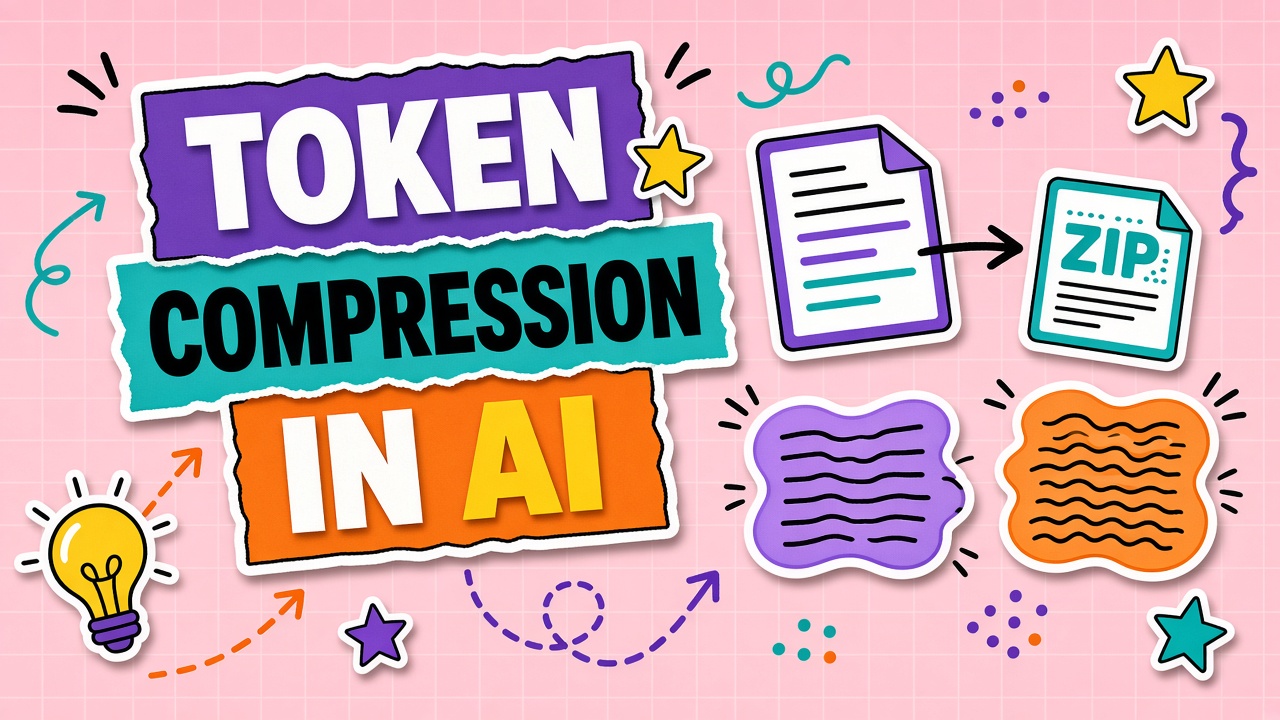
Token compression means transforming text, structured data, or conversation history into a smaller token representation before sending it to a language model. The goal is to stay within context limits without abandoning the task. Compression happens upstream of inference: in retrieval pipelines, middleware layers, or client-side preprocessing. The model still receives natural language or structured content, but that content occupies fewer tokens than the original source material.
Compression differs from simply using a smaller model. A smaller model may cost less per token but does not increase how much source material fits in one request. Compression also differs from RAG chunk selection alone. Chunking picks which pieces to include; compression additionally shrinks those pieces or replaces them with summaries, embeddings metadata, or structured extracts.
Lossy vs lossless compression
Lossless compression preserves every fact needed to reconstruct the original meaning for the task at hand. Examples include removing boilerplate headers, normalizing whitespace, deduplicating repeated paragraphs, stripping HTML tags while keeping text, and converting verbose JSON into compact key-value lines. No semantic content is intentionally dropped.
Lossy compression discards detail to save tokens. Summarization, aggressive truncation, keeping only the top-k sentences by relevance score, and replacing long tables with aggregate statistics are lossy. The saved tokens come at the price of omitted nuance. Legal, medical, and financial workflows often reject lossy defaults unless a human reviews compressed output before it reaches the model.
| Method | Type | Typical savings | Risk |
|---|---|---|---|
| Whitespace and markup stripping | Lossless | 5 to 20 percent | Accidentally removes code formatting cues |
| Deduplication | Lossless | Varies by corpus | Repeated warnings in logs may matter |
| Extractive summarization | Lossy | 40 to 70 percent | Misses facts not in selected sentences |
| Abstractive summarization | Lossy | 50 to 85 percent | Hallucinated summary details |
| Structured field extraction | Mostly lossless | 60 to 90 percent for tables | Wrong field mapped in schema |
Chunking Strategies: Split Before You Compress
Chunking divides large documents into segments sized for retrieval or direct injection. Effective chunking is the foundation of most compression pipelines because the model rarely needs every paragraph at once. Chunk boundaries affect recall: splits mid-sentence lose cross-boundary context; splits at section headers preserve topic coherence.
Common approaches include fixed token windows with overlap, semantic splits at paragraph or heading boundaries, and structure-aware splits for code, markdown, or HTML. Overlap of 10 to 20 percent between adjacent chunks reduces the chance that a fact spanning two chunks disappears from retrieval results. Teams running productivity copilots over wikis should tune chunk size against their embedding model and the average question scope.
Parameters that change chunk quality
- Chunk size: Larger chunks preserve local context but reduce retrieval precision.
- Overlap: Reduces boundary artifacts at the cost of more stored tokens in the vector index.
- Metadata: Titles, section paths, and timestamps help the model disambiguate similar chunks.
- Pre-filtering: Removing navigation menus and footers before chunking saves index space losslessly.
// Example: approximate token budget per request
const CONTEXT_LIMIT = 128_000;
const RESERVED_OUTPUT = 4_096;
const SYSTEM_AND_TOOLS = 8_000;
const USER_MESSAGE = 500;

const availableForRetrieval =
  CONTEXT_LIMIT - RESERVED_OUTPUT - SYSTEM_AND_TOOLS - USER_MESSAGE;
// Pass only top chunks until sum(chunk.tokens) <= availableForRetrieval
Recursive Summarization: Compress in Layers
Recursive summarization handles material too large for a single pass. The pipeline splits a document into sections, summarizes each section, then summarizes the summaries until the result fits the token budget. Map-reduce patterns in LangChain and similar frameworks implement this flow. Each layer adds latency and compounds summarization error, so production systems often cap recursion depth at two or three levels.
A practical pattern keeps raw chunks in storage while injecting only rolling summaries into the active context. When the user asks for a detail the summary omitted, the orchestrator fetches the underlying chunk on demand. That hybrid approach balances default compression with on-demand fidelity. Private chatbot deployments described in private AI chatbot listings sometimes advertise "unlimited document upload" but still apply hidden summarization before inference.
Guardrails for summarization pipelines
- Preserve named entities, dates, numbers, and citations explicitly in summary prompts.
- Log compression ratio and summary model version for debugging wrong answers.
- Compare abstractive output against extractive baselines on a golden question set.
- Allow users to expand "show source section" when answers feel incomplete.
When Compression Hides Details the Model Needs
Compression fails silently. The model answers confidently from incomplete context because it cannot know what was removed. High-risk scenarios include contract clause analysis, multi-step math across long tables, code debugging where line numbers shifted after stripping, and compliance checks that depend on footnotes or appendices.
Warning signs include rising "I don't have enough information" rates after enabling summarization, increased hallucination on numeric questions, and user reports that answers worked before document size grew. Mitigations include task-aware compression (lossless for code, lossy for narrative), citation requirements that force chunk retrieval, and human review gates when compression ratio exceeds team thresholds.
| Language | Compression note | Recommendation |
|---|---|---|
| English | Tokenizer well optimized; summaries often shorter per fact | Standard chunk sizes (512 to 1024 tokens) usually work |
| Chinese, Japanese, Korean | Fewer characters per token; byte-level savings differ | Measure tokens, not character count, when budgeting |
| German, Finnish | Compound words inflate token counts | Prefer extractive over aggressive abstractive summarization |
| Arabic, Hebrew | Diacritics and bidirectional text affect preprocessing | Normalize Unicode before chunking; avoid stripping direction marks blindly |
| Code (multi-language) | Whitespace matters; lossy summarization breaks syntax | Use AST-aware chunking; keep lossless paths for debugging tasks |
Implementation Patterns for Production Stacks
Mature teams treat compression as a measurable pipeline stage with metrics: tokens in, tokens out, compression ratio, retrieval hit rate, and answer accuracy on eval sets. Middleware can enforce budgets per tenant, per feature, or per model tier. When budgets tighten, drop oldest chat turns before summarizing retrieved docs, because stale conversation noise often wastes more tokens than high-value source material.
Vendor platforms may expose compression opaquely as "smart context" or "auto memory." Ask whether you can disable lossy steps, inspect intermediate summaries, and export chunk sources for audit. For regulated workloads, lossless preprocessing plus selective retrieval usually beats blanket summarization.
Frequently Asked Questions
Is a larger context window enough without compression?
Larger windows reduce urgency but increase cost and latency per request. Very long contexts also suffer attention dilution, where models overlook middle sections. Compression plus targeted retrieval often outperforms stuffing entire corpora into one prompt.
Does compression work the same across languages?
No. Tokenizers assign different token counts per language and script. Summarization quality varies by training data availability. Evaluate compression pipelines per locale rather than assuming English-tuned settings transfer globally.
Should lossy summarization be the default?
Only for low-stakes narrative tasks with citation or expand-source escape hatches. For code, contracts, and numeric analysis, default to lossless chunking and retrieval until measurements prove summarization is safe.
How do teams measure compression quality?
Track compression ratio alongside accuracy on a fixed question set, hallucination rate on factoid queries, and user thumbs-down trends after pipeline changes. A high ratio with flat accuracy is a win; a high ratio with falling accuracy means the pipeline is too aggressive.
What should buyers ask private chatbot vendors?
Ask whether uploaded files are summarized before each query, whether raw chunks remain accessible, and whether admins can set lossless modes for specific document libraries. Marketing claims of huge uploads rarely mean full raw text reaches the model every turn.
Balancing Fidelity and Fit
Token compression techniques let teams fit more conversation, documentation, and tool output into finite context windows. The decision is not whether to compress but where to apply lossless cleanup, where to chunk and retrieve, and where lossy summarization is acceptable. Productivity-focused AI tools that handle large knowledge bases should expose compression settings transparently and preserve paths back to source material when answers must be precise.
Start with lossless wins, measure token budgets explicitly, and add summarization only where eval data proves safety. Combine recursive summarization with on-demand chunk expansion so users get concise default context without sacrificing depth when it matters. That balance keeps private and enterprise chatbots useful at scale without silent information loss.