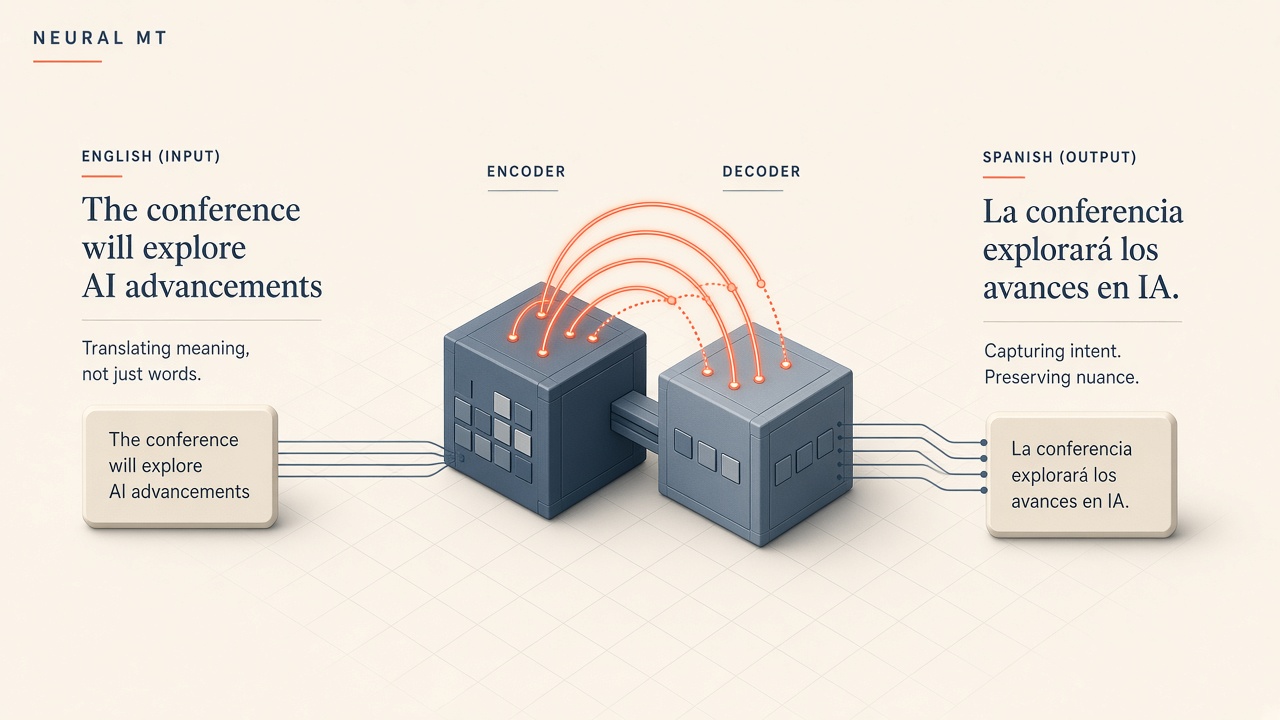
A product team ships a help center in twelve languages. Marketing pastes copy into Google Translate, legal rejects two paragraphs, and support bots answer tourists with awkward phrasing. Neural machine translation explained in one line: deep learning models read an entire source sentence, build an internal representation, and generate a target sentence word by word, learning fluency from millions of parallel examples instead of hand-tuned phrase tables. NMT powers localization pipelines, multilingual AI chatbot replies, and document workflows inside AI productivity suites from DeepL, Google Cloud Translation, Microsoft Translator, and Amazon Translate.
Statistical vs Neural Translation
Statistical machine translation (SMT) broke sentences into phrases and scored combinations with separate language, translation, and reordering models; neural machine translation (NMT) replaces that stack with one end-to-end neural network trained on parallel corpora. SMT peaked in the 2000s with Moses and phrase-based systems. NMT, popularized by encoder-decoder models around 2016, produces more fluent output on many language pairs but still struggles with rare terms, long sentences, and domains absent from training data.
| Approach | Strength | Weakness |
|---|---|---|
| Phrase-based SMT | Predictable on narrow domains with large phrase tables | Choppy fluency, brittle reordering |
| Neural MT (RNN/LSTM era) | Smoother sentences, single model | Slow training, attention bottlenecks on long text |
| Transformer NMT | Parallelizable, strong on many pairs | Hallucination risk on out-of-domain terms |
| LLM translation prompts | Flexible instructions, glossary hints in prompt | Higher cost, less deterministic at scale |
Buyers today rarely choose SMT for new projects. They compare managed NMT APIs, on-prem Marian or OpenNMT deployments, and large language models prompted for translation. The decision hinges on volume, latency, glossary enforcement, and whether human post-editing is mandatory for regulated content.
Encoder-Decoder and Attention Intuition
Encoder-decoder NMT reads the source sentence into hidden states, then the decoder generates each target token while attention weights highlight which source words matter for the current output word. Early seq2seq models compressed the whole sentence into one vector (the bottleneck problem). Attention mechanisms let the decoder peek at all encoder states dynamically, improving alignment for long sentences and morphologically rich languages.
Transformer architecture
Modern systems use Transformer encoder and decoder stacks with self-attention and cross-attention layers. Training optimizes cross-entropy loss on token predictions from parallel sentence pairs (English, German) drawn from news, United Nations proceedings, and web crawls. Subword tokenization (SentencePiece, BPE) handles rare compounds and product names by splitting them into frequent pieces.
- Tokenize source and target text into subword units.
- Encoder layers build contextual representations of the source.
- Decoder layers predict the next target token conditioned on prior outputs and encoder states.
- Beam search or sampling selects the final hypothesis among candidates.
Multilingual models share one network across dozens of languages, improving low-resource pairs via transfer from high-resource neighbors. Language tags in the input (e.g., <2de>) tell the model which target language to emit. Zero-shot translation between languages never seen as a direct pair in training can work when a shared representation emerges, though quality varies.
Quality Metrics Teams Actually Use
BLEU compares n-gram overlap between machine output and one or more human references; COMET and similar neural metrics score semantic similarity and correlate better with human judgments on many benchmarks. No single number replaces human review for marketing, medical, or legal strings. Teams track segment-level BLEU during model upgrades, then sample 200 to 500 sentences for professional linguist scoring (adequacy, fluency) before promoting a model to production.
| Metric | What it measures | Limitation |
|---|---|---|
| BLEU | N-gram overlap with reference translations | Penalizes valid paraphrases; reference dependent |
| chrF | Character n-gram F-score | Better for morphological languages, still automatic |
| COMET | Neural estimate of human quality | Model version drift; domain sensitivity |
| Human MQM | Error typology scored by linguists | Slow and expensive; gold standard for risk |
When automatic metrics mislead
A translation can score high BLEU while mistranslating a negation or unit (mg vs g). Conversely, creative marketing copy may score low BLEU despite being acceptable. Build a domain test set from real UI strings, support macros, and policy paragraphs. Track error categories: terminology, grammar, locale formatting (dates, currencies), and brand voice.
Domain Adaptation and Glossaries
Domain adaptation fine-tunes or constrains NMT on in-domain parallel data and term glossaries so product names, SKUs, and regulated phrases translate consistently. Generic models translate "Oracle" as the noun or the company unpredictably. Glossaries map source terms to approved targets and many cloud APIs enforce do-not-translate lists for trademarks. Fine-tuning on 50k to 500k in-domain sentence pairs often beats prompting alone for stable UI localization.
- Glossary injection: Hard or soft constraints at decode time.
- Custom models: Vendor-trained adapters on customer parallel data.
- Retrieval augmentation: Similar translated segments retrieved from translation memory.
- Style guides in prompts: LLM path for informal vs formal register instructions.
Translation memory (TM) stores previously approved segment pairs. CAT tools (memoQ, Trados, Phrase) suggest TM matches before NMT fills gaps. Integrations that sync TM with CI pipelines reduce regression when English source strings change frequently in agile releases.
Post-Editing Workflows
Machine translation post-editing (MTPE) has linguists correct NMT output under time budgets; light post-editing fixes major errors only, while full post-editing targets publishable quality. ISO 18587 frames post-editing requirements. Enterprises adopt MTPE when raw NMT reaches 70 to 90 percent adequacy on internal tests, cutting cost versus human translation from scratch. Legal, medical, and safety-critical content often mandates full post-editing or human-only translation regardless of automatic scores.
| Workflow | Best for | Risk if skipped |
|---|---|---|
| Raw NMT only | Internal drafts, gisting, low-risk FAQs | Brand damage, compliance gaps |
| Light post-editing | Support articles, knowledge base at scale | Subtle terminology drift |
| Full post-editing | Marketing, regulated disclosures | Higher cost; still cheaper than translate-from-scratch |
| Human translation | Contracts, clinical trials, launch campaigns | Slowest throughput |
Human-in-the-loop decision tree
Ask: Can a mistranslation cause financial loss, injury, or regulatory action? If yes, require human translation or full post-editing. Is content user-visible but non-binding? Light post-edit sample batches and monitor feedback. Is content internal gisting? Raw NMT may suffice. Re-evaluate when you change models or add languages; quality is not transferable by assumption.
LLM Translation and Hybrid Stacks
Large language models prompted with "translate to French, preserve XML tags" compete with dedicated NMT APIs, especially when copy needs tone adjustments or inline glossary notes in the same request. Hybrid stacks run NMT for bulk UI string files at low cost, then route marketing landing pages through an LLM rewrite pass for brand voice. The LLM path costs more per token and can drift from source meaning if prompts lack constraints; always keep a back-translation spot check on high-risk paragraphs.
XML and JSON localization files need tag preservation. NMT systems trained with placeholder tokens handle
variables like {userName} better than naive copy-paste into chat UIs. Validate that gendered
languages receive correct agreement when placeholders expand to runtime values. Failing tests here show up as
customer-facing bugs in Slavic or Romance locales long after the English source shipped.
Routing by content type
- UI strings: NMT plus glossary, no creative paraphrase.
- Support macros: NMT with TM matches above 90 percent fuzzy threshold.
- Blog posts: NMT draft, human or LLM polish, legal review if claims appear.
- Chat replies: Real-time NMT or multilingual LLM with latency budget under 500 ms.
Deployment Patterns for Product Teams
SaaS products typically call translation APIs at publish time or pre-translate resource files in CI, storing locale JSON or PO files with version control and pseudolocale QA passes. Real-time chat translation adds latency budgets (often under 300 ms per message); batch document translation prioritizes throughput and layout preservation (PDF, DOCX). Layout-aware tools attempt to keep formatting while swapping text layers.
Pseudolocalization expands strings with accents and padding to catch truncation before translators start. Continuous localization platforms (Lokalise, Crowdin, Phrase) hook Git branches to NMT plus TM suggestions. Engineering should never hardcode English in views; externalize strings early so NMT pipelines stay mechanical.
Evaluating Vendor NMT Offerings
Procurement should score vendors on supported language pairs, glossary APIs, document format handling, throughput limits, and whether custom models retrain on customer data in isolated environments. Run the same 500-segment test set through two finalists. Measure COMET or chrF plus linguist hours required for light post-editing per thousand words. Hidden costs include TM sync connectors, OCR for scanned PDFs, and per-seat CAT licenses for reviewers.
| RFP question | Why ask it |
|---|---|
| Do you log source text for model improvement? | Unreleased product names may leak into global training |
| Can glossaries enforce do-not-translate? | Trademarks must stay Latin script in all locales |
| What file types preserve layout? | PDF manuals need structure-aware extraction |
| How do you version custom models? | Rollback when a retrain hurts BLEU on regression set |
Frequently Asked Questions
How well does NMT work for low-resource languages?
Quality drops when parallel training data is scarce; multilingual models and back-translation help but do not match high-resource pairs like English-Spanish. Evaluate with native speakers on your actual content, not public benchmarks alone. Some vendors offer human-in-the-loop data collection for rare pairs.
Can NMT control formality (tu vs vous, polite Japanese)?
Some APIs expose formality parameters; others require glossary rules or LLM prompts with explicit register instructions. Japanese keigo and regional Spanish variants still need linguist review for customer-facing copy.
Is NMT safe for UI strings and microcopy?
Short strings lack context, so NMT confuses homographs and gender agreement; provide string comments, placeholders, and glossary locks. Never translate isolated "Book" without context. Use ICU MessageFormat for plurals and variables; avoid concatenating translated fragments in code.
Should we use an LLM instead of dedicated NMT?
LLMs excel at instructed translation with inline glossary notes; dedicated NMT APIs often win on cost, throughput, and deterministic glossary features at billions of tokens per month. Hybrid designs NMT first, LLM rewrite for tone on high-visibility pages only.
What about data privacy when sending text to cloud translators?
Enterprise tiers offer no-logging, private endpoints, and customer-managed encryption; verify BAAs and GDPR data processing terms before sending PII or unreleased product names. On-prem or VPC-hosted models trade convenience for operational burden.
Continuous Localization with NMT
Agile teams ship English strings daily; continuous localization pipelines diff resource files, send only changed segments to NMT, and route high-visibility changes to human review while low-risk labels auto-merge. Feature flags should gate untranslated locales so partial language packs never surface mixed-language screens. Version string tables in Git with the application code they belong to. Rollback a bad translation batch as you would revert a faulty deploy.
Locale Formatting Beyond Words
Translation is not only word substitution: dates, currencies, number separators, address order, and units must follow locale conventions or the UI looks broken even when sentences are fluent. Engineers should use ICU MessageFormat and locale-aware formatting libraries instead of translating pre-formatted numbers. Right-to-left languages need layout mirroring tests. NMT will not fix CSS that assumes left-aligned Latin scripts. Localization QA checklists should include screenshot diff per locale before store submission.
Conclusion
Neural machine translation explained for buyers is encoder-decoder fluency at scale, tempered by domain adaptation, glossary discipline, and human post-editing where stakes demand it. Measure with BLEU and COMET on your own test sets, not marketing claims. Pair NMT with translation memory, linguist workflows, and engineering practices that keep strings externalized. The technology is mature for gisting and many customer workflows; accountability still lives in glossaries, metrics, and the humans who sign off before publish.