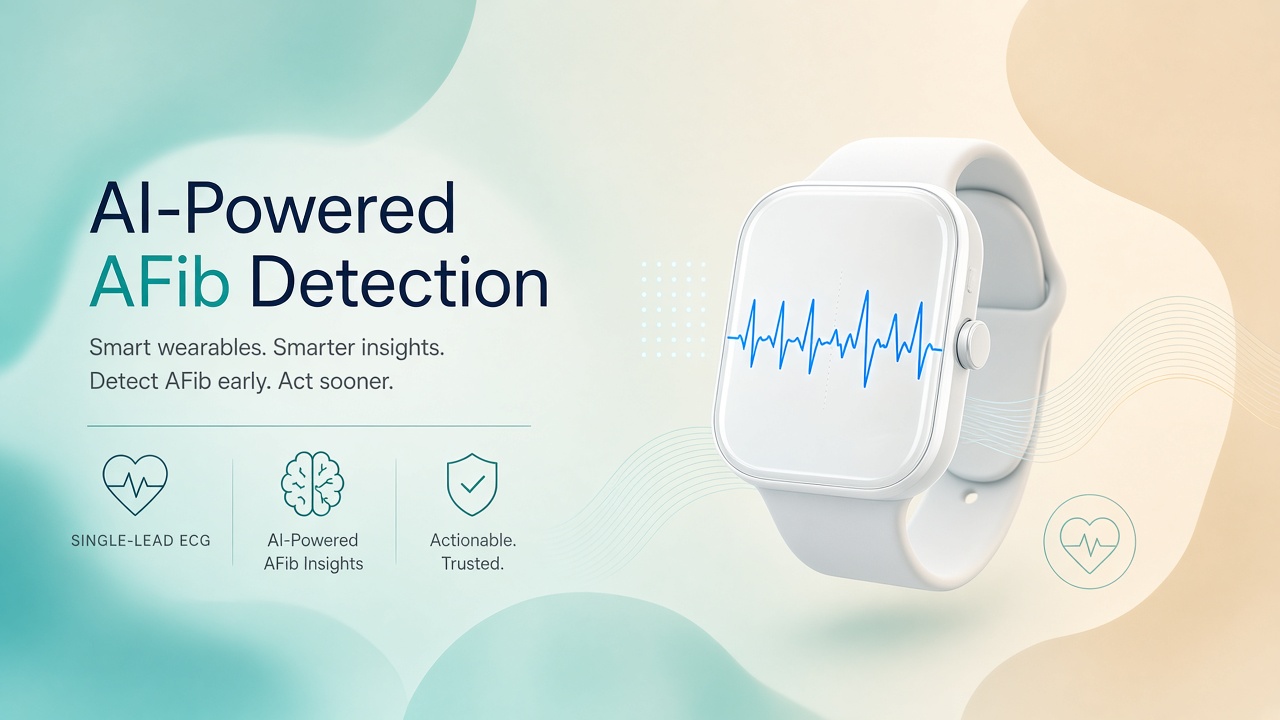
AI AFib detection on consumer wearables uses single-lead ECG classifiers and photoplethysmography irregular rhythm notifications to flag possible atrial fibrillation, requiring physician follow-up before treatment decisions. Meta-analyses in 2024 and 2025 report pooled Apple Watch ECG sensitivity near 95% and specificity near 96% against Holter or 12-lead reference standards, with area under the ROC curve around 0.96. The Apple Heart Study (2018) enrolled more than 419,000 participants, illustrating population-scale screening feasibility. Irregular rhythm notifications show high specificity but lower sensitivity for brief paroxysmal episodes. Patients exploring AI healthcare wearables should understand that a watch alert is a screening signal, not a diagnosis that automatically starts blood thinners.
AFib Stroke Risk in Plain Language
Atrial fibrillation is an irregular heart rhythm in the upper chambers that allows blood to pool and clot; clots traveling to the brain cause ischemic stroke, which AFib patients face at roughly five-fold higher risk than age-matched controls in sinus rhythm. Many episodes are paroxysmal (intermittent) and asymptomatic, so patients feel fine while AFib silently raises stroke risk. CHA2DS2-VASc scores guide anticoagulation: factors such as age, hypertension, diabetes, and prior stroke increase benefit from blood thinners. Screening wearables aim to detect undiagnosed AFib in ambulatory adults before a stroke occurs.
Detection alone does not dictate therapy. Guidelines emphasize confirming sustained AFib on clinical-grade ECG, assessing bleeding risk (HAS-BLED), and shared decision-making about anticoagulants versus left atrial appendage occlusion in select patients. Watch-detected AFib in low-risk young adults may warrant observation rather than immediate anticoagulation, illustrating why cardiologist interpretation remains mandatory.
Public health programs in aging societies view opportunistic screening at scale as complementary to pulse checks in primary care. Wearables extend reach to adults who skip annual physicals but already own smartwatches for fitness tracking.
Stroke prevention guidelines from ESC and AHA emphasize confirmed AFib rather than device-only suspicion. Watch-detected episodes shorter than 30 seconds may not meet guideline thresholds for anticoagulation in all jurisdictions; cardiologists correlate symptom burden, CHA2DS2-VASc score, and ambulatory monitoring duration before committing to lifelong oral anticoagulants with bleeding trade-offs.
Single-Lead ECG on Consumer Devices
Apple Watch, Withings ScanWatch, Samsung Galaxy Watch, and AliveCor Kardia devices record lead-I-equivalent ECG tracings when users touch an electrode (crown, bezel, or phone-backed pad) for 30 seconds. On-board or phone-paired classifiers output sinus rhythm, atrial fibrillation, inconclusive, or poor recording categories. Photoplethysmography sensors on the wrist detect pulse interval irregularity and can notify users to take a confirmatory ECG. PPG lacks the morphologic detail of ECG P-wave analysis but enables passive surveillance between active recordings.
Machine learning pipelines bandpass-filter signals, detect QRS complexes, and feed convolutional or recurrent networks trained on labeled clinician-adjudicated tracings. Motion artifact, loose watch fit, and low heart rate or high heart rate branches route to inconclusive buckets rather than forcing AFib labels. 2024 pragmatic Holter comparison studies found 8% inconclusive and 5% poor recording rates among thousands of Apple Watch ECGs, with false-positive AFib often linked to frequent premature atrial or ventricular complexes.
| Device / feature | Sensor | User action | Typical output |
|---|---|---|---|
| Apple Watch ECG app | Electrical + PPG | 30-second finger on crown | SR, AFib, inconclusive, poor recording |
| Apple irregular rhythm notification | PPG only | Passive wear | Prompts ECG if irregularity persists |
| Withings ScanWatch | PPG + on-demand ECG | Bezel touch for ECG | AFib detection with SpO2 context |
| AliveCor KardiaMobile | Handheld electrodes | Phone-paired 30-second strip | FDA-cleared AFib algorithm (Kardia) |
Pivotal Validation Studies Summarized
The Apple Heart Study demonstrated feasibility of virtual enrollment and AFib notification at scale; subsequent hospital-based studies compared watch ECG to Holter gold standards with more rigorous per-patient adjudication. Apple Heart Study (Stanford-led, 2018): 419,297 Apple Watch users enrolled; 0.5% received irregular pulse notifications, and 34% of those who returned ECG patches showed AFib. A 2024 meta-analysis pooling 11 studies (4,241 participants, mean age 62.6) reported Apple Watch ECG sensitivity 94.8% (95% CI 91.7 to 96.8%) and specificity 95% (88.6 to 97.8%). A 2024 Philippine pragmatic Holter study (140 participants) found ECG-based detection sensitivity 100% and specificity 99.1% among interpretable tracings, while irregular rhythm notifications showed sensitivity 21.4% with specificity 100%, highlighting modality differences.
2025 smartwatch meta-analyses across brands report pooled specificity 96.12% with Apple Watch at 96.97%, Withings at 95.03%, and heterogeneity across device generations. Apple received FDA 510(k) clearance for ECG features, distinct from full PMA approval, meaning clearance relied on substantial equivalence and targeted validation rather than large randomized outcome trials.
Researchers publishing AI research on wearable arrhythmia detection should report whether studies enrolled known AFib patients (inflating sensitivity) versus unselected populations. Subgroup data by sex remains sparse despite female underrepresentation in several cohorts.
False Positives and Clinical Workflows
False-positive AFib alerts from wearables commonly stem from premature beats, motion artifact, and tachycardia; clinical workflows route watch flags to cardiology review with 12-lead ECG, ambulatory monitoring, or event recorders before anticoagulation. A watch AFib label with CHA2DS2-VASc score of 0 in a 40-year-old athlete differs clinically from the same label in a 75-year-old with hypertension and diabetes. EHR integration via Apple Health exports or patient-shared PDFs should document confirmation status. Some health systems run AFib clinics that batch-review wearable exports weekly to avoid emergency department overload from anxious patients.
False negatives occur with very brief AFib episodes below PPG sampling resolution or when users do not take ECG during symptomatic palpitations. Continuous clinical Holter remains superior for quantifying AFib burden to guide rate versus rhythm control and ablation candidacy. Wearables excel at first detection, not long-term burden monitoring unless vendors ship multi-day patch equivalents.
Anticoagulation shared decision-making incorporates bleeding risk, fall risk, and patient preference. Watch detection that prompts early cardiology referral may advance oral anticoagulant start in appropriate high-risk patients, but outcome trials proving stroke reduction from mass wearable screening remain limited compared with diagnostic accuracy studies.
Cryptogenic stroke workups increasingly include extended wearable monitoring after negative inpatient telemetry. A watch AFib notification months after discharge may explain a previously unexplained event and change secondary prevention from antiplatelet to anticoagulant therapy after confirmatory Holter. Neurology and cardiology shared pathways should define how watch data enters the cryptogenic stroke algorithm to avoid duplicate testing.
Regulatory Classifications by Region
United States FDA classifies Apple Watch ECG and Kardia algorithms as Class II medical devices via 510(k); EU MDR and UKCA frameworks apply to Withings and Samsung CE-marked features with country-specific labeling. Over-the-counter availability distinguishes consumer wearables from prescription cardiac monitors. Labeling states users should not change medication without consulting a physician. Software updates that alter classifier thresholds may require regulatory notification depending on change magnitude. Australia TGA and Health Canada have parallel clearances for major brands with region-locked feature flags.
Clinical laboratories and telehealth platforms importing watch PDFs into EHRs should treat them as patient-generated health data requiring clinician validation before billing or quality metrics. AFib detection features are not indicated for pediatric populations or during pregnancy in most labeling, where physiological tachycardia mimics irregularity.
Employer wellness programs sometimes subsidize watches for middle-aged employees with hypertension, creating equity questions when low-income patients without devices miss screening opportunities. Public health partnerships with insurers may distribute Kardia devices to high CHA2DS2-VASc primary care panels while studying whether detection rates justify cost. Longitudinal registry studies linking watch-detected AFib to stroke and anticoagulant use will clarify population benefit beyond diagnostic accuracy papers.
Machine learning updates on watches ship through firmware without patient awareness. Regulatory frameworks expect manufacturers to monitor post-market performance when classifiers change. Cardiologists should ask patients which watch generation and software version produced an export, because sensitivity shifts between hardware releases documented in meta-analysis subgroup tables.
Frequently Asked Questions
Is Kardia as accurate as Apple Watch?
Both use FDA-cleared AFib algorithms with high reported specificity in validation studies. Handheld Kardia may produce cleaner tracings when wrist motion is problematic. Head-to-head studies in identical patients are limited.
Can pregnant women use AFib wearables?
Manufacturer labeling generally excludes pregnancy because elevated heart rate and hemodynamic changes confuse classifiers. Obstetric arrhythmia evaluation should use clinical-grade monitoring.
Do athletes get false AFib alerts?
High sinus rates and ectopic beats during recovery exercise trigger inconclusive or false-positive readings. Athletes with symptoms should use post-exercise rest recordings and cardiologist review.
Does AFib detection start blood thinners automatically?
No. Anticoagulation requires confirmed AFib, stroke risk assessment, and shared decision-making. Watch alerts initiate evaluation, not automatic prescription.
How often should I record ECG?
After irregular rhythm notifications or symptoms. Routine daily recording is unnecessary for asymptomatic users unless a cardiologist advises a surveillance protocol.
Are irregular pulse notifications enough?
Notifications screen for irregularity but ECG confirmation is recommended before clinical action. Studies show lower sensitivity for brief AFib with PPG-only pathways.
Can wearables replace Holter monitors?
Not for quantifying AFib burden over 24 to 72 hours. Wearables supplement episodic screening; Holter, patch, or implantable loop recorders remain standard for clinical burden assessment.
Primary care integration pathways vary: some systems auto-import Apple Health ECG PDFs into Epic MyChart for nurse triage, while others require in-person 12-lead confirmation before scheduling cardiology. Clear patient-facing education that sinus rhythm on a watch does not exclude paroxysmal AFib detected only during sleep reduces false reassurance among older adults with intermittent arrhythmia.
Withings ScanWatch and Samsung Galaxy Watch users should verify regional regulatory clearance before interpreting AFib labels as equivalent to Apple or Kardia validation studies. Meta-analyses pool heterogeneous device firmware; clinicians interpreting exports should cite the specific hardware generation referenced in the manufacturer's instructions for use.