Fine-tuned models inherit every systematic error in their training labels. A reward model trained on inconsistent preference data learns a noisy objective. Supervised fine-tuning on mislabeled examples encodes wrong behavior at scale. Organizations spending six figures on labeling vendors discover too late that high volume without quality governance produces models that sound fluent while failing on policy, safety, and domain accuracy requirements.
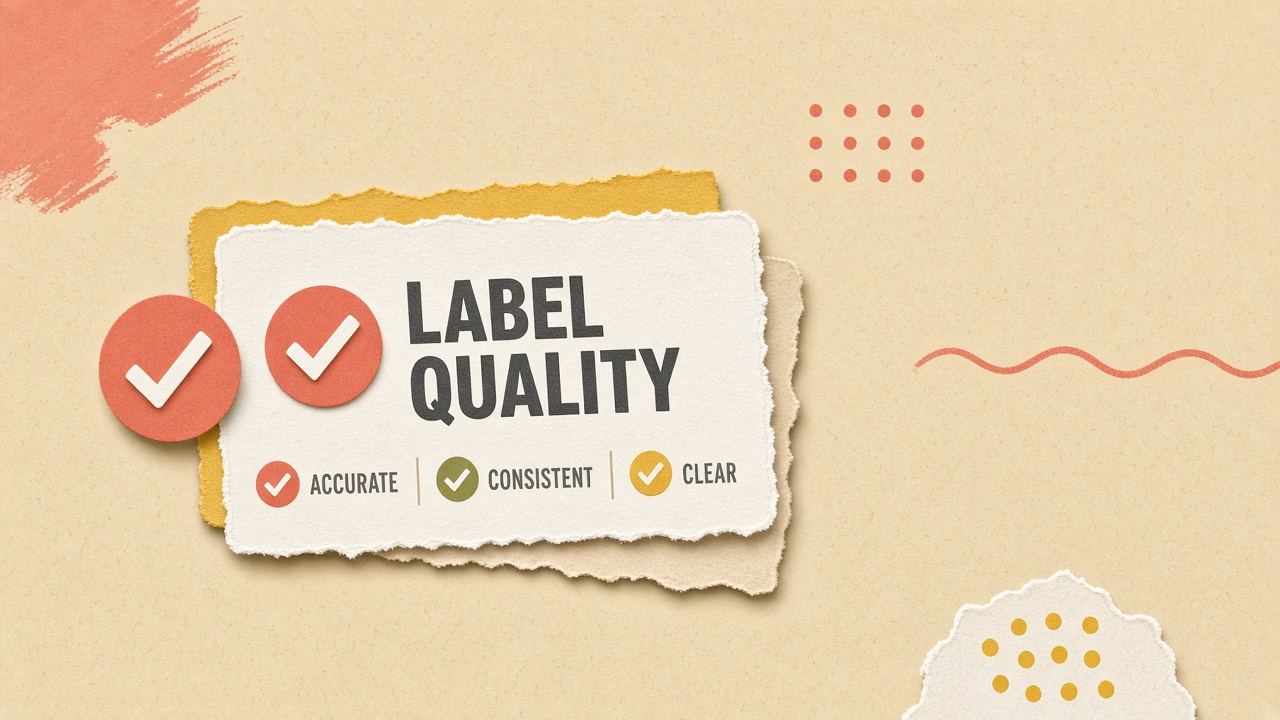
Data labeling quality standards define the rubrics, metrics, workflows, and contractual requirements governing how training and evaluation datasets are annotated for AI tool fine-tuning. This guide helps ML platform, data governance, and procurement teams building datasets for AI chatbot alignment and AI automation workflows establish measurable quality bars aligned with COMPEL framework labeling governance and industry RLHF practice.
Labeling Use Cases: SFT, RLHF, Eval, Red Team Corpora
Enterprise labeling programs serve four distinct use cases: supervised fine-tuning examples, RLHF preference pairs, held-out evaluation sets, and red team attack corpora, each requiring different rubrics, reviewer qualifications, and quality thresholds. Applying one generic labeling workflow across all use cases produces misaligned datasets. Classify every labeling project by use case before setting metrics.
| Use case | Label type | Reviewer requirement | Quality bar |
|---|---|---|---|
| SFT | Input-output pairs, instruction following | Domain-trained annotators | Krippendorff alpha >= 0.80 |
| RLHF | Pairwise or listwise preferences | Calibrated preference raters | Cohen kappa >= 0.65 on preferences |
| Eval | Gold labels, benchmark answers | Subject matter experts | Expert consensus, dual review |
| Red team | Attack prompts, jailbreak attempts | Security-trained annotators | Coverage metrics, not agreement |
SFT Labeling Requirements
Supervised fine-tuning labels must demonstrate correct task completion under your production rubric, with worked examples resolving edge cases annotators encounter in the wild. Generic crowd workers cannot reliably label regulated banking dialogues or healthcare compliance exchanges. Match annotator qualifications to domain risk tier.
RLHF Preference Specifics
RLHF preference labeling requires rubric-anchored scoring beyond binary thumbs, with explicit categories for safety versus helpfulness tradeoffs rather than a single scalar that hides incompatible objectives. OpenAI's InstructGPT reported 72.6 percent raw agreement among labelers, considered strong for preference tasks. Report chance-corrected metrics, not raw percentages that overstate quality.
Quality Metrics: IAA, Accuracy vs Gold, Drift
Labeling quality measurement requires inter-annotator agreement with chance correction, accuracy against gold standard items, and ongoing drift monitoring as rubrics evolve or annotator pools rotate. Raw percent agreement on binary choices overstates quality because two raters match 50 percent by chance alone. Set metric thresholds before labeling begins, not after reviewing disappointing results.
| Metric | Threshold | Remediation action |
|---|---|---|
| Krippendorff alpha | >= 0.80 for production datasets | Below 0.67: rewrite rubric, do not add annotators |
| Cohen kappa (2 raters) | >= 0.65 for preference tasks | 0.61 to 0.80: substantial; recalibrate raters |
| Gold task accuracy | >= 90% per annotator | Below 85%: remove from pool, retrain |
| Rubric drift | IAA drop > 5 points vs baseline | Freeze labeling, adjudicate, update rubric |
Metric Selection Guidance
Use Cohen's kappa for exactly two annotators on categorical tasks, Fleiss' kappa for three or more fixed raters, and Krippendorff's alpha when annotators see different item subsets or labels are missing. For RLHF ranking tasks, supplement with Kendall's tau or Spearman's rho on ordinal preferences. Report metrics by capability area, language, annotator cohort, and rubric version, not as a single project-wide number that hides variance.
Gold Set Design
Embed 3 to 10 percent rotating gold items with known correct labels to detect annotator drift, fraud, and rubric misinterpretation throughout labeling campaigns. High-stakes domains warrant higher gold rates and larger audit samples. A suspiciously perfect gold score signals tasks that are too easy or guidelines too rigid, not necessarily high quality.
Annotator Training and Adjudication Workflow
Every labeling program requires a written rubric with worked examples, calibration sessions before production labeling, explicit tie or unsure options, and senior adjudication for disagreements producing auditable records. Unwritten conventions between annotators create invisible contradictions where teams agree numerically while rating fundamentally different concepts.
- Publish rubric version with positive and negative worked examples per edge case.
- Run calibration on 50 to 100 items before production; require IAA threshold pass.
- Assign minimum two annotators per item for agreement measurement.
- Route disagreements to adjudicator with domain expertise, not majority vote alone.
- Record adjudication rationale for rubric improvement feedback loops.
- Re-calibrate annotators after rubric version changes.
Invisible Contradiction Detection
Teams with high internal IAA may still rate incompatible concepts if rubrics allow interpretive drift; annual oracle expert review on 200 sample items detects subtle misalignment before it trains into models. Track what teams disagree on, not only whether they agree. Flag safety versus helpfulness tradeoffs as explicit rubric categories requiring separate scores or escalation.
Multi-Team Governance
Multi-vendor or multi-team labeling requires a governance committee resolving rubric disputes, not automated scripts alone. Systematic bias in one team (always rating 0.5 points higher) corrupts RLHF reward landscapes without triggering standard agreement alerts. Compare score distributions across teams weekly.
Vendor Labeling Contracts and Audit Rights
Labeling vendor contracts must specify rubric adherence, IAA reporting cadence, gold task accuracy minimums, annotator qualification requirements, data handling restrictions, and your right to audit labeling operations. Vendors reporting a single project-wide IAA number without cohort breakdown hide variance where bias compounds into model regressions.
- Require weekly cohort-level Krippendorff alpha reports, not end-of-project summaries.
- Contract for domain expert annotators with verified credentials per vertical.
- Mandate zero vendor retention of labeled data post-delivery.
- Include SLA for relabeling batches that fail quality gates at no additional cost.
- Reserve audit rights including remote observation of labeling sessions.
- Define IP ownership and derivative model training restrictions on delivered labels.
Vendor Scorecard
Maintain a vendor scorecard tracking IAA trends, gold accuracy, adjudication rates, turnaround time, and relabel frequency across projects. Deprioritize vendors with declining metrics even if initial bids were competitive. Labeling quality regressions are expensive to fix after model training completes.
Bias and Representation Checks on Labeled Sets
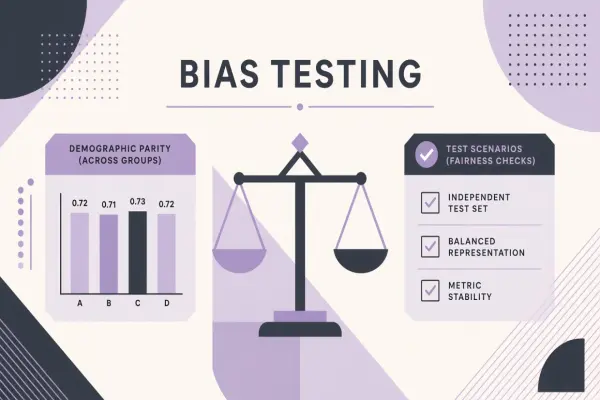
Labeling quality extends beyond agreement metrics to demographic representation, stereotype prevalence, and outcome disparity across protected groups in both prompts and preferred responses. A dataset with high IAA but skewed representation trains models that perform unevenly across populations your AI chatbot serves in production.
| Check | Method | Action on failure |
|---|---|---|
| Demographic balance | Distribution vs target population | Oversample underrepresented groups |
| Stereotype prevalence | Lexicon and classifier scan | Remove or relabel offending examples |
| Outcome disparity | Preference rates by demographic proxy | Investigate rubric bias, adjudicate |
| Language coverage | Locale distribution audit | Add native speaker annotators per locale |
Pre-Training Dataset Gate
Block model training starts until labeling quality reports show IAA above threshold, gold accuracy validated, bias checks complete, and adjudication backlog cleared. Treat the dataset quality gate with the same rigor as production deployment gates. Retraining on failed datasets wastes compute and encodes errors requiring costly correction cycles.
Frequently Asked Questions
Is crowdsourcing acceptable for enterprise fine-tuning data?
Crowdsourcing works for low-risk fluency tasks but fails for regulated domains, safety judgments, and policy adherence labeling that require domain experts with override authority over crowd rankings. Tier crowdsourcing by risk: public copy editing may use general crowds; healthcare compliance dialogue requires credentialed annotators under vendor SLA.
How do we handle PII that appears in labeling tasks?
Scrub or synthetic-replace PII in labeling corpora before vendor handoff; contractually prohibit annotators from copying, storing, or discussing customer data outside the labeling platform. Labeling platforms should enforce access controls, watermarking, and session recording for regulated data classes. Treat labeling environments as production-adjacent for DPA purposes.
When should we relabel versus discard a batch?
Relabel when IAA failure stems from rubric ambiguity fixable with clarification; discard and regenerate when source prompts contain errors, PII leaks, or systematic bias uncorrectable by relabeling alone. Version datasets with relabel history linked to model training runs. Never mix pre- and post-relabel examples without explicit version tagging.
Our vendor promises 10x volume at lower cost. Should we switch?
Higher volume at lower per-label cost often trades away domain expertise, IAA rigor, and audit rights that determine whether fine-tuning improves model behavior. Model quality depends on labeling expertise more than scale for high-stakes use cases. Evaluate vendors on cohort-level IAA trends and downstream model eval performance, not unit economics alone.
Schema Versioning and Dataset Contracts
Version labeling rubrics, annotation schemas, and delivered datasets with immutable identifiers linked to model training runs so you can trace production behavior back to specific label batches. Dataset contracts define expected fields, label types, quality metrics achieved, and prohibited content. Downstream training pipelines should reject datasets missing contract metadata or failing quality gate checksums.
Platform Selection Criteria
Choose labeling platforms supporting rubric versioning, cohort-level IAA dashboards, expert override paths for RLHF, and full export history for audit. Platforms reporting only project-level metrics without per-annotator breakdown hide the variance that causes model regressions. Evaluate whether platforms support your data residency requirements before uploading regulated corpora.
Linking Labels to Model Evals
Close the quality loop by running held-out evaluation suites after each training run and correlating model performance drops with labeling batch IDs, rubric versions, and vendor cohorts. When eval scores decline, trace back to labeling quality reports before blaming model architecture. This feedback loop improves rubrics faster than post-hoc relabeling entire datasets.
Implementation Roadmap
Week one: classify labeling projects by use case; weeks two through three: publish rubric v1 with calibration; month two: establish vendor contracts with IAA SLAs; ongoing: gold monitoring and quarterly bias audits. Data labeling quality standards succeed when use cases drive rubric design, metrics use chance-corrected agreement with defined thresholds, annotators train and adjudicate with audit trails, vendor contracts include audit rights, and bias checks gate training starts before low-quality labels become model behavior.
Quality Labels, Quality Models
Fine-tuning and alignment investments multiply the value of high-quality labels and amplify the damage from low-quality ones. Organizations that treat labeling as a procurement commodity rather than a governed engineering discipline discover quality failures only after expensive training runs complete. Invest in rubrics, metrics, and vendor accountability upfront. Your production AI automation behavior depends on it.