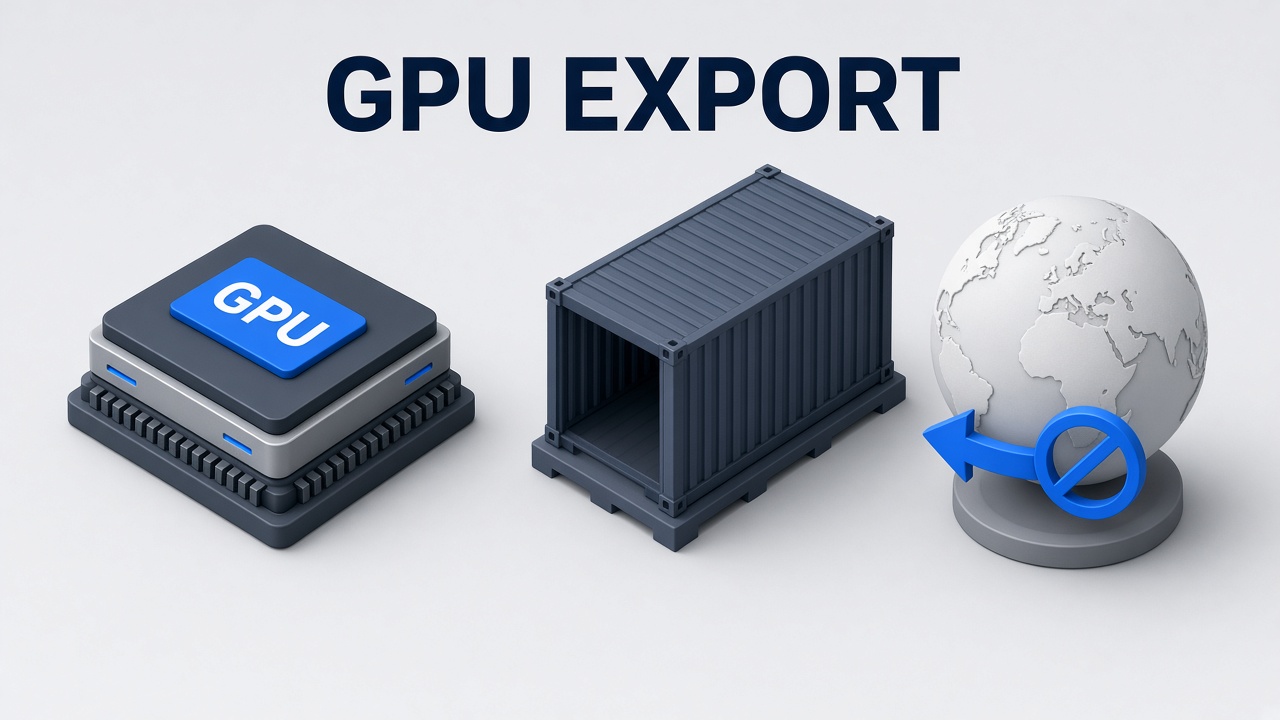
U.S. export controls on NVIDIA AI accelerators shifted again in 2025 and 2026, reshaping where frontier models can be trained and how enterprises procure GPU capacity. The Commerce Department maintained presumption of denial for H100, A100, and Blackwell B100/B200 parts to China and Macau, while President Trump approved a conditional pathway for H200 sales subject to case-by-case licenses, a 25% U.S. revenue share, and mandatory U.S. territory inspection of chips before re-export. Beijing mirrored Washington with NDRC per-purchase approvals and routing requirements through Hong Kong. By August 2026, ByteDance and Tencent reportedly received initial H200 deliveries of roughly 10,000 units each after months of policy stalemate.
NVIDIA export controls in 2026 affect training geography, cloud region selection, and secondary sanctions risk for distributors. Teams building on AI code and agent workloads should map chip eligibility before signing multi-year cloud commits. Compare hosting options via NVIDIA AI infrastructure tools.
Latest Export Rule Changes in 2026
The Biden-era AI diffusion framework proposed tiered country caps in January 2025, but the Trump administration rescinded it before the May 2025 compliance deadline, replacing country tiers with Validated End User programs for non-allied markets while keeping hard bans on Tier 3 destinations including China. Subsequent 2026 actions focused on the H200 exception, distributor due diligence, and closing cloud loopholes for Chinese-headquartered firms operating abroad.
Key 2025-2026 policy milestones:
- January 2025: Commerce publishes AI diffusion rule; Trump rescinds before effective date.
- December 2025: Trump announces conditional H200 exports to approved Chinese customers with 25% U.S. revenue share.
- January 2026: Formal Commerce guidance moves H200 license applications to case-by-case review; inspection-in-U.S. requirement formalized.
- May 2026: Commerce clears roughly 10 Chinese firms including Alibaba, Tencent, ByteDance, and JD.com; Lutnick notes Beijing delayed import approvals to protect domestic chipmakers.
- May 31, 2026: U.S. clarification extends licensing to Chinese and Macau entities operating worldwide, targeting Hong Kong routing loopholes.
- July-August 2026: First meaningful H200 deliveries reported; NVIDIA trims approved Asian distributor list for compliance.
Affected NVIDIA Chip Models Table
Export restrictions tie to performance thresholds (TPP and related metrics) and product families, not only the H100 nameplate. Enterprises should verify BIS ECCN classifications on purchase orders, not marketing names alone.
| SKU / family | China / Macau status (mid-2026) | Notes |
|---|---|---|
| H100 / H800 variants | Presumption of denial | Core Hopper training chips; cloud access also restricted |
| A100 (40GB / 80GB) | Presumption of denial | Named in NVIDIA 2023 SEC disclosure on BIS controls |
| Blackwell B100 / B200 / GB200 | Presumption of denial | Next-gen training and rack-scale systems blocked |
| H200 | Case-by-case license; NDRC mirror approval | ~6x H20 performance; 25% U.S. revenue share on sales |
| H20 (downgraded Hopper) | Licensed with prior 15% revenue share framework | China-compliant SKU; insufficient for frontier training at scale |
| RTX 4090 consumer GPU | Restricted under TPP thresholds | Relevant for smuggling and diversion enforcement |
Huawei Ascend and other domestic Chinese accelerators gained share while H200 deliveries stalled, but reporting in 2026 noted leading labs still sought NVIDIA silicon for frontier-scale training, influencing Beijing's conditional import approvals.
Cloud Loophole and Compliance Debates
Regulators spent 2026 closing gaps where Chinese firms might access restricted compute through overseas cloud regions or shell entities. U.S. rules historically targeted physical exports; training jobs running on U.S. hyperscaler regions by foreign customers triggered debate over remote access as an export. The May 2026 clarification applying licensing to Chinese-headquartered entities wherever they operate aimed to block Hong Kong data center workarounds.
Compliance debates include:
- VEU status: Non-allied countries can pursue Validated End User designations with audit obligations for higher GPU allocations.
- Diversion enforcement: Commerce and NVIDIA tightened distributor lists after smuggling cases involving consumer GPUs and mislabeled server cards.
- Allied sharing: Tier 1 allies face fewer caps but must prevent re-export to China.
- Revenue share optics: The 25% H200 levy unusual in export control history drew bipartisan criticism in Washington and nationalist pushback in Beijing.
Impact on Model Training Geography
Export controls push frontier pretraining toward U.S., allied, and Middle East regions with assured Hopper and Blackwell supply, while Chinese labs split training across domestic chips, smaller NVIDIA clusters, and cross-border research partnerships. A 10,000-GPU H200 cluster approximates serious frontier capacity, comparable to early GPT-4 era builds, but remains a fraction of U.S. hyperscaler fleets.
Strategic effects observers track in 2026:
- Model release gaps: Chinese open-weight models optimize for hardware available locally, sometimes lagging on largest-parameter tiers.
- Data residency: Enterprises in regulated industries choose cloud regions based on chip legality and political risk, not price alone.
- Investment flows: Gulf sovereign funds and U.S. allies expand data centers marketing unrestricted NVIDIA access to global customers.
- Research collaboration: Universities face export compliance reviews when foreign nationals access restricted clusters.
Developers using AI coding tools on cloud APIs should confirm provider region maps and subprocessors in vendor DPAs.
Enterprise Procurement Guidance
Buyers should treat GPU export status as a supply-chain compliance field alongside price and performance. Procurement and legal teams can reduce risk with the following steps:
- End-user statements: Collect end-user and end-use certifications from resellers and cloud vendors.
- Region locking: Contractually restrict training jobs to approved countries and audit cloud tenancy configurations.
- SKU verification: Match order lines to current BIS ECCN lists, not legacy H800 marketing names.
- Secondary market caution: Gray-market GPUs carry diversion and warranty risks; prefer authorized channels.
- Policy monitoring: Subscribe to BIS rule updates; 2026 showed rules can change within weeks during summit diplomacy.
Explore vetted vendors in the NVIDIA AI directory and document compliance reviews before multi-year reserved instance purchases.
Frequently Asked Questions
Can Chinese companies buy H100 GPUs in 2026?
Generally no. H100 and most advanced Hopper and Blackwell parts remain under presumption of denial for China and Macau without rare specific licenses.
What is different about the H200 export pathway?
H200 exports require U.S. case-by-case licenses, Chinese NDRC approval, chip inspection in U.S. territory, a 25% revenue share to the U.S. Treasury, and reported routing through Hong Kong for some buyers.
Do export rules affect U.S. companies buying cloud GPUs domestically?
Direct U.S. domestic use is unaffected, but contracts should address whether subsidiaries or partners in restricted countries can access the same tenant or weights.
How should startups plan GPU capacity?
Model size ambitions against available SKUs in your target region. Many startups rent U.S. or allied cloud GPUs rather than purchasing hardware subject to re-export rules.
Will controls tighten or loosen after 2026?
Policy oscillated in 2025 and 2026 with summit diplomacy and domestic politics on both sides. Treat export status as volatile and build architectural portability across regions where possible.