Google Cloud shipped Gemini 3.8 Flash Cyber alongside the general Flash tier in September 2026, but the release notes describe capabilities. They do not tell a security operations center which integration to wire first, how long tuning takes, or when false positives drop below analyst tolerance. Early adopters across managed detection and response firms and in-house SOCs are now publishing pilot patterns.
Gemini Flash Cyber SOC integration starts with alert summarization and log enrichment, not autonomous containment. Teams that skip prerequisites such as IAM scoping, Chronicle normalization, and human-in-the-loop review often stall in week two when noisy clusters flood the queue. This analysis maps the workflows security teams deploy first, SIEM and SOAR hooks Google documents, tuning lessons from public pilots, and how Flash Cyber benchmarks compare to legacy ML triage for teams evaluating AI code and cybersecurity stacks on Vertex AI.
Flash Cyber SOC Use Cases Teams Deploy First
The highest-return Flash Cyber SOC use cases in early 2026 pilots are alert cluster summarization, entity enrichment from Chronicle and Security Command Center, and draft incident timelines with cited log lines. These workflows keep humans in the decision loop while cutting mean time to understand on repetitive alert floods. Teams rarely start with autonomous playbook execution because model outputs still require analyst sign-off for escalation and containment.
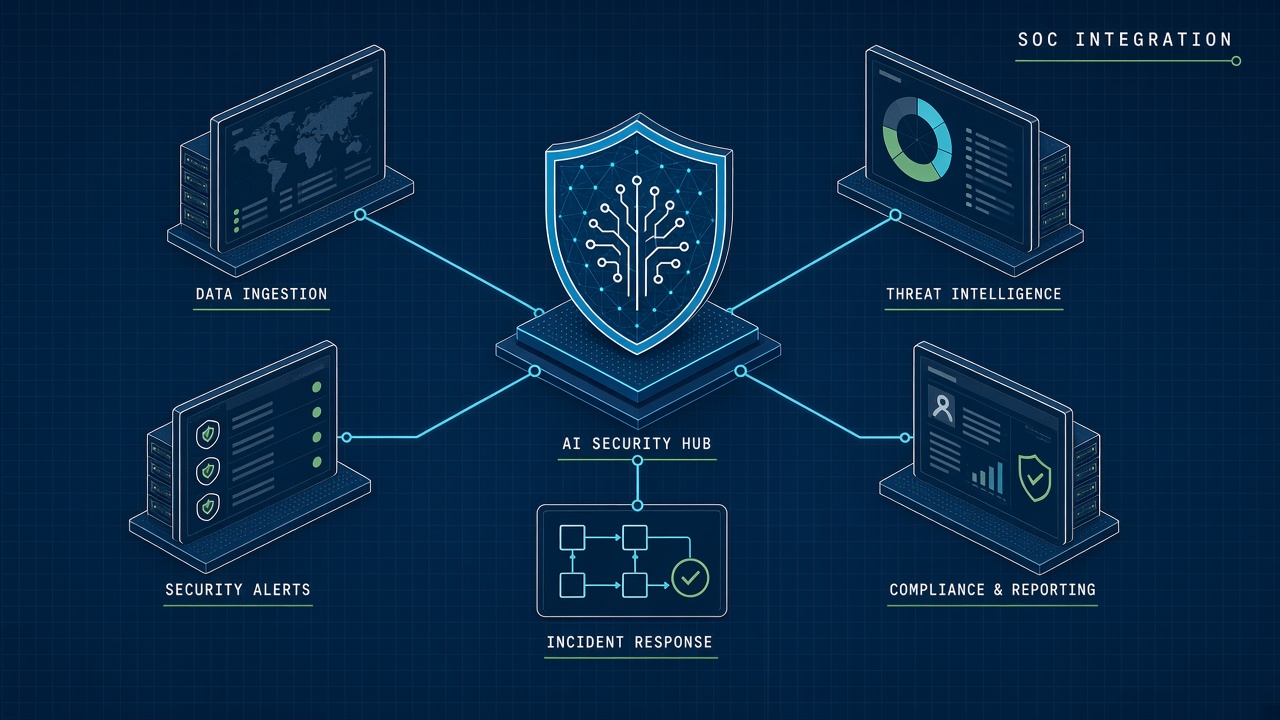
A typical first deployment ingests normalized alerts from Chronicle SIEM, groups events by shared indicators such as IP, user, or process hash, and asks Flash Cyber to produce a one-page narrative: what happened, affected assets from SCC inventory, recommended next checks, and confidence qualifiers. Analysts edit the draft before it enters the ticketing system. Google reports pilot teams reducing initial triage time by roughly 30 to 45 percent on commodity malware and phishing clusters, though results vary by log quality and alert rule maturity.
| Use case | Deploy order | Human gate | Typical pilot duration |
|---|---|---|---|
| Alert cluster summary | Week 1 shadow mode | Analyst edits before ticket | 2 to 3 weeks |
| Entity enrichment | Week 2 with SCC connector | Verify asset mapping | 2 weeks |
| Threat intel brief | Week 3 on curated feeds | Intel lead review | 3 to 4 weeks |
| Playbook draft | Week 4 after FP baseline | Senior analyst approval | 4+ weeks |
| SOAR auto-step | Post-pilot only | Change advisory board | 8+ weeks |
What Not to Automate First
Pilots that skip straight to automated containment or customer-facing notifications see higher rollback rates than teams that start with read-only summarization. Flash Cyber includes stricter refusals on offensive content, but refusal behavior does not replace change control on production SOAR steps. Treat the model as a drafting assistant until false positive and false negative rates are measured on a representative sample of your alert mix.
SIEM and SOAR Integration Prerequisites
Flash Cyber SOC integration requires Chronicle or compatible SIEM normalization, a dedicated Vertex AI service account, IAM roles scoped to the Cyber model ID, and optional SOAR webhooks for approved playbook steps. Google ships first-party connectors for Chronicle and Security Command Center. Third-party SIEMs can call the Vertex prediction API directly if events are pre-redacted and formatted as structured JSON context blocks.
Integration architecture typically follows three layers. The ingestion layer pulls alerts and bounded log samples into a staging bucket with field-level redaction for PCI, PHI, or credentials. The inference layer calls Flash Cyber through Vertex AI with system prompts tuned for your severity taxonomy. The action layer writes summaries back to the SIEM case, SOAR ticket, or chat channel without executing containment unless explicitly enabled. Google Cloud documentation recommends separate projects for Cyber inference versus general application workloads to simplify audit scope.
| Integration | Prerequisite | Google component |
|---|---|---|
| Chronicle SIEM | Normalized UDM events, case API access | Chronicle connector for Flash Cyber |
| Security Command Center | Asset inventory sync enabled | SCC finding enrichment plugin |
| SOAR platform | Webhook with HMAC validation | Vertex AI + Cloud Functions bridge |
| Third-party SIEM | Redacted JSON export under size cap | Direct Gemini API on Vertex |
Vertex Security Operations Settings
Enable Cloud Logging data access logs on the Cyber service account and restrict model access with organization policies that allow only approved project IDs. Flash Cyber carries a per-token premium over standard Flash; budget alerts at the project level prevent runaway costs when analysts re-run summaries on large clusters. Provisioned throughput endpoints reduce latency variance during incident surges but require capacity planning with Google account teams.
SOAR Webhook Architecture
SOAR integrations should treat Flash Cyber as an enrichment step that returns structured JSON summaries, not as a decision engine that closes cases automatically. A typical webhook flow validates the incoming alert ID, fetches redacted context from the SIEM, calls Vertex with a versioned prompt template, validates output schema, and writes results to a read-only case field. Playbook authors then branch on analyst acknowledgment. Google Cloud Functions or Cloud Run work well as bridge services with VPC-SC egress controls when SOAR platforms run outside GCP.
Teams using Palo Alto XSOAR, Splunk SOAR, or ServiceNow Security Operations should map Cyber output fields to existing custom properties rather than creating parallel ticket systems. Maintain prompt version hashes in case notes so post-incident reviews can reproduce summaries. For cross-cloud SOCs, replicate the same pattern in each region with data residency constraints on where alert payloads may be sent for inference.
Tuning and False Positive Control
False positive tuning for Flash Cyber focuses on prompt templates, severity thresholds, and grounding scope rather than retraining the base model. Pilots report the highest noise when the model receives unbounded raw logs instead of curated alert context. Cap input tokens per case, exclude noisy detection rules from auto-summarization, and require explicit analyst triggers for re-analysis after new events arrive.
A practical tuning loop runs weekly during pilot. Collect analyst edits to Cyber drafts and tag error types: wrong entity linkage, overstated severity, missed lateral movement, or hallucinated log lines. Adjust system prompts and grounding connectors based on tagged patterns. Google provides eval sets for threat intel summarization; supplement with 50 to 100 blinded cases from your environment before promoting to production queues. Teams that document edit rates below roughly 15 percent on high-volume alert types report smoother go-live; your threshold should reflect risk appetite.
Human-in-the-Loop Patterns
Shadow mode, where analysts see Cyber output alongside manual triage without customer impact, remains the default recommendation in Google Cloud security workshops. Promote to assisted mode when edit rates stabilize. Reserve auto-mode for low-severity informational alerts only after change advisory board approval. Maintain a kill switch that disables Cyber calls per severity band without redeploying SIEM rules.
Measuring Pilot Success
Define success metrics before pilot start: mean time to understand, analyst edit rate, false escalation rate, and cost per summarized case. Compare four-week rolling averages against a pre-Cyber baseline on the same alert categories. Google Cloud partners report strongest ROI on phishing and identity alert floods where narrative context reduces swivel-chair lookups across three consoles. Low ROI often indicates immature detection rules feeding garbage context into the model rather than model failure.
Document negative findings as rigorously as wins. If Cyber hallucinates log lines on a specific data source, exclude that source until normalization improves. Share tuning notes with your detection engineering team so rule changes and model prompt updates happen in tandem. Procurement should tie phase-two spend to documented edit-rate thresholds, not vendor enthusiasm alone.
Benchmarks vs Legacy ML Triage
Google positions Flash Cyber against legacy ML classifiers and rules-only triage on internal evals for phishing narrative quality, MITRE technique mapping, and time-to-first-actionable-summary. Vendor figures show Cyber matching or exceeding prior Chronicle ML tiers on curated benchmarks while adding natural language explanations analysts can audit. Legacy ML still wins on deterministic, low-latency scoring for single-field anomalies where explainability requirements are minimal.
| Approach | Strength | Weakness | Best fit |
|---|---|---|---|
| Flash Cyber | Narrative summaries, multi-source fusion | Token cost, latency on huge logs | Complex multi-event incidents |
| Legacy ML classifiers | Fast, cheap, deterministic scores | Limited explanation | High-volume single-signal alerts |
| Rules-only SOAR | Predictable automation | Brittle on novel TTPs | Known playbooks with stable IOAs |
Hybrid architectures keep ML scoring for routing and Flash Cyber for analyst-facing narrative. Compare total cost of ownership including analyst time, not token price alone. A Cyber summary that prevents a 20-minute manual reconstruction pays for itself even at the security-tier token rate.
Legacy ML Coexistence Strategy
Most mature SOCs will run Flash Cyber alongside existing unsupervised anomaly detectors and supervised phishing classifiers for years rather than replacing them outright. Map which alert types already achieve acceptable precision with legacy ML and reserve Cyber for clusters where narrative context adds value. Re-evaluate the split quarterly as Google publishes updated Cyber eval slices and your detection engineering team matures rules feeding cleaner context into the model.
Document integration ownership clearly. Detection engineering owns alert quality feeding Cyber; platform engineering owns Vertex endpoints and IAM; SOC managers own analyst workflow changes and KPI targets. Without RACI clarity, pilots stall when token bills arrive before workflow adoption. Include Cyber spend in existing SIEM budget lines rather than experimental AI slush funds that finance teams challenge at renewal.
Frequently Asked Questions
Which integration should our SOC wire first?
Start with Chronicle or your primary SIEM case API in shadow-mode alert summarization before enabling SOAR write actions. Entity enrichment from Security Command Center is the usual second step once asset mapping accuracy is validated.
Is Chronicle required for Flash Cyber?
Chronicle is not mandatory; Flash Cyber runs on Vertex AI with any SIEM that can export structured, redacted alert context. Google connectors reduce integration time for Chronicle and SCC customers.
How long until false positives are manageable?
Most pilots report usable edit rates after three to four weeks of prompt and scope tuning on a representative alert sample. Complex environments with immature detection rules may need longer shadow periods.
Can we use standard Flash for SOC work?
Standard Gemini 3.8 Flash works for generic summarization but lacks Cyber-specific safety filters, Chronicle connectors, and SOC-tuned eval coverage. Security teams should use the Cyber model ID for production telemetry processing.
Does Flash Cyber satisfy regulatory audit requirements?
Flash Cyber provides IAM audit logs and data processing terms, but compliance outcomes depend on your deployment, retention policies, and contracts. Document human review steps for regulators reviewing automated triage assistance.
Can MDR providers resell Flash Cyber summaries?
MDR contracts must clarify whether Cyber inference runs in the customer tenant or provider tenant and which party owns prompt templates and eval data. Google Cloud partner programs offer co-sell paths with Chronicle-native MDRs; verify data processing addendum coverage before multi-tenant use.
How do we exit if results degrade?
Keep portable prompt libraries and shadow-mode toggles so disabling Cyber is a configuration change, not a SIEM rebuild. Maintain fallback summarization with standard Flash or rules-only playbooks tested quarterly.