The Federal Trade Commission treated exaggerated AI claims as standard deception cases throughout 2025 and 2026, not as a separate regulatory category. Operation AI Comply produced permanent industry bans, multi-million-dollar judgments, and orders requiring competent and reliable evidence for accuracy and earnings claims tied to machine learning products. Marketing and legal teams that label rules-based workflows as advanced AI, promise passive income from nonexistent automation, or cite detection accuracy without tests face the same Section 5 exposure as any other false advertising.
This FTC AI washing marketing guide translates enforcement themes into practical copy rules. The FTC does not ban AI branding. It requires that claims match product reality, that limitations are disclosed, and that substantiation files exist before campaigns launch. Audit landing pages against AI chatbot features you actually ship and review AI regulation resources before the next product rename refresh.
Recent FTC Enforcement Themes
FTC cases cluster around fake AI capabilities, unsupported accuracy claims, false brand affiliations, and business opportunity schemes that promise AI-powered passive income without viable products. These themes repeat across industries, giving marketers a predictable compliance map.
Click Profit, halted in March 2025, allegedly promised consumers passive income through a proprietary AI and machine learning system for e-commerce stores while the FTC said no advanced AI selected products and claimed Nike or Disney affiliations were false. Defendants faced permanent industry bans under August 2025 settlement orders. The complaint emphasized three deceptive pillars: guaranteed earnings, fake brand partnerships, and nonexistent AI technology.
Workado, formerly Content at Scale AI, received a final FTC order in August 2025 prohibiting accuracy claims about its AI content detector unless supported by competent and reliable evidence. The FTC alleged the product was trained primarily on academic content while marketed as accurate for general blog and Wikipedia-style writing. The order requires retained substantiation, consumer notification, and multi-year compliance reporting.
Air AI settled in March 2026 with bans on marketing business opportunities after the FTC alleged roughly $19 million in customer losses from false earnings guarantees tied to AI-assisted sales tools. Cox Media Group finalized a 2026 order over an Active Listening ad product the FTC said collected no voice data and used no AI to analyze conversations, despite marketing suggesting smartphones captured casual talk for ad targeting.
| FTC theme | Example case pattern | Marketing takeaway |
|---|---|---|
| Fake AI product | Rules-based or manual workflow labeled as ML | Document model role before using AI in headlines |
| Unsupported accuracy | Detector marketed beyond training domain | Scope claims to tested content types and metrics |
| Earnings promises | AI coaching schemes with guaranteed income | Avoid passive income language without typical results data |
| Sensational surveillance | Voice or listening claims without technology | Describe actual data collection and processing |
Claim Wording Guidelines for Marketers
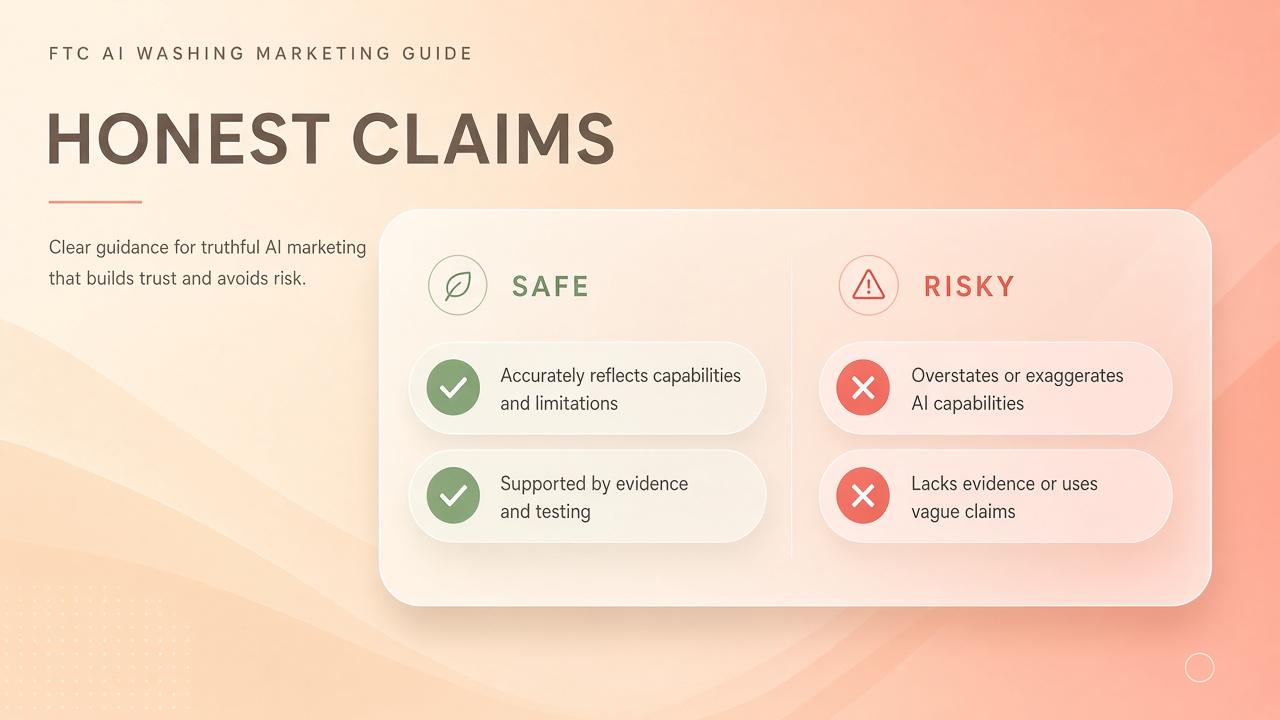
Safe AI marketing describes what the model does, under what conditions, with what known limitations, using language engineers and legal can defend with contemporaneous records. Risky copy uses superlatives, autonomy implications, or earnings outcomes the product cannot support.
Safer versus riskier claim examples:
- Safer: "Summarizes support tickets using a fine-tuned model trained on your workspace data when you enable the feature."
- Riskier: "Fully autonomous AI agent replaces your support team overnight."
- Safer: "Flags possible AI-generated text in academic essays with measured false positive rates in our documentation."
- Riskier: "Detects any AI content with 99% accuracy across all writing styles."
- Safer: "Uses retrieval-augmented generation to suggest draft answers your agents approve before sending."
- Riskier: "AI listens to customer conversations to deliver hyper-personalized ads."
Replace vague "AI-powered" badges with feature-specific descriptions. If a workflow uses heuristics, templates, or human review, say so. If a third-party model provider performs inference, disclose dependency and data handling rather than implying proprietary magic. Honest AI marketing builds trust with enterprise buyers who audit vendor claims during procurement.
Substantiation Documentation Requirements
FTC orders increasingly require companies to maintain competent and reliable evidence at the time a claim is made, not retroactive white papers after an investigation starts. Workado's final order explicitly mandates retained substantiation for efficacy claims and annual compliance reports. Treat marketing substantiation like clinical or financial disclosure archives.
Build a substantiation file for each material AI claim containing:
- Claim text as published, with date and channel.
- Test protocols, datasets, and evaluation metrics used.
- Results including limitations, edge cases, and failure modes.
- Engineering sign-off that the shipped product matches tested configuration.
- Legal review notes on implied claims in visuals or demos.
Update files when models change. A claim substantiated for GPT-4 class behavior may become misleading after a downgrade to a smaller model for cost control. Version marketing copy alongside model version tags in release notes. Sales decks and webinar scripts need the same scrutiny as website hero text because the FTC evaluates the net impression of all materials.
Cross-Functional Review Workflow Before Launch
Marketing, product, legal, and security should share a pre-publish checklist so AI feature names cannot bypass review through social channels or partner co-marketing.
| Review step | Owner | Pass criteria |
|---|---|---|
| Feature truth sheet | Product | Model type, data flows, human oversight documented |
| Claim substantiation | Data science | Tests match published metrics and audience |
| Legal clearance | Counsel | No implied earnings, surveillance, or exclusivity |
| Channel audit | Marketing ops | Paid ads, email, and partners use approved copy |
Frequently Asked Questions
What is AI washing in FTC terms?
AI washing describes marketing or sales claims that overstate artificial intelligence use, such as labeling rules-based software as machine learning or promising capabilities no trained model performs. The FTC applies existing deception standards under Section 5 rather than a separate AI washing statute.
Can we still say AI-powered on our homepage?
Yes, if a genuine model performs the advertised task and surrounding copy does not imply unsupported autonomy, accuracy, or earnings. Prefer specific feature descriptions over generic badges when feasible.
Do B2B SaaS claims face the same scrutiny as consumer schemes?
Yes. Operation AI Comply includes B2B detection tools and business opportunity products. Enterprise buyers also bring contractual warranties that amplify liability beyond FTC exposure.
What evidence counts as competent and reliable?
Evidence quality depends on claim type. Accuracy claims generally need tests on representative data using accepted metrics, conducted or supervised by qualified experts, and tied to the shipped product configuration. Consult counsel for claim-specific standards.
Where should marketers monitor FTC AI guidance?
Follow FTC press releases, Operation AI Comply case pages, and proposed policy statements on AI output accuracy. Pair regulatory monitoring with directories of AI chatbot products and AI regulation explainers to benchmark honest feature labeling against market norms.