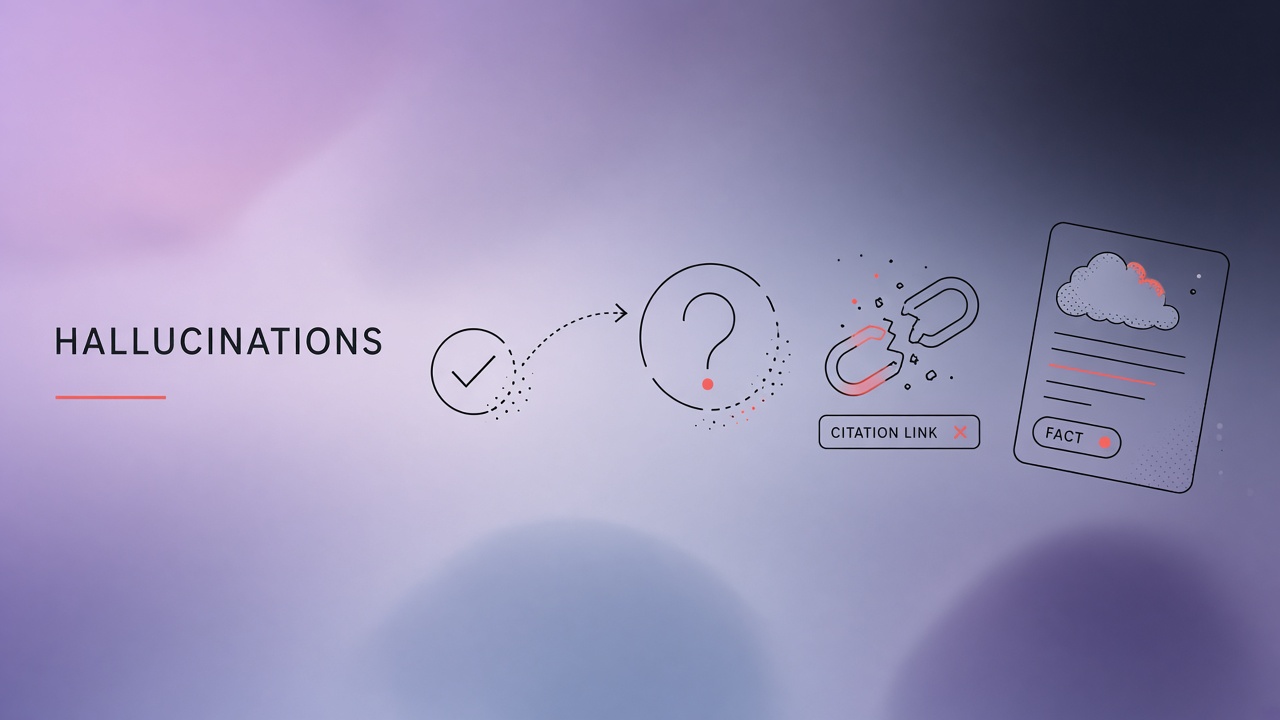
A lawyer asks a chatbot for case citations. The model returns three plausible-looking references with correct formatting. Two do not exist. The third misquotes the holding. That failure mode is a hallucination: the model optimizes for fluent, helpful text, not verified truth. AI hallucination explained in one sentence: language models sometimes generate confident statements that are false, outdated, or unsupported because they predict likely tokens from training patterns rather than retrieving verified facts at generation time. Hallucinations affect AI chatbot products, coding assistants in the AI code category, and any workflow where users treat model output as authoritative without verification.
Definition and Types of Hallucination
Hallucination in AI systems means output that appears credible but is factually incorrect, inconsistent with provided context, or fabricated (names, URLs, statistics, API methods, legal citations). Types include intrinsic hallucinations (contradicting supplied context), extrinsic hallucinations (adding unverifiable facts beyond context), and confabulation (plausible narrative filling gaps). Not every error is a hallucination: typos and math slips differ from inventing a nonexistent research paper.
| Type | Example | Detection hint |
|---|---|---|
| Intrinsic | Summary claims doc says X; doc says Y | Compare to source span |
| Extrinsic | Adds CEO name not in context | No supporting chunk retrieved |
| Citation fabrication | Fake DOI or case number | Database lookup fails |
| Code hallucination | Invented library function | Compiler or linter errors |
Confidence vs calibration
Models often sound equally confident when correct and when wrong; calibration (matching stated uncertainty to actual error rate) remains imperfect even in frontier systems. UI design should avoid implying verification the backend did not perform. Phrases like "I found" without retrieval logs mislead professionals in legal, medical, and financial settings.
Training, Alignment, and Decoding Causes
Hallucinations arise from pretraining on noisy web text, RLHF pressure to be helpful rather than silent, autoregressive decoding that favors plausible continuations, and knowledge cutoff dates that stale factual answers. Alignment teaches models to answer questions directly; abstention ("I do not know") is under-rewarded compared to guessing. Temperature and top-p sampling increase creative variance and can increase fabrication on factual tasks.
Parametric memory stores statistical associations, not a queryable database. When a user asks for a obscure fact, the model may compose a believable answer from related patterns. Long-context windows reduce some errors but introduce "lost in the middle" failures where evidence in the middle of the prompt is ignored. Multilingual queries on monolingual-heavy training data increase wrong entity names and dates.
Decoding settings for factual tasks
Lower temperature, constrained decoding, and schema-locked outputs reduce creative drift on structured tasks. For open-ended brainstorming, higher temperature may be appropriate with explicit disclaimers. Match decoding policy to task risk class rather than one global default across the product.
Grounding with RAG and Citations
Retrieval augmented generation grounds answers in retrieved passages, enabling citations and fresher facts without full retraining, but RAG still hallucinates when retrieval misses, chunks are misleading, or the model overgeneralizes beyond cited text. Effective grounding requires hybrid retrieval, reranking, citation-required prompt formats, and UI that links claims to source offsets users can inspect.
- Retrieve top-k chunks with metadata filters (tenant, date, product).
- Label context blocks as authoritative only for those spans.
- Instruct the model to cite chunk IDs for each factual claim.
- Post-process: drop claims without valid citation mapping.
- Abstain when retrieval score falls below threshold.
| Grounding method | Hallucination reduction | Remaining risk |
|---|---|---|
| RAG with citations | Strong for internal docs | Bad retrieval, wrong chunk cited |
| Tool lookup (API, SQL) | Strong for live transactional data | Wrong query composed by model |
| Web search with fetch | Fresh public facts | SEO spam pages in results |
| Pure parametric answer | Low engineering overhead | Highest fabrication rate on niche facts |
Faithfulness metrics
Evaluate faithfulness separately from fluency: does each sentence follow from retrieved context? Automated metrics (NLI-based checks, RAGAS-style scores) help regression testing; domain experts must review high-risk categories. Track hallucination rate by topic tag (pricing, compliance, biography) to prioritize corpus fixes.
Verification Workflows for High-Stakes Output
Production systems add verification layers: deterministic checks, secondary model critique, human review queues, and block-release rules when confidence or retrieval scores fail thresholds. Verification should be task-specific. Legal citation bots should call external legal databases. Medical summaries should require clinician review. Code suggestions should run tests and static analysis before merge.
A practical workflow for enterprise knowledge answers: generate draft with citations, validate each citation resolves to text containing the claim, run a lightweight entailment model flagging unsupported sentences, route flagged items to human review, publish only approved answers to customer-facing channels. Log verification outcomes to retrain retrieval and prompts.
Human in the loop design
Reviewers need side-by-side source highlighting, not a wall of generated prose. One-click "unsupported" labels feed golden evaluation sets. SLAs for review queues must match user expectations: real-time chat cannot wait hours unless the product clearly switches to async mode for verified answers.
When to Abstain Instead of Guessing
Abstention policies instruct models to decline, ask clarifying questions, or offer generic guidance without specific facts when evidence is insufficient. Abstention reduces harm in medical, legal, and financial advice scenarios but frustrates users if overused. Tune abstention thresholds by risk tier and surface "sources not found" transparently rather than vague apologies.
- Low risk (brainstorming): allow creative answers with disclaimers.
- Medium risk (internal HR policy): require RAG hit above score threshold.
- High risk (clinical dosing): abstain unless verified protocol retrieved.
- Regulated (investment advice): block specific recommendations entirely.
UX patterns for "I don't know"
Good abstention explains what was missing: "No document in your library mentions parental leave in France." Bad abstention hides retrieval failure behind "Sorry, I cannot help." The former builds trust and prompts users to upload missing policies. Pair abstention with suggested next steps: search terms, human contact, or ticket creation.
Frequently Asked Questions
Why do models fail at math?
LLMs predict tokens, not execute symbolic math; arithmetic errors are common especially on multi-step problems unless paired with calculators or code interpreters. Route quantitative work to deterministic tools. Display intermediate steps and verify results programmatically before showing users final numbers.
Are hallucinations a legal liability?
Deploying AI that fabricates citations, contracts, or compliance advice without verification can create professional negligence, advertising, and consumer protection exposure depending on jurisdiction. Document limitations, require human review for consequential outputs, and avoid implying attorney or auditor replacement unless licensed professionals oversee results.
How dangerous are medical hallucinations?
Medical hallucinations can recommend wrong dosages, contraindications, or diagnoses; FDA and EU regulators scrutinize health AI claims accordingly. Use approved clinical knowledge bases, abstain on patient-specific treatment without clinician input, and never present generative text as diagnosis. Localize disclaimers to regional healthcare rules.
Does fine-tuning fix hallucinations?
Fine-tuning can improve style and domain vocabulary but does not guarantee factual accuracy unless paired with curated data, retrieval, and ongoing evaluation. Fine-tuning on synthetic Q&A without source grounding can even increase confident wrong answers. Prefer RAG plus verification for changing facts.
Do AI detectors spot hallucinations?
AI detectors measure synthetic text likelihood, not factual correctness; a hallucinated paragraph may score as "human-like" or "AI-generated" without revealing false claims. Use entailment checks, citation validation, and domain databases instead of detector scores for truth verification.
Measuring Hallucination Rate in Production
Define hallucination operationally for your product: unsupported claim rate on golden questions, citation invalid rate, or human reviewer "major factual error" labels on sampled sessions. Report metrics weekly by model version, prompt template, and retrieval index version. Roll back releases that spike unsupported claims even if user satisfaction scores rise short term from fluent wrong answers.
| Metric | Definition | Target direction |
|---|---|---|
| Citation validity | Share of citations resolving to supporting text | Increase toward high nineties on doc Q&A |
| Abstention precision | Correct "unknown" on unanswerable items | Increase without excess false abstains |
| Unsupported claim rate | Human-labeled errors per 100 answers | Decrease quarter over quarter |
| User correction rate | Thumbs-down citing "wrong facts" | Monitor spikes after deploys |
Buyer Checklist for Factual AI Products
Ask vendors how they ground answers, measure faithfulness, handle abstention, and update indexes when source documents change. Request evaluation reports on your domain golden set, not generic benchmarks alone. Confirm whether the product distinguishes generative brainstorming mode from verified answer mode in the UI and API.
- Can you show retrieval traces and citations for each factual claim?
- What happens when retrieval returns nothing relevant?
- How do you regression-test prompt and model upgrades?
- Which tasks are blocked from fully automated answers?
- How are user corrections fed back into retrieval or review queues?
Domain-Specific Mitigation Patterns
Hallucination controls differ by domain: code assistants need compile-test loops, legal tools need citation database validation, medical assistants need protocol libraries with clinician gates, and customer support bots need ticket-system lookups instead of guessed order statuses. Generic "be accurate" instructions in system prompts barely move metrics. Domain pipelines that verify outputs against external systems do.
For AI code generation, run suggested changes in CI, require passing unit tests, and surface diff-only views so developers spot invented imports quickly. For AI chatbot FAQ bots, restrict answers to retrieved article IDs and render source links above the generated paragraph so users verify before acting.
Synthetic training data risks
Teams that fine-tune on model-generated Q&A pairs can amplify hallucination patterns if synthetic answers were never verified. Human labeling of golden answers remains the gold standard for high-risk fine-tuning datasets. Automated consistency checks between labeled answers and source documents catch label drift early.
User Trust and Disclosure
Transparent products state knowledge cutoff dates, retrieval status, and verification steps performed before showing an answer. Hidden limitations erode trust faster than occasional abstention. When users report a wrong answer, show whether retrieval ran, which documents ranked highest, and invite correction linked to review queues. Closing the feedback loop reduces repeat hallucinations on the same topic.
Marketing language matters: "AI assistant" implies general intelligence; "draft generator with citations" sets appropriate expectations. Regulated industries benefit from mode switches users understand, such as brainstorming versus verified policy lookup, implemented as separate routes with different backend pipelines rather than one prompt with hopeful wording.
Post-Processing and Output Filters
Output filters scan generated text for known hallucination signatures: fake DOI patterns, URLs on blocklists, numeric claims without citations, and entity names absent from retrieval logs. Filters run after generation and before user display. They can downgrade answers to drafts, trigger re-generation with stricter prompts, or route to human review. Balance false positives against risk tier per route.
Ensemble approaches ask a second model or NLI system whether each sentence is entailed by provided context. Sentences failing entailment drop or get bracketed as unverified. This adds latency and cost but catches confident extrinsic hallucinations RAG alone misses when wrong chunks were retrieved.
Temperature settings by risk class
Route factual Q&A through low-temperature decoding with citation requirements; route marketing copy brainstorming through higher temperature with visible "draft only" labels. Mixing both in one endpoint without mode separation confuses users who received creative prose when they expected verified policy text. API design should expose `mode=verified` versus `mode=creative` with different backend pipelines, not one shared prompt.
Long-running production systems should version prompts, retrieval indexes, and model IDs in answer metadata so support teams replay hallucination reports against the exact stack that produced the error. Without versioning, root cause analysis devolves into guessing whether retrieval, decoding, or source documents caused the failure.
Conclusion
AI hallucination explained for builders is not a rare bug but a predictable consequence of generative design: models optimize fluency and helpfulness, not guaranteed truth. Reduce harm with grounding through RAG and tools, citation-required formats, verification workflows, calibrated abstention, and continuous measurement. Match controls to risk in math, legal, medical, and code domains. Users of AI chatbot and AI code tools should treat confident output as drafts until your product proves otherwise with transparent sources and checks users can audit.