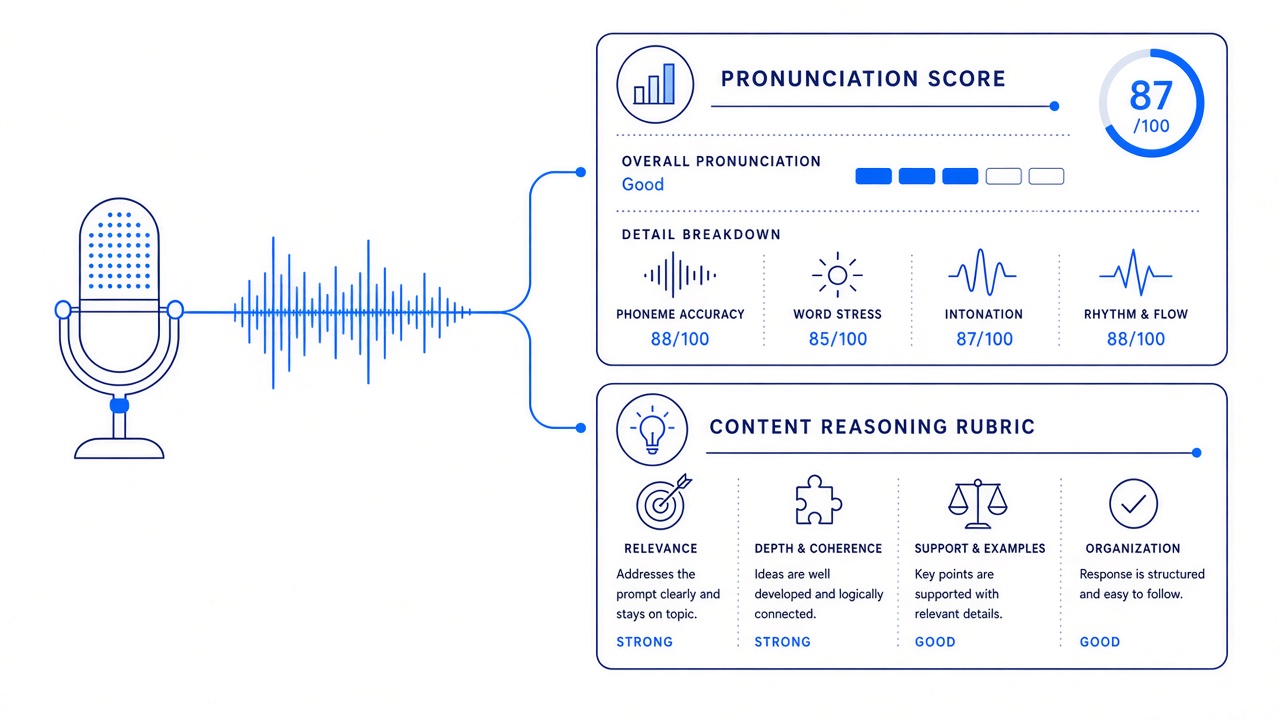
Written exams capture grammar but miss whether a student can build an spoken argument under time pressure. AI oracy assessment scores pronunciation, fluency, vocabulary, grammar, and discourse structure from recorded responses, scaling practice feedback beyond what one teacher can hear in a week of class discussions. Research systems like CASA split acoustic encoders from content LLMs; commercial platforms align rubrics to CEFR, IELTS, or regional exams such as HKDSE Paper 4.
Oracy includes physical, linguistic, cognitive, and social-emotional dimensions in frameworks like the Cambridge Oracy Assessment Toolkit. AI tools cover linguistic delivery well but still struggle with collaborative discussion dynamics. Teams exploring AI chatbot speaking coaches should verify bias testing and human moderation paths. More education explainers appear on the EliteAI.tools blog index.
High-stakes speaking exams historically required trained human examiners listening to recordings or conducting live interviews, limiting how often students could practice under exam-like conditions. AI scales formative feedback so a student might complete ten mock orals per week instead of one teacher-led session. The trade-off is accent bias in automatic speech recognition and LLM rubric graders that reward verbose generic answers. CASA explicitly splits Whisper acoustic encoders from Qwen3.5 content scoring because fluency features alone cannot proxy reasoning quality on argumentative tasks.
What AI Oracy Assessment Means in Plain Language
AI oracy assessment uses speech recognition, prosody analysis, and language models to evaluate how effectively a learner speaks: clarity, pace, organization of ideas, and appropriate vocabulary for a task. It differs from general transcription because scoring rubrics weight reasoning, not just word error rate.
High-stakes oracy historically required trained human examiners listening to recordings or live interviews. AI scales formative practice with instant feedback, but summative certification still demands human oversight in most jurisdictions. Speechace-style engines report re-test reliability near 0.82 Pearson correlation and scores within about 0.5 to 1.0 points of human examiners on validated samples, mapping to CEFR, IELTS, and other proficiency scales when calibrated on representative learner populations rather than narrow accent subsets.
| Dimension | AI measurement approach | Human review need |
|---|---|---|
| Pronunciation | Phoneme alignment, acoustic models | Low for drill; medium for accents |
| Fluency | Pause rate, speech rate features | Medium when disfluency is neurodiversity |
| Content and reasoning | LLM rubric scoring on transcript | High for high-stakes tasks |
| Group interaction | Turn-taking logs, limited AI | High; teacher-led still gold standard |
How the Underlying AI Pipeline Works
Learners record responses via web or mobile clients; audio preprocesses for noise reduction; automatic speech recognition transcribes; parallel acoustic and text branches score rubric dimensions; dashboards aggregate class and individual trends for teachers. Adaptive dialogue systems add conversational prompts that follow student answers.
CASA acoustic and content branches
CASA (Content-Acoustic Speaking Assessment) pairs a Whisper-medium encoder for delivery features with Qwen3.5-2B for transcript-based content scoring, achieving RMSE 0.358 on the S&I test set, slightly beating prior speech-LLM state of the art near 0.360 with far fewer inference parameters. Ablations show both branches contribute; fluency features alone cannot proxy reasoning quality.
Speech large language models for L2 proficiency
Recent work fine-tunes speech LLMs as end-to-end oral proficiency graders, outperforming cascaded ASR-plus-text models on standard L2 datasets and generalizing across exam tasks via audio understanding learned during pretraining. Challenges include accented speech, disfluency, and limited public training data due to copyright on exam items.
Commercial speaking test platforms
Speechace-style engines report re-test reliability near 0.82 Pearson correlation and scores within about 0.5 to 1.0 points of human examiners on validated samples, mapping to CEFR, IELTS, TOEFL, and other scales. Regional products like Essai and Sayo Speak target Hong Kong curricula (TSA, HKDSE Paper 4) with real-time dialogue, SEN-friendly pacing options, and per-dimension rubrics teachers can weight.
Cambridge Oracy Assessment Toolkit context
The Cambridge Oracy Assessment Toolkit provides teacher-led tasks and rubrics spanning physical, linguistic, cognitive, and social-emotional skills. AI complements toolkit practice by automating repetitive pronunciation and fluency drills while teachers assess group discussion and empathy dimensions kits emphasize. Mapping automated scores to toolkit level descriptors helps districts adopt AI without inventing proprietary rubrics disconnected from professional development materials teachers already trust.
Separating delivery versus content scoring
Effective oracy AI explicitly decouples delivery scores (pace, pronunciation, filler words) from content scores (thesis clarity, evidence use, rebuttal quality). A student with strong ideas but accented English should not receive a single collapsed low score. CASA-style pipelines prompt LLMs with separate rubric sections; acoustic models feed delivery channels only. Cambridge cognitive strands primarily use transcript semantics, while physical strands use audio features even when automatic speech recognition is imperfect on dialect speech.
- Record standardized or classroom oracy tasks with calibrated microphones.
- Transcribe with Whisper or speech-native encoders; flag low-confidence spans.
- Extract prosody, disfluency, and diarization features for physical and social strands.
- Score content strands with Qwen3.5 or speech LLMs using Cambridge-aligned prompts.
- Calibrate against human raters; report RMSE and subgroup bias metrics.
- Deliver formative feedback; reserve summative decisions for human-audited samples.
Real Deployments and Published Evidence
Deployments range from university admissions speaking screens to school pilots reporting double-digit gains for struggling speakers after weeks of AI practice, though gains shrink for already proficient students. Peer-reviewed CASA Whisper plus Qwen3.5 pipelines achieve RMSE 0.358 on speaking score prediction against human ratings. Speech LLM graders advance L2 proficiency rating from audio-native encoders, reducing reliance on error-prone transcripts for accent-diverse learners.
Speechace reports re-test reliability near 0.82 Pearson correlation when learners repeat comparable tasks, indicating moderate consistency suitable for formative practice but not sole high-stakes placement. Language learning apps deploy pronunciation scoring at scale for consumer practice. K-12 pilots focus on formative feedback in ELA and ESL classrooms rather than ranking teachers. Generative AI cheating introduces vectors where students read AI-generated scripts fluently without understanding; content scoring should include impromptu follow-up questions verifying comprehension.
Bias and fairness audits
ASR word error rates remain higher for African American English and many L2 accents, cascading into unfair linguistic scores if models rely on naive grammar error counts. Fair pipelines use accent-robust ASR, dialect-aware NLP, and periodic human recalibration per school population. Separate delivery scoring prevents conflating accent with unclear organization of ideas. Disability justice advocates demand accommodations when algorithms penalize dysfluency associated with neurological conditions rather than measuring content knowledge.
Formative practice versus summative certification
Districts achieve the best outcomes when AI oracy tools power daily rehearsal with instant rubric feedback while teachers retain authority over grades that appear on transcripts. Adaptive dialogue systems that follow student answers with impromptu follow-up questions reduce scripted-fluency cheating where learners read AI-generated text without understanding. University admissions offices using speaking screens should disclose whether scores are automated, human-reviewed, or hybrid, and publish appeal procedures for candidates flagged by accent-sensitive ASR errors.
Limits, Risks, and Ethical Guardrails
ASR bias against regional accents and stuttering can depress content scores unfairly. LLM rubric graders may reward verbose generic answers over concise correct reasoning. Recording minors requires consent and secure storage. High-stakes decisions (graduation, visa) should retain human double-marking when AI flags borderline scripts.
- ASR bias: Mis-transcription lowers grammar scores for dialect speakers.
- Privacy: Stored voice biometrics raise consent issues for minors.
- Over-automation: Summative grades without human appeal paths harm students.
- Social dimension gaps: Group talk scoring remains technically immature.
- Scripted fluency: Reading AI text sounds proficient while hiding understanding gaps.
Ethical guardrails require informed parental consent, opt-out assignments with equivalent written alternatives, human review for high-stakes placement, published subgroup fairness reports, accommodations for speech disabilities, and prohibition on selling student voice data to third-party advertisers. Districts should separate formative coaching tools from accountability metrics tied to teacher evaluation.
Who Should Use This and Who Should Wait
ESL programs needing formative pronunciation feedback, ELA departments practicing Cambridge oracy strands, and language apps with human-calibrated models should deploy CASA-style and Speechace-informed tooling now. High-stakes graduation exams and solitary summative rankings should wait for legal review and demonstrated fairness across accents before replacing human double-marking on borderline scripts.
| Context | Use AI oracy | Defer |
|---|---|---|
| Secondary exam prep | Daily AI mock orals with teacher review | Replace live group discussion assessment |
| Corporate English screening | Tier-1 automated filter plus human interview | Auto-reject on accent-sensitive ASR alone |
| Primary oracy development | Gamified fluency practice alongside toolkit tasks | Score 8-year-olds with high-stakes rubrics |
| High-stakes exam board | Wait for multi-year bias and appeal studies | 0.82 reliability insufficient alone |
Frequently Asked Questions
Is oracy just pronunciation scoring?
No. Oracy includes reasoning, listening response, and discussion skills; pronunciation is one linguistic subskill. CASA explicitly separates acoustic delivery from transcript content branches.
How close are AI scores to human examiners?
Validated commercial engines report roughly 0.5 to 1.0 point gaps on standardized scales and re-test reliability near 0.82; research CASA RMSE 0.358 aligns with human variance on S&I. Correlation varies by accent and task type.
Can AI assess group discussions?
Most tools focus on individual responses; multi-speaker separation and turn-quality scoring remain immature for high-stakes HKDSE-style group interaction. Use teacher observation for collaborative oracy dimensions.
Do platforms support SEN learners?
Products like Essai offer slower pacing, repeat prompts, and extended response windows; stuttering-friendly design still requires ASR tuning and human grace in scoring. Audit accessibility before mandating use.
What happens to student audio?
FERPA and local child privacy laws apply; contracts should limit vendor model training on student recordings without consent. Prefer on-device preprocessing when districts require it.
Can AI alone certify graduation speaking requirements?
Few boards accept fully automated summative oracy certification today; AI excels at formative practice with teacher moderation on borderline cases. Check your exam authority rules before replacing human markers.
What does CASA RMSE 0.358 mean?
RMSE 0.358 indicates the Whisper plus Qwen3.5 CASA pipeline's predicted speaking scores deviate from human raters by roughly 0.36 points on average on the benchmark scale used in the study. Lower RMSE is better; validate on your local rubric before deployment in summative contexts.
Why separate delivery from content?
Delivery covers how speech sounds (pace, clarity, fillers); content covers ideas and reasoning. Separation prevents penalizing strong thinkers with accented English or rewarding fluent recitation of weak arguments. CASA and Cambridge frameworks both emphasize the split in rubric design.
Conclusion
AI oracy assessment for spoken language combines Whisper transcription, Qwen3.5 scoring in CASA pipelines (RMSE 0.358), speech LLMs for L2 proficiency, Cambridge Oracy Assessment Toolkit physical, linguistic, cognitive, and social strands, and commercial reliability benchmarks such as Speechace re-test reliability 0.82. Separating delivery from content is essential for fair feedback. Deploy automated oracy tools formatively with bias audits and human appeals; withhold high-stakes decisions until subgroup fairness and legal defensibility catch up to promising lab metrics. Oracy AI scales practice and rubric consistency; it does not replace human judgment on whether a student truly thinks critically in community with peers.